
What Is Margin? How Collateral Works in Leveraged Trading

 Prefer us on Google


Margin is the collateral you put up to open and maintain a leveraged position. It is not a fee and not the full cost of the position — it is a deposit the platform holds while your trade is open. When people talk about "margin trading," they mean trading with borrowed exposure backed by this collateral.
Like leverage, margin is not a crypto invention. Stock and forex traders have posted margin for decades. The idea is identical across markets; here we anchor it in crypto futures.
How Margin Works
Margin and leverage are two sides of the same coin. If leverage is the multiple, margin is the deposit that multiple is applied to.
A worked example: you want a 1,000 USDT position on ETH. At 10x leverage, the required initial margin is 100 USDT (1,000 ÷ 10). That 100 USDT is set aside as collateral; the rest of the exposure is provided by the platform.
There are two margin concepts every trader should know:
- Initial margin — the minimum collateral needed to open the position (100 USDT above).
- Maintenance margin — the minimum collateral needed to keep it open. If your losses erode the collateral below this level, you approach liquidation and may receive a margin call (a warning to add funds or reduce the position).
You will also choose a margin mode:
- Isolated margin — only the margin assigned to that one position is at risk. If it liquidates, your loss is capped at that amount.
- Cross margin — your whole available balance backs the position, which lowers the chance of liquidation but puts more of your account at risk.
Why It Matters to a Trader
Margin is where risk becomes concrete. The size of your margin relative to your position determines how much price movement you can withstand before liquidation. A larger margin buffer (lower effective leverage) survives bigger swings; a thin margin (high leverage) is wiped out by a small move.
Understanding margin also stops a common beginner error: confusing margin with the maximum you can lose. With leverage, an adverse move can consume your entire margin, and in cross mode it can reach beyond a single position into your balance.
The Risk Section — Read This Carefully
- Margin can be fully lost. If the market moves against you enough, your posted margin is consumed and the position is liquidated.
- Maintenance margin is a moving line. As your position loses value, the gap to liquidation shrinks. Do not assume the level you opened at is safe.
- Cross margin spreads risk across your account. It reduces single-position liquidation risk but can draw down your whole balance. Isolated margin contains the damage but liquidates sooner.
- Margin calls are not guaranteed to save you. In fast markets, liquidation can happen before you have time to react.
Margin management guarantees nothing — it is a discipline for controlling risk, not a way to remove it.
A Practical Next Step
Before trading real margin, practise the mechanics in a demo account with simulated funds. WEEX offers a demo futures mode where you can see exactly how initial margin, maintenance margin, and liquidation behave using virtual money. When you switch to real funds, keep your effective leverage low, prefer isolated margin while learning, and never post more margin than you can afford to lose.
Start by downloading the WEEX app and opening the futures section to explore demo mode first.
FAQ
Q. What is the difference between margin and leverage? A. Margin is the collateral you deposit; leverage is the multiple applied to it. 100 USDT of margin at 10x leverage opens a 1,000 USDT position — they describe the same trade from two angles.
Q. What is a margin call? A. A warning that your collateral has fallen close to the maintenance requirement. You typically must add margin or reduce the position to avoid liquidation.
Q. Isolated or cross margin — which is safer? A. Isolated caps your loss to one position's margin; cross uses your whole balance as backing. Isolated contains risk (good while learning); cross reduces liquidation frequency but exposes more of your account.
Q. Can margin trading put me in debt? A. Crypto futures are generally designed to liquidate at the point your margin is exhausted, capping the loss at your collateral. Always confirm the exact terms on your platform.
This article is general educational information about trading terminology, not investment advice. Margin trading carries a high risk of loss and guarantees no profit. Trade at your own responsibility.
Disclaimer: This content is provided for general branding and informational purposes only and doesn't constitute financial, investment, legal, or tax advice. Any events, rewards, online events, or related information mentioned herein should not be considered a recommendation, solicitation, or invitation to purchase, sell, trade, or otherwise deal in any crypto assets or to use any services. Crypto assets are highly volatile and may result in loss. WEEX services and online events may not be available in all regions and are subject to applicable laws, regulations, and eligibility requirements. You are responsible for ensuring that your use of WEEX services complies with local laws and for carefully assessing the risks before participating in any crypto-related activities.
You may also like
Gold Price Outlook 2026: Third-Party Analyst Scenarios (Maintained, Educational)
Silver Price Outlook 2026: Third-Party Analyst Scenarios (Maintained, Educational)
How to Buy Bitcoin in Brazil: A Step by Step Guide for Beginners
Dolar Crypto in Argentina: How to Use Stablecoins for Dollar Exposure and Buy Bitcoin
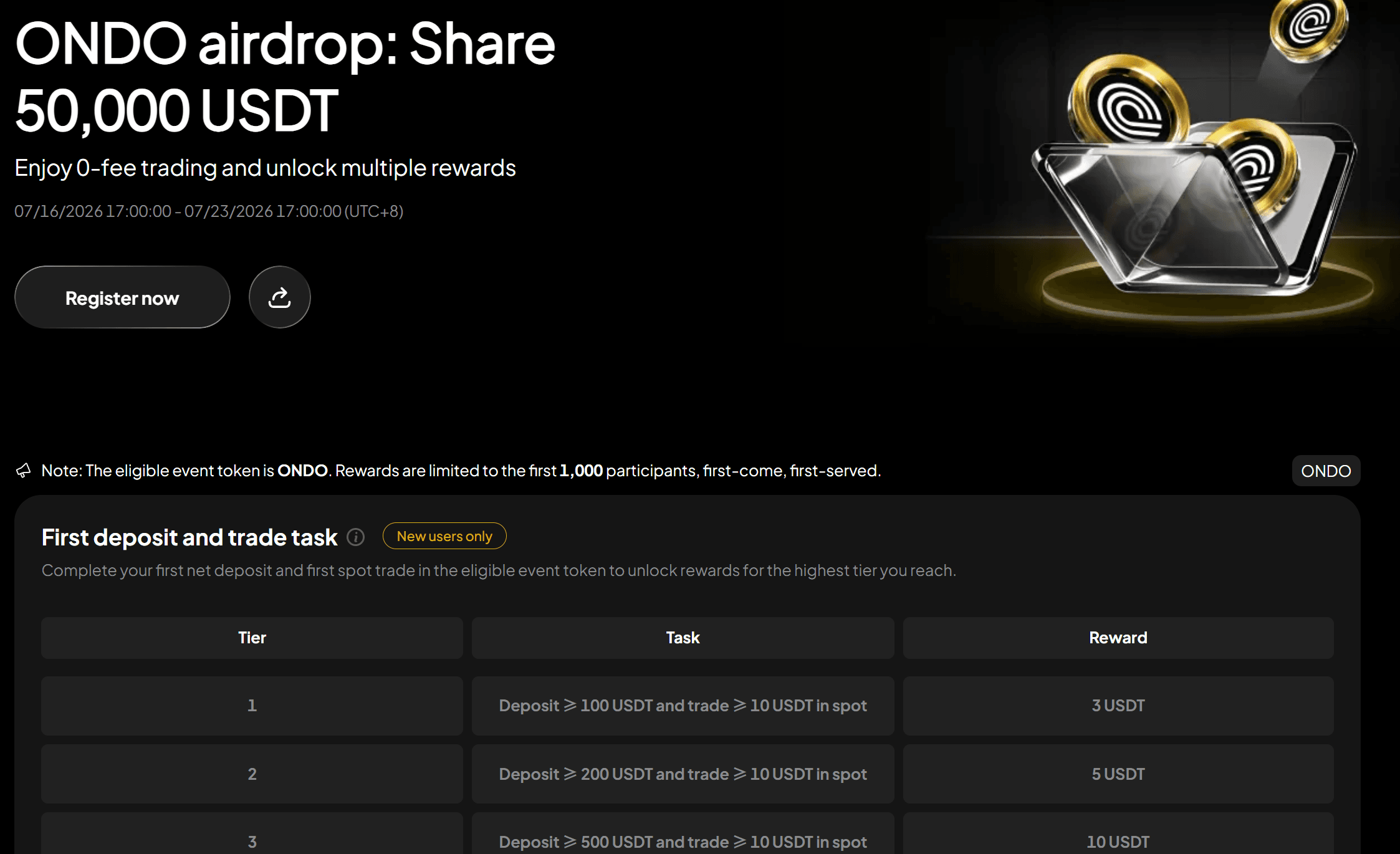
Claim ONDO Airdrop Rewards: Complete Tasks and Share 50,000 USDT
Claim ONDO Airdrop rewards on WEEX and share 50,000 USDT. Learn how to join, complete trading tasks, earn bonuses, and trade ONDO/USDT during the event.
Japan's Crypto Regulation Basics: The FSA, JVCEA, and User Protections
How Overseas Crypto Exchanges Work for Japan Residents (and the Risks)
Modelo 721 Explained: Declaring Foreign Crypto Holdings in Spain
DEX vs CEX for Perpetuals: Trading Perps On-Chain vs on an Exchange
What Is an On-Chain Order Book? How Order-Book DEXs Work
What Is a Perp DEX? Perpetual Futures on Decentralized Exchanges
Italy Crypto Tax 2026: The Capital Gains Rate Rises to 33%
Support and Resistance: How to Identify Key Levels on the Chart
Supply and Demand Zones: A Smart-Money Trading Guide
Price Action Trading: Reading Raw Market Behavior
Head and Shoulders Pattern: How to Spot and Trade It
Classic Chart Patterns: Triangles, Double Tops/Bottoms and Flags
Airdrop Farming: How to Farm Crypto Airdrops the Right Way
What Is a Moving Average (MA)? Types and How to Read Them
What Is Elliott Wave Theory? A Beginner's Guide to Counting Waves
What Is Fibonacci Retracement? How to Draw and Use It
What Is the Ichimoku Cloud? A Beginner's Guide to Reading It
What Is the VIX (Fear Index)? How to Read It and Its Link to Crypto
What Is Dow Theory? The Six Principles Explained
What Is a Death Cross? Understanding the Bearish Signal
What Is a Golden Cross? A Beginner's Guide to the Bullish Signal
MiCA Regulation: What Changes for Polish Crypto Investors
Open Interest: What It Means in Futures Trading
Call vs Put Options: What They Are and How They Differ
What Are Sakata's Five Methods? Classic Candlestick Patterns Explained
Gold Price Outlook 2026: Third-Party Analyst Scenarios (Maintained, Educational)
Silver Price Outlook 2026: Third-Party Analyst Scenarios (Maintained, Educational)
How to Buy Bitcoin in Brazil: A Step by Step Guide for Beginners
Dolar Crypto in Argentina: How to Use Stablecoins for Dollar Exposure and Buy Bitcoin
Claim ONDO Airdrop Rewards: Complete Tasks and Share 50,000 USDT
Claim ONDO Airdrop rewards on WEEX and share 50,000 USDT. Learn how to join, complete trading tasks, earn bonuses, and trade ONDO/USDT during the event.
Japan's Crypto Regulation Basics: The FSA, JVCEA, and User Protections
Contents
Latest articles






Latest coin listings on WEEX


