
What Is a Perp DEX? Perpetual Futures on Decentralized Exchanges

 Prefer us on Google


A perp DEX — short for perpetual decentralized exchange — is a decentralized exchange built specifically for trading perpetual futures contracts on-chain. It combines two ideas covered elsewhere in this wiki: the decentralized exchange (DEX) model, where trading happens through smart contracts instead of a company holding your funds, and the perpetual future, a derivative with no expiry date. This article explains what a perp DEX is and how one works, at a mechanical level. It is educational and is not a recommendation of any venue or of derivatives trading, which carries a high level of risk.
The problem a perp DEX solves
Most perpetual futures volume has historically sat on centralized exchanges, where you deposit funds into an account and the exchange operates the order matching, custody and settlement. A perp DEX aims to offer the same instrument — a leveraged, non-expiring contract that tracks an underlying asset — while keeping trading non-custodial: you connect a self-custody wallet, your collateral is posted to a smart contract or protocol rather than handed to a company, and settlement is recorded on-chain. The trade-off between these two models is examined in DEX vs CEX for Perpetuals.
The core components
Whatever the specific design, a perp DEX has to reproduce the machinery that a centralized venue normally runs internally:
- A matching or pricing mechanism. Some perp DEXs use an order-book model, matching buyers and sellers directly — explained in What Is an On-Chain Order Book?; others use a pool-based or oracle-priced model, closer to the automated market maker (AMM) idea from spot DEXs.
- Collateral and margin. Traders post margin as collateral, and the protocol tracks each position's health.
- A funding mechanism. Like any perpetual, a perp DEX uses a periodic funding rate — payments exchanged between longs and shorts — to keep the contract price anchored to the underlying spot price.
- A liquidation engine. When a position's margin falls below the maintenance requirement, the protocol closes it. Liquidation on a perp DEX is executed automatically by smart contracts and keepers rather than by a company's risk desk.
- Liquidity. The other side of your trade has to come from somewhere: from other traders on an order book, from a market-maker vault that pools depositors' capital, or from a liquidity pool that quotes against an oracle price.
How a trade works, step by step
The exact flow depends on the design, but a typical order-book perp DEX works like this:
- You connect a self-custody wallet and deposit collateral (often a stablecoin) into the protocol.
- You open a position — say, a long on an asset with several times leverage. The protocol records your position and reserves your margin.
- While the position is open, funding is exchanged periodically with the other side of the market, and your unrealised profit or loss moves with the mark price.
- If the market moves against you far enough, your position is liquidated to protect the system's solvency.
- When you close, your collateral and any profit or loss settle back to your wallet on-chain.
Because leverage magnifies both gains and losses, the same move that produces an outsized gain can also wipe out the collateral entirely — this is inherent to the instrument, not to the venue type.
Different designs in the market
Perp DEXs are not all built the same way. As a neutral, factual matter, several well-known venues illustrate the range of designs: Hyperliquid runs a fully on-chain order book (see the existing explainer, What Is Hyperliquid?); dYdX has used an order-book model on its own chain; and GMX pioneered a pool-and-oracle model where a shared liquidity pool takes the other side of trades. These are named only to show that "perp DEX" is a category, not a single product. This article does not endorse, rank or recommend any of them.
Why the mechanics matter for risk
The appeal of a perp DEX is self-custody and permissionless access; the risks are specific to the model. Smart-contract bugs, oracle failures, thin liquidity, and the ordinary danger of leveraged liquidation all apply. Non-custodial also means non-recoverable: if you lose your keys or sign a malicious transaction, there is no support desk to reverse it. None of this makes a perp DEX better or worse than a centralized venue — it makes it different, with a different risk surface to understand before trading.
Key takeaways
- A perp DEX is a decentralized exchange for trading perpetual futures on-chain, without handing custody of your funds to a company.
- It must reproduce matching/pricing, margin, funding, liquidation and liquidity — the machinery a centralized exchange runs internally.
- Designs vary widely (on-chain order books, pool-and-oracle models); "perp DEX" is a category.
- Leverage risk is inherent to the instrument, and self-custody adds smart-contract and key-management risk.
For the underlying instrument, start with perpetual contracts; to see how a centralized venue differs, read DEX vs CEX for Perpetuals. On a centralized exchange such as WEEX, the same instrument — perpetual futures — is traded through your exchange account rather than a self-custody wallet.
This article is for educational and informational purposes only and does not constitute investment, financial, legal or tax advice, nor an endorsement of any exchange. Cryptocurrency derivatives — especially perpetual futures with leverage — carry a high level of risk, including the total loss of your collateral. Always do your own research.
Disclaimer: This content is provided for general branding and informational purposes only and doesn't constitute financial, investment, legal, or tax advice. Any events, rewards, online events, or related information mentioned herein should not be considered a recommendation, solicitation, or invitation to purchase, sell, trade, or otherwise deal in any crypto assets or to use any services. Crypto assets are highly volatile and may result in loss. WEEX services and online events may not be available in all regions and are subject to applicable laws, regulations, and eligibility requirements. You are responsible for ensuring that your use of WEEX services complies with local laws and for carefully assessing the risks before participating in any crypto-related activities.
You may also like

Gold Price Outlook 2026: Third-Party Analyst Scenarios (Maintained, Educational)

Silver Price Outlook 2026: Third-Party Analyst Scenarios (Maintained, Educational)
How to Buy Bitcoin in Brazil: A Step by Step Guide for Beginners

Dolar Crypto in Argentina: How to Use Stablecoins for Dollar Exposure and Buy Bitcoin
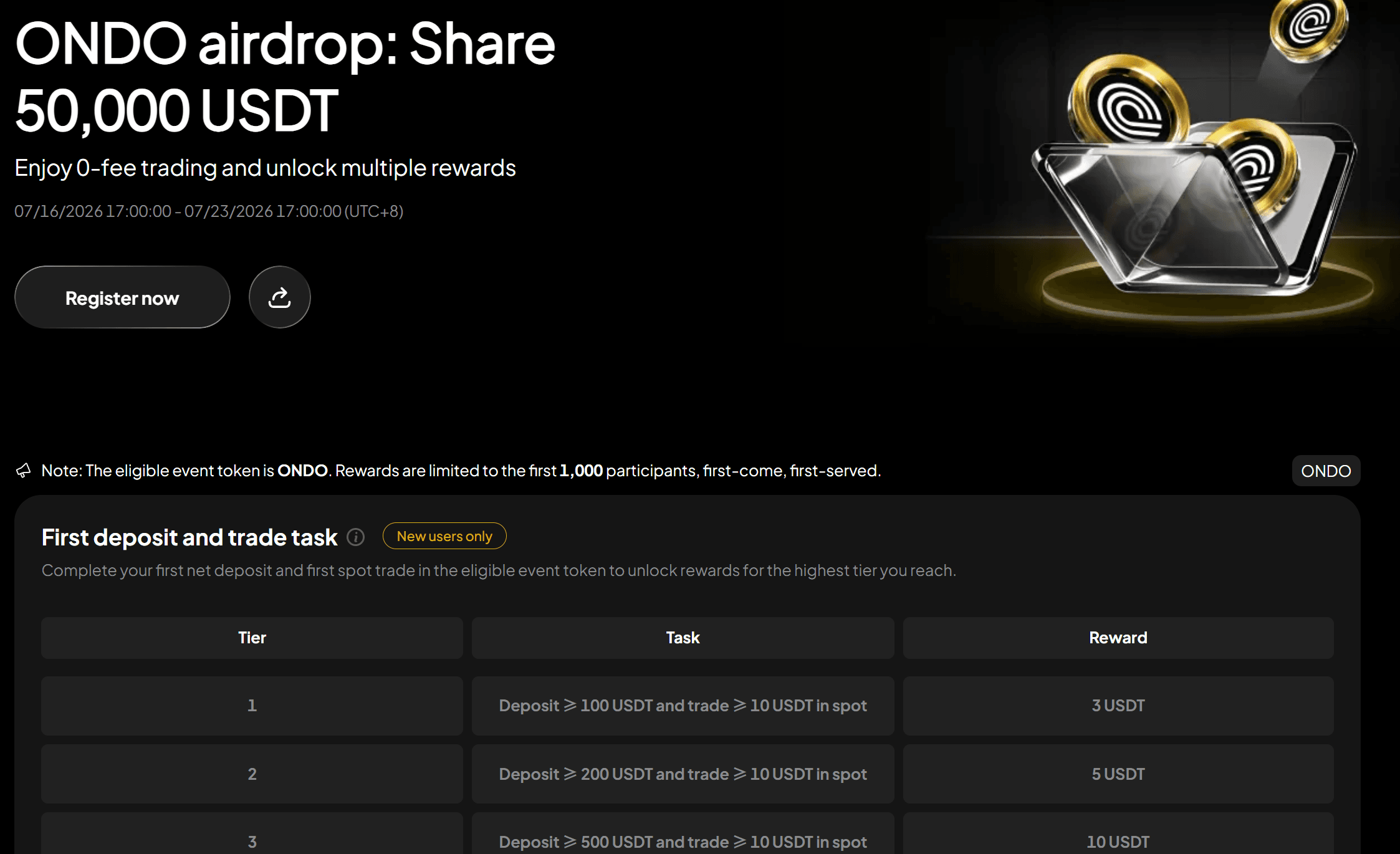
Claim ONDO Airdrop Rewards: Complete Tasks and Share 50,000 USDT
Claim ONDO Airdrop rewards on WEEX and share 50,000 USDT. Learn how to join, complete trading tasks, earn bonuses, and trade ONDO/USDT during the event.

Japan's Crypto Regulation Basics: The FSA, JVCEA, and User Protections

How Overseas Crypto Exchanges Work for Japan Residents (and the Risks)
Modelo 721 Explained: Declaring Foreign Crypto Holdings in Spain

DEX vs CEX for Perpetuals: Trading Perps On-Chain vs on an Exchange

What Is an On-Chain Order Book? How Order-Book DEXs Work
Italy Crypto Tax 2026: The Capital Gains Rate Rises to 33%
Support and Resistance: How to Identify Key Levels on the Chart

Supply and Demand Zones: A Smart-Money Trading Guide
Price Action Trading: Reading Raw Market Behavior

Head and Shoulders Pattern: How to Spot and Trade It

Classic Chart Patterns: Triangles, Double Tops/Bottoms and Flags
Airdrop Farming: How to Farm Crypto Airdrops the Right Way
What Is a Moving Average (MA)? Types and How to Read Them
What Is Elliott Wave Theory? A Beginner's Guide to Counting Waves
What Is Fibonacci Retracement? How to Draw and Use It
What Is the Ichimoku Cloud? A Beginner's Guide to Reading It
What Is the VIX (Fear Index)? How to Read It and Its Link to Crypto
What Is Dow Theory? The Six Principles Explained
What Is a Death Cross? Understanding the Bearish Signal
What Is a Golden Cross? A Beginner's Guide to the Bullish Signal
MiCA Regulation: What Changes for Polish Crypto Investors
Open Interest: What It Means in Futures Trading
Call vs Put Options: What They Are and How They Differ
What Are Sakata's Five Methods? Classic Candlestick Patterns Explained
What Is the FOMC? Meeting Schedule and Why Crypto Reacts
Gold Price Outlook 2026: Third-Party Analyst Scenarios (Maintained, Educational)
Silver Price Outlook 2026: Third-Party Analyst Scenarios (Maintained, Educational)
How to Buy Bitcoin in Brazil: A Step by Step Guide for Beginners
Dolar Crypto in Argentina: How to Use Stablecoins for Dollar Exposure and Buy Bitcoin
Claim ONDO Airdrop Rewards: Complete Tasks and Share 50,000 USDT
Claim ONDO Airdrop rewards on WEEX and share 50,000 USDT. Learn how to join, complete trading tasks, earn bonuses, and trade ONDO/USDT during the event.
Japan's Crypto Regulation Basics: The FSA, JVCEA, and User Protections
Contents
Latest articles



Latest coin listings on WEEX


