
MiCA Regulation: What Changes for Polish Crypto Investors

 Prefer us on Google


MiCA — the Markets in Crypto-Assets Regulation, Regulation (EU) 2023/1114 — is the European Union's comprehensive rulebook for crypto-assets. It aims to create one harmonised framework across all EU member states, replacing the patchwork of national rules that existed before. This article explains what MiCA is and, specifically, what it means for crypto users in Poland as of July 2026. (For the Portuguese perspective, see the separate MiCA explainer for investors in Portugal; the rules are EU-wide, but national implementation differs — and Poland's situation is notably different.)
What MiCA sets out to do
MiCA introduces EU-wide requirements in areas that previously lacked dedicated EU-level rules or were fragmented across national regimes, including:
- Authorisation of service providers. Firms that offer crypto services — exchanges, custody, brokerage — must be authorised as Crypto-Asset Service Providers (CASPs).
- Stablecoin rules. Issuers of asset-referenced tokens (ARTs) and e-money tokens (EMTs) face reserve, disclosure and governance requirements.
- Consumer protection and transparency. Whitepapers, clear risk disclosures and rules against market abuse.
- The passport. A firm authorised in one member state can "passport" its services across the EU without a fresh licence in each country.
The key dates (EU-wide)
According to the European Commission and ESMA, MiCA's timeline has run as follows:
- 29 June 2023 — MiCA entered into force after publication in the Official Journal.
- 30 June 2024 — the rules for stablecoins (ARTs and EMTs, Titles III and IV) began to apply.
- 30 December 2024 — the rules for CASPs (the rest of the regulation) began to apply.
- 1 July 2026 — the outer limit of the transitional ("grandfathering") period during which member states could let existing providers keep operating while seeking authorisation. In a statement dated 17 April 2026, ESMA confirmed that after this point, providing crypto services without a CASP authorisation breaches EU law — regardless of whether an individual member state has finished its own implementation.
What is different in Poland
Here is the Poland-specific angle. Because MiCA is a regulation, it applies directly in Poland as EU law. But MiCA also requires each member state to pass national provisions — most importantly, to designate a national competent authority and set out supervisory powers, fees and penalties. As of July 2026, Poland had not yet completed that step.
- Poland's implementing bill — the Crypto-Asset Market Act (Ustawa o rynku kryptoaktywów) — passed the Sejm on 15 May 2026 and cleared the Senate, but President Karol Nawrocki declined to sign it. As of early July 2026 the law was not in force.
- According to the Polish Financial Supervision Authority (KNF), as of 1 July 2026 no Polish public authority had been designated as the competent authority for MiCA supervision — with the exception of issuers of e-money tokens (EMTs).
- Under the draft act, the KNF is the authority intended to license and supervise CASPs once the law takes effect.
The practical consequence, widely reported in mid-2026, is that domestic Polish firms could not yet obtain a MiCA CASP licence at home, and some have sought authorisation in other EU member states and passported services back into Poland. This is a description of the market situation, not a recommendation. Because this landscape is changing quickly and is politically contested, treat every date and status here as a snapshot dated July 2026.
What it means for everyday users
For an individual using crypto in Poland, MiCA's broad direction is toward more regulated, more transparent services: authorised providers, clearer disclosures and stronger consumer protections over time. In the near term, the unfinished national implementation means some uncertainty about which providers are fully licensed domestically. Sensible, non-advice steps include favouring providers that are transparent about their regulatory status, reading the risk disclosures that MiCA is designed to standardise, and keeping records for tax purposes — a separate topic covered in the Poland crypto tax guide.
MiCA also affects derivatives-adjacent products indirectly through provider authorisation; if you are learning how leveraged products work, start with the fundamentals of crypto futures and their risks before anything else.
Key takeaways
- MiCA (Regulation (EU) 2023/1114) is the EU's harmonised crypto framework, phased in from 2024 with the transitional period ending 1 July 2026.
- It applies directly in Poland, but national implementation — including designating the KNF as competent authority — was still unfinished as of July 2026 after the implementing act was not signed into law.
- For users, the trajectory is toward more regulated and transparent services, with some short-term uncertainty.
- Always verify the current status through official sources.
This article is for informational and educational purposes only and does not constitute legal, tax, or investment advice. Legal status described here is a snapshot as of July 2026; crypto regulation is changing rapidly. For the current position, consult official sources such as the KNF (knf.gov.pl), ESMA and the European Commission, or a qualified professional. Cryptocurrency trading — especially futures trading with leverage — carries a high level of risk.
Disclaimer: This content is provided for general branding and informational purposes only and doesn't constitute financial, investment, legal, or tax advice. Any events, rewards, online events, or related information mentioned herein should not be considered a recommendation, solicitation, or invitation to purchase, sell, trade, or otherwise deal in any crypto assets or to use any services. Crypto assets are highly volatile and may result in loss. WEEX services and online events may not be available in all regions and are subject to applicable laws, regulations, and eligibility requirements. You are responsible for ensuring that your use of WEEX services complies with local laws and for carefully assessing the risks before participating in any crypto-related activities.
You may also like

Gold Price Outlook 2026: Third-Party Analyst Scenarios (Maintained, Educational)

Silver Price Outlook 2026: Third-Party Analyst Scenarios (Maintained, Educational)
How to Buy Bitcoin in Brazil: A Step by Step Guide for Beginners

Dolar Crypto in Argentina: How to Use Stablecoins for Dollar Exposure and Buy Bitcoin
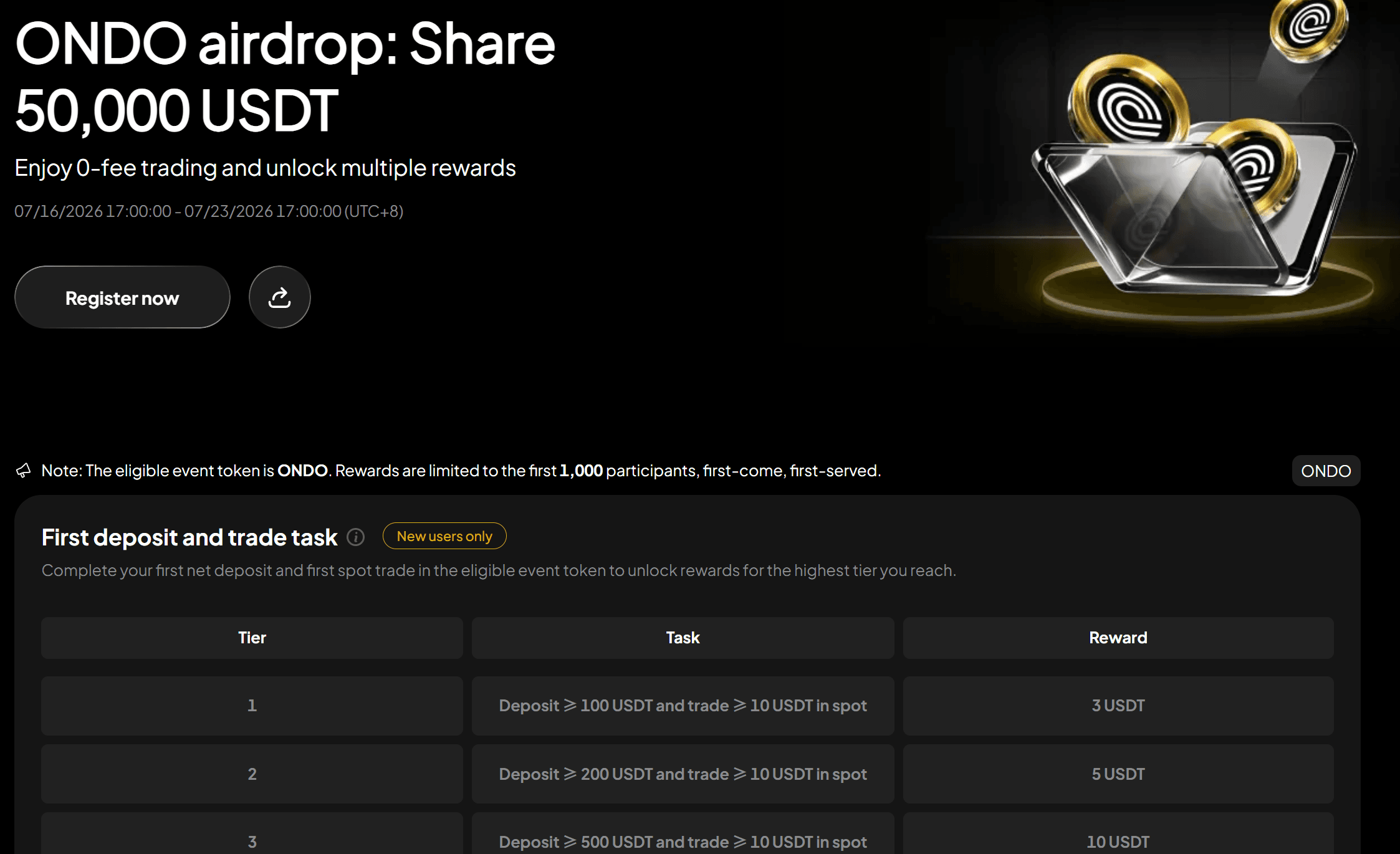
Claim ONDO Airdrop Rewards: Complete Tasks and Share 50,000 USDT
Claim ONDO Airdrop rewards on WEEX and share 50,000 USDT. Learn how to join, complete trading tasks, earn bonuses, and trade ONDO/USDT during the event.
Japan's Crypto Regulation Basics: The FSA, JVCEA, and User Protections
How Overseas Crypto Exchanges Work for Japan Residents (and the Risks)
Modelo 721 Explained: Declaring Foreign Crypto Holdings in Spain
DEX vs CEX for Perpetuals: Trading Perps On-Chain vs on an Exchange
What Is an On-Chain Order Book? How Order-Book DEXs Work
What Is a Perp DEX? Perpetual Futures on Decentralized Exchanges
Italy Crypto Tax 2026: The Capital Gains Rate Rises to 33%
Support and Resistance: How to Identify Key Levels on the Chart

Supply and Demand Zones: A Smart-Money Trading Guide
Price Action Trading: Reading Raw Market Behavior

Head and Shoulders Pattern: How to Spot and Trade It
Classic Chart Patterns: Triangles, Double Tops/Bottoms and Flags
Airdrop Farming: How to Farm Crypto Airdrops the Right Way
What Is a Moving Average (MA)? Types and How to Read Them
What Is Elliott Wave Theory? A Beginner's Guide to Counting Waves
What Is Fibonacci Retracement? How to Draw and Use It
What Is the Ichimoku Cloud? A Beginner's Guide to Reading It
What Is the VIX (Fear Index)? How to Read It and Its Link to Crypto
What Is Dow Theory? The Six Principles Explained
What Is a Death Cross? Understanding the Bearish Signal
What Is a Golden Cross? A Beginner's Guide to the Bullish Signal
Open Interest: What It Means in Futures Trading
Call vs Put Options: What They Are and How They Differ
What Are Sakata's Five Methods? Classic Candlestick Patterns Explained
What Is the FOMC? Meeting Schedule and Why Crypto Reacts
Gold Price Outlook 2026: Third-Party Analyst Scenarios (Maintained, Educational)
Silver Price Outlook 2026: Third-Party Analyst Scenarios (Maintained, Educational)
How to Buy Bitcoin in Brazil: A Step by Step Guide for Beginners
Dolar Crypto in Argentina: How to Use Stablecoins for Dollar Exposure and Buy Bitcoin
Claim ONDO Airdrop Rewards: Complete Tasks and Share 50,000 USDT
Claim ONDO Airdrop rewards on WEEX and share 50,000 USDT. Learn how to join, complete trading tasks, earn bonuses, and trade ONDO/USDT during the event.
Japan's Crypto Regulation Basics: The FSA, JVCEA, and User Protections
Contents
Latest articles



Latest coin listings on WEEX


