
Open Interest: What It Means in Futures Trading

 Prefer us on Google



Open interest is one of the most useful metrics in crypto futures trading. It measures the total number of futures (or perpetual) contracts that are currently open and have not yet been settled or closed. In simple terms, open interest tells you how much money is committed to a market right now — a gauge of participation and, often, of conviction.
How open interest works
Every futures contract has two sides: a buyer (long) and a seller (short). One open contract equals one unit of open interest. The number changes only when new contracts are created or existing ones are closed:
- When a new buyer and a new seller open a position together, open interest rises — fresh money has entered.
- When an existing long and an existing short both close, open interest falls — money has left the market.
- When a new trader simply takes over an existing trader's position, open interest is unchanged — the contract just switched hands.
Open interest vs. trading volume
These two are easy to confuse but measure different things:
- Volume counts how many contracts changed hands over a period (for example, one day). It resets each period.
- Open interest counts how many contracts are open at a given moment. It carries over and accumulates.
A helpful analogy: volume is like the number of tickets sold at a cinema today, while open interest is the number of people currently sitting inside. High volume with rising open interest suggests new positions are being built; high volume with falling open interest suggests positions are being closed.
How traders read open interest
Analysts often combine the direction of price with the direction of open interest to gauge the strength behind a move. A widely cited framework is:
- Price up + open interest up: new money supporting the move — often read as a stronger trend.
- Price up + open interest down: a rally driven by shorts closing rather than new buyers — often read as weaker.
- Price down + open interest up: new short positions building — often read as a stronger downtrend.
- Price down + open interest down: longs closing out — the move may be losing steam.
These are general interpretations, not rules that hold every time. Open interest is most informative alongside other data, such as the funding rate and broader context like Bitcoin dominance.
Why it matters for risk
Rapidly rising open interest can mean a market is becoming crowded and heavily leveraged. When many positions are stacked on one side, a sharp move can trigger a cascade of liquidations, amplifying volatility. Reading open interest can therefore be as much about awareness of risk as about spotting opportunity. On WEEX, open interest is one of the futures metrics traders monitor when sizing positions — remembering always that leverage magnifies both gains and losses.
A quick worked example
Imagine a market opens the day with 10,000 contracts of open interest. During the session, a trader new to the market buys a contract from another new trader who sells it short — that single fresh pairing lifts open interest to 10,001. Later, an existing long and an existing short agree to close, and the figure drops back to 10,000. If instead one of them had simply sold their position to a brand-new participant, the total would not have moved at all — ownership changed hands, but no contract was created or destroyed. Watching this figure over days, rather than in a single snapshot, is what makes it informative.
Where to find it
Open interest is published by exchanges and data aggregators, usually as a chart plotted beneath price. Because different venues report their own figures, aggregated open interest across the market is often the most useful view of overall positioning.
Key takeaways
- Open interest is the total number of open futures contracts at a point in time.
- It rises when new positions open and falls when positions close.
- Unlike volume, which resets each period, open interest accumulates.
- Combined with price and funding, it helps gauge the strength and crowdedness of a move — but it is context, not a signal on its own.
Learn more about crypto futures and the funding rate to complete the picture.
This article is for educational and informational purposes only and does not constitute investment, financial, or trading advice. Cryptocurrency trading — especially futures trading with leverage — carries a high level of risk. Always do your own research before making any decisions.
Disclaimer: This content is provided for general branding and informational purposes only and doesn't constitute financial, investment, legal, or tax advice. Any events, rewards, online events, or related information mentioned herein should not be considered a recommendation, solicitation, or invitation to purchase, sell, trade, or otherwise deal in any crypto assets or to use any services. Crypto assets are highly volatile and may result in loss. WEEX services and online events may not be available in all regions and are subject to applicable laws, regulations, and eligibility requirements. You are responsible for ensuring that your use of WEEX services complies with local laws and for carefully assessing the risks before participating in any crypto-related activities.
You may also like

Gold Price Outlook 2026: Third-Party Analyst Scenarios (Maintained, Educational)
Silver Price Outlook 2026: Third-Party Analyst Scenarios (Maintained, Educational)
How to Buy Bitcoin in Brazil: A Step by Step Guide for Beginners

Dolar Crypto in Argentina: How to Use Stablecoins for Dollar Exposure and Buy Bitcoin
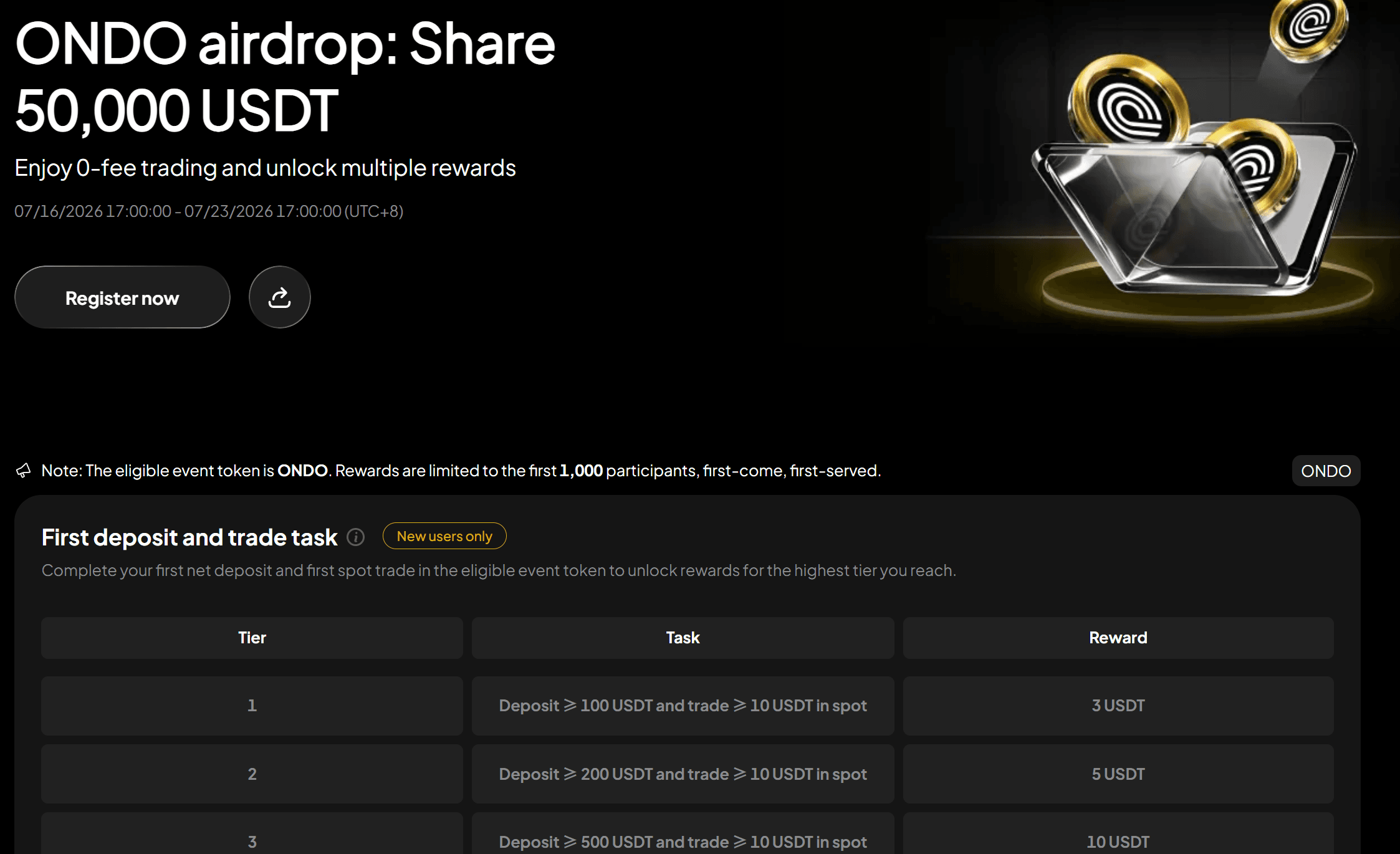
Claim ONDO Airdrop Rewards: Complete Tasks and Share 50,000 USDT
Claim ONDO Airdrop rewards on WEEX and share 50,000 USDT. Learn how to join, complete trading tasks, earn bonuses, and trade ONDO/USDT during the event.
Japan's Crypto Regulation Basics: The FSA, JVCEA, and User Protections

How Overseas Crypto Exchanges Work for Japan Residents (and the Risks)
Modelo 721 Explained: Declaring Foreign Crypto Holdings in Spain
DEX vs CEX for Perpetuals: Trading Perps On-Chain vs on an Exchange
What Is an On-Chain Order Book? How Order-Book DEXs Work
What Is a Perp DEX? Perpetual Futures on Decentralized Exchanges
Italy Crypto Tax 2026: The Capital Gains Rate Rises to 33%
Support and Resistance: How to Identify Key Levels on the Chart

Supply and Demand Zones: A Smart-Money Trading Guide
Price Action Trading: Reading Raw Market Behavior

Head and Shoulders Pattern: How to Spot and Trade It
Classic Chart Patterns: Triangles, Double Tops/Bottoms and Flags
Airdrop Farming: How to Farm Crypto Airdrops the Right Way
What Is a Moving Average (MA)? Types and How to Read Them
What Is Elliott Wave Theory? A Beginner's Guide to Counting Waves
What Is Fibonacci Retracement? How to Draw and Use It
What Is the Ichimoku Cloud? A Beginner's Guide to Reading It
What Is the VIX (Fear Index)? How to Read It and Its Link to Crypto
What Is Dow Theory? The Six Principles Explained
What Is a Death Cross? Understanding the Bearish Signal
What Is a Golden Cross? A Beginner's Guide to the Bullish Signal
MiCA Regulation: What Changes for Polish Crypto Investors
Call vs Put Options: What They Are and How They Differ
What Are Sakata's Five Methods? Classic Candlestick Patterns Explained
What Is the FOMC? Meeting Schedule and Why Crypto Reacts
Gold Price Outlook 2026: Third-Party Analyst Scenarios (Maintained, Educational)
Silver Price Outlook 2026: Third-Party Analyst Scenarios (Maintained, Educational)
How to Buy Bitcoin in Brazil: A Step by Step Guide for Beginners
Dolar Crypto in Argentina: How to Use Stablecoins for Dollar Exposure and Buy Bitcoin
Claim ONDO Airdrop Rewards: Complete Tasks and Share 50,000 USDT
Claim ONDO Airdrop rewards on WEEX and share 50,000 USDT. Learn how to join, complete trading tasks, earn bonuses, and trade ONDO/USDT during the event.
Japan's Crypto Regulation Basics: The FSA, JVCEA, and User Protections
Contents
Latest articles


Latest coin listings on WEEX


