
What Is a Death Cross? Understanding the Bearish Signal

 Prefer us on Google


A death cross is a chart pattern that occurs when a shorter-term moving average crosses below a longer-term moving average. It is the bearish mirror image of the golden cross, and traders watch it as a widely recognised warning that momentum may be turning downward. The dramatic name reflects its reputation, but like any single indicator it is a clue, not a verdict.
How a death cross forms
The pattern is built from moving averages, the smoothing tool explained in moving averages. The classic version uses a 50-period average (the shorter, faster line) and a 200-period average (the longer, slower line).
- When price has been strong, the fast 50-period line typically sits above the slow 200-period line.
- As selling pressure builds, the fast line falls more quickly than the slow line.
- When the fast line finally crosses down through the slow line, that crossover is the death cross.
The reasoning is that recent prices (captured by the fast average) have weakened enough to fall beneath the longer-term average, which some traders read as evidence that the trend may be turning down.
What it does — and does not — tell you
The death cross is popular for the same reason as its bullish twin: it is simple and visual. The same caveats apply, too:
- It lags. Built from past prices, it confirms weakness that has already developed rather than predicting a crash.
- It can whipsaw. In sideways markets the lines can cross repeatedly, generating signals that quickly reverse.
- It is not standalone. Traders often seek confirmation from volume, momentum, and the wider trend structure — for example the trend concepts in Dow Theory — before acting.
Its bullish counterpart, where the fast line crosses back above the slow line, is the golden cross, covered in the golden cross. The two are usually discussed together.
A worked example
Imagine an asset has rallied for months, leaving its 50-period average above its 200-period average.
- Selling pressure emerges, and price begins to slide, pulling the 50-period line downward.
- Eventually the 50-period line crosses below the 200-period line — a death cross forms.
- Some traders treat this as a signal that the uptrend may be over, while others note that death crosses have sometimes appeared after much of a decline has already happened, and wait for further confirmation.
Because the signal lags and can fail, acting on it carries risk, and leverage magnifies that risk. Anyone applying it in futures or perpetual contracts should predefine risk limits and avoid treating one crossover as certainty. This is educational information, not a recommendation to buy or sell.
A common misconception
A recurring misunderstanding is that a death cross automatically means a large decline is coming. History shows the opposite is often true: because the pattern lags, a death cross has sometimes appeared near the end of a decline, after most of the drop has already happened, which can trap traders who sell into it expecting much more downside. As with the golden cross, timeframe matters enormously — a crossover on a weekly chart signals a slower, broader change than one on a one-minute chart, where the lines cross constantly. The pattern is also prone to whipsaws in sideways markets, where a death cross can be quickly followed by a golden cross and back again. For these reasons, seasoned traders treat a death cross as a cue to examine the wider picture — trend structure, volume, and momentum — rather than as a standalone reason to sell.
Related concepts
- Golden cross: the bullish mirror image — the golden cross.
- Moving average (MA): the building block of the pattern — moving averages.
- Dow Theory: a framework for judging whether a trend is genuinely turning — Dow Theory.
Summary
A death cross is when a shorter moving average crosses below a longer one, a widely watched hint that momentum may be turning bearish. Like the golden cross it is simple but lagging and prone to false signals, so it is best treated as one confirming clue within a broader analysis rather than a standalone sell trigger.
This article is for educational and informational purposes only and does not constitute investment, financial, or tax advice. Cryptocurrency and derivatives trading involve significant risk. Always do your own research.
Disclaimer: This content is provided for general branding and informational purposes only and doesn't constitute financial, investment, legal, or tax advice. Any events, rewards, online events, or related information mentioned herein should not be considered a recommendation, solicitation, or invitation to purchase, sell, trade, or otherwise deal in any crypto assets or to use any services. Crypto assets are highly volatile and may result in loss. WEEX services and online events may not be available in all regions and are subject to applicable laws, regulations, and eligibility requirements. You are responsible for ensuring that your use of WEEX services complies with local laws and for carefully assessing the risks before participating in any crypto-related activities.
You may also like

Gold Price Outlook 2026: Third-Party Analyst Scenarios (Maintained, Educational)

Silver Price Outlook 2026: Third-Party Analyst Scenarios (Maintained, Educational)
How to Buy Bitcoin in Brazil: A Step by Step Guide for Beginners

Dolar Crypto in Argentina: How to Use Stablecoins for Dollar Exposure and Buy Bitcoin
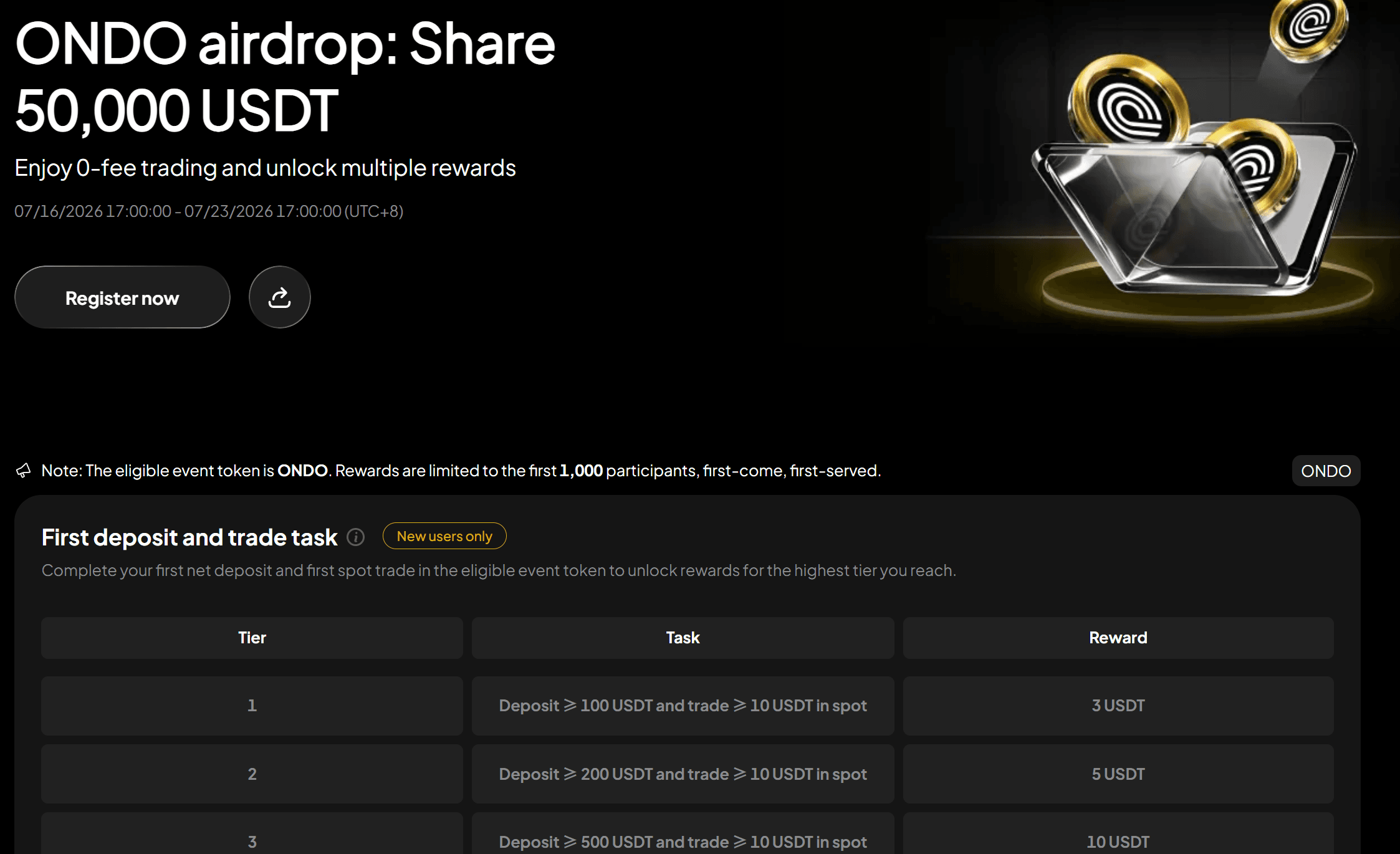
Claim ONDO Airdrop Rewards: Complete Tasks and Share 50,000 USDT
Claim ONDO Airdrop rewards on WEEX and share 50,000 USDT. Learn how to join, complete trading tasks, earn bonuses, and trade ONDO/USDT during the event.

Japan's Crypto Regulation Basics: The FSA, JVCEA, and User Protections

How Overseas Crypto Exchanges Work for Japan Residents (and the Risks)
Modelo 721 Explained: Declaring Foreign Crypto Holdings in Spain

DEX vs CEX for Perpetuals: Trading Perps On-Chain vs on an Exchange

What Is an On-Chain Order Book? How Order-Book DEXs Work
What Is a Perp DEX? Perpetual Futures on Decentralized Exchanges
Italy Crypto Tax 2026: The Capital Gains Rate Rises to 33%
Support and Resistance: How to Identify Key Levels on the Chart

Supply and Demand Zones: A Smart-Money Trading Guide
Price Action Trading: Reading Raw Market Behavior

Head and Shoulders Pattern: How to Spot and Trade It

Classic Chart Patterns: Triangles, Double Tops/Bottoms and Flags
Airdrop Farming: How to Farm Crypto Airdrops the Right Way
What Is a Moving Average (MA)? Types and How to Read Them
What Is Elliott Wave Theory? A Beginner's Guide to Counting Waves
What Is Fibonacci Retracement? How to Draw and Use It
What Is the Ichimoku Cloud? A Beginner's Guide to Reading It
What Is the VIX (Fear Index)? How to Read It and Its Link to Crypto
What Is Dow Theory? The Six Principles Explained
What Is a Golden Cross? A Beginner's Guide to the Bullish Signal
MiCA Regulation: What Changes for Polish Crypto Investors
Open Interest: What It Means in Futures Trading
Call vs Put Options: What They Are and How They Differ
What Are Sakata's Five Methods? Classic Candlestick Patterns Explained
What Is the FOMC? Meeting Schedule and Why Crypto Reacts
Gold Price Outlook 2026: Third-Party Analyst Scenarios (Maintained, Educational)
Silver Price Outlook 2026: Third-Party Analyst Scenarios (Maintained, Educational)
How to Buy Bitcoin in Brazil: A Step by Step Guide for Beginners
Dolar Crypto in Argentina: How to Use Stablecoins for Dollar Exposure and Buy Bitcoin
Claim ONDO Airdrop Rewards: Complete Tasks and Share 50,000 USDT
Claim ONDO Airdrop rewards on WEEX and share 50,000 USDT. Learn how to join, complete trading tasks, earn bonuses, and trade ONDO/USDT during the event.
Japan's Crypto Regulation Basics: The FSA, JVCEA, and User Protections