
What Is a Policy Interest Rate? How Central Banks Move Markets

 Prefer us on Google


A policy interest rate is the benchmark interest rate set by a country's central bank. It is the single most important lever central banks use to influence the economy, because it acts as the anchor from which most other interest rates — for loans, savings, and bonds — take their cue. When people say "the Fed raised rates" or "the Bank of Japan is expected to move," the policy rate is what they mean.
What the policy rate is
Central banks such as the US Federal Reserve, the European Central Bank, and the Bank of Japan each set a target for a key short-term interest rate. This rate governs, directly or indirectly, the cost at which banks lend to and borrow from one another overnight. Because banks pass those costs along, the policy rate ripples out into the rates households and businesses actually face.
The policy rate is the central tool of monetary policy — the management of money and credit conditions in the economy. Its counterpart concept, the overall stock of money in circulation, is explained in M2.
How central banks use it
A central bank typically has a mandate that includes keeping inflation stable and, in some cases, supporting employment. It moves the policy rate to steer the economy toward those goals:
- Raising the rate tightens conditions: borrowing costs rise, demand cools, and inflation pressure tends to ease. The direction and mechanics of these moves are covered in rate hikes and cuts.
- Lowering the rate loosens conditions: borrowing becomes cheaper, spending and investment are encouraged, and a weak economy gets support.
To judge whether policy is on track, central banks watch inflation gauges closely — including the personal consumption expenditures measure in PCE, which the US Federal Reserve emphasises — alongside growth and jobs data.
Why the policy rate matters to markets and crypto
The policy rate sets the "risk-free" baseline against which every other investment is judged. When it is high, safe assets pay a meaningful return, which raises the bar that riskier assets must clear to attract capital. When it is low, that bar falls, and investors may reach further out on the risk spectrum.
Crypto is frequently discussed in this context. Lower policy rates and looser conditions are often described as a more supportive backdrop for risk assets, while higher rates are cited as a headwind. This is a general market narrative, not a mechanical law — crypto has its own drivers, and correlations shift over time.
A worked example
Imagine a central bank holds its policy rate at a low level for an extended period.
- Savings accounts and short-term government bonds pay very little.
- Investors seeking higher returns move capital toward assets with more risk and more potential upside.
- If the central bank later signals that it will raise the rate, the calculation reverses: safe assets become more attractive, and some capital may rotate out of riskier positions.
Traders often position ahead of these shifts based on expectations of where the policy rate is heading, which is why forward guidance from central banks can move markets even before any rate actually changes. Leverage magnifies the effect, so users of futures or perpetual contracts should size risk carefully around policy events.
Related concepts
- Rate hikes and cuts: how the policy rate is adjusted — rate hikes and cuts.
- Money supply: the broader monetary backdrop — M2.
- PCE: the inflation gauge central banks watch — PCE.
Summary
The policy interest rate is the benchmark rate a central bank sets to steer inflation and growth. It anchors borrowing and saving costs across the economy and defines the risk-free baseline that every other asset is measured against. For crypto traders it is core macro context — powerful, but one factor among many.
This article is for educational and informational purposes only and does not constitute investment, financial, or tax advice. Cryptocurrency and derivatives trading involve significant risk. Always do your own research.
Disclaimer: This content is provided for general branding and informational purposes only and doesn't constitute financial, investment, legal, or tax advice. Any events, rewards, online events, or related information mentioned herein should not be considered a recommendation, solicitation, or invitation to purchase, sell, trade, or otherwise deal in any crypto assets or to use any services. Crypto assets are highly volatile and may result in loss. WEEX services and online events may not be available in all regions and are subject to applicable laws, regulations, and eligibility requirements. You are responsible for ensuring that your use of WEEX services complies with local laws and for carefully assessing the risks before participating in any crypto-related activities.
You may also like
Crypto Exchange Comparison for Germany (2026): Fees, Products, and How to Choose

Crypto Apps Compared for Germany (2026): Features, Demo Mode and Security — What to Check Before You Download

Crypto Platform Comparison for France (2026): Fees, Products, and How to Choose

Crypto Apps Compared for France (2026): Features, Demo Mode and Security — What to Check Before You Download
NVIDIA (NVDA) Earnings Date: When Q2 FY2027 Reports and What to Watch
Is WEEX Safe? A Facts-First Look at WEEX's Reserves, Security, and Regulatory Status in Japan

When an Overseas Exchange Ends Its Japan Service: The Typical Sequence and What Users Should Check
Bybit Japan Service Termination: The Complete Timeline and What Happens on July 22, 2026
How to Withdraw From Bybit After the Japan Service Shutdown: Step-by-Step and a Deadline Checklist
The Tax Consequences of a Forced Liquidation for Japanese Crypto Traders
After Bybit's Japan Shutdown: A Neutral Map of Where Your Funds Can Go
Gold Price Outlook 2026: Third-Party Analyst Scenarios (Maintained, Educational)

Silver Price Outlook 2026: Third-Party Analyst Scenarios (Maintained, Educational)
How to Buy Bitcoin in Brazil: A Step by Step Guide for Beginners
Dolar Crypto in Argentina: How to Use Stablecoins for Dollar Exposure and Buy Bitcoin
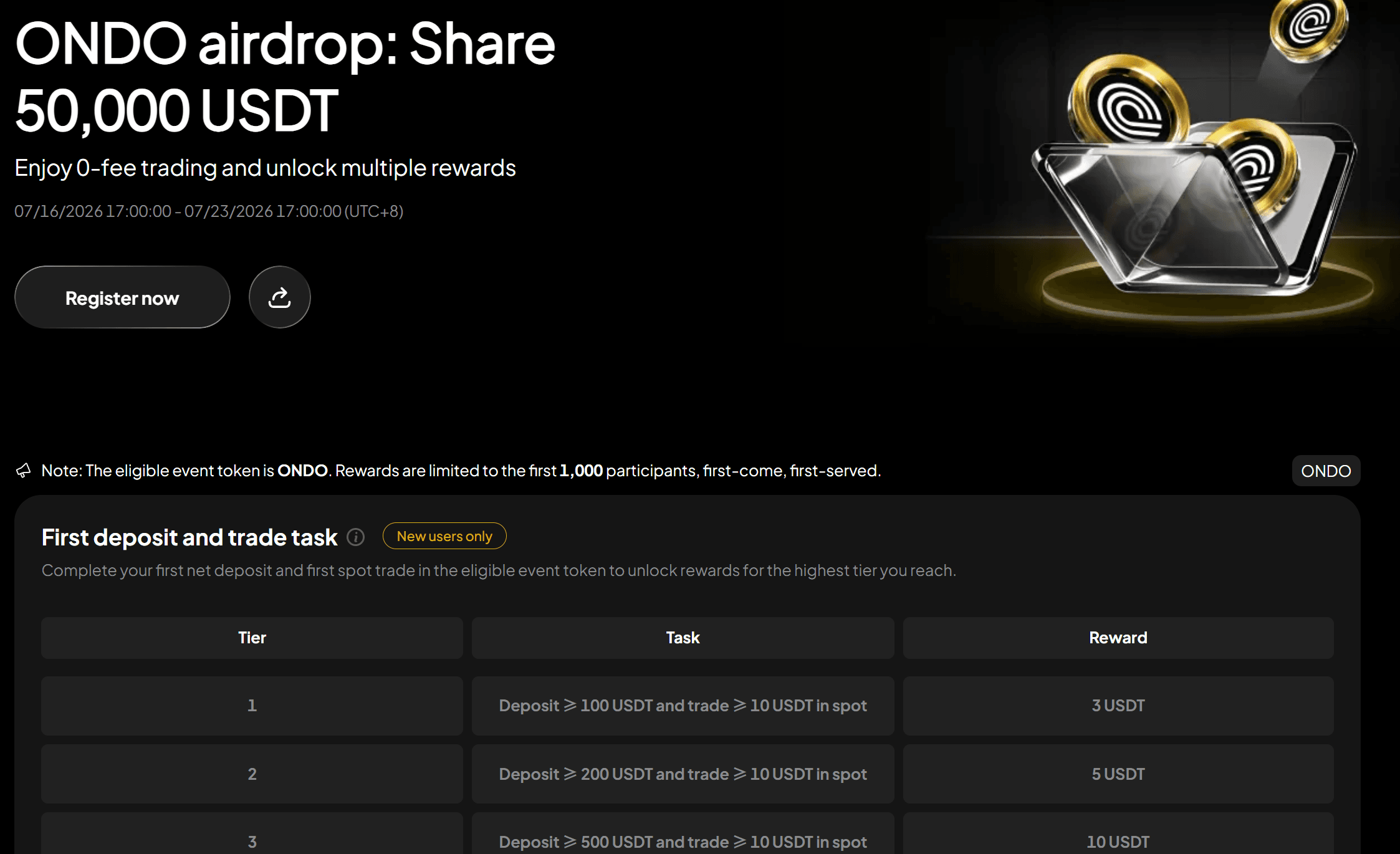
Claim ONDO Airdrop Rewards: Complete Tasks and Share 50,000 USDT
Claim ONDO Airdrop rewards on WEEX and share 50,000 USDT. Learn how to join, complete trading tasks, earn bonuses, and trade ONDO/USDT during the event.
Japan's Crypto Regulation Basics: The FSA, JVCEA, and User Protections
How Overseas Crypto Exchanges Work for Japan Residents (and the Risks)
Modelo 721 Explained: Declaring Foreign Crypto Holdings in Spain
DEX vs CEX for Perpetuals: Trading Perps On-Chain vs on an Exchange
What Is an On-Chain Order Book? How Order-Book DEXs Work
What Is a Perp DEX? Perpetual Futures on Decentralized Exchanges
Italy Crypto Tax 2026: The Capital Gains Rate Rises to 33%
Support and Resistance: How to Identify Key Levels on the Chart
Supply and Demand Zones: A Smart-Money Trading Guide
Price Action Trading: Reading Raw Market Behavior
Head and Shoulders Pattern: How to Spot and Trade It
Classic Chart Patterns: Triangles, Double Tops/Bottoms and Flags
Airdrop Farming: How to Farm Crypto Airdrops the Right Way
What Is a Moving Average (MA)? Types and How to Read Them
Crypto Exchange Comparison for Germany (2026): Fees, Products, and How to Choose
Crypto Apps Compared for Germany (2026): Features, Demo Mode and Security — What to Check Before You Download
Crypto Platform Comparison for France (2026): Fees, Products, and How to Choose
Crypto Apps Compared for France (2026): Features, Demo Mode and Security — What to Check Before You Download
NVIDIA (NVDA) Earnings Date: When Q2 FY2027 Reports and What to Watch
Is WEEX Safe? A Facts-First Look at WEEX's Reserves, Security, and Regulatory Status in Japan








