
What Are Rate Hikes and Cuts? How Monetary Policy Moves Crypto

 Prefer us on Google


A rate hike is when a central bank raises its policy interest rate; a rate cut is when it lowers it. These decisions are among the most closely watched events in finance because the policy rate influences the cost of borrowing across the whole economy — from mortgages and business loans to the appetite for riskier assets, including crypto.
What the policy rate does
A central bank's policy rate is the benchmark that guides other interest rates in the economy. The mechanics of the rate itself are covered in the policy interest rate; the key idea is that raising or lowering it makes money broadly more expensive or cheaper to borrow.
- Rate hikes make borrowing more expensive and saving more rewarding. They are typically used to cool an overheating economy and to bring down inflation by dampening demand.
- Rate cuts make borrowing cheaper and saving less rewarding. They are typically used to support a weak economy by encouraging spending and investment.
Central banks adjust rates gradually and communicate their thinking carefully, because expectations about future moves can matter as much as the moves themselves.
Why rates move crypto and other risk assets
There is a widely discussed relationship between interest rates and the price of risk assets. When rates are low, the return on "safe" assets like cash and short-term government debt is small, which can push investors toward higher-risk, higher-potential-return assets — a backdrop sometimes described as "risk-on." When rates rise, safe assets pay more, and the relative appeal of riskier bets can fade — a "risk-off" backdrop.
Crypto is often grouped with risk assets in this framing. During periods of low rates and ample liquidity, some investors have pointed to supportive conditions for crypto; during rate-hiking cycles, tighter conditions are often cited as a headwind. Liquidity itself, captured by measures such as M2, is part of the same story. These are observed tendencies discussed in markets, not guarantees — the relationship can change, and crypto has many drivers unrelated to rates.
Who decides, and when
In the United States, rate decisions are made by the Federal Reserve's policy committee, whose meetings are explained in the FOMC. Markets often move not only on the decision itself but on the guidance about what might come next, and on whether the outcome matched expectations.
A worked example
Suppose inflation has been running hot and a central bank raises its policy rate.
- Borrowing becomes more expensive, so businesses and households spend and invest a little less.
- Savers earn more on cash, so the opportunity cost of holding volatile assets rises.
- Markets that had expected an even larger hike might actually rally on the "smaller-than-feared" outcome, while markets that expected no change might fall.
The lesson is that the surprise relative to expectations often matters more than the raw decision. Traders using leveraged products such as futures or perpetual contracts should be especially mindful around policy announcements, when volatility can rise sharply.
Related concepts
- Policy interest rate: the benchmark rate itself — the policy interest rate.
- Money supply: the liquidity backdrop rate moves work through — M2.
- FOMC: the US committee that sets rates — the FOMC.
Summary
Rate hikes and cuts are how central banks tighten or loosen financial conditions. Hikes cool demand and fight inflation; cuts support a weak economy. Because rates shape the appeal of risk assets, crypto traders watch them closely — but the relationship is a tendency, not a rule, and expectations often matter more than the decision itself.
This article is for educational and informational purposes only and does not constitute investment, financial, or tax advice. Cryptocurrency and derivatives trading involve significant risk. Always do your own research.
Disclaimer: This content is provided for general branding and informational purposes only and doesn't constitute financial, investment, legal, or tax advice. Any events, rewards, online events, or related information mentioned herein should not be considered a recommendation, solicitation, or invitation to purchase, sell, trade, or otherwise deal in any crypto assets or to use any services. Crypto assets are highly volatile and may result in loss. WEEX services and online events may not be available in all regions and are subject to applicable laws, regulations, and eligibility requirements. You are responsible for ensuring that your use of WEEX services complies with local laws and for carefully assessing the risks before participating in any crypto-related activities.
You may also like
Crypto Exchange Comparison for Germany (2026): Fees, Products, and How to Choose

Crypto Apps Compared for Germany (2026): Features, Demo Mode and Security — What to Check Before You Download

Crypto Platform Comparison for France (2026): Fees, Products, and How to Choose
Crypto Apps Compared for France (2026): Features, Demo Mode and Security — What to Check Before You Download
NVIDIA (NVDA) Earnings Date: When Q2 FY2027 Reports and What to Watch
Is WEEX Safe? A Facts-First Look at WEEX's Reserves, Security, and Regulatory Status in Japan
When an Overseas Exchange Ends Its Japan Service: The Typical Sequence and What Users Should Check
Bybit Japan Service Termination: The Complete Timeline and What Happens on July 22, 2026
How to Withdraw From Bybit After the Japan Service Shutdown: Step-by-Step and a Deadline Checklist
The Tax Consequences of a Forced Liquidation for Japanese Crypto Traders
After Bybit's Japan Shutdown: A Neutral Map of Where Your Funds Can Go
Gold Price Outlook 2026: Third-Party Analyst Scenarios (Maintained, Educational)
Silver Price Outlook 2026: Third-Party Analyst Scenarios (Maintained, Educational)
How to Buy Bitcoin in Brazil: A Step by Step Guide for Beginners
Dolar Crypto in Argentina: How to Use Stablecoins for Dollar Exposure and Buy Bitcoin
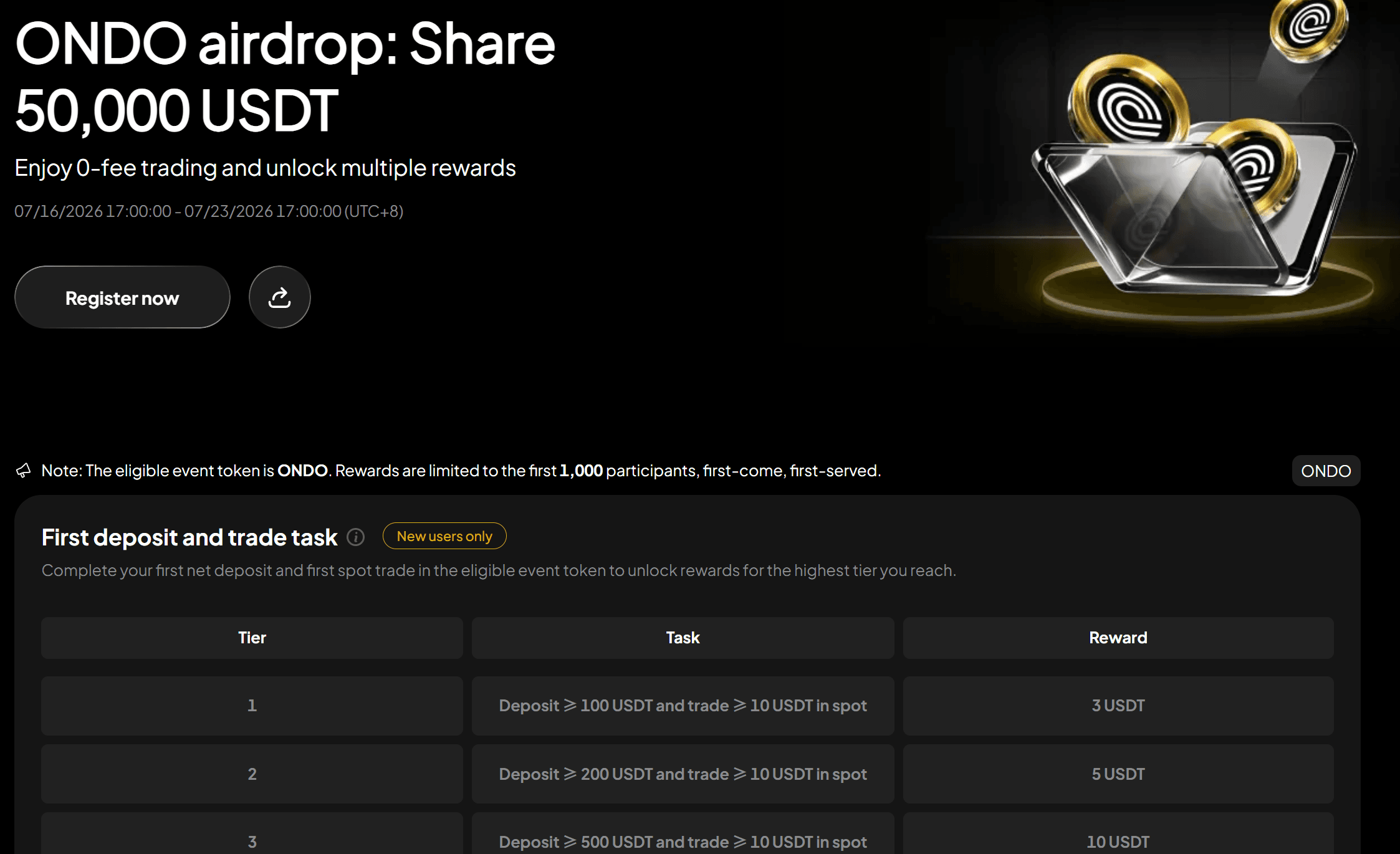
Claim ONDO Airdrop Rewards: Complete Tasks and Share 50,000 USDT
Claim ONDO Airdrop rewards on WEEX and share 50,000 USDT. Learn how to join, complete trading tasks, earn bonuses, and trade ONDO/USDT during the event.
Japan's Crypto Regulation Basics: The FSA, JVCEA, and User Protections
How Overseas Crypto Exchanges Work for Japan Residents (and the Risks)
Modelo 721 Explained: Declaring Foreign Crypto Holdings in Spain
DEX vs CEX for Perpetuals: Trading Perps On-Chain vs on an Exchange
What Is an On-Chain Order Book? How Order-Book DEXs Work
What Is a Perp DEX? Perpetual Futures on Decentralized Exchanges
Italy Crypto Tax 2026: The Capital Gains Rate Rises to 33%
Support and Resistance: How to Identify Key Levels on the Chart
Supply and Demand Zones: A Smart-Money Trading Guide
Price Action Trading: Reading Raw Market Behavior
Head and Shoulders Pattern: How to Spot and Trade It
Classic Chart Patterns: Triangles, Double Tops/Bottoms and Flags
Airdrop Farming: How to Farm Crypto Airdrops the Right Way
What Is a Moving Average (MA)? Types and How to Read Them
Crypto Exchange Comparison for Germany (2026): Fees, Products, and How to Choose
Crypto Apps Compared for Germany (2026): Features, Demo Mode and Security — What to Check Before You Download
Crypto Platform Comparison for France (2026): Fees, Products, and How to Choose
Crypto Apps Compared for France (2026): Features, Demo Mode and Security — What to Check Before You Download
NVIDIA (NVDA) Earnings Date: When Q2 FY2027 Reports and What to Watch
Is WEEX Safe? A Facts-First Look at WEEX's Reserves, Security, and Regulatory Status in Japan