
How to Withdraw From Bybit After the Japan Service Shutdown: Step-by-Step and a Deadline Checklist

 Prefer us on Google


With Bybit ending services for Japanese residents, the practical task for an affected account holder is straightforward to state and easy to get wrong in the details: get your crypto out cleanly, without sending it to the wrong network or missing a step. This page is a step-by-step walkthrough of the withdrawal flow, the fees and limits to expect, the mistakes that most often cause a failed or lost withdrawal, and a checklist to run before the deadline. It is general information, not financial advice.
Where withdrawals sit in the timeline
Two dates from the wind-down shape how you should think about withdrawing:
- From March 23, 2026 (Close-Only mode): trading is off. Your account can only use Convert (crypto-to-crypto, into BTC, ETH, or USDC only) and crypto withdrawals. From this point, the account is effectively exit-only.
- July 22, 2026, 12:00 JST (forced liquidation): any still-open derivative positions are force-closed. Importantly, Bybit's notice says Convert and crypto withdrawals remain available after this date, and no final withdraw-by deadline has been published.
So withdrawals are not cut off on July 22. The reason to move early is not that your crypto vanishes that day — it does not — but that (a) an open position left to July 22 is force-closed at a price and time you do not control, and (b) it is not prudent to leave assets on a service that is winding down. Treat the withdrawal as something to complete on your own schedule, sooner rather than later.
Before-the-deadline checklist
- ☐ Note whether you hold any open derivative positions. Decide whether to close them yourself (on your terms) before July 22 rather than let them be force-closed.
- ☐ Confirm your identity verification is complete — withdrawals generally require a verified account.
- ☐ Check that two-factor authentication (2FA) works and you can access your email and authenticator.
- ☐ Prepare your destination in advance (see "Where your funds can go" below) and have its deposit address ready.
- ☐ Confirm the network (chain) your destination supports for each coin.
- ☐ Set up address whitelisting early — some security changes trigger a temporary hold, so do this before you are in a hurry.
- ☐ Leave enough balance to cover the network withdrawal fee and clear the minimum withdrawal amount.
- ☐ Do a small test withdrawal first if you are moving a large balance.
Step-by-step: withdrawing your crypto
The exact screens can change, so treat this as the shape of the flow and confirm each field in the app. Bybit's own Help Center is the authoritative source for the current steps.
1. Consolidate what you cannot withdraw directly
In Close-Only mode, Convert is limited to BTC, ETH, and USDC. If you hold smaller tokens, you may need to convert them into one of those three before withdrawing. Close any open derivative positions you want to control the exit on.
2. Decide the destination first
Know where the crypto is going before you start: a domestic FSA-registered exchange account, a self-custody wallet you control, or another destination you have vetted. Have the receiving deposit address in hand.
3. Whitelist the destination address
Address whitelisting (an allow-list of pre-approved withdrawal addresses) is a security feature. Add and confirm your destination address ahead of time. Adding a new address or changing security settings can trigger a temporary withdrawal hold, so do this early rather than at the last minute.
4. Choose the correct network (chain) — the single biggest risk
When you withdraw a coin, you select the network it travels on (for example, an ERC-20 token can move over different chains). The sending network must match what the receiving wallet or exchange supports. Sending to an address on the wrong network is the most common way people permanently lose crypto in a withdrawal, and it is usually unrecoverable. Verify the network on both sides before confirming.
5. Enter the amount — mind fees and minimums
Each coin/network has a network withdrawal fee and a minimum withdrawal amount. The fee is deducted from what you send, so you need enough balance to cover both the amount and the fee. If you want to empty the balance, account for the fee in your figure.
6. Confirm with 2FA and verification
Confirm the withdrawal with your security factors (2FA code, email/SMS confirmation as prompted). Then check the transaction on a block explorer using the transaction ID to confirm it arrived.
Fees and minimums
Bybit charges a network withdrawal fee that varies by coin and by network, and each asset has a minimum withdrawal amount. Exact figures change over time and differ per chain, so read the amounts shown on the withdrawal screen and in Bybit's fee schedule rather than relying on a number quoted elsewhere. As a rule of thumb, consolidating into a coin/network with a lower fee before withdrawing can reduce total cost, but never let fee optimization push you onto a network your destination does not support.
Common failure modes
| What goes wrong | Why | How to avoid it |
|---|---|---|
| Funds sent, never arrive | Wrong network selected; destination does not support that chain | Match the network on both sides; do a small test first |
| Withdrawal blocked temporarily | Recent security change (new address, password/2FA change) triggered a hold | Make security changes and whitelist addresses well in advance |
| "Amount too low" error | Below the minimum withdrawal amount, or balance can't cover the fee | Check the minimum and leave headroom for the fee |
| Can't withdraw a small token | In Close-Only mode, direct trading is off | Use Convert into BTC/ETH/USDC first, then withdraw |
| Account can't withdraw at all | Verification incomplete | Complete identity verification before you need to withdraw |
If your withdrawal won't go through
When a Bybit withdrawal won't process, it is almost always one of the causes above. Check them in roughly this order:
- Verification not complete. Withdrawals generally require a verified account — check your verification status first.
- Temporary hold after a security change. Recently changing your password, 2FA, or withdrawal address can lock withdrawals for a period. Wait it out, or make such changes well in advance next time.
- Below the minimum, or balance can't cover the fee. You need enough to cover the amount plus the network fee.
- Address not whitelisted. If whitelisting is enabled, you can only send to pre-approved addresses.
- A small token with no direct exit. In Close-Only mode, direct trading is off — Convert into BTC/ETH/USDC first, then withdraw.
- Network congestion or maintenance. Withdrawals on a specific chain can be paused temporarily; wait, or use another supported chain — always matching the destination's supported network.
If it still won't process, read the on-screen error message and Bybit's Help Center — the error text usually names the cause.
Where your funds can go
Once your crypto is off the platform, a former Bybit Japan user factually has a few destinations. Stated neutrally, as categories rather than recommendations:
- A domestic, FSA-registered crypto-asset exchange. Operators registered with Japan's Financial Services Agency under the Payment Services Act appear in the FSA's public register (searchable at search.fsa.go.jp). This is the regulated domestic route.
- A self-custody wallet that you control directly.
- Another overseas venue. These exist, but note that many operators serving Japanese residents do so without FSA registration. The FSA publishes a public warning list of unregistered crypto-asset exchange operators and cautions that dealing with unregistered operators carries higher risk because the authorities cannot verify that customer-protection safeguards are in place. Check any venue against that list before moving funds to it.
Primary sources
- Bybit official announcement — "Service Changes for Japanese Residents" (timeline, Close-Only and post-July-22 withdrawal availability)
- Bybit Help Center — current withdrawal steps, supported networks, and fee schedule (confirm in-app)
- FSA — register of licensed operators (search.fsa.go.jp) and warning on unregistered operators (fsa.go.jp/ordinary/chuui/highrisk.html)
This is general information about withdrawing during a service wind-down, not financial advice. Withdrawal steps, fees, minimums, and hold rules are set by Bybit and can change — always confirm against Bybit's own Help Center and the figures shown on the withdrawal screen.
Disclaimer: This content is provided for general branding and informational purposes only and doesn't constitute financial, investment, legal, or tax advice. Any events, rewards, online events, or related information mentioned herein should not be considered a recommendation, solicitation, or invitation to purchase, sell, trade, or otherwise deal in any crypto assets or to use any services. Crypto assets are highly volatile and may result in loss. WEEX services and online events may not be available in all regions and are subject to applicable laws, regulations, and eligibility requirements. You are responsible for ensuring that your use of WEEX services complies with local laws and for carefully assessing the risks before participating in any crypto-related activities.
You may also like
Is WEEX Safe? A Facts-First Look at WEEX's Reserves, Security, and Regulatory Status in Japan
When an Overseas Exchange Ends Its Japan Service: The Typical Sequence and What Users Should Check
Bybit Japan Service Termination: The Complete Timeline and What Happens on July 22, 2026

The Tax Consequences of a Forced Liquidation for Japanese Crypto Traders
After Bybit's Japan Shutdown: A Neutral Map of Where Your Funds Can Go
Gold Price Outlook 2026: Third-Party Analyst Scenarios (Maintained, Educational)
Silver Price Outlook 2026: Third-Party Analyst Scenarios (Maintained, Educational)
How to Buy Bitcoin in Brazil: A Step by Step Guide for Beginners
Dolar Crypto in Argentina: How to Use Stablecoins for Dollar Exposure and Buy Bitcoin
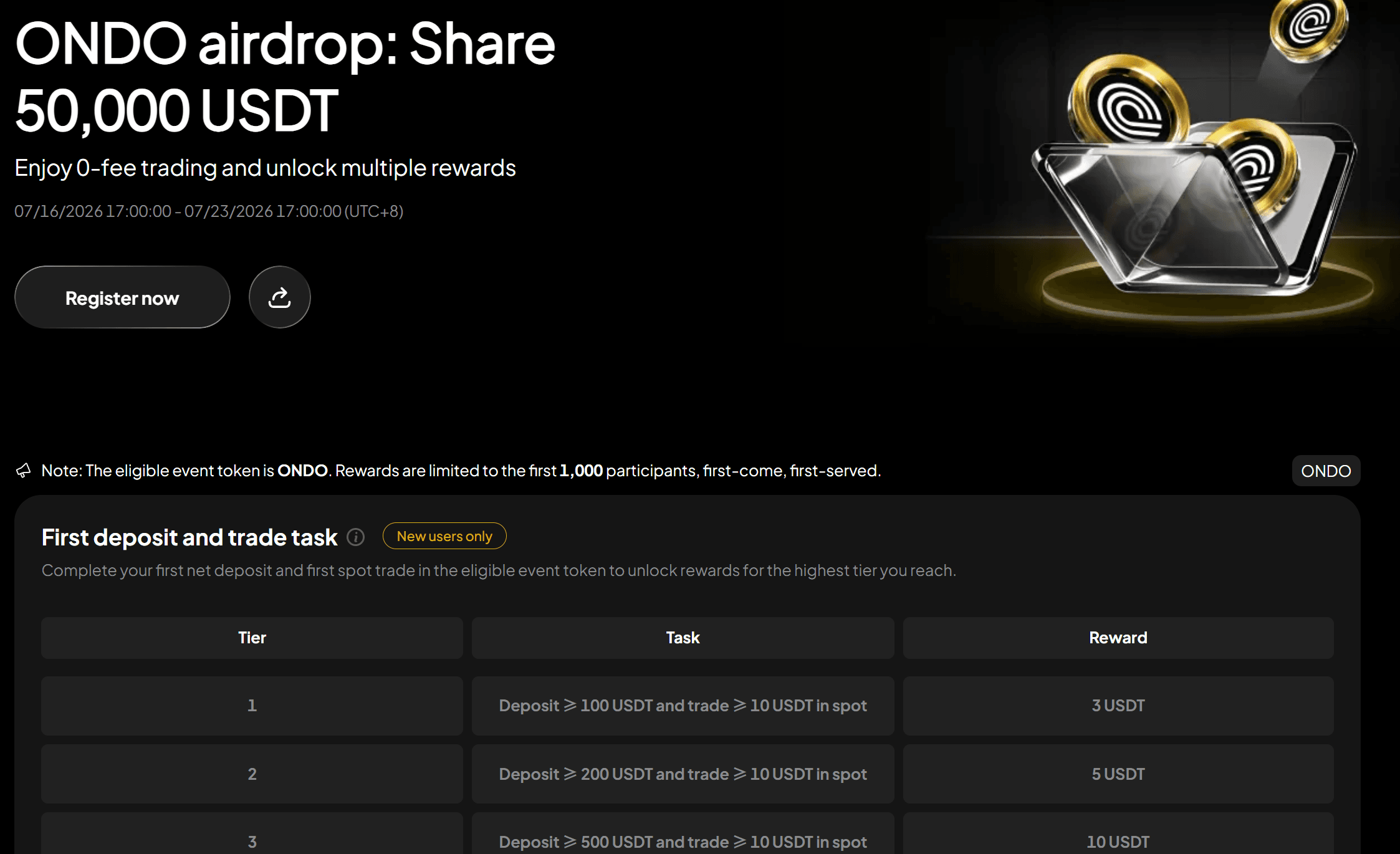
Claim ONDO Airdrop Rewards: Complete Tasks and Share 50,000 USDT
Claim ONDO Airdrop rewards on WEEX and share 50,000 USDT. Learn how to join, complete trading tasks, earn bonuses, and trade ONDO/USDT during the event.
Japan's Crypto Regulation Basics: The FSA, JVCEA, and User Protections
How Overseas Crypto Exchanges Work for Japan Residents (and the Risks)
Modelo 721 Explained: Declaring Foreign Crypto Holdings in Spain
DEX vs CEX for Perpetuals: Trading Perps On-Chain vs on an Exchange
What Is an On-Chain Order Book? How Order-Book DEXs Work
What Is a Perp DEX? Perpetual Futures on Decentralized Exchanges
Italy Crypto Tax 2026: The Capital Gains Rate Rises to 33%
Support and Resistance: How to Identify Key Levels on the Chart
Supply and Demand Zones: A Smart-Money Trading Guide
Price Action Trading: Reading Raw Market Behavior
Head and Shoulders Pattern: How to Spot and Trade It

Classic Chart Patterns: Triangles, Double Tops/Bottoms and Flags
Airdrop Farming: How to Farm Crypto Airdrops the Right Way
What Is a Moving Average (MA)? Types and How to Read Them
What Is Elliott Wave Theory? A Beginner's Guide to Counting Waves
What Is Fibonacci Retracement? How to Draw and Use It
What Is the Ichimoku Cloud? A Beginner's Guide to Reading It
What Is the VIX (Fear Index)? How to Read It and Its Link to Crypto
What Is Dow Theory? The Six Principles Explained
What Is a Death Cross? Understanding the Bearish Signal
Is WEEX Safe? A Facts-First Look at WEEX's Reserves, Security, and Regulatory Status in Japan
When an Overseas Exchange Ends Its Japan Service: The Typical Sequence and What Users Should Check
Bybit Japan Service Termination: The Complete Timeline and What Happens on July 22, 2026
The Tax Consequences of a Forced Liquidation for Japanese Crypto Traders
After Bybit's Japan Shutdown: A Neutral Map of Where Your Funds Can Go
Gold Price Outlook 2026: Third-Party Analyst Scenarios (Maintained, Educational)
Contents
Latest articles




Latest coin listings on WEEX


