
Etherscan's Surcharge Scandal Exposes Ethereum Ecosystem's Data Dependency Dilemma

 Prefer us on Google


Original Article Title: "Etherscan Cancels Several Free APIs, Revealing Unforeseen Issues"
Original Article Author: Eric, Foresight News
On November 23, Lefteris Karapetsas, the founder of the open-source portfolio tracker Rotki, took to Twitter to complain about Etherscan. He mentioned that during Devcon, Etherscan suddenly announced that they would no longer provide free APIs for the Avalanche C-Chain, Base, BNB Chain, and OP Mainnet block explorers.
While he understood the pressure of providing free services, he questioned why there was no advance notice or why such a decision was made during a major event when everyone was away, leading to a "sudden attack" without any time to react.
According to Etherscan's announcement, as the chain's performance gradually improved, the data volume also increased significantly, leading to a substantial rise in costs. In this situation, they could no longer afford to provide all APIs for free and had to reluctantly convert some previously free APIs into paid versions.
It is evident that the decision to no longer offer free APIs for specific chains was likely due to insufficient funding or resource support.
Finally, the founder expressed some confusion, questioning why, apart from Avalanche, Base, OP Mainnet, and BNB Chain did not have enough money to support such critical services.
However, opposing voices quickly emerged, with the founder of Routescan and operator of the Avalanche block explorer Snowtrace, Jack, at the forefront. Jack provided some industry-insider data:
· Etherscan charges supported chains approximately between $1.5 million to $2 million annually, with some as low as around $300,000, but providing only basic data;
· For chains that are already paying, Etherscan only provides a free API with 5 RPS (Requests Per Second), and for additional requests, the monthly subscription fee can go up to $899.
· Last month, the independent visitor numbers of various chain explorers on Etherscan were as follows: OP Mainnet, 102k; BNB Chain, 2.5M; Base, 1M; HyperEVM, 30k; Avalanche, 16k. Etherscan itself had 4M visitors.
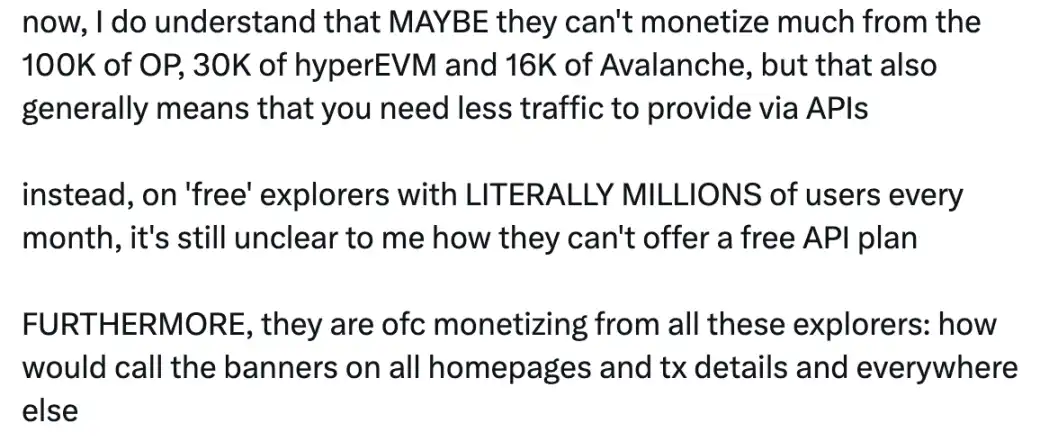
The CEO's implicit meaning is: Charging for a small number of APIs is indeed due to financial constraints, not because we find the income insignificant. For some chains that don't pay us, we have offered free service for a while and have done our utmost. Let's stop arguing about this and move on.
There isn't much to say about the discussion on this issue; it's simply a matter of some people thinking Etherscan is too greedy, while others view it as justifiable business behavior. However, some discussions arising from this event are quite interesting.
First of all, it was through this incident that the author learned about an ecosystem alliance called VERA, which promotes convenient, standardized, and open access to EVM smart contract source code, as well as the Open Labels Initiative, which drives the standardization framework and data model for EVM address labels. The fundamental goal of both organizations is to support the accessibility of blockchain data, especially validation.
The Open Labels Initiative retweeted Lefteris Karapetsas's complaint tweet, stating that over the past year, they have been working to prevent incidents like this caused by overreliance on centralized on-chain data providers. They believe that such critical infrastructure should not be monopolized but rather co-developed.
Entities such as sourcefify.eth for verifying Ethereum contract code, the Ethereum data visualization platform growthepie, the open-source block explorer Blockscout, and the previously mentioned Routescan are all contributing to the readability and accessibility of Ethereum data.
According to Akshat Mittal, a DeFi engineer at Reserve Protocol, Etherscan has not been involved in these initiatives. Is it for commercial gain? No one knows, but even if it is, it's understandable. The Ethereum ecosystem will always have individuals who adhere to open-source culture and reject excessive commercialization, which is not a matter of right or wrong but rather showcases the diversity of the ecosystem. Profit-driven institutions can ensure service quality, while open-source products will still have their place.
Furthermore, there has been recent effusive praise by IC's zCloak Network founder 0xFrancis, once again comparing IC to Ethereum.
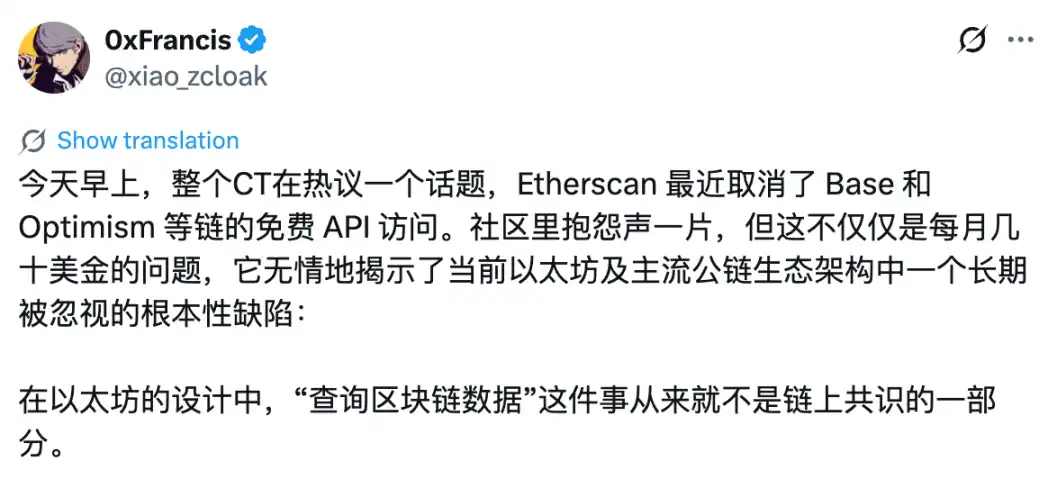
0xFrancis argues that Ethereum does not include "querying block data" as part of its consensus, so DApp development must rely on third-party RPC services. If RPC nodes collectively go offline, the chain will still run but become "unreadable."
Going deeper, if centralized RPC nodes or websites like Etherscan provide false data, they can easily deceive users. The Internet Computer (IC) incorporates querying as part of its protocol. When someone initiates a query, the request is executed through the ICP node network and returns cryptographically authenticated data to ensure its accuracy.
0xFrancis's point is not unfounded. This can be seen as a case of IC being too forward-thinking, with the Etherscan fee controversy being a typical debate about centralization versus decentralization. However, could it be that Ethereum's imperfections and the need for commercialized components have actually contributed to the ecosystem's prosperity?
Disclaimer: This content is provided for general branding and informational purposes only and doesn't constitute financial, investment, legal, or tax advice. Any events, rewards, online events, or related information mentioned herein should not be considered a recommendation, solicitation, or invitation to purchase, sell, trade, or otherwise deal in any crypto assets or to use any services. Crypto assets are highly volatile and may result in loss. WEEX services and online events may not be available in all regions and are subject to applicable laws, regulations, and eligibility requirements. You are responsible for ensuring that your use of WEEX services complies with local laws and for carefully assessing the risks before participating in any crypto-related activities.
You may also like
![[JJ Column] The Reason for Revisiting the Unsettling Books Written by Engels... The Political Economy of the AI Transition](/public-static/22_d448f7b258.png?format=avif)
[JJ Column] The Reason for Revisiting the Unsettling Books Written by Engels... The Political Economy of the AI Transition

Valuation Doubles to $1.2 Billion in Six Months as Flex Targets Stablecoin + AI Integration

Russia Cuts Off Oxygen for Cryptocurrencies. Banks to Get Powerful Weapon to Block Accounts

SBI Bets on RWA! Partners with Ondo to Promote Tokenization of Japanese Stocks and Introduce Yen Stablecoin Settlement

What is the funding rate? Trading Minute
Solana Surpasses 3 Trillion Won, Leading the Tokenized Securities Market
Project Eleven Develops Technology to Prove Bitcoin Ownership After Quantum Threat Becomes Reality
Grayscale Introduces Quarterly Cash Distribution for Solana ETF Staking Rewards

This Week's Highlights: South Korea Tightens Regulations on Single Stock Leveraged ETFs; US Inflation Cools; US-Iran Conflict Escalates
New Tool Aims to Improve Energy Efficiency in Bitcoin Mining

Who Will Become Pump.fun on the Robinhood Chain?
Uweb In-Depth Report: Global AIDC Transformation Cycle and Valuation Reconstruction Logic of Listed Companies

Bitcoin Leaves Extreme Fear Behind After Months of Pessimism

Ripple wins EU-wide access as ESMA adds it to MiCA register
![[New York Gold, Bonds, Dollar] Dollar and Gold Rise Amid Middle East Tensions... 10-Year Bonds Decline](/public-static/37_d544230b33.png?format=avif)
[New York Gold, Bonds, Dollar] Dollar and Gold Rise Amid Middle East Tensions... 10-Year Bonds Decline

Augur returns with decentralized layer for disputed prediction markets
Anthropic turns to Meta for $10B in computing power before IPO

CryptoQuant says Strategy still needs disciplined bitcoin buying and selling framework
Giant from Wall Street Bets on Altcoins. The First Actively Managed Crypto ETF Chooses These Tokens
Bitcoin Among the 10% Most Discounted in History: Is It Time to Buy?
UnitedHealth Surprises Wall Street and Signals Turnaround

Cardano Tests Support As ADA Traders Look For A Better Catalyst
Chainlink Holds Support As CCIP Adoption Becomes A Longer-Term Test
Solana Tests $77 Support As Risk-Off Pressure Spreads Across Layer 1s
XRP Stalls Below Resistance As Traders Wait For Regulatory Relief To Turn Into Demand
Ethereum Weakens As ETF Optimism Runs Into A Cooler Policy Backdrop
SEC Pushes Ahead with Plan to Eliminate Quarterly Earnings Reports Despite 200,000 Opposition Comments
"AI should not be the solo of one country": Xi Jinping mobilizes the Global South against American restrictions

Summer Vacation Season Sees Continued Gasoline Supply Crisis and Price Surge in the U.S.
Stripe and Swift race to control the next generation of global payments infrastructure
[JJ Column] The Reason for Revisiting the Unsettling Books Written by Engels... The Political Economy of the AI Transition
Valuation Doubles to $1.2 Billion in Six Months as Flex Targets Stablecoin + AI Integration
Russia Cuts Off Oxygen for Cryptocurrencies. Banks to Get Powerful Weapon to Block Accounts
SBI Bets on RWA! Partners with Ondo to Promote Tokenization of Japanese Stocks and Introduce Yen Stablecoin Settlement
What is the funding rate? Trading Minute
Solana Surpasses 3 Trillion Won, Leading the Tokenized Securities Market
Contents
Latest articles






Latest coin listings on WEEX


