Solana After the Mega-Hack: Is the Ecosystem Stable or Is a Domino Effect Looming?

TL;DR: Summary for Quick Readers
On April 1, 2026, the Solana DeFi project Drift Protocol fell victim to a hack in which approximately $285 million was stolen. The attackers did not exploit a vulnerability in the Solana blockchain itself, but rather compromised the protocol's governance through social engineering and the Solana "Durable Nonce" function. Despite a massive drop in TVL within the DeFi sector, the Solana ecosystem remains structurally stable, though it is responding with new system-wide security standards such as STRIDE and SIRN.
Key Takeaways
- Damage Amount and Target: On April 1, 2026, approximately $285 million was stolen in the hack of the derivatives DEX Drift Protocol – the largest native Solana DeFi exploit to date.
- No Blockchain Error: The Solana infrastructure (Layer-1) remained intact. The attack exploited governance weaknesses (a 2-of-5 multisig without a timelock), social engineering, and the Solana "Durable Nonce" function.
- Market Reaction: The Total Value Locked (TVL) of Drift halved almost immediately, and the entire Solana DeFi ecosystem lost nearly $1 billion in liquidity in the short term. The SOL price declined only by a single-digit percentage.
- New Security Standards: As a direct response to the incident, the Solana Foundation launched the security programs STRIDE and SIRN for the continuous monitoring of system-relevant protocols and for emergency coordination.
- No Global Domino Effect: A collapse of the entire Solana blockchain is unlikely. History and current on-chain data show a structurally growing ecosystem, even if local domino effects remain a real risk for individual DeFi protocols.
What Happened During the Solana Mega-Hack?
On April 1, 2026, the Solana ecosystem experienced one of the largest security incidents in its history. The Drift Protocol, the leading decentralized derivatives exchange (DEX) on Solana, lost crypto assets worth approximately $285 million within just 12 minutes. The stolen assets included USDC, SOL, and various Bitcoin and Ethereum derivatives.
This incident, quickly dubbed the "Solana Mega-Hack" in crypto media, sent shockwaves through the market. The Total Value Locked (TVL) of Drift halved almost instantly from around $550 million to under $300 million. The SOL token price also saw a short-term decline in the single-digit percentage range.

How Was the Drift Protocol Hacked?
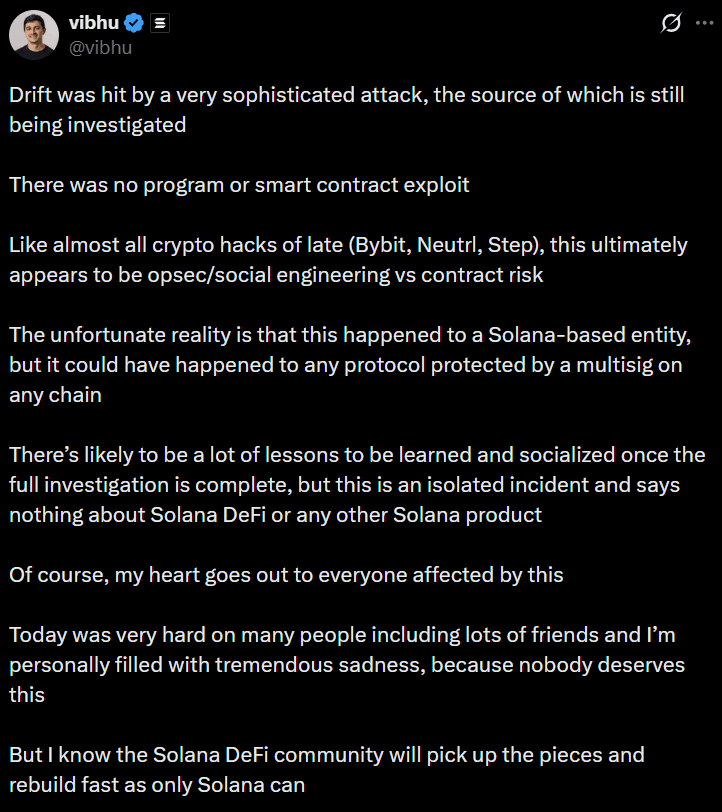
Important for investors' risk assessment: The hack was not an error in the Layer-1 code of Solana. The blockchain continued to function flawlessly. According to forensic analyses by security firms like BlockSec, the attack was based on a failure of protocol governance.
The attack vector consisted of three elementary steps:
- Social Engineering: The presumably professional attackers gained the trust of the administrators of the Drift Security Council.
- Multisig Weakness: Drift used a 2-of-5 multisig procedure without a mandatory time delay (timelock). Thus, two compromised signatures were sufficient to carry out far-reaching changes.
- Exploitation of Durable Nonce: The attackers had the administrators sign seemingly harmless transactions in advance. Using the Solana-specific Durable Nonce function, these signatures were stored and later executed simultaneously.
This allowed the hackers to deposit manipulated tokens as collateral and withdraw real assets from the vaults.
Is a Domino Effect Now Threatening the Solana Ecosystem?
The concern about a domino effect in the tightly interconnected DeFi (Decentralized Finance) sector is justified, as protocols often share liquidity with one another. However, current on-chain data and historical comparisons show a nuanced picture.
The Short-Term Consequences: Local Domino Effects
Immediately after the hack, the entire Solana DeFi ecosystem temporarily lost nearly $1 billion in TVL. Users withdrew capital preventively for fear of further vulnerabilities. In similar incidents in the past, smaller protocols that depended on the liquidity of the hacked platforms had to cease operations.
The Long-Term Forecast: Structural Stability
Despite the shock, Solana is not facing a total collapse. History proves this resilience: the network already weathered the Wormhole hack ($326 million) and the Mango Markets exploit ($116 million) in 2022. Current ecosystem reports show that metrics such as active developers, newly launched dApps, and transaction volumes continue to show a clear upward trend. Solana remains one of the most well-capitalized DeFi chains worldwide.
Solana's Response: The Security Programs STRIDE and SIRN
To regain the trust of institutional and private investors, the Solana Foundation immediately launched two new, cross-system security initiatives:
- STRIDE (Solana DeFi Trust and Resilience Infrastructure): A program for the continuous monitoring of system-relevant DeFi protocols (TVL over $10 million) and for promoting formal code verifications.
- SIRN (Solana Incident Response Network): A global emergency network of cybersecurity experts that responds in a coordinated manner to future attacks to stop hacks and freeze funds via exchanges and bridges.
Conclusion: Lessons for Crypto Investors
The Drift hack marks a turning point for Solana. It proves that the scalability of the technology does not protect against the risks of human error and weak governance. A global domino effect that endangers Solana as a whole remains unlikely. Nevertheless, DeFi users must rethink: those seeking yield on Solana must in the future check metrics such as multisig procedures, the existence of timelocks, and external audits just as strictly as the code itself.
FAQ Regarding the Solana Mega-Hack
Was the Solana blockchain itself affected by the hack? No. The Solana infrastructure (Layer-1) showed no errors and continued to run without interruption. The hack utilized organizational vulnerabilities and social engineering within the third-party protocol Drift.
What is a Durable Nonce on Solana? A Durable Nonce is a legitimate function of the Solana blockchain that allows transactions to be pre-signed and executed at a later, unspecified time. Hackers abused this feature to use obtained administrator rights with a time delay for the theft.
Is my money on Solana still safe? Assets held in cold wallets (hardware wallets) on the Solana blockchain are safe. Risks exist primarily when funds are deposited in DeFi smart contracts (such as liquidity pools or lending protocols), as protocol risks apply here.
WEEX | Rising Star of Crypto Exchanges in the DACH Region
WEEX combines security, innovation, and community with features for beginners and pros:
Security & Protection
- 1,000 BTC Protection Fund: Self-funded reserve for rapid loss protection in exceptional cases
Trading & Earning
- Auto Earn: Daily automatic USDT earnings without effort
- Copy Trading: Follow elite traders automatically or apply as an elite trader for additional benefits
- WE-Launch: Early access to new projects – exclusive for WEEX users
Benefits & Rewards
- Promotions & Rewards: Trading competitions and special bonuses for active users
- Affiliate Program: Lifetime commissions from new users – details here
- VIP Benefits: Lowest fees, market insights, and personal support for high-volume traders
- WXT Token: Fee discounts, airdrops, and exclusive platform benefits
Discover current trends on WEEX Spot and start now: Register now
Disclaimer – Legal Notice from WEEX Exchange
WEEX and its affiliates offer services for the exchange of digital assets, including derivatives and margin trading, only where legal and to eligible users. All content is general information, not financial advice – seek independent advice before trading. Trading cryptocurrencies involves high risk and can lead to a total loss. By using WEEX services, you accept all associated risks and terms. Never invest more than you can afford to lose. Further information can be found in our Terms of Use and in the Risk Disclosure.
Follow WEEX on social media:
X: @WEEX_Official
Instagram: @WEEX Exchange
TikTok: @weex_global
YouTube: @WEEX_official
Discord: WEEX Community
Telegram: WeexGlobal Group