RWA vs. Memecoins: Web3 Future or Just Hype?

TL;DR
The crypto market is currently dominated by two opposing narratives: Real-World Assets (RWA) and Memecoins. While RWA drive the tokenization of traditional financial assets (real estate, government bonds) and attract massive institutional capital (forecasts up to 30 trillion USD by 2030), memecoins dominate the short-term trading volume of retail investors. RWA offer fundamental intrinsic value and regulatory security, whereas memecoins are based on community hype and carry an extreme risk of total loss.
Key Takeaways
- Structural Contrast: Real-World Assets (RWA) tokenize real assets (real estate, bonds) with intrinsic value, while memecoins are driven by community hype as a purely speculative asset class.
- Institutional Potential (RWA): The market for tokenized assets is attracting massive Wall Street capital. Analysts forecast market growth to 16 to 30 trillion US dollars by the year 2030.
- Extreme Risks (Memecoins): Despite potentially immense short-term returns, experts and regulators warn of the risk of total loss due to market manipulation and so-called rug pulls.
- Regulatory Framework: The European MiCA regulation creates clear legal frameworks for RWA infrastructure while simultaneously taking stricter action against the misleading marketing of memecoins.
- Symbiosis in Web3: Memecoins currently act as a high-volume onboarding tool for decentralized exchanges (DEX), while RWA build the long-term, sustainable financial foundation of the crypto ecosystem.
What are Real-World Assets (RWA) in the crypto sector?
Real-World Assets (RWA) refer to the tokenization of traditional, physical, or financial assets on a blockchain. Through this process, previously illiquid asset classes such as real estate, government bonds (Treasuries), or private credit are converted into digital tokens.
RWA tokenization solves central problems of traditional finance (TradFi):
- Fractional Ownership: Expensive assets are divided into small units.
- Liquidity: Tradability around the clock (24/7) without classic intermediaries.
- DeFi Integration: Tokenized assets can be used as collateral for loans in Decentralized Finance (DeFi).
Leading protocols such as MakerDAO, Ondo Finance, and Centrifuge have already proven how real-world loans can be mapped on-chain. The institutional breakthrough is evident, among other things, through crypto initiatives by major players like BlackRock and the integration of blockchain infrastructure by Wall Street actors.

What are memecoins and how do they work?
Memecoins are cryptocurrencies based primarily on internet culture, memes, and viral social media trends. Unlike RWA or established Layer-1 blockchains like Ethereum, they generally possess no fundamental underlying value or technological use case.
The dynamics of memecoins are determined by:
- Community Hype: The price scales exclusively through attention and subsequent buyers.
- High Volatility: Memecoins often record four- to five-digit percentage growth rates in the short term, but crash just as quickly.
- Systemic Risks: Traditional financial institutions as well as blockchain analysts warn of extreme dangers due to market manipulation such as pump-and-dump schemes or smart-contract exploits (rug pulls).
Well-known examples are Dogecoin (DOGE) and Shiba Inu (SHIB), which reached historical billion-dollar valuations but are still classified by experts as a highly speculative asset class without intrinsic value.
RWA vs. Memecoins: Data, facts, and forecasts 2024–2030
To clarify the structural differences, a direct comparison of data and facts for both narratives is helpful:
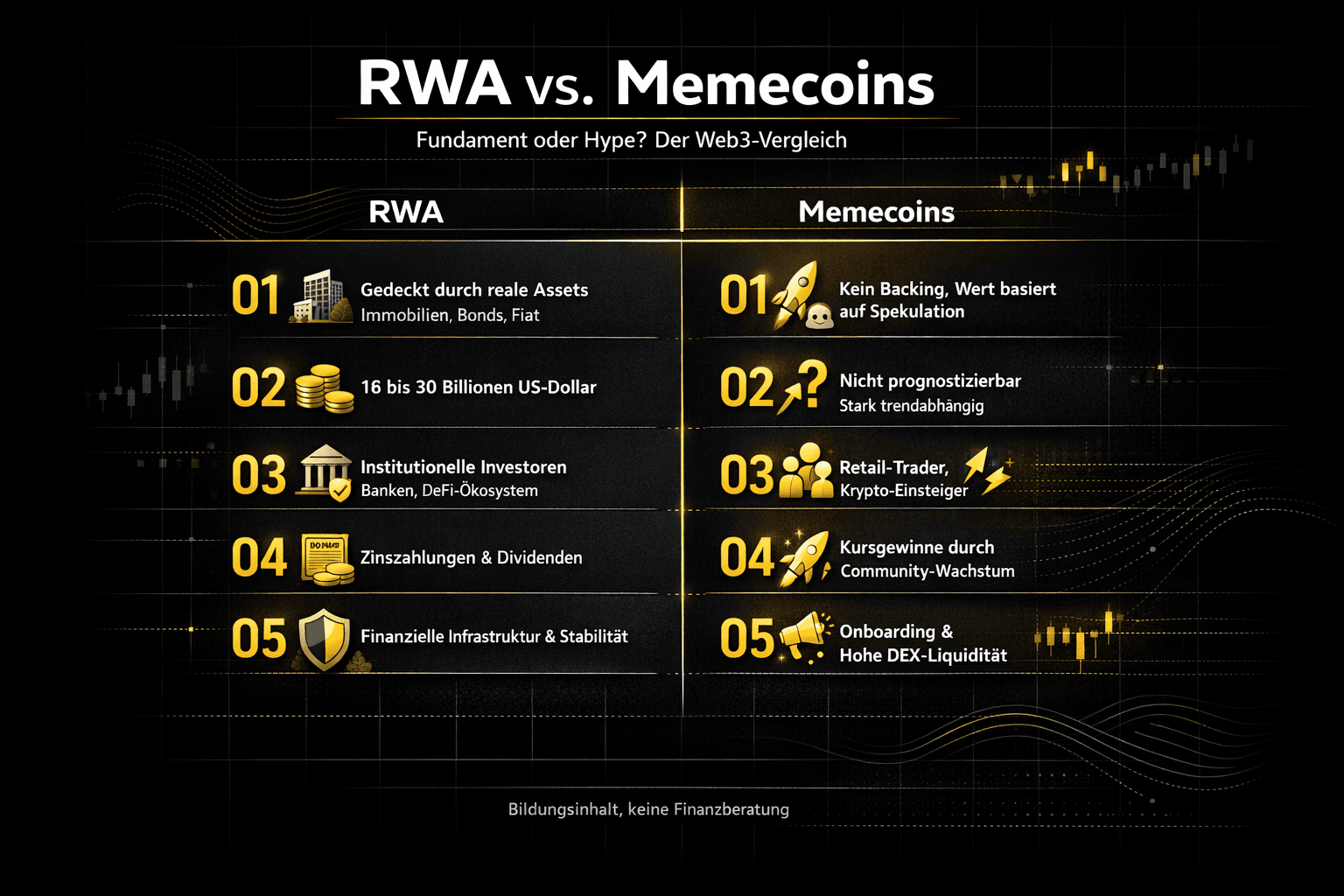
Data platforms that analyze the on-chain volume of tokenized assets confirm steady institutional capital growth in the RWA sector. In contrast, memecoins recorded a market capitalization of over 140 billion US dollars at times during peak phases in 2024, driven by massive retail speculation.
Regulation: MiCA regulation and investor protection
A decisive factor for the future of both sectors is the regulatory classification, especially in Europe.
For RWA, the regulatory focus is on securities regulation (Security Token Offerings). Issuers must comply with strict KYC (Know Your Customer) and AML (Anti-Money Laundering) guidelines. This creates legal certainty for institutional capital.
For memecoins, authorities are focusing on investor protection. The European Securities and Markets Authority (ESMA) has published an explicit warning regarding speculative crypto-assets. Under the European MiCA regulation (Markets in Crypto-Assets), market manipulation and misleading marketing on social media will be pursued much more strictly in the future, which could significantly restrict the business model of many memecoin promoters.
Conclusion: Who will dominate the Web3 future?
Memecoins and RWA serve two completely different market needs. Memecoins act as a high-octane onboarding tool: they generate traffic, bind users to decentralized exchanges (DEX), and create short-term liquidity. They are the hype of Web3.
Real-World Assets (RWA), on the other hand, are building the future. They bridge the gap between the traditional financial system and blockchain technology. With a projected market volume in the trillion-dollar range and the active participation of Wall Street actors, RWA are establishing the sustainable infrastructure for the finance of tomorrow.
FAQ: Frequently asked questions about RWA and memecoins
What is the difference between RWA and memecoins? RWA (Real-World Assets) are blockchain tokens that represent physical or financial assets with real cash flow. Memecoins are speculative tokens without intrinsic value that are based on internet trends and community engagement.
What risk do memecoins have? Memecoins are subject to extreme volatility and carry a high risk of total loss. Common dangers include pump-and-dump schemes, lack of liquidity, and so-called rug pulls (fraud by developers).
Why are banks investing in Real-World Assets? Institutional investors use tokenization to reduce transaction costs, reduce settlement times to seconds, and make previously illiquid markets globally tradable.
Are memecoins legal in Europe? Yes, trading is legal. However, they are increasingly falling under the investor protection of the European MiCA regulation, which provides strict rules against market manipulation and misleading advertising.
WEEX | Rising star of crypto exchanges in the DACH region
WEEX combines security, innovation, and community with features for beginners and professionals:
Security & Protection
- 1,000 BTC Protection Fund: Self-funded reserve for rapid loss protection in exceptional cases
Trading & Earning
- Auto Earn: Daily automatic USDT earnings without effort
- Copy Trading: Follow elite traders automatically or apply as an elite trader for additional benefits
- WE-Launch: Early access to new projects – exclusive for WEEX users
Benefits & Rewards
- Promotions & Rewards: Trading competitions and special bonuses for active users
- Affiliate Program: Lifetime commissions from new users – details here
- VIP Benefits: Lowest fees, market insights, and personal support for high-volume traders
- WXT Token: Fee discounts, airdrops, and exclusive platform benefits
Discover current trends on WEEX Spot and get started now: Register now
Disclaimer – Legal notice from WEEX exchange
WEEX and its affiliates offer services for the exchange of digital assets, including derivatives and margin trading, only where legal and for eligible users. All content is general information, not financial advice – seek independent advice before trading. Trading cryptocurrencies is associated with high risk and can lead to a total loss. By using the services of WEEX, you accept all associated risks and conditions. Never invest more than you can afford to lose. Further information can be found in our Terms of Use and in the Risk Disclosure.
Follow WEEX on social media:
X: @WEEX_Official
Instagram: @WEEX Exchange
TikTok: @weex_global
YouTube: @WEEX_official
Discord: WEEX Community
Telegram: WeexGlobal Group