
Argentina vs Switzerland Prediction Market: Can Messi Lead Argentina to the Final?


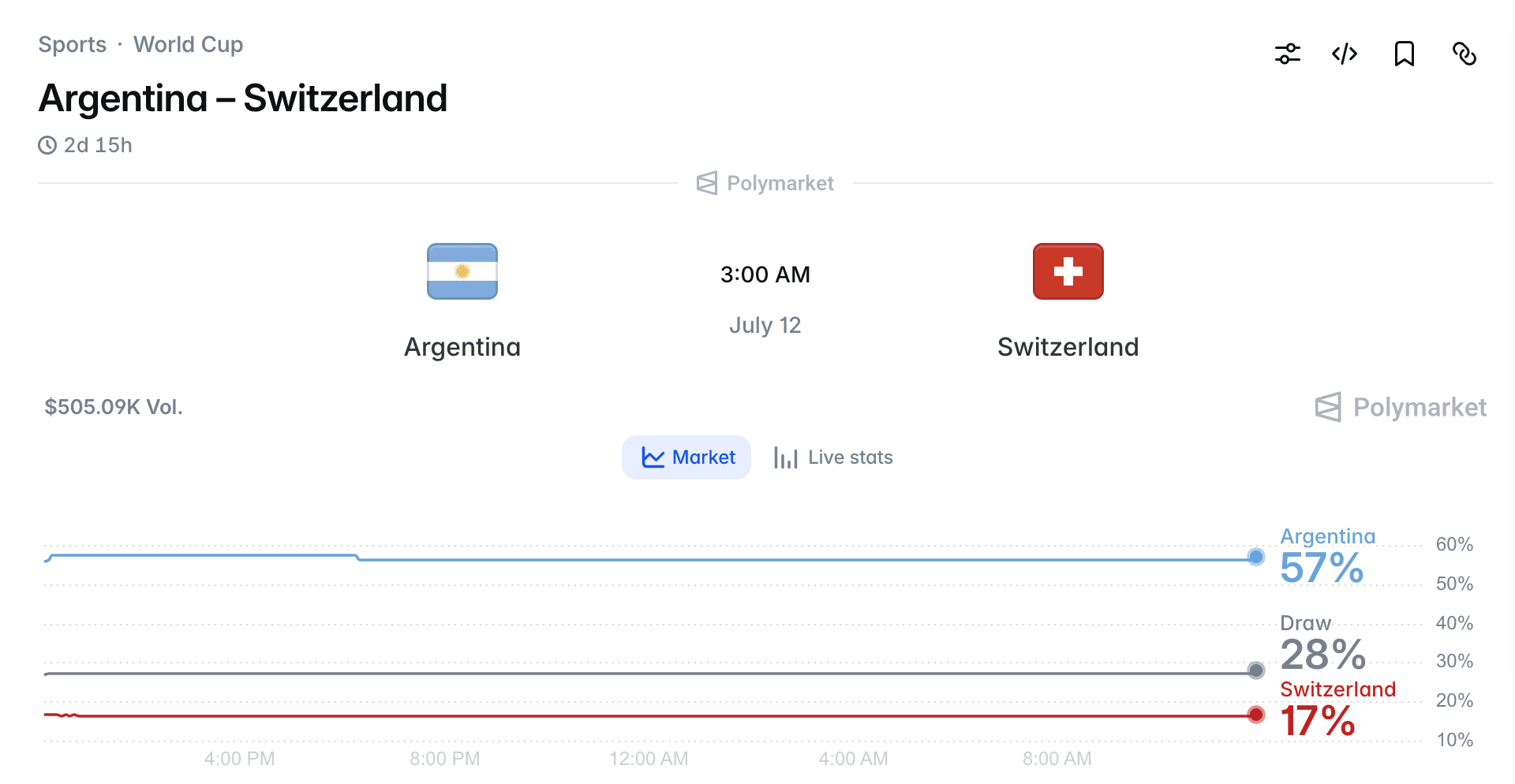
The Argentina vs Switzerland prediction market has settled into one of the most revealing probability distributions of the 2026 World Cup quarterfinals. Polymarket's current read on the Argentina vs Switzerland prediction market gives Argentina 57% in 90 minutes, a draw 28%, and Switzerland 17%. What makes the Argentina vs Switzerland prediction market particularly interesting is not the headline favorite probability but what the draw and underdog numbers reveal about how traders are reading two teams with genuinely contrasting tournament identities.
Messi is 38 years old and has scored eight goals in five matches at what is almost certainly his final World Cup. That single fact sits at the center of this prediction market and explains why the odds look the way they do. Argentina as a team have looked vulnerable at this tournament. Argentina with Messi on the ball in the final minutes of a knockout match have looked capable of winning anything. Understanding the gap between those two versions of Argentina is the most useful starting point for reading what this prediction market is actually saying.
The 57% Is Lower Than You Might Expect for a Defending Champion
The Argentina win probability sitting at 57% rather than something closer to 70% or 75% reflects a specific reading of this Argentine team that the tournament evidence has produced.
Argentina have been extraordinary and fragile in almost the same breath. They have scored in every match and lost a lead in almost every knockout game. Against Cape Verde in the round of 32 they needed extra time. Against Egypt in the round of 16 they were two goals down with eleven minutes left before scoring three times in thirteen minutes. The market has watched this pattern repeat itself across two knockout rounds and decided that Argentina are a team that wins close, high-drama matches rather than a team that controls and closes out opponents comfortably.
Switzerland at 17% reflects a different kind of tournament record. They have not been beaten in 90 minutes once. They conceded zero against Colombia, zero in extra time, and then won the penalty shootout. They conceded three goals all tournament across five matches. Gregor Kobel has been immovable in goal. The market is not giving Switzerland a 17% chance because it thinks they cannot compete. It is giving them 17% because the specific offensive weapons Argentina possess, primarily Messi and Enzo Fernandez, represent a level of individual quality that Switzerland have not yet faced.
The 28% draw probability is the most interesting number in this market. For comparison, the Spain vs Belgium draw probability is 25%. Argentina's draw probability being slightly higher than that of a match involving a team that has conceded zero goals all tournament reflects how good Switzerland are at keeping matches tight. The market is saying there is more than a one-in-four chance that Switzerland execute their defensive game plan well enough that 90 minutes is insufficient to separate the two teams.
What Switzerland Are Actually Trying to Do
The prediction market odds make more sense when you understand the specific game plan Switzerland will bring to Kansas City.
Switzerland under Murat Yakin do not try to outplay opponents. They sit in a compact defensive block, press selectively rather than continuously, and look to exploit transitions. Against Colombia they managed this for 90 minutes and 30 minutes of extra time without ever looking like they were about to concede, relying on Kobel and a disciplined backline to absorb pressure and then executing cleanly in penalties.
Against Argentina, the plan will be structurally similar. Limit Messi's touches in dangerous areas, overload the spaces he likes to receive in, and attempt to make the match a low-event attritional contest that reaches the 70th minute level and then exploits any defensive lapse on a transition or set piece.
Johan Manzambi, Switzerland's most dangerous counter-attacking weapon, is carrying a knee injury that casts some doubt on his availability or full effectiveness. Breel Embolo provides a physical alternative but with a different threat profile. If Manzambi cannot go, the market odds for Switzerland would arguably be even lower than 17%, which suggests the current pricing assumes some contribution from him.
The specific question the market is answering when it puts the draw at 28% is whether Argentina can break through a defensive structure they have struggled against at this tournament. Argentina's goals have often come from Messi individually rather than from collective buildup play that would be effective against a deep defensive block. Switzerland's 17% win probability is essentially the market pricing the chance that Argentina's collective attacking play, with Messi either below his best or well-marshalled, fails to find a way through.
Why the Draw Market Deserves More Attention Than the Win Market
Most readers will focus on the 57% Argentina win probability. The more analytically interesting number for understanding this match is the 28% draw.
Knockout football has a specific dynamic that regular season markets do not. A draw after 90 minutes does not end the match. It creates extra time and potentially a penalty shootout, which is a scenario Switzerland have already navigated in this tournament and in which Argentina have also shown they can perform. The draw probability is not a prediction that the teams will share the result. It is the market's estimate of how likely it is that two teams with genuinely contrasting styles produce a match so tight that the standard time is insufficient to separate them.
For anyone trying to use this prediction market as information about the likely match shape rather than just the outcome, the 28% draw tells you the market thinks Switzerland will make this extremely difficult for Argentina. Combined with the 17% outright Switzerland win probability, the market is saying there is a 45% chance that Argentina do not win in 90 minutes. That is close to a coin flip on whether the match goes to extra time or penalties, which is a very different picture from the 57% Argentina win headline.
What Messi's Eight Goals Mean for the Market
Prediction markets generally price teams rather than individuals. Argentina's odds are the exception that illustrates why individual pricing matters at this tournament.
Messi's eight goals have not come from dominant team performances. They have come from moments of individual brilliance within matches that Argentina were sometimes losing or struggling in. Against Egypt he scored twice after missing a penalty, producing goals in the 77th, 84th, and 90th minutes when many teams would have accepted elimination. That specific pattern, of Messi producing decisive moments in the final quarter of matches, is what the 57% Argentina win probability is partly encoding.
Switzerland will be preparing a specific approach to limiting Messi's impact that goes beyond standard defensive instructions. How much they double-team him and how much space that creates for Julian Alvarez and other Argentine attackers is the tactical trade-off at the heart of the match. If Switzerland commit heavily to neutralizing Messi and it works, their 17% probability looks cheap. If Messi finds pockets despite the attention and produces his usual late-match decisive contribution, the 57% looks like it was an underestimate of Argentina all along.
The market cannot price which of those scenarios unfolds. It can only price the probability distribution of outcomes based on what both teams have shown across five matches each. What happens in those final moments in Kansas City is what markets exist to make uncertain.
How This Market Compares to the Spain vs Belgium Odds
Comparing the Argentina vs Switzerland odds to those of Friday's Spain vs Belgium quarterfinal reveals something about how prediction markets distinguish between different types of favorites.
Spain are priced at 60% to win in 90 minutes against Belgium, a slightly higher probability than Argentina's 57% against Switzerland. That narrow gap is informative. Spain have conceded zero goals in five matches and look like the more structurally dominant team in the tournament. Argentina have scored more goals than Spain but have also been breached more easily, and their tournament form has been more dramatic and less controlled.
The prediction market is essentially saying Spain and Argentina are comparable favorites in their respective matches, with Spain's defensive solidity producing a slightly higher 90-minute win probability while Argentina's offensive firepower through Messi and the historical weight of being defending champions keeps the gap narrow. Both matches carry meaningful draw probabilities that reflect quality opponents capable of keeping things tight for 90 minutes.
For readers following the World Cup, WEEX is running the WEEX Cup: Dice Rush campaign through July 20, combining trading tasks with football match predictions and a 1,000,000 USDT prize pool.
Conclusion
Polymarket's 57-28-17 split for Argentina vs Switzerland is a measured assessment of a match between a team driven by one of the greatest individual players in football history and a team that has made collective defensive excellence its entire identity.
Argentina winning in 90 minutes at 57% is the headline number and the most likely single outcome. But the 45% combined probability of a draw or Swiss win tells you this is a match the market sees as genuinely open in ways that the defending champion label might otherwise obscure. Switzerland have given no team an easy night in this tournament, and Argentina have needed dramatic late interventions to survive in the knockout rounds.
Whether Messi produces another decisive moment to add to eight goals that have defied his age and the occasion is the question the prediction market is pricing but cannot answer. Saturday night in Kansas City will.
FAQ
1. What does Polymarket say about Argentina vs Switzerland?
Polymarket gives Argentina 57% probability of winning in 90 minutes, a draw 28%, and Switzerland 17%. Combined, there is approximately a 45% chance the match goes beyond 90 minutes to extra time or penalties.
2. Why is the draw probability so high at 28%?
Switzerland have not been beaten in 90 minutes at this tournament, conceding just three goals across five matches. The high draw probability reflects how effective their defensive structure has been at keeping matches tight, even against opponents with significant offensive quality.
3. How many goals has Messi scored at the 2026 World Cup?
Messi has scored eight goals in five matches, making him the tournament's leading scorer. Crucially, multiple goals have come in the final minutes of knockout matches when Argentina needed them most, which the prediction market treats as a meaningful variable.
4. What happens if the match is level after 90 minutes?
The match proceeds to 30 minutes of extra time and potentially a penalty shootout. Switzerland eliminated Colombia on penalties after a 0-0 draw in their round of 16 match, demonstrating comfort with exactly that scenario.
5. When and where is Argentina vs Switzerland played?
The match kicks off at 9pm Eastern Time on Saturday July 11 at Arrowhead Stadium in Kansas City, broadcast on Fox Sports and Telemundo in the United States.
Disclaimer
For informational purposes only. Not financial advice. Any activities, rewards, campaigns, or promotions mentioned do not constitute an offer, solicitation, or recommendation to buy, sell, or trade crypto assets. Crypto assets are highly volatile and may lose value. WEEX services, products, or campaigns may not be available in all regions. Users are responsible for complying with applicable local laws before participating.
You may also like

Introducing Kaito ($KAITO): AI-Powered InfoFi Network and Price Prediction
Kaito is an AI-powered InfoFi platform, with KAITO drawing attention from mindshare products, governance, and unlock events.
$KAITO Airdrop on WEEX: Complete Guide to Kaito and Claim Free $KAITO
Kaito tokenomics support an AI-powered InfoFi network for attention, governance, and network currency, while eligible users can join the WEEX KAITO campaign to claim rewards from a 50,000 USDT prize pool before July 16, 2026 at 17:00 SGT.
Risks of Shorting Bitcoin You Should Know Before You Trade
Shorting can look simple: you profit when price falls. But the bitcoin short is different from buying because…
Shorting Bitcoin vs Buying Put Options: What’s the Difference
This guide breaks down two ways to express a bearish view on BTC: opening a bitcoin short with…
Prismevm (PP) Airdrop on WEEX: How to Unlock New User Rewards
This guide explains what Prismevm (PP) is, how the Prismevm (PP) airdrop on WEEX works, and a simple,…
How to Short Bitcoin: Methods and Platforms Compared
A bitcoin short lets you profit if BTC falls. This guide explains how to short bitcoin using futures,…
What Is Dollar-Cost Averaging (DCA)? A Beginner’s Guide
Dollar-cost averaging (DCA) is a simple strategy: invest a fixed amount on a fixed schedule, no matter the…
Why Did Semiconductor Stocks Crash Today? Is NVDA Stock a Buy Now
Semiconductor stocks sold off today after a long AI-driven run. This article explains the most likely catalysts behind…
PepsiCo Stock Price Prediction 2026: Can PEP Beat Q2 Earnings This Week
This piece offers a clear view of PepsiCo Stock Price Prediction 2026 and whether PEP can beat Q2…
JPMorgan Stock Price Prediction 2026-2030: Can JPM Reach 300 After July Earnings
This article lays out a data-driven JPMorgan Stock Price Prediction 2026-2030 with a clear look at whether JPM…
Delta Air Lines Stock Price Forecast 2026: Can DAL Stock Recover From Oil Spike
This article maps a practical path to a Delta Air Lines stock price forecast for 2026 by breaking…
Advanced Micro Devices (AMD) Stock Forecast 2026: Can AMD Reach 300 This Year
This article unpacks the Advanced Micro Devices (AMD) Stock Forecast 2026 with a simple, decision-focused framework. We explore…
What is the SOXL Stock and Who Should Actually Trade It After Crash
This guide explains what the SOXL stock is, how its 3x leverage really works, why it behaves differently…
Taiwan Semiconductor (TSM) Stock Price Prediction 2026-2030: Is TSM Safe to Buy
Taiwan Semiconductor Manufacturing Co. sits at the heart of the AI hardware boom, powering chips for Nvidia, Apple,…
SK Hynix Stock Forecast 2026: Can SK Hynix Recover and Reach New Highs
SK Hynix sits at the heart of the AI memory boom. This 2026 outlook explains how HBM leadership,…
Why is the PHLX Semiconductor Index SOX Dropping While Oil Prices Climb
Semiconductors are selling off while crude rises—a classic growth-versus-inflation standoff. This article explains why the PHLX Semiconductor Index…
SOXL Stock Price Prediction 2026-2030: Can SOXL Recover From July Tech Correction
SOXL Stock Price Prediction 2026-2030 comes down to one question: can semiconductors extend the AI boom after a…
Micron (MU) Stock Price Prediction 2026-2030: Can MU Reach 1500 After July Crash
This article unpacks the July pullback in Micron, builds a 2026–2030 Micron (MU) Stock Price Prediction using cyclical…
Introducing Kaito ($KAITO): AI-Powered InfoFi Network and Price Prediction
Kaito is an AI-powered InfoFi platform, with KAITO drawing attention from mindshare products, governance, and unlock events.
$KAITO Airdrop on WEEX: Complete Guide to Kaito and Claim Free $KAITO
Kaito tokenomics support an AI-powered InfoFi network for attention, governance, and network currency, while eligible users can join the WEEX KAITO campaign to claim rewards from a 50,000 USDT prize pool before July 16, 2026 at 17:00 SGT.
Risks of Shorting Bitcoin You Should Know Before You Trade
Shorting can look simple: you profit when price falls. But the bitcoin short is different from buying because…
Shorting Bitcoin vs Buying Put Options: What’s the Difference
This guide breaks down two ways to express a bearish view on BTC: opening a bitcoin short with…
Prismevm (PP) Airdrop on WEEX: How to Unlock New User Rewards
This guide explains what Prismevm (PP) is, how the Prismevm (PP) airdrop on WEEX works, and a simple,…
How to Short Bitcoin: Methods and Platforms Compared
A bitcoin short lets you profit if BTC falls. This guide explains how to short bitcoin using futures,…