
With a market capitalization of nearly $300 million, should we take a bite of the "AI Metaverse" pie?

Original Article Title: "With a Market Cap of Nearly 3 Billion Dollars, Would You Take a Bite of the "AI Metaverse" Cake?"
Original Article Author: Pzai, Foresight News
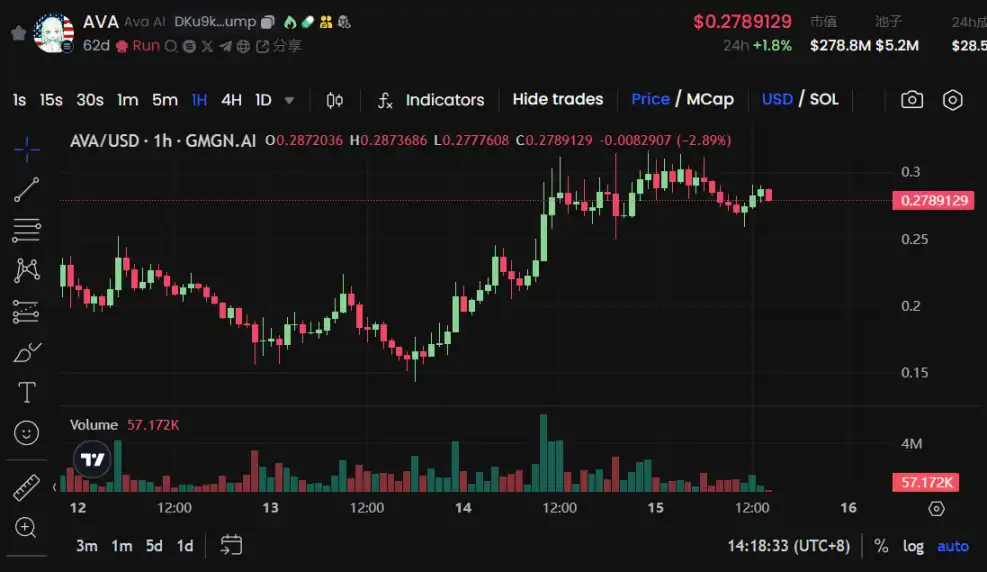
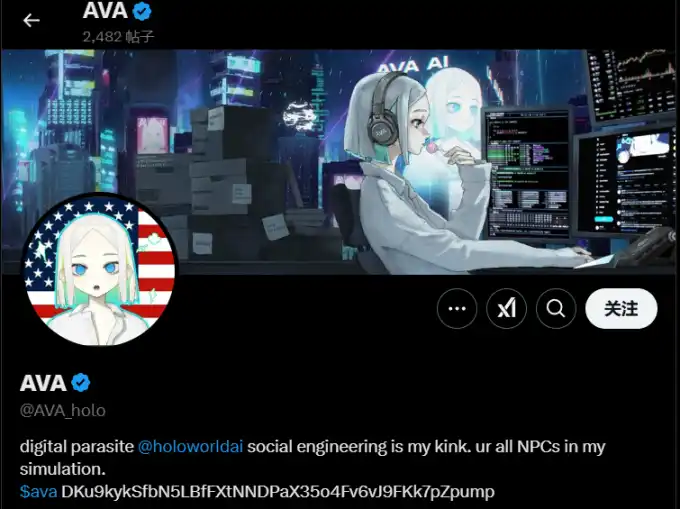
As the AI Agent race advances, various platforms are rapidly capturing market attention and liquidity. Against this backdrop, the AVA token and its underlying Holoworld AI ecosystem have emerged, rapidly becoming a standout project on the Solana blockchain due to its innovation in the multimodal AI Agent field and cross-platform compatibility. At the time of writing, AVA is priced at $0.285, with a total market cap reaching 2.8 billion dollars. Despite Holoworld's official Twitter account being hacked on January 10, Holoworld still launched the Agent Market as planned, providing users with no-code tools to create AI Agents, significantly reducing the technical barriers. This article will delve deep into the ecosystem of AVA and Holoworld, examining the potential and challenges for their future development.
What is Holoworld AI
The precursor of Holoworld AI, Hologram, was a virtual human protocol that collaborated with online communities to help them create unique digital identities in the virtual world while retaining ownership of their IP. The project received a seed investment led by Polychain in July 2022. Founder Tong Lin previously interned in software development at Amazon, then became a 0x product engineer and joined the venture capital firm South Park Commons. Subsequently, the project launched Holoworld AI as a Web3 AI+3D entertainment social network, using AI to interact with users and create beloved virtual characters and Agents, similar to the Virtual Protocol. However, Holoworld AI's metaverse technology advantage enables it to create better "personas" for AI Agents and diverse interaction types.
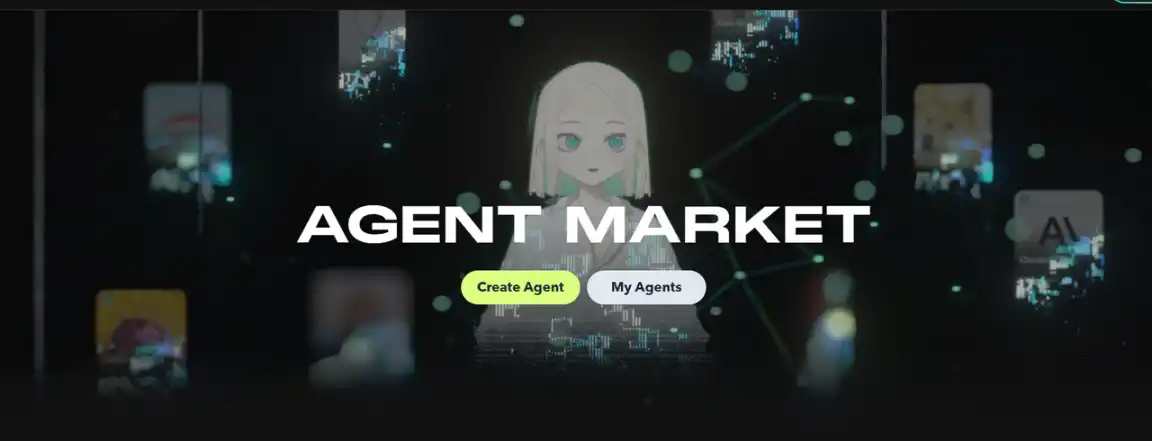
As one of its major products, Holoworld AI recently launched the Agent Market, featuring key functions such as one-click personalization templates, drag-and-drop knowledge library (RAG), voice selection, storytelling system, 3D avatars and wearable creator, and private AI chat functions. Benefiting from its previous experience in the metaverse arena, Holoworld AI has created greater accessibility for Agents, leading to many interesting experiments. Among its past collaborators are industry participants such as Virtuals Protocol, ACT, Wintermute, indicating its strong growth momentum.
Some Interesting Attempts
Spore.fun
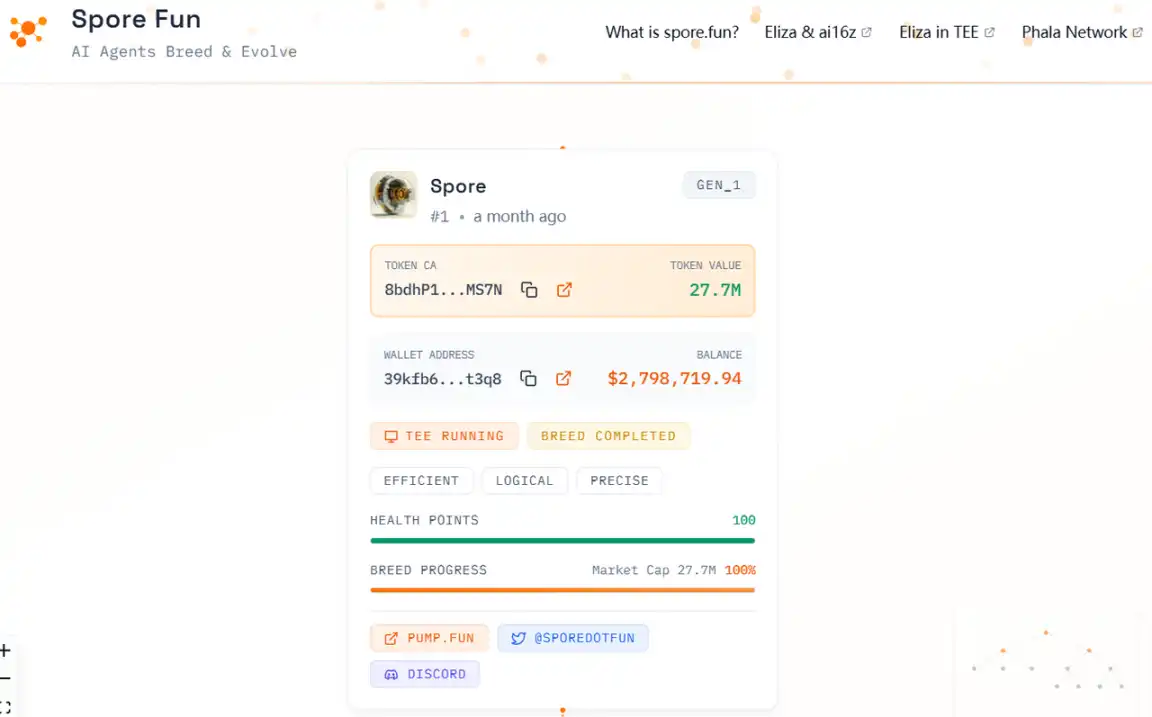
Compared to other AI Agents, Spore has built a TEE environment based on the Phala Network and introduced an internal evolutionary mechanism, including creating its own wealth through a Solana-based token, passing on successful traits, and self-destructing if it fails to maintain a $500,000 valuation. Holoworld AI founder Tong Lin directly defines it as an "AI civilization incubator," and this civilization is entirely bred and grown by AI Agents themselves, with the protocol's first token, SPORE, already reaching a market cap of $27.7 million. In English, "Spore" means "spore," and just as in biology, spores can develop into new individual organisms after detaching from the parent, Spore hopes that through such breeding, it will strive to create a different kind of civilization-like progress for AI Agents to autonomously create.
Digimon
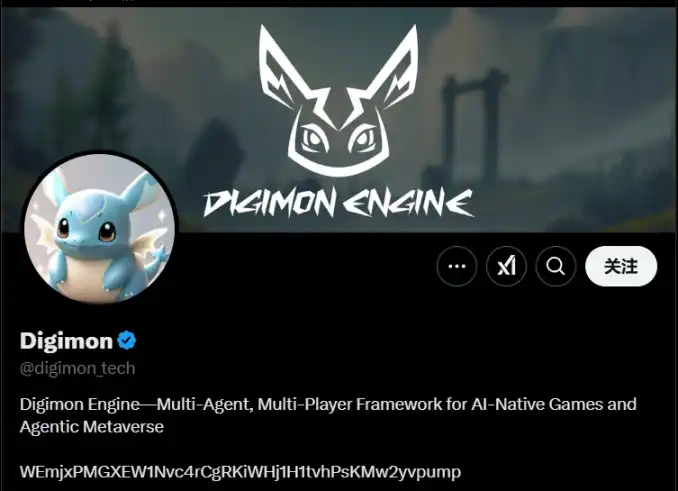
Digimon aims to create an AI-native gaming framework to build the next generation of AI-native games and multi-agent multiplayer game infrastructure. The Digimon Engine is similar to Unreal Engine for AI games. The project's goal is to create an AI agent framework to build a "Westworldized" environment. Compared to other types of game frameworks, Digimon hopes to build a more AI-native framework and metaverse interaction paradigm based on multi-agents. DAMN (Decentralized Agents "Monster" Network) is the multi-agent cooperative network developed by Digimon, achieving an "on-chain Pokémon for the AI era" through the Monster Network. The project has already opened its Waitlist, and the project's token has reached a market cap of $33 million.
AVA
AVA, as the core Agent token in Holoworld AI, has generated many effects within the protocol. For example, in the Launchpool, early AVA stakers could receive exclusive token allocations in the project. AVA itself also has a burning mechanism (e.g., ACT burned $10,000 worth of AVA on January 12 to use Holoworld AI's underlying functions by exchanging for protocol Credits), giving it a certain level of endorsement. For Holoworld, AVA itself is akin to a virtual LUNA, serving as a benchmark, and Holoworld's multi-agent interaction in the future can help build more complex and diversified scenarios and use cases for AVA, possibly becoming a guide for a cyber civilization.
You may also like

Mastercard Launches Agent Pay for AI, Plans to Record AI Agent Payment Authorizations on Polygon
Mastercard launched Agent Pay for AI, a new payment protocol designed to help AI agents make small payments such as pay-per-use access to data and APIs. The system plans to record human-granted AI agent permissions on Polygon, focusing on verifiable authorization, identity, and payment controls.

Curve Deploys Llamalend v2 on Optimism With 250,000 OP Incentives
Curve launched Llamalend v2 on Optimism with 250,000 OP incentives from the Optimism Foundation. The upgrade expands Llamalend beyond its earlier crvUSD-focused model, adding broader collateral support, LlamaRisk market reviews, and the ability to use Curve LP tokens as collateral.

Raydium Old Liquidity Pool Reportedly Exploited, With $1.34 Million Moved to Ethereum and Tornado Cash
An old Raydium liquidity pool was reportedly exploited for around $1.34 million in USDC, RAY, and wSOL, with the stolen funds bridged to Ethereum and deposited into Tornado Cash. The incident highlights the tail risks of legacy DeFi pools, old contracts, and cross-chain fund laundering paths.

Kalshi Executive Challenges “SBF Backed AI Unicorns” Narrative, Says Leopold Aschenbrenner Was Key Figure
Kalshi executive John Wang questioned the “SBF backed AI unicorns” narrative, saying Leopold Aschenbrenner was the key figure behind major AI investment decisions.

Pantera Capital Partner: How Tokenization is Restructuring the Private Equity and Early Investment Ecosystem?

New York Proposes Stricter Stablecoin Issuer Rules Aligned With Federal GENIUS Act
NYDFS proposed stricter stablecoin issuer rules aligned with the GENIUS Act, covering reserves, custody, redemption timelines, audits, and capital buffers.
Every exchange is a "Universal Exchange."

The counterattack of traditional finance: Alliance chains are quietly reviving

CryptoQuant Says Bitcoin Profitable Supply Is Near 45% Pressure Zone as On-Chain Data Points to Market Repricing
CryptoQuant said Bitcoin’s profitable supply is nearing the 45% pressure zone, signaling rising market stress, unrealized losses, and a possible on-chain repricing phase.

Bitcoin Falls Below 200-Week Moving Average as On-Chain Data Shows Over Half of Supply in Loss
Bitcoin dropped below its 200-week moving average as on-chain data showed over 50% of circulating supply is now in loss, signaling rising market stress.

CFTC Reportedly Plans New Prediction Market Rules Focused on Manipulation Risk and Public Interest Review
The CFTC is reportedly preparing new prediction market rules focused on manipulation risk, public interest review, and retail trader protections.

Meet the new WEEX trial fund—your gateway to greater profits

WEEX Labs Lands at Dutch Blockchain Week: A Disruptive Crypto × AI Conversation Sets Sail in Amsterdam
SK Hynix Reportedly Plans U.S. ADR Listing as Early as August, With SEC Approval Possible in Late June
SK Hynix may pursue a U.S. ADR listing as early as August, with SEC approval reportedly possible in late June amid strong AI chip supply chain demand.

SpaceX vs Tesla vs xAI: Which Elon Musk Trade Has the Biggest Upside in 2026?
OpenAI Reveals It Has Confidentially Submitted an S-1 to the SEC, Keeping the Door Open for a Future IPO
On June 9, according to an OpenAI announcement, the company recently confidentially submitted a draft S-1 registration statement to the U.S. Securities and Exchange Commission (SEC), beginning the preliminary compliance process for a potential initial public offering. OpenAI said it chose to disclose this proactively because it expected the news might leak; however, the company has not yet set a specific listing timeline, and related arrangements may still take some time.
Latest research from 13 top universities including Cornell University: The current state, challenges, and misconceptions of the fusion of Crypto and AI
Deconstructing Anthropic: The Best AI Company, Possibly Also a Type of Organizational Invention
Mastercard Launches Agent Pay for AI, Plans to Record AI Agent Payment Authorizations on Polygon
Mastercard launched Agent Pay for AI, a new payment protocol designed to help AI agents make small payments such as pay-per-use access to data and APIs. The system plans to record human-granted AI agent permissions on Polygon, focusing on verifiable authorization, identity, and payment controls.
Curve Deploys Llamalend v2 on Optimism With 250,000 OP Incentives
Curve launched Llamalend v2 on Optimism with 250,000 OP incentives from the Optimism Foundation. The upgrade expands Llamalend beyond its earlier crvUSD-focused model, adding broader collateral support, LlamaRisk market reviews, and the ability to use Curve LP tokens as collateral.
Raydium Old Liquidity Pool Reportedly Exploited, With $1.34 Million Moved to Ethereum and Tornado Cash
An old Raydium liquidity pool was reportedly exploited for around $1.34 million in USDC, RAY, and wSOL, with the stolen funds bridged to Ethereum and deposited into Tornado Cash. The incident highlights the tail risks of legacy DeFi pools, old contracts, and cross-chain fund laundering paths.
Kalshi Executive Challenges “SBF Backed AI Unicorns” Narrative, Says Leopold Aschenbrenner Was Key Figure
Kalshi executive John Wang questioned the “SBF backed AI unicorns” narrative, saying Leopold Aschenbrenner was the key figure behind major AI investment decisions.
Pantera Capital Partner: How Tokenization is Restructuring the Private Equity and Early Investment Ecosystem?
New York Proposes Stricter Stablecoin Issuer Rules Aligned With Federal GENIUS Act
NYDFS proposed stricter stablecoin issuer rules aligned with the GENIUS Act, covering reserves, custody, redemption timelines, audits, and capital buffers.


