
 Buy Crypto
- Markets
 Futures
- Spot
- Copy Trade
- Earn
- More
Warmonger Trump has forgotten about Americans waiting in airport lines for hours


In recent times, international news has been dominated by the Iran situation and President Trump's fluctuating stance on the war.
However, one thing that once monopolized the headlines in 2025 is now rarely mentioned in the mainstream media—on February 14, due to a deadlock between the Democrats and Republicans on the Department of Homeland Security (DHS) funding bill, a partial DHS shutdown officially began.
As of today, the shutdown has not ended.
During this nearly two-month shutdown period, over 100,000 DHS employees have been unable to receive their pay, and nearly 11% of Transportation Security Administration (TSA) employees have been absent. In New Orleans, passengers queuing for security screening snaked from inside the terminal building to outside, even circling the parking lot seven times before reaching the entrance.

For the United States, which has almost no high-speed rail network and heavily relies on air travel, turbulence in the civil aviation system is deadly. Even Musk publicly expressed willingness to personally pay the salaries of affected TSA employees.
Also starting in March, the prediction market Polymarket launched a weekly updated "This week's number of delayed flights in the US" prediction event—traders can bet on how many flights will be delayed each week, with the opportunity to earn money if their prediction is correct and lose everything if wrong.
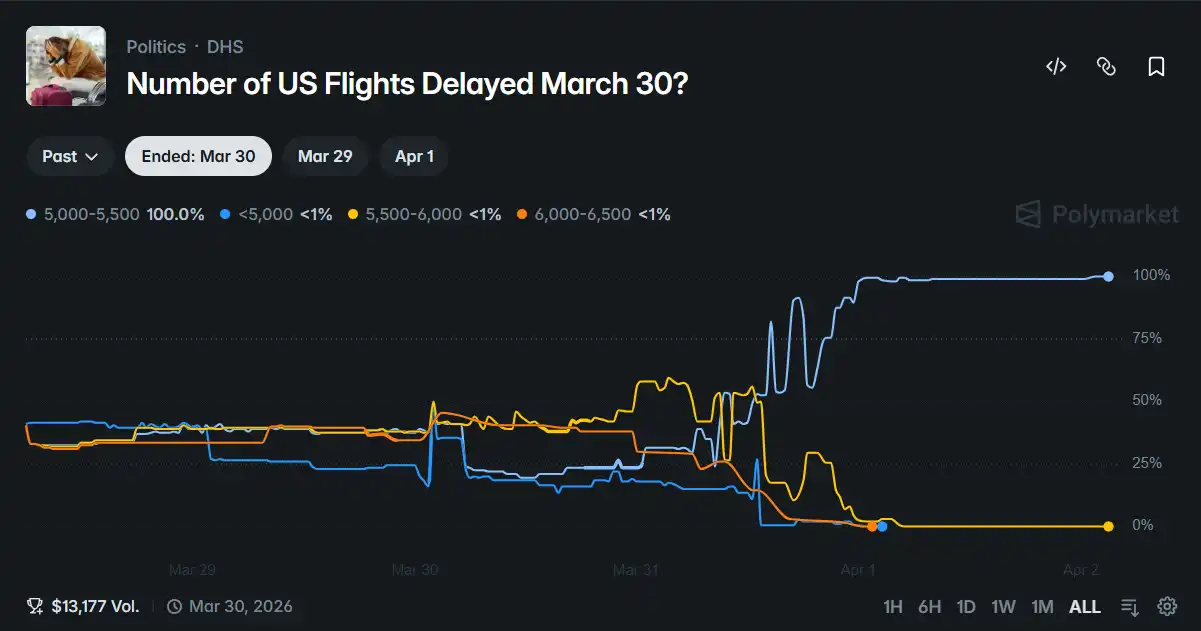
In addition to this purely entertainment-based event, Polymarket has also launched several topics of significant reference value. Through the probabilities reflected by these topics, we can attempt to interpret the current state of the government shutdown and even domestic affairs in the United States.
The Shutdown Game Between the Two Parties
This shutdown has already broken Trump's previous record of 35 days. In the embarrassing situation of widespread flight delays and the near-collapse of the security system, the most concerning question for the affected population within the United States is when the shutdown will end.
Currently on Polymarket, there is already a related event: "DHS Shutdown will end by ___." As of the time of writing, the probability of the shutdown ending between April 5th and 8th is 9%, and the probability of the shutdown not ending in April is 44%.
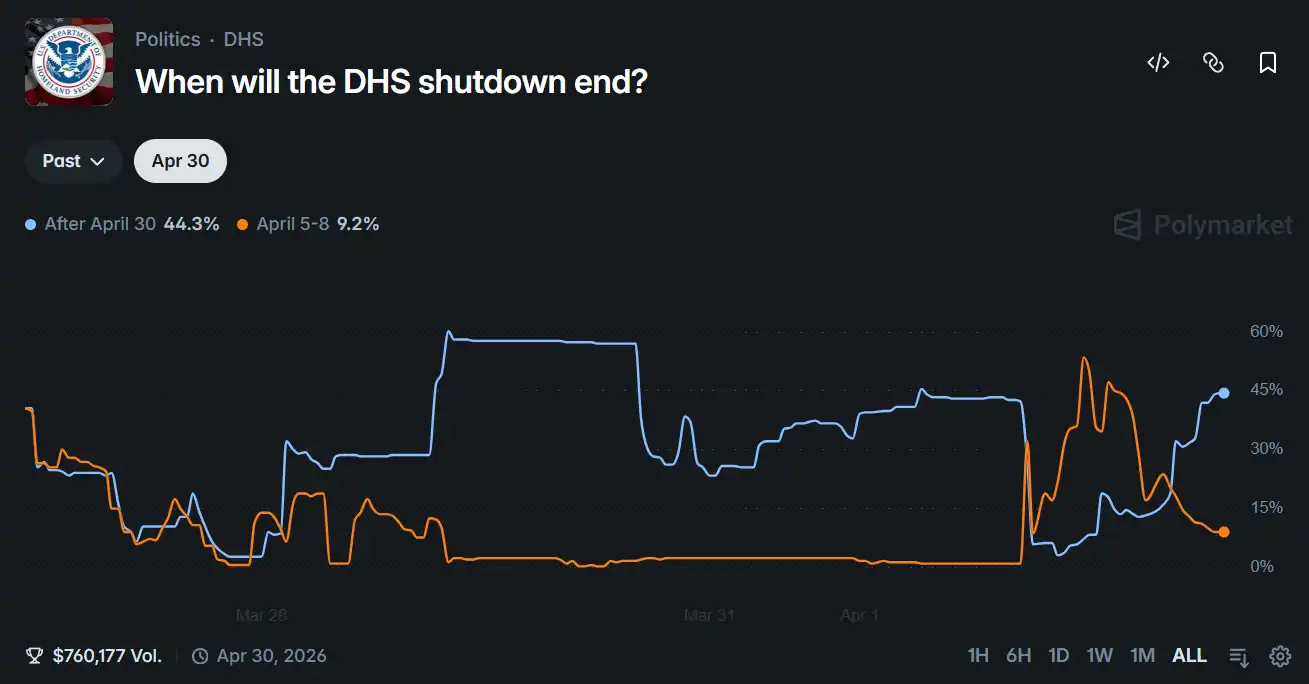
Many "smart money" has been placed on these two time points—senior traders with high accuracy in past predictions and outstanding profitability in the political sector. Behind such trading profiles, it confirms a clear logic: if the shutdown does not end within the April 5th to 8th window, the likelihood of reaching an agreement this month will significantly decrease.
April 5-8 coincides with Congress returning to work after a break, and the two parties will once again put the appropriations bill on the table. If they can reach an agreement in the days following their return to work and the bill is passed by both the Senate and the House, the shutdown will come to an end.
However, if this window is missed once again, the Senate and the House will then be caught up in other scheduling matters. Without strong political pressure, the motivation for both parties to return to the negotiating table will significantly weaken.
Musk's "Tab" and ICE's "Overtime"
Due to ongoing TSA staff shortages causing severe delays at major airports, Musk tweeted on March 21 that he was willing to pay TSA workers' salaries, giving rise to the Polymarket trading event "Will Musk pay TSA staff salaries?".
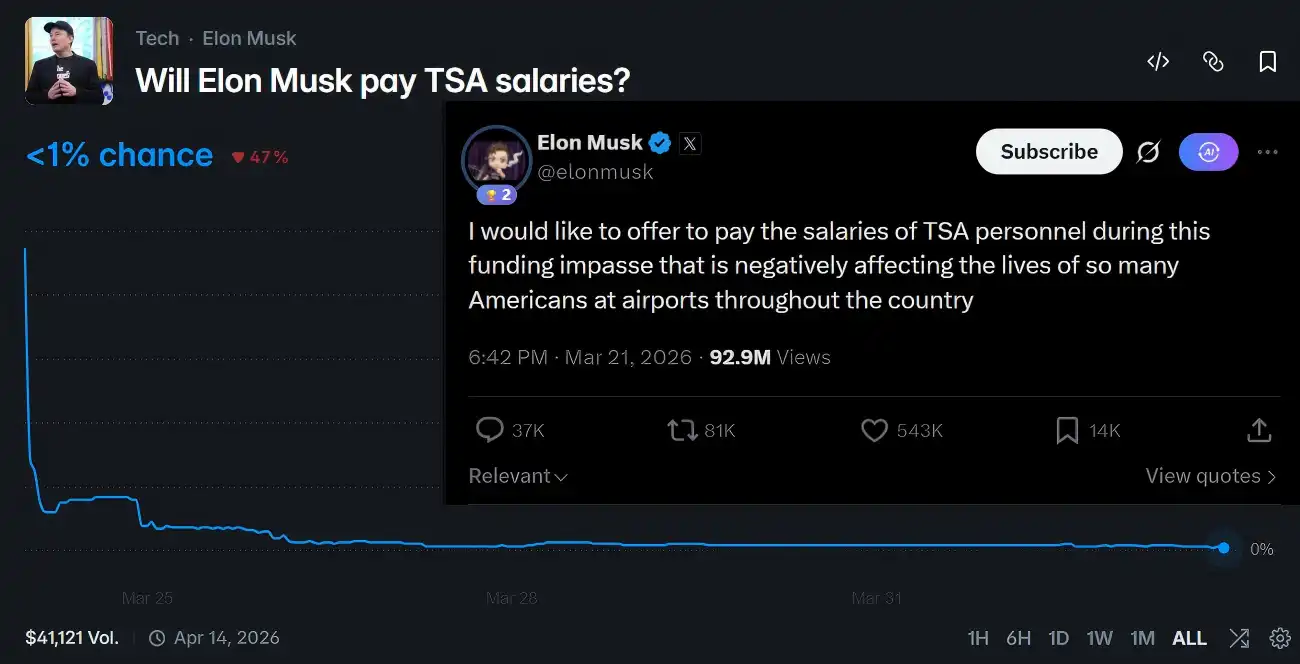
However, shortly after Musk's tweet, the White House rejected the proposal citing legal compliance and conflicts of interest: under U.S. federal law, government employees cannot accept external compensation related to their official duties; furthermore, Musk's deep involvement in federal government contracts presents a significant conflict of interest in directly paying wages.
While there is legal basis for the rejection, ordinary people still have to live. To minimize the impact of the aviation system's paralysis on the midterm elections, in March, Trump ordered the deployment of Immigration and Customs Enforcement (ICE) agents to airports to replace TSA workers who had resigned due to unpaid leave.
However, the scene that unfolded after these ICE agents arrived at the airport made the entire shutdown situation look even more absurd.
Since taking office, ICE has been aggressively downsizing recruitment and training processes to achieve the goal of "arresting 3,000 people daily and deporting millions annually" – planning to hire an additional ten thousand law enforcement officers and shortening the original 16-week physical training to 8 weeks.

In short, the professionalism of these ICE agents themselves is already questionable.
Yet TSA's security work requires systematic training, covering core skills such as X-ray machine operation and explosive detection, which ICE agents simply do not possess.
Thus, a historic scene unfolds: TSA workers are volunteering on the job while also showing ICE agents the security screening process and teaching them how to maintain order. Most ICE agents are not performing actual security screening but are patrolling the terminals, using their law enforcement status to interrogate and deport suspected undocumented immigrants.

The data confirmed the outcome of this farce: After ICE was deployed to the airport, the flight delay situation did not significantly improve. As of the end of March, the U.S. aviation system still experienced thousands of flight delays per day on average, with nearly a 40% TSA absenteeism rate at the Atlanta airport and over 350 flight delays in a single day. These numbers indicate that the ICE agents, who were supposed to act as a shutdown cushion, did not play the role that everyone expected.
The "Nuclear Option" to Break the Deadlock
Another transaction event related to this government shutdown is "Will the Republican Party use the 'nuclear option' to break obstruction by December 31, 2026?", with the current probability at 31%.
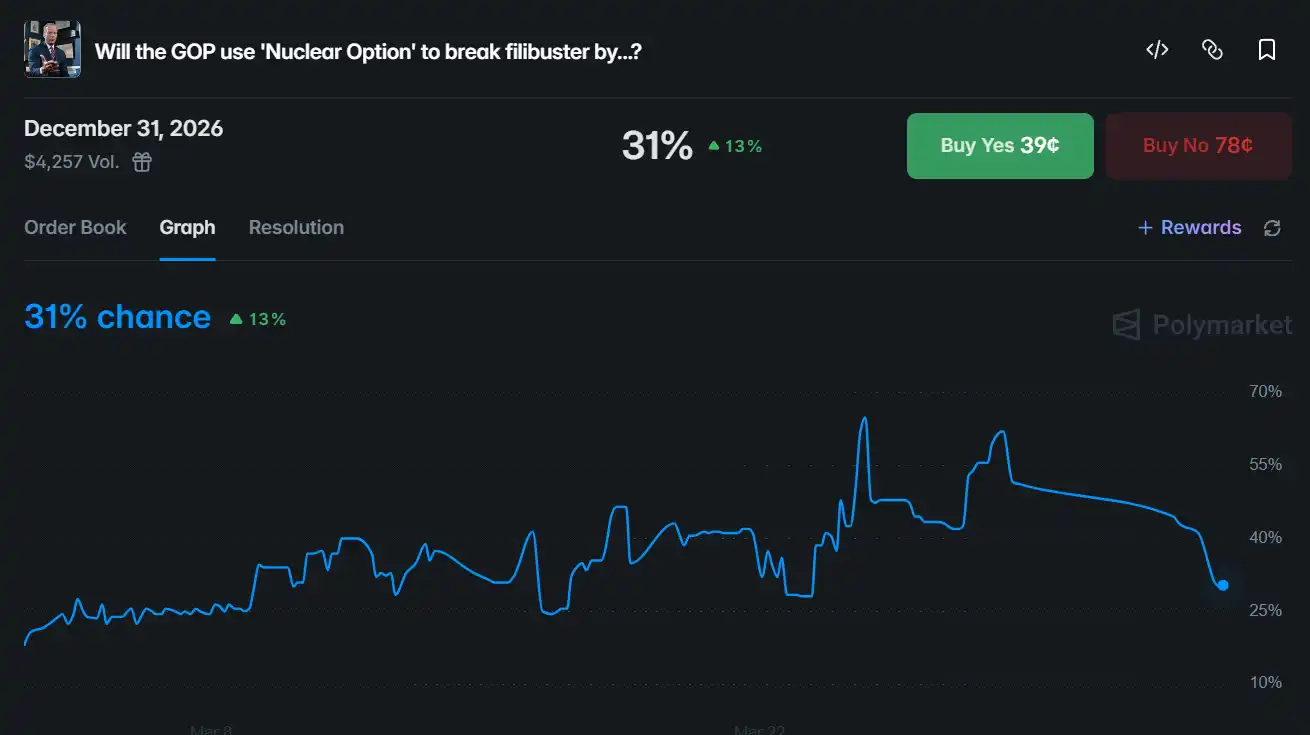
At first glance, the term "nuclear option" may seem intimidating; however, in the U.S. political arena, it is not a literal nuclear weapon but rather one of the few yet highly destructive bargaining chips the Republican Party holds.
In the U.S. legislative system, the House of Representatives is responsible for proposing and drafting fiscal appropriation bills, while the Senate is responsible for deliberation and voting. Typically, ending debate and advancing to a vote in the Senate requires the support of 60 votes — meaning the minority party only needs 41 votes to indefinitely delay debate and block any bill.
The "nuclear option" provides a way to bypass this threshold: a senator can make a procedural appeal to overturn the presiding officer's ruling with a simple majority (51 votes), thus forcibly lowering the vote threshold required to end debate from 60 votes.
Currently, the Republican Party holds 53 seats in the Senate, and once the nuclear option is triggered, the Democrats' ability to obstruct will be nearly nonexistent.
However, the reason it's called the "nuclear" option is that it comes with a high cost to the user: breaking Senate procedural rules would be seen as an abuse of power by voters; more importantly, if the Republican Party loses the majority in the future, the same rules could be used by the Democrats to retaliate.
The hole dug today may need to be filled by the digger tomorrow. The 31% probability is the market's true pricing of this dilemma.
Amidst this ongoing shutdown deadlock, Trump also finds himself dealing with the escalating situation in Iran.
On one side, there is a high-stakes diplomatic and military game, while on the other side, there are airport queues, unpaid wages, and interparty wrangling — the troubles that this U.S. administration needs to coordinate are far more numerous than what the headlines suggest. Internal and foreign crises never wait for each other to be resolved first.
Amid this turmoil, the rich landscape of political and current events prediction markets will continue to act as an objective mirror, helping us capture the true trajectory of these narratives.
You may also like

Consumer-grade Crypto Global Survey: Users, Revenue, and Track Distribution

Prediction Markets Under Bias

Stolen: $290 million, Three Parties Refusing to Acknowledge, Who Should Foot the Bill for the KelpDAO Incident Resolution?

ASTEROID Pumped 10,000x in Three Days, Is Meme Season Back on Ethereum?

ChainCatcher Hong Kong Themed Forum Highlights: Decoding the Growth Engine Under the Integration of Crypto Assets and Smart Economy

Why can this institution still grow by 150% when the scale of leading crypto VCs has shrunk significantly?

Anthropic's $1 trillion, compared to DeepSeek's $100 billion

Geopolitical Risk Persists, Is Bitcoin Becoming a Key Barometer?

Annualized 11.5%, Wall Street Buzzing: Is MicroStrategy's STRC Bitcoin's Savior or Destroyer?

An Obscure Open Source AI Tool Alerted on Kelp DAO's $292 million Bug 12 Days Ago

Mixin has launched USTD-margined perpetual contracts, bringing derivative trading into the chat scene.
The privacy-focused crypto wallet Mixin announced today the launch of its U-based perpetual contract (a derivative priced in USDT). Unlike traditional exchanges, Mixin has taken a new approach by "liberating" derivative trading from isolated matching engines and embedding it into the instant messaging environment.
Users can directly open positions within the app with leverage of up to 200x, while sharing positions, discussing strategies, and copy trading within private communities. Trading, social interaction, and asset management are integrated into the same interface.
Based on its non-custodial architecture, Mixin has eliminated friction from the traditional onboarding process, allowing users to participate in perpetual contract trading without identity verification.
The trading process has been streamlined into five steps:
· Choose the trading asset
· Select long or short
· Input position size and leverage
· Confirm order details
· Confirm and open the position
The interface provides real-time visualization of price, position, and profit and loss (PnL), allowing users to complete trades without switching between multiple modules.
Mixin has directly integrated social features into the derivative trading environment. Users can create private trading communities and interact around real-time positions:
· End-to-end encrypted private groups supporting up to 1024 members
· End-to-end encrypted voice communication
· One-click position sharing
· One-click trade copying
On the execution side, Mixin aggregates liquidity from multiple sources and accesses decentralized protocol and external market liquidity through a unified trading interface.
By combining social interaction with trade execution, Mixin enables users to collaborate, share, and execute trading strategies instantly within the same environment.
Mixin has also introduced a referral incentive system based on trading behavior:
· Users can join with an invite code
· Up to 60% of trading fees as referral rewards
· Incentive mechanism designed for long-term, sustainable earnings
This model aims to drive user-driven network expansion and organic growth.
Mixin's derivative transactions are built on top of its existing self-custody wallet infrastructure, with core features including:
· Separation of transaction account and asset storage
· User full control over assets
· Platform does not custody user funds
· Built-in privacy mechanisms to reduce data exposure
The system aims to strike a balance between transaction efficiency, asset security, and privacy protection.
Against the background of perpetual contracts becoming a mainstream trading tool, Mixin is exploring a different development direction by lowering barriers, enhancing social and privacy attributes.
The platform does not only view transactions as execution actions but positions them as a networked activity: transactions have social attributes, strategies can be shared, and relationships between individuals also become part of the financial system.
Mixin's design is based on a user-initiated, user-controlled model. The platform neither custodies assets nor executes transactions on behalf of users.
This model aligns with a statement issued by the U.S. Securities and Exchange Commission (SEC) on April 13, 2026, titled "Staff Statement on Whether Partial User Interface Used in Preparing Cryptocurrency Securities Transactions May Require Broker-Dealer Registration."
The statement indicates that, under the premise where transactions are entirely initiated and controlled by users, non-custodial service providers that offer neutral interfaces may not need to register as broker-dealers or exchanges.
Mixin is a decentralized, self-custodial privacy wallet designed to provide secure and efficient digital asset management services.
Its core capabilities include:
· Aggregation: integrating multi-chain assets and routing between different transaction paths to simplify user operations
· High liquidity access: connecting to various liquidity sources, including decentralized protocols and external markets
· Decentralization: achieving full user control over assets without relying on custodial intermediaries
· Privacy protection: safeguarding assets and data through MPC, CryptoNote, and end-to-end encrypted communication
Mixin has been in operation for over 8 years, supporting over 40 blockchains and more than 10,000 assets, with a global user base exceeding 10 million and an on-chain self-custodied asset scale of over $1 billion.

$600 million stolen in 20 days, ushering in the era of AI hackers in the crypto world
Vitalik's 2026 Hong Kong Web3 Summit Speech: Ethereum's Ultimate Vision as the "World Computer" and Future Roadmap
On the same day Aave introduced rsETH, why did Spark decide to exit?
Full Post-Mortem of the KelpDAO Incident: Why Did Aave, Which Was Not Compromised, End Up in Crisis Situation?

After a $290 million DeFi liquidation, is the security promise still there?
ZachXBT's post ignites RAVE nearing zero, what is the truth behind the insider control?




 App
App