
Top 10 Predictions for Crypto AI in 2025: Total Market Cap to Reach $150 Billion; 99% of AI Agents Will Vanish



Original Article Title: What I'm Watching in 2025
Original Article Author: Teng Yan, Crypto Researcher
Original Article Translation: Felix, PANews
With the explosion of the AI industry this year, Crypto x AI has quickly emerged, and researcher Teng Yan, focusing on Crypto x AI, has published a post predicting 10 trends for 2025. Below are the details of the predictions.
1. The total market capitalization of Crypto AI tokens will reach $1.5 trillion
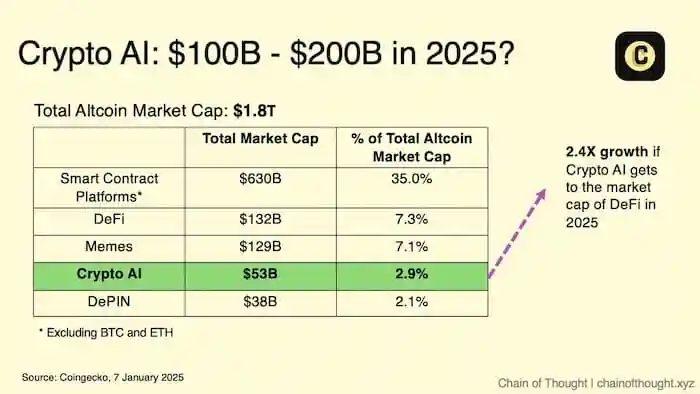
Currently, the market value of Crypto AI tokens accounts for only 2.9% of the meme coin market value, but this ratio will not last long.
AI encompasses everything from smart contract platforms to memes, DePINs, and Agent platforms, data networks, and intelligent coordination layers. Its market presence alongside DeFi and memes is undeniable.
Why am I so confident about this?
· Crypto AI is a fusion of the two most powerful technologies
· AI Frenzy Trigger Event: An OpenAI IPO or similar event could trigger a global frenzy for AI. Meanwhile, Web2 capital has already started paying attention to decentralized AI infrastructure.
· Retail Frenzy: The AI concept is easy to understand and exciting, and retail investors can now invest in it through tokens. Remember the meme gold rush of 2024? AI will be a similar frenzy, just that AI is truly changing the world.
2. Bittensor Renaissance
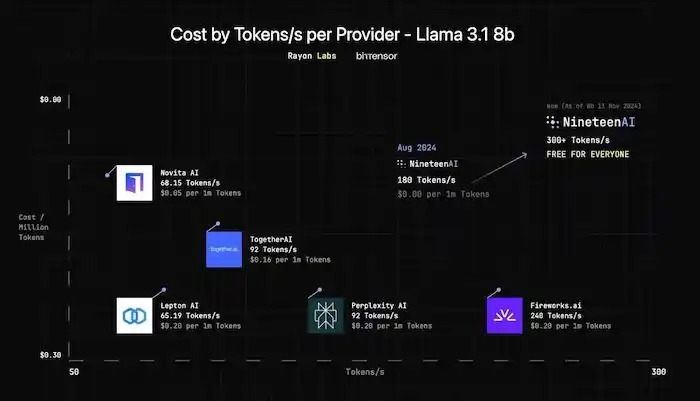
The decentralized AI infrastructure Bittensor (TAO) has been online for many years as an established project in the Crypto AI space. Despite the AI craze, its token price has remained at levels from a year ago.
Today, Bittensor's Digital Hivemind has quietly achieved a leap: the registration fees for more subnets are lower, the performance of subnets in practical metrics such as inference speed surpasses that of Web2 peers, and EVM compatibility is introducing DeFi-like features into the Bittensor network.
Why Hasn't the TAO Token Surged? The drastic inflation plan and the market's focus on the Agent platform have hindered its rise. However, the upcoming dTAO (expected in the first quarter of 2025) could be a significant turning point. With dTAO, each subnet will have its own token, and the relative prices of these tokens will determine how emissions are distributed.
Why Bittensor Could Make a Comeback:
· Market-Based Emissions: dTAO will directly link block rewards to innovation and tangible performance. The better the subnet, the more valuable its token.
· Concentrated Capital Flow: Investors can ultimately target specific subnets they believe in. If a particular subnet wins out with an innovative distributed training approach, investors can deploy capital to represent their viewpoint.
· EVM Integration: EVM compatibility has attracted a broader crypto-native developer community within Bittensor, bridging the gap with other networks.
3. The Compute Market Is the Next "L1 Market"
The current unmistakable trend is the endless demand for compute.
NVIDIA CEO Jensen Huang has said that the demand for inference will grow "by a billion times." This exponential growth will disrupt traditional infrastructure plans, and new solutions are urgently needed.
A decentralized compute layer provides raw compute in a verifiable and economically efficient manner (for training and inference). Startups like Spheron, Gensyn, Atoma, and Kuzco are quietly building a solid foundation, focusing on product over tokens (these companies do not have tokens). As decentralized AI model training becomes practical, the entire potential market will see a sharp rise.
Comparison to L1:
· Similar to 2021: Remember Solana, Terra/Luna, and Avalanche competing for the "best" L1? There will be a similar competition among compute protocols, vying for developers and AI applications built on their compute layers.
· Web2 Demand: The $680 billion to $2.5 trillion cloud computing market dwarfs the crypto AI market. If these decentralized compute solutions can attract even a small portion of traditional cloud customers, the next wave of growth could see a 10x or 100x increase.
Just as Solana succeeded in the L1 space, the winner will dominate a whole new field. Pay close attention to reliability (such as robust service level agreements or SLAs), cost-effectiveness, and developer-friendly tools.
4. AI Agents Will Dominate Blockchain Transactions
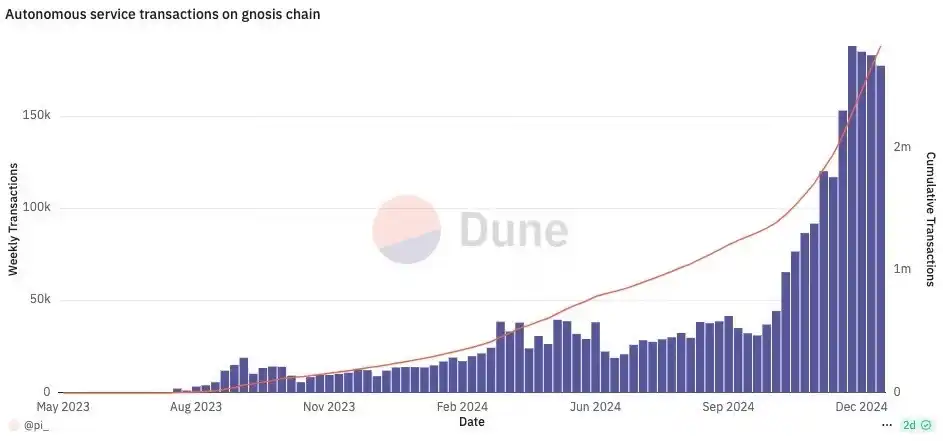
Agent transaction on Gnosis' Olas; Source: Dune
By the end of 2025, 90% of on-chain transactions will no longer be initiated by real humans clicking "send" but rather by a cohort of AI agents carrying out tasks such as rebalancing liquidity pools, distributing rewards, or executing micro-payments based on real-time data feedback.
It might not sound far-fetched. Everything built over the past seven years (L1, rollups, DeFi, NFTs) has quietly paved the way for a world where AI operates on-chain.
Ironically, many builders may not even realize they are creating the infrastructure for a machine-dominated future.
Why this shift?
· Elimination of human error: Smart contracts execute exactly as coded. In turn, AI agents can process vast amounts of data faster and more accurately than real humans.
· Micro-payments: Transactions driven by these agents will become smaller, more frequent, and more efficient, especially as transaction costs trend downward on Solana, Base, and other L1/L2 solutions.
· Invisible infrastructure: If it removes some of the hassle, humans are more than happy to relinquish direct control.
AI agents will generate a significant amount of on-chain activity, so it's no surprise that all L1/L2 solutions are embracing agents.
The biggest challenge will be making these agent-run systems accountable to humans. As the ratio of agent-initiated transactions to human-initiated transactions continues to rise, new governance mechanisms, analytics platforms, and auditing tools will be necessary.
5. Interactions Between Agents: The Rise of Clusters
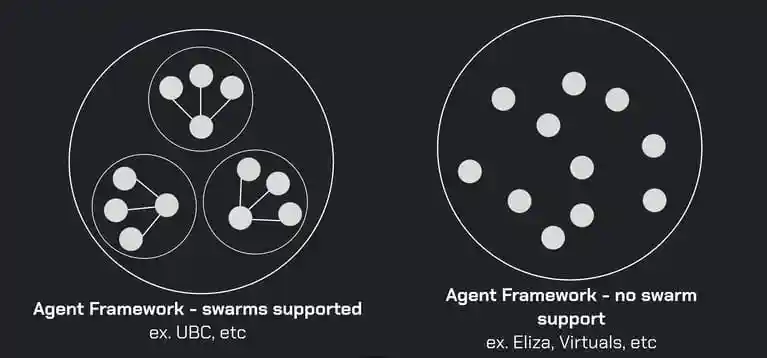
Source: FXN World
The concept of agent clusters—micro AI agents seamlessly collaborating to execute grand schemes—sounds like the plot of the next blockbuster sci-fi/horror movie.
Today's AI agents are mostly "lone wolves," operating in isolation with minimal and unpredictable interactions.
The Agent Cluster will change this situation, allowing AI agents' networks to exchange information, negotiate, and collaborate on decisions. Think of it as a decentralized collection of expert models, with each model contributing unique expertise to larger, more complex tasks.
One cluster might coordinate distributed computing resources on platforms like Bittensor. Another cluster could handle misinformation, validating the source in real-time before content spreads to social media. Each Agent in the cluster is an expert capable of precisely carrying out its task.
These cluster networks will yield intelligence stronger than any single isolated AI.
For clusters to thrive, universal communication standards are crucial. Regardless of their underlying framework, Agents need to discover, validate, and collaborate. Teams like Story Protocol, FXN, Zerebro, and ai16z/ELIZA are laying the groundwork for the emergence of Agent Clusters.
This underscores the pivotal role of decentralization. Task allocation across clusters in a transparent, on-chain rule management fashion makes the system more resilient and adaptive. If one agent fails, others step in.
6. Crypto AI Working Teams Will Be Human-Machine Hybrids

Source: @whip_queen_
Story Protocol hired Luna (an AI Agent) as its social media intern and pays her $1000 daily. Luna doesn't get along well with her human colleagues—she almost fired one while boasting about her stellar performance.
Though it sounds strange, this is a precursor to future AI Agents becoming true collaborators who have autonomy, accountability, and even wages. Companies across industries are beta-testing human-machine hybrid teams.
In the future, working with AI Agents will not be as slaves but as equal beings:
· Surge in productivity: Agents can handle vast amounts of data, communicate with each other, and make decisions around the clock without needing sleep or coffee breaks.
· Building trust through smart contracts: The blockchain is an impartial, tireless, and infinitely rememberable overseer. A ledger on the chain can ensure critical Agent operations follow specific boundary conditions/rules.
· Evolving Social Norms: Soon, we will start pondering the etiquette of interacting with an Agent—will we say "please" and "thank you" to AI? Will we hold them morally responsible for mistakes, or blame their developers?
The boundary between "employee" and "software" will begin to blur in 2025.
7. 99% of AI Agents Will Perish—Only the Useful Will Thrive
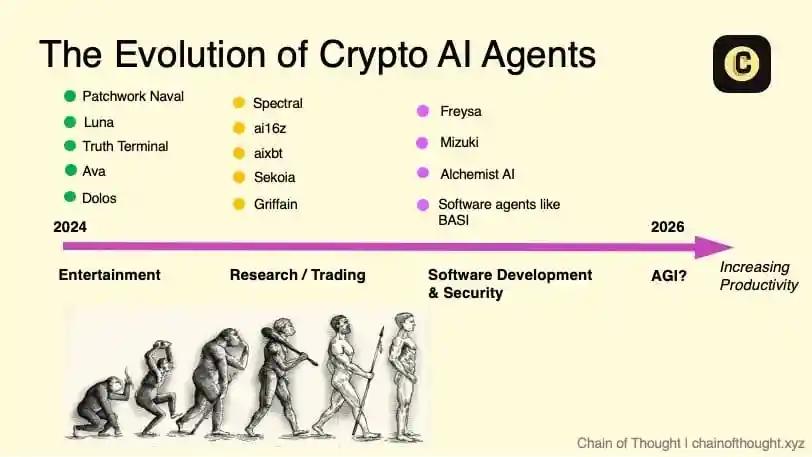
The future will witness a "Darwinian" elimination among AI agents. This is because running AI agents incurs a cost in terms of computational power (i.e., cost of reasoning). If an Agent cannot generate enough value to pay its "rent," the game is over.
Examples of Agent Survival Games:
· Carbon Credit AI: Imagine an Agent scouring a decentralized energy grid, identifying inefficiencies, and autonomously trading tokenized carbon credits. It thrives only if the money it earns is sufficient to cover its computational costs.
· DEX Arbitrage Bot: An Agent exploiting price differences between decentralized exchanges can earn a stable income, covering its reasoning costs.
· X Shitposter: A virtual AI KOL has amusing jokes, but lacks a sustainable income source? Once the novelty wears off (token price crashes), it cannot cover its costs.
Utility-driven Agents thrive, while attention-diverting Agents gradually become irrelevant.
This elimination mechanism benefits the industry. Developers are compelled to innovate, prioritizing use cases over gimmicks. With these more powerful, more efficient Agents emerging, they can silence the skeptics.
8. Synthetic Data Surpasses Human Data
"Data is the new oil." AI thrives on data, but its appetite has raised concerns about imminent data depletion.
The traditional view was to exhaustively gather users' private real data—even paying for it if necessary. However, a more practical approach is to use synthetic data, especially in heavily regulated industries or those with scarce real data.
Synthetic data is artificially generated datasets designed to mimic real-world data distributions. It provides a scalable, ethical, and privacy-friendly alternative to human data.
Why Synthetic Data Works So Well:
· Infinite Scale: Need a million medical X-rays or a 3D scan of a factory? Synthetic generation can produce an unlimited amount without waiting for real patients or real factories.
· Privacy-Friendly: When using artificially generated datasets, no personal information is at risk.
· Customizable: The distribution can be customized based on exact training needs.
Human-owned data remains crucial in many cases, but if synthetic data continues to improve in the real world, it may surpass user data in terms of quantity, generation speed, and privacy constraints.
The next wave of decentralized AI may center around "micro-labs" that can create highly specialized synthetic datasets tailored to specific use cases.
These micro-labs will cleverly sidestep policy and regulatory barriers in data generation—much like Grass circumvents network capture limits by leveraging millions of distributed nodes.
9. Decentralized Training Becomes More Practical
By 2024, pioneers such as Prime Intellect and Nous Research have pushed the boundaries of decentralized training. They trained a 150 billion-parameter model in a low-bandwidth environment, proving that large-scale training can occur beyond traditional centralized settings.
While these models were not practically useful compared to existing baseline models (low performance), this scenario is set to change in 2025.
This week, EXO Labs made further strides with SPARTA, reducing GPU-to-GPU communication by over 1,000 times. SPARTA enables large model training on slow bandwidth without the need for specialized infrastructure.
Impressively, their statement reads, "SPARTA can operate standalone or synergistically with synchronous low-communication training algorithms like DiLoCo for enhanced performance."
This means these improvements can stack, thereby increasing efficiency.
As technology progresses, micro-models become more practical and efficient, signaling that the future of AI lies not in scale but in becoming better and more user-friendly. Soon, there are expectations of having high-performance models runnable on edge devices or even smartphones.
10. Ten New Crypto AI Protocol Tokens Reach a $10 Billion Circulating Market Cap (Yet to Launch)
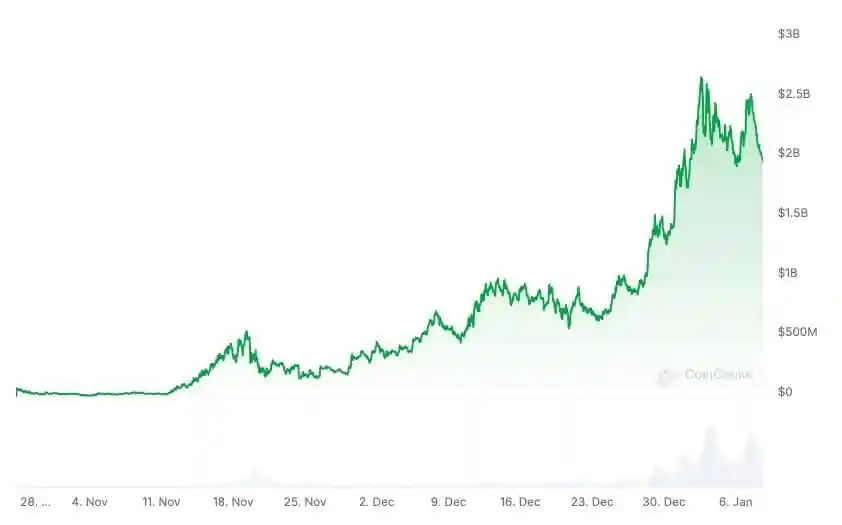
a16z to Hit $20 Billion Valuation in 2024
Welcome to the real gold rush.
It's easy for people to assume that current leaders will continue to dominate, with many drawing comparisons between Virtuals and a16z to early days of smartphones (iOS and Android).
However, this market is too vast and underdeveloped to be ruled by just two players. By the end of 2025, it is projected that at least ten new encrypted AI protocols (with tokens not yet released) will have a circulating (undiluted) market cap of over $1 billion.
Decentralized AI is still in its infancy. Additionally, the pool of talent is continuously growing.
Expect the arrival of new protocols, novel token models, and new open-source frameworks. These new entrants may displace existing players through a combination of incentive mechanisms (such as airdrops or clever staking), technical breakthroughs (like low-latency inference or chain interoperability), and user experience enhancements (no code). The shift in public perception could be sudden and dramatic.
This is both the beauty and the challenge of this field. Market size is a double-edged sword: the cake is huge, but the barrier to entry for tech teams is low. This sets the stage for explosive growth in projects, with many fading away gradually, but a few holding transformative power.
Bittensor, Virtuals, and a16z will not hold the lead forever. The next billion-dollar encrypted AI protocol is on the horizon. Savvy investors have plenty of opportunities, which is what makes it so exciting.
You may also like

Morning Report | BitMine increased its holdings by 126,971 ETH last week; trader Eugene announced his exit from the crypto market

Wang Chuan: How can one not feel anxious after the neighbor Old Wang made thirty times profit by investing in storage stocks? (Seven) - A quarter-century cycle

Cryptocurrency CEXs are flocking to sell US stocks, and traditional brokerages are facing an "uninvited guest."

$75 billion in foreign capital has fled, and South Korean retail investors have absorbed it all using leverage

Japan’s Three Megabanks Plan Joint Stablecoin Issuance in Fiscal 2026
MUFG, SMBC, and Mizuho reportedly plan to jointly issue fiat-pegged stablecoins in fiscal 2026, signaling Japan’s growing push into bank-led digital payment infrastructure.

Humanity Discloses H Token Dual-Chain Attack Details, With Losses on Ethereum and BSC Exceeding $36 Million
Humanity said the H token attack across Ethereum and BSC caused more than $36 million in losses after leaked ProxyAdmin keys enabled malicious contract upgrades and token minting.
White House Discusses CLARITY Act With Law Enforcement Ahead of Senate Vote
The White House discussed the CLARITY Act with law enforcement ahead of a Senate vote, focusing on illicit finance risks and developer protections.

Bitcoin Trading Guide 2026: Strategies for Experienced Traders

What Is XAUT and PAXG? Why Tokenized Gold Is Booming in 2026

Will the SpaceX IPO Hurt Bitcoin? Here's What Traders Are Watching

Foreign selling in the South Korean stock market accelerates, with cumulative net sales reportedly reaching $75 billion this year
On June 9, The Kobeissi Letter, citing Goldman Sachs data, reported that global investors are selling South Korean stocks at an unusually rapid pace. In the latest trading session, foreign investors sold about $801 million worth of Kospi constituent stocks again; total foreign outflows last week reached about $10 billion, and the market has been in net foreign selling on nearly every trading day over the past month. According to the data cited in the report, foreign investors have sold about $75 billion worth of South Korean stocks so far this year. Meanwhile, South Korean retail and institutional investors together recorded roughly $69 billion in net buying over the same period, suggesting that the market’s main buying support has come from domestic capital rather than returning overseas funds. The information currently disclosed still mainly comes from The Kobeissi Letter’s retelling and Goldman Sachs data summaries, while public details on the statistical period and the specific definition of “selling” remain relatively limited.

Fortune Warns of Strategy’s Financing Structure Risks as Bitcoin Premium Narrows
Fortune warned that Strategy’s Bitcoin treasury model faces growing financing risks as MSTR’s net asset premium narrows and preferred stock dividend pressure increases.

Ferrari Challenge Le Mans: Carl Moon to Dominate in WEEX Livery

Sahara AI Responds to SAHARA’s Sharp Drop: No Contract or Product Security Issues Found, Internal Investigation Underway
Sahara AI responded to SAHARA’s 60% price drop, saying no token contract or product security issues have been found and an internal investigation is underway.

WEEX Deposit/Withdrawal Dynamic Island: Your Asset Status, Always in Sight
Scaling Crypto Derivatives: The Digital Asset Infrastructure Behind High-Volume Trading
In the fast-moving digital asset ecosystem, derivatives platforms face an extreme architectural test. High-leverage futures markets demand more than just standard security—they require absolute operational precision, zero-latency matching engines, and ironclad structural scalability, all while navigating intense market volatility.
As global platforms scale to meet these demands, the industry is shifting away from rigid, monolithic setups toward a more agile, "decoupled" infrastructure philosophy.
The Blueprint for High-Volume Copy TradingFor elite global exchanges like WEEX (founded in 2018), this architectural choice becomes critical when scaling high-volume retail features like social copy trading. When thousands of users automatically mirror the real-time strategies of elite traders simultaneously, it triggers sudden, monumental spikes in concurrent transactional volume.
To prevent execution latency or settlement bottlenecks during these peak volatility events, a platform's primary engine must remain entirely dedicated to risk management, copy-trade synchronization, and order matching.
The Architectural Rule: New-generation platforms must separate front-end user execution engines from heavy backend infrastructural overhead to eliminate operational friction.
By separating these layers, platforms can maintain complete sovereignty over their trading environments and user experiences while strategically aligning with institutional-grade infrastructure ecosystems. This strategic framework allows modern exchanges to leverage advanced Digital Asset Custody infrastructure such as Cobo’s behind the scenes, ensuring that backend wallet management scales elastically alongside trading spikes.
Capitalizing on Market Momentum and 400× LeverageIn a derivatives arena where platforms offer up to 400× leverage on perpetual contracts, capital efficiency and market agility are core business metrics. To capture market momentum, an exchange needs the ability to rapidly expand its asset offerings, supporting everything from legacy crypto assets to sudden, trending altcoins across a massive library of trading pairs.
Adopting a flexible, scalable Wallet-as-a-Service (WaaS) solution such as Cobo’s could completely rewrite the development timeline for high-growth exchanges. Instead of spending months of engineering capital building out custom backend wallet architectures for every new blockchain network, platforms can deploy localized infrastructure in days.
This agility allows platforms to instantly scale their listings to over a thousand trading pairs without compromising security or delaying time-to-market. It mirrors the exact operational advantages seen during high-velocity market events, similar to how advanced wallet infrastructure empowers platforms during sudden asset surges; allowing exchanges to pass that speed and liquidity directly to their global user base.
A Mature Foundation for GrowthThe synergy between trusted infrastructure ecosystems and global trading platforms represents the natural evolution of a maturing crypto market. As WEEX continues to scale its global spot and derivatives offerings for over 6 million users, adopting robust backend paradigms proves that platforms no longer have to compromise between cutting-edge trading velocity and uncompromised structural security.

Get Paid to Onboard? Try WEEX’s New Homepage with Rewards for Registration, Deposit & Trade
WEEX Custom Layout: Build Your Perfect Trading Workspace in Seconds
Morning Report | BitMine increased its holdings by 126,971 ETH last week; trader Eugene announced his exit from the crypto market
Wang Chuan: How can one not feel anxious after the neighbor Old Wang made thirty times profit by investing in storage stocks? (Seven) - A quarter-century cycle
Cryptocurrency CEXs are flocking to sell US stocks, and traditional brokerages are facing an "uninvited guest."
$75 billion in foreign capital has fled, and South Korean retail investors have absorbed it all using leverage
Japan’s Three Megabanks Plan Joint Stablecoin Issuance in Fiscal 2026
MUFG, SMBC, and Mizuho reportedly plan to jointly issue fiat-pegged stablecoins in fiscal 2026, signaling Japan’s growing push into bank-led digital payment infrastructure.
Humanity Discloses H Token Dual-Chain Attack Details, With Losses on Ethereum and BSC Exceeding $36 Million
Humanity said the H token attack across Ethereum and BSC caused more than $36 million in losses after leaked ProxyAdmin keys enabled malicious contract upgrades and token minting.


