
The first stablecoin issuer Circle is quickly plummeting back to its opening price. What is the market worried about?

Original Author: Rubin, Top Influencer in the Knowledge Power List for Economics and Management
Editor's Note: This article is excerpted from a roundtable event on "Penetrating Stablecoins" jointly hosted by Zhihu and BlockBeats. The roundtable has accumulated over 26 million views since its launch, attracting widespread attention from both within and outside the industry. The event aims to present the latest developments, key mechanisms, and future trends of stablecoins to the public in a more intuitive and systematic manner.
Roundtable Link: https://www.zhihu.com/roundtable/stablecoin
The following is the original content:
Circle this quarter seems like a pig flying high on the high-interest rate trend, but the market is worried the wind direction may change:
Narrowing spreads, rising costs, single-profit business, regulatory uncertainty;
With these headwinds, companies flying high may also be prone to quick falls.
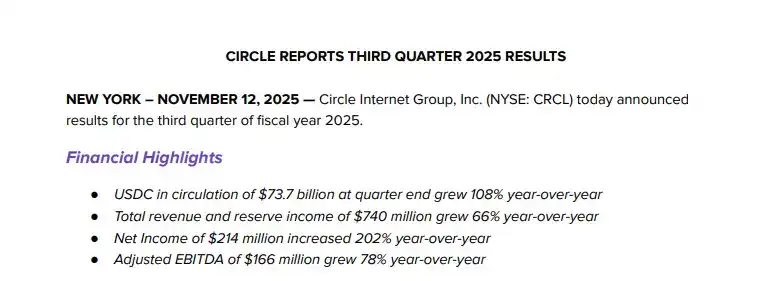
Imagine the stock market as a "marathon-style gamble," where yesterday player Circle rushed through a mid-race aid station (Q3) and achieved a good profit result. However, after investors reviewed the report, they believed that the upcoming slope, player pace, and aid may not be sustainable, leading to selling and causing a price drop.
1) Investors Focus More on the "Future"
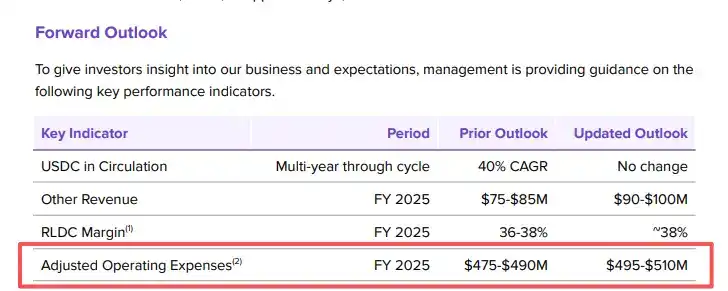
Although Circle significantly exceeded expectations in Q3, it also raised its full-year operating expense forecast ($495–510M). This implies that the company's future profit growth rate may be "eaten up," making it unable to achieve high profits again.
2) Reserve Yield Declining
Companies like Circle, which operate stablecoins, make a significant portion of their earnings through:
Issuing stablecoins, users buying stablecoins, and the company receiving dollars to purchase conservative asset investments such as government bonds/short-term notes
Take the spread without paying interest through this method.
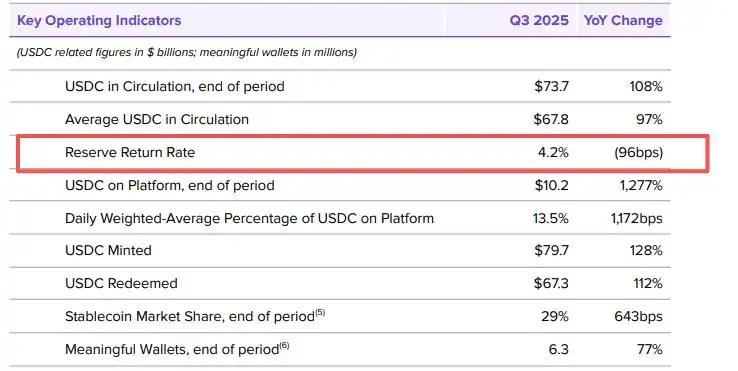
A report shows that although the total amount of reserve income is large, the reserve's simple interest return has decreased by approximately 96 bps.
If market interest rates decline or short-term yields compress, this profit-making method will significantly shrink in the future, directly impacting earnings.
3) Income Highly Relies on "Reserve Income"
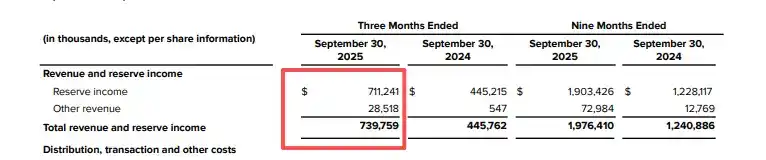
Out of Q3's $740M, the vast majority comes from reserve income ($711M), while "other income" (subscriptions, services, transactions, etc.) is only $29M.
This means that Circle's current business is more like a large treasury that doesn't need to pay interest to users, rather than a traditional SaaS or payment company;
When the market is concerned about narrowing spreads or regulatory impact, this single-income model will be discounted.
4) Regulatory and Policy Risks
Stablecoins are closely related to reserve assets, and any regulation (such as strict rules from the U.S. Congress/regulators on stablecoins) or on reserve assets (such as restrictions on holding government bonds/short-term notes) will affect revenue expectations.
During regulatory uncertainty, investors often demand a higher risk premium, leading to sell-offs and stock price declines.
In fact, Circle is currently in a delicate stage:
Its profit model is sound, its compliance foundation is solid, but the growth story is losing momentum.
Perhaps in the eyes of many traditional investors, it is more like a "dollar fund company," making safe but unimaginative money.
You may also like

Morning News | CME Group launches Nasdaq Cryptocurrency Index futures; Asset management giant Janus Henderson strategically invests in Ethena

Why did Oracle deliver the strongest financial report in history, yet its stock price fell?

Bitcoin Layer 2 Network Botanix: Why Did We Choose to Dissolve?

Morning Report | OpenAI has submitted an S-1 registration statement draft to the U.S. SEC; Morpho completes $175 million financing

Galaxy Deep Research Report: How Hyperliquid's HIP-4 Upgrade Changes the Landscape of Prediction Markets?

Latest research from 13 top universities including Cornell University: The current state, challenges, and misconceptions of the fusion of Crypto and AI
Deconstructing Anthropic: The Best AI Company, Possibly Also a Type of Organizational Invention

Every exchange is a "Universal Exchange."

The counterattack of traditional finance: Alliance chains are quietly reviving
Pantera Capital Partner: How Tokenization is Restructuring the Private Equity and Early Investment Ecosystem?

Mastercard Launches Agent Pay for AI, Plans to Record AI Agent Payment Authorizations on Polygon
Mastercard launched Agent Pay for AI, a new payment protocol designed to help AI agents make small payments such as pay-per-use access to data and APIs. The system plans to record human-granted AI agent permissions on Polygon, focusing on verifiable authorization, identity, and payment controls.

Curve Deploys Llamalend v2 on Optimism With 250,000 OP Incentives
Curve launched Llamalend v2 on Optimism with 250,000 OP incentives from the Optimism Foundation. The upgrade expands Llamalend beyond its earlier crvUSD-focused model, adding broader collateral support, LlamaRisk market reviews, and the ability to use Curve LP tokens as collateral.

Raydium Old Liquidity Pool Reportedly Exploited, With $1.34 Million Moved to Ethereum and Tornado Cash
An old Raydium liquidity pool was reportedly exploited for around $1.34 million in USDC, RAY, and wSOL, with the stolen funds bridged to Ethereum and deposited into Tornado Cash. The incident highlights the tail risks of legacy DeFi pools, old contracts, and cross-chain fund laundering paths.
Kalshi Executive Challenges “SBF Backed AI Unicorns” Narrative, Says Leopold Aschenbrenner Was Key Figure
Kalshi executive John Wang questioned the “SBF backed AI unicorns” narrative, saying Leopold Aschenbrenner was the key figure behind major AI investment decisions.

New York Proposes Stricter Stablecoin Issuer Rules Aligned With Federal GENIUS Act
NYDFS proposed stricter stablecoin issuer rules aligned with the GENIUS Act, covering reserves, custody, redemption timelines, audits, and capital buffers.

CryptoQuant Says Bitcoin Profitable Supply Is Near 45% Pressure Zone as On-Chain Data Points to Market Repricing
CryptoQuant said Bitcoin’s profitable supply is nearing the 45% pressure zone, signaling rising market stress, unrealized losses, and a possible on-chain repricing phase.

Bitcoin Falls Below 200-Week Moving Average as On-Chain Data Shows Over Half of Supply in Loss
Bitcoin dropped below its 200-week moving average as on-chain data showed over 50% of circulating supply is now in loss, signaling rising market stress.

CFTC Reportedly Plans New Prediction Market Rules Focused on Manipulation Risk and Public Interest Review
The CFTC is reportedly preparing new prediction market rules focused on manipulation risk, public interest review, and retail trader protections.
Morning News | CME Group launches Nasdaq Cryptocurrency Index futures; Asset management giant Janus Henderson strategically invests in Ethena
Why did Oracle deliver the strongest financial report in history, yet its stock price fell?
Bitcoin Layer 2 Network Botanix: Why Did We Choose to Dissolve?
Morning Report | OpenAI has submitted an S-1 registration statement draft to the U.S. SEC; Morpho completes $175 million financing
Galaxy Deep Research Report: How Hyperliquid's HIP-4 Upgrade Changes the Landscape of Prediction Markets?
Latest research from 13 top universities including Cornell University: The current state, challenges, and misconceptions of the fusion of Crypto and AI

Popular coins
Latest Crypto News


