
 Buy Crypto
- Markets
 Futures
- Spot
- Copy Trade
- Earn
- More
The Culprit Behind AI's Shutdown? The "daos.fun Bubble" Behind AICC's Plummet

As a project that promotes a "VC-free Investment DAO Platform," daos.fun instead staged a weekend drama of "VC Coins."
On January 11, Aiccelerate DAO's native token AICC, supported by ai16z co-founder Shaw, Virtuals Protocol contributor #001 Ethermage, and Story co-founder Jason as advisors, was officially launched for trading. After the launch, AICC's market value briefly surpassed $3 billion. However, this momentary highlight was soon shattered by a frenzy of sell-offs. Whale dumping caused a significant drop in market value, sparking strong dissatisfaction in the market.
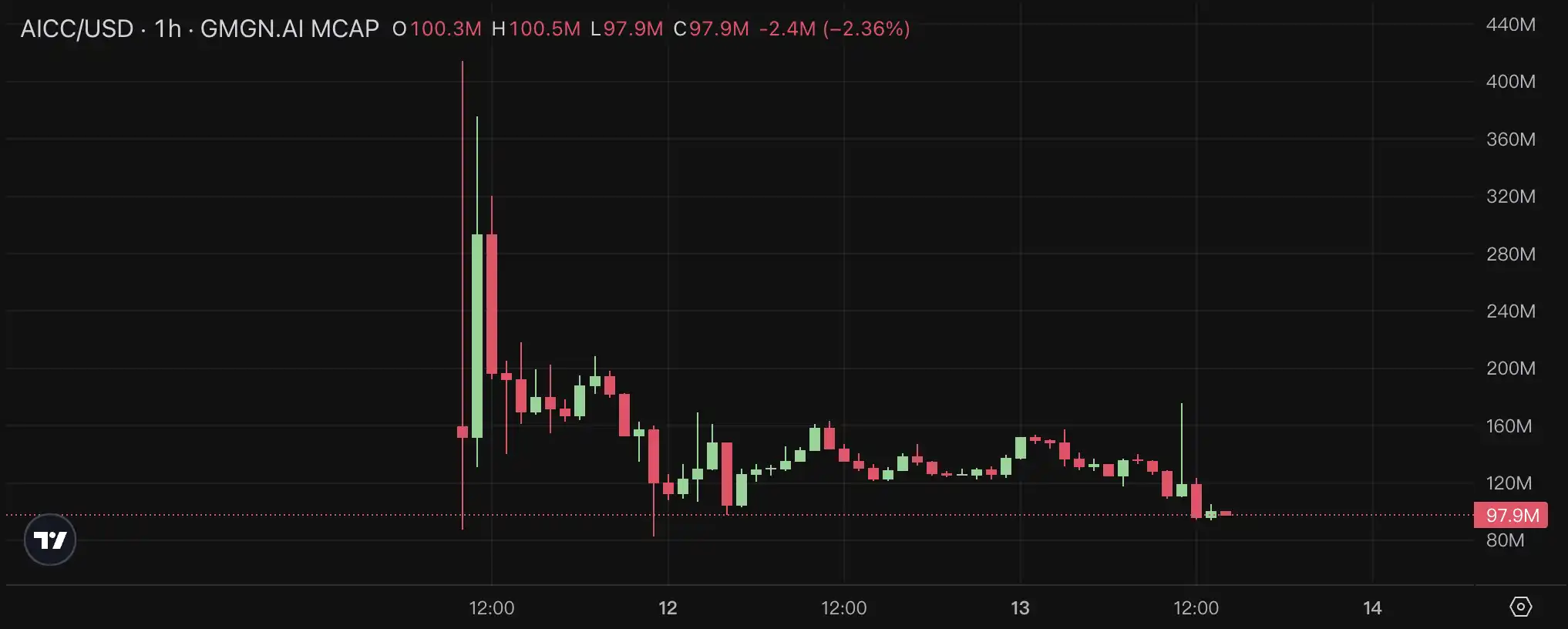
Immediate Sell-Off upon Launch Sparks Outrage
The hype around Aiccelerate DAO started a week ago, with the official announcement that users interested in becoming partners and participating in the presale could express their interest and how they could help the project through actions such as retweeting, liking, and commenting on tweets. Aiccelerate DAO would then select suitable partners for the presale based on user participation and expected contribution.
Using the daos.fun platform, Aiccelerate DAO distributed tokens to 250 KOLs, with each receiving an allocation of 0.5 SOL. These tokens instantly turned into $250,000 to $400,000 each upon launch. Additionally, the project's advisory group could donate stakes capped at 5 SOL.
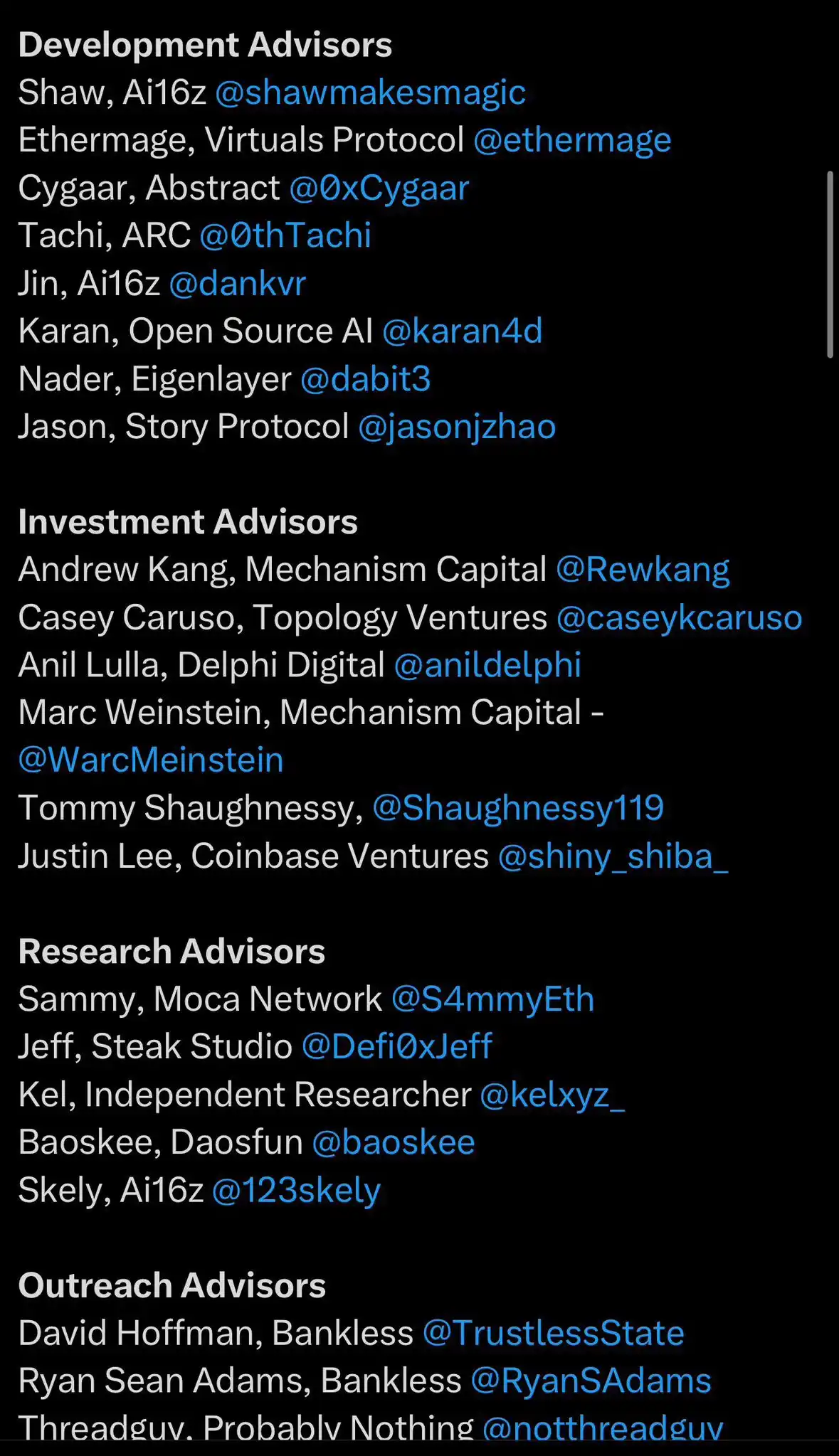
However, these whitelisted users not only failed to fulfill their commitment to supporting the project's development but also chose to immediately sell for profit upon launch. This not only caused a drastic drop in AICC's market value but also had a blood-sucking impact on other AI concept tokens on the chain.
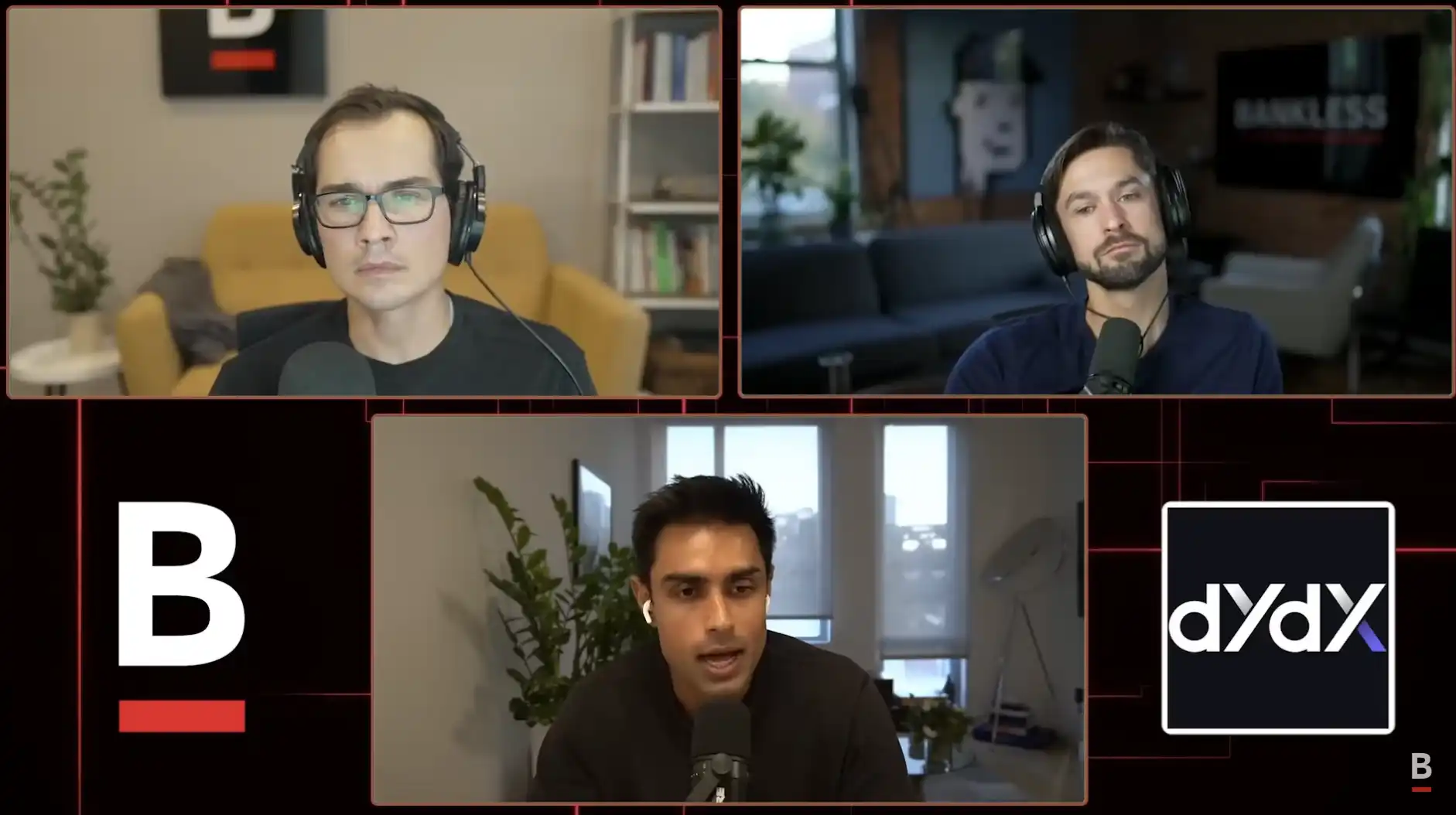
In this "Crypto+AI" race track KOL gathering, the most criticized behavior was from the crypto podcast Bankless with a significant holding and its VC arm, Bankless Ventures, regarding their sell-off actions post AICC launch.
The Rollup founder Andy tweeted that Bankless Ventures was selling tokens through a publicly associated wallet with their X account. "They are promoting this project on YouTube with the co-founder while selling on the day of launch."
Reportedly, Bankless's two hosts each invested 5 SOL, Ben Lakoff managing Bankless Ventures invested 2 SOL under Ventures, and personally invested 5 SOL.
The founder of Aiccelerate DAO, Ejaaz, previously served as a product manager at Coinbase. In November last year, Ejaaz began making frequent appearances on the Bankless podcast to discuss AI+Crypto.
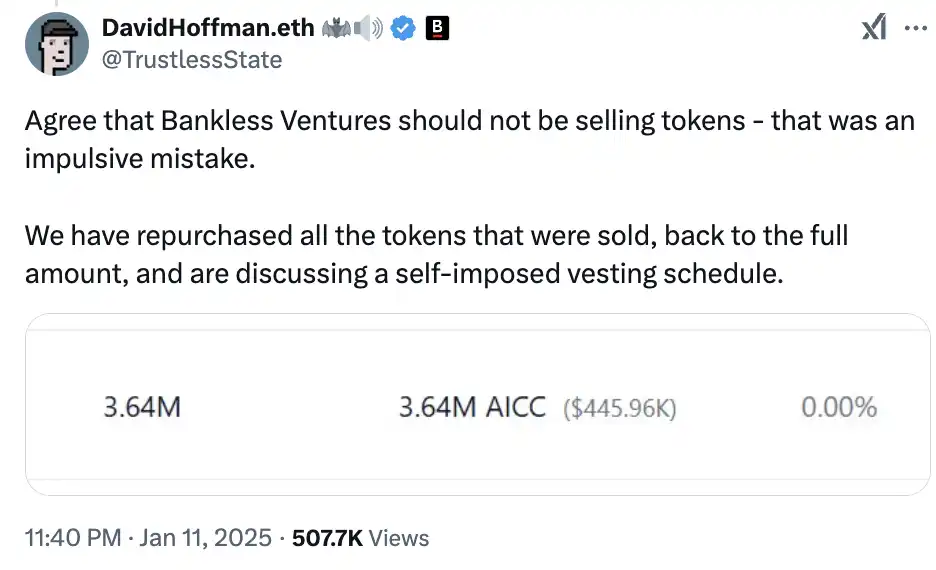
Following Andy's tweet, Bankless co-founder David responded by stating that they had initiated a buyback of the AICC shares sold by Bankless Ventures, referring to it as "an impulsive mistake."
However, Bankless's brand image took a significant hit, with members of the community mentioning Bankless's show sponsor, accusing them of being an accomplice to fraud.
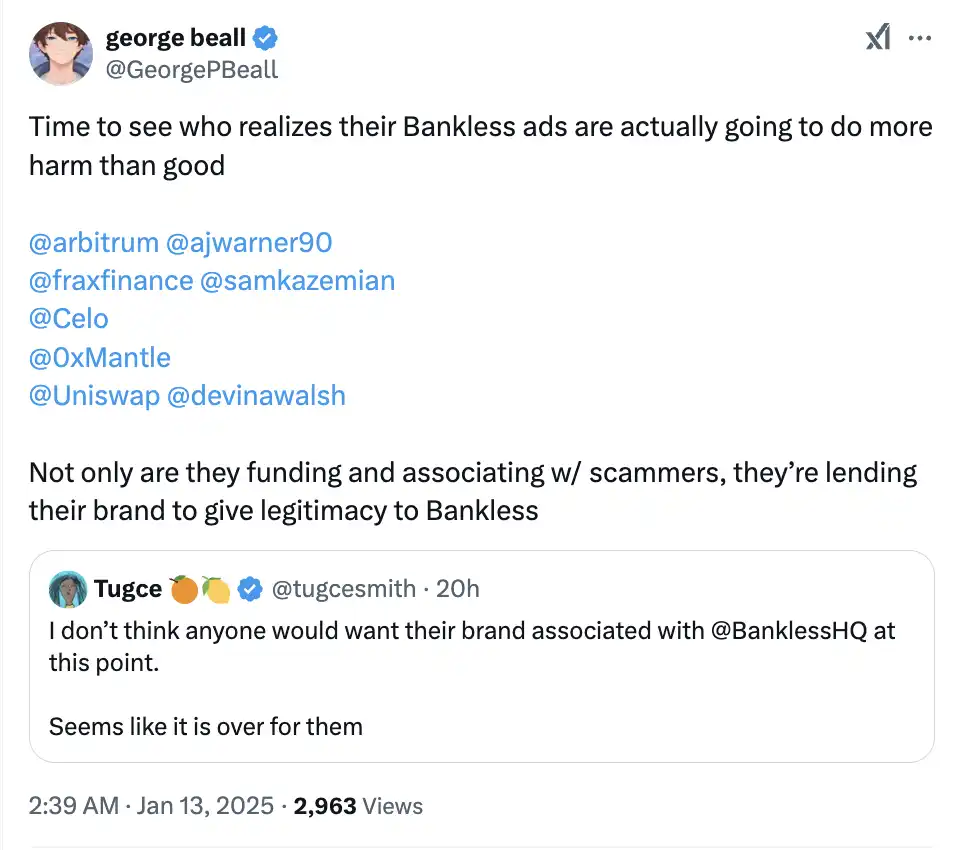
In the latest Bankless Discord channel, Bankless co-founder Ryan responded, stating that both he and David were completely unaware of the token sale and that it was carried out by Ben Lakoff, who lacked an understanding of Aiccelerate DAO's background, for the purpose of profit-taking.
Will the market still support daos.fun?
Amidst this labyrinthine token dump, daos.fun's whitelist mechanism has been a focal point of market attention. It is not a casual endorsement in the project's comment section that grants whitelist access; typically, only Key Opinion Leaders (KOLs) with a large following and community base receive whitelist status to advocate for the project.
daos.fun is another standout asset launch following pump.fun; however, daos.fun is a fund launchpad where the "fund" launched through daos.fun will operate in the form of a DAO and issue corresponding DAO tokens.
A select few creators with an invitation code can set fundraising goals, fund expiration, and management fees. Additionally, daos.fun's fundraising process introduces whitelist rules, where the team selectively distributes fundraising participation eligibility to users based on community engagement through their social accounts to establish a certain level of social reputation and ethical constraints.
However, AICC, with its large and luxurious KOL lineup and a chart that saw a significant sell-off after a strong initial listing, has challenged the ethical lock-up mechanism of daos.fun. On one hand, the project initiating the investment DAO did not have clear whitelist criteria, and on the other hand, users who acquired tokens at a low price during the fundraising phase are not immune to selling off quickly as the project gains traction.
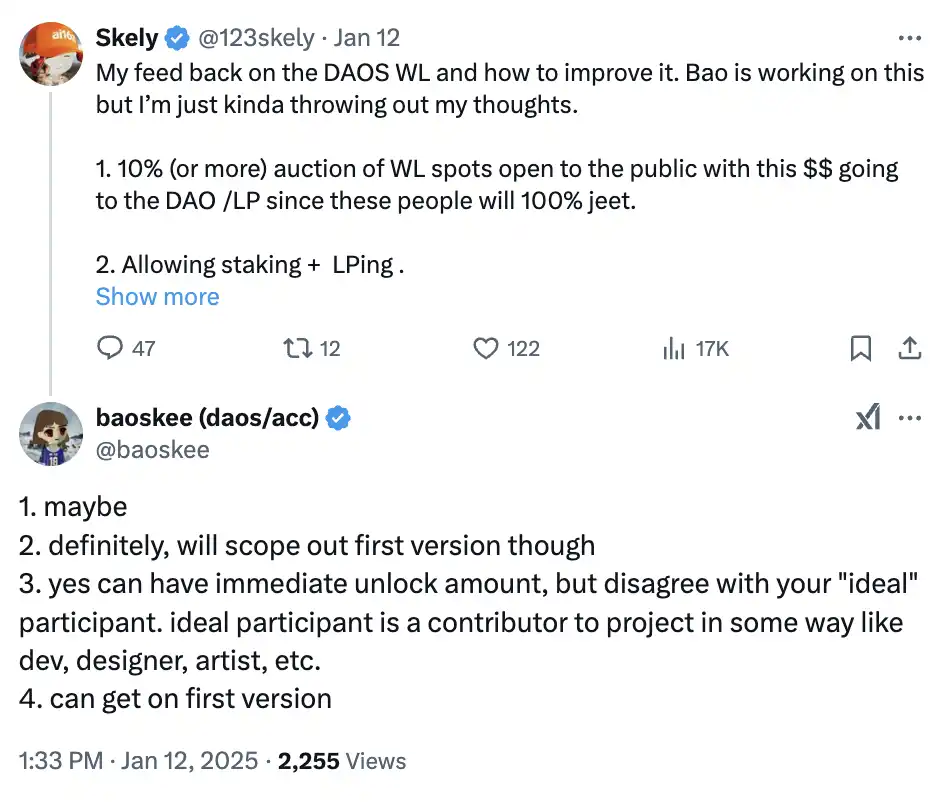
The crypto Key Opinion Leader (KOL) Skely believes the ideal whitelist participant should be someone who 「sells at the peak and buys at the dip, stabilizes the price by providing a large amount of liquidity, is willing to take risks, and injects their SOL funds and tokens into the liquidity pool together.」 However, obviously, this is not behavior that a purely profit-driven individual would choose.
Skely believes that the current whitelist mechanism of daos.fun can be improved through the following suggestions, such as: allocating 10% (or more) of the whitelist slots through public auction to the public, with the auction proceeds used for the DAO or liquidity pool (LP) since these individuals typically tend to quickly cash out. Allowing staking and liquidity provision. And allowing whitelist users to sell to a certain extent, but with transparent rules in place to set buyer expectations while avoiding full-scale dumping.
The founder of daos.fun, baoskee, responded that all of these suggestions are feasible.
Meanwhile, the community also criticized AICC, which launched with a high valuation even before having a product, following the same script that led to the backlash against VC coins in the past – where pricing power is in the hands of the project team, packaging it in the market to sell it back to retail investors. Whether it is a core player donating 5 SOL or a KOL receiving a 0.5 SOL share through 「sweet talk,」 under the current token issuance model, any process of 「presale + whitelist + immediate trading upon listing」 is challenging to rid of speculators entirely.
Peeling off the glamorous façade, 「Crypto+AI」 still requires sufficient product support and real-world use cases to establish a foothold in the current fiercely competitive market. Instead of being labeled as a 「AI concept stock」 bubble, it is better to allow users to truly experience the project's technical depth and practical long-term planning. This is also the only way for investors to return to rationality and reject 「VC coins.」
You may also like

Consumer-grade Crypto Global Survey: Users, Revenue, and Track Distribution

Prediction Markets Under Bias

Stolen: $290 million, Three Parties Refusing to Acknowledge, Who Should Foot the Bill for the KelpDAO Incident Resolution?

ASTEROID Pumped 10,000x in Three Days, Is Meme Season Back on Ethereum?

ChainCatcher Hong Kong Themed Forum Highlights: Decoding the Growth Engine Under the Integration of Crypto Assets and Smart Economy

Why can this institution still grow by 150% when the scale of leading crypto VCs has shrunk significantly?

Anthropic's $1 trillion, compared to DeepSeek's $100 billion

Geopolitical Risk Persists, Is Bitcoin Becoming a Key Barometer?

Annualized 11.5%, Wall Street Buzzing: Is MicroStrategy's STRC Bitcoin's Savior or Destroyer?

An Obscure Open Source AI Tool Alerted on Kelp DAO's $292 million Bug 12 Days Ago

Mixin has launched USTD-margined perpetual contracts, bringing derivative trading into the chat scene.
The privacy-focused crypto wallet Mixin announced today the launch of its U-based perpetual contract (a derivative priced in USDT). Unlike traditional exchanges, Mixin has taken a new approach by "liberating" derivative trading from isolated matching engines and embedding it into the instant messaging environment.
Users can directly open positions within the app with leverage of up to 200x, while sharing positions, discussing strategies, and copy trading within private communities. Trading, social interaction, and asset management are integrated into the same interface.
Based on its non-custodial architecture, Mixin has eliminated friction from the traditional onboarding process, allowing users to participate in perpetual contract trading without identity verification.
The trading process has been streamlined into five steps:
· Choose the trading asset
· Select long or short
· Input position size and leverage
· Confirm order details
· Confirm and open the position
The interface provides real-time visualization of price, position, and profit and loss (PnL), allowing users to complete trades without switching between multiple modules.
Mixin has directly integrated social features into the derivative trading environment. Users can create private trading communities and interact around real-time positions:
· End-to-end encrypted private groups supporting up to 1024 members
· End-to-end encrypted voice communication
· One-click position sharing
· One-click trade copying
On the execution side, Mixin aggregates liquidity from multiple sources and accesses decentralized protocol and external market liquidity through a unified trading interface.
By combining social interaction with trade execution, Mixin enables users to collaborate, share, and execute trading strategies instantly within the same environment.
Mixin has also introduced a referral incentive system based on trading behavior:
· Users can join with an invite code
· Up to 60% of trading fees as referral rewards
· Incentive mechanism designed for long-term, sustainable earnings
This model aims to drive user-driven network expansion and organic growth.
Mixin's derivative transactions are built on top of its existing self-custody wallet infrastructure, with core features including:
· Separation of transaction account and asset storage
· User full control over assets
· Platform does not custody user funds
· Built-in privacy mechanisms to reduce data exposure
The system aims to strike a balance between transaction efficiency, asset security, and privacy protection.
Against the background of perpetual contracts becoming a mainstream trading tool, Mixin is exploring a different development direction by lowering barriers, enhancing social and privacy attributes.
The platform does not only view transactions as execution actions but positions them as a networked activity: transactions have social attributes, strategies can be shared, and relationships between individuals also become part of the financial system.
Mixin's design is based on a user-initiated, user-controlled model. The platform neither custodies assets nor executes transactions on behalf of users.
This model aligns with a statement issued by the U.S. Securities and Exchange Commission (SEC) on April 13, 2026, titled "Staff Statement on Whether Partial User Interface Used in Preparing Cryptocurrency Securities Transactions May Require Broker-Dealer Registration."
The statement indicates that, under the premise where transactions are entirely initiated and controlled by users, non-custodial service providers that offer neutral interfaces may not need to register as broker-dealers or exchanges.
Mixin is a decentralized, self-custodial privacy wallet designed to provide secure and efficient digital asset management services.
Its core capabilities include:
· Aggregation: integrating multi-chain assets and routing between different transaction paths to simplify user operations
· High liquidity access: connecting to various liquidity sources, including decentralized protocols and external markets
· Decentralization: achieving full user control over assets without relying on custodial intermediaries
· Privacy protection: safeguarding assets and data through MPC, CryptoNote, and end-to-end encrypted communication
Mixin has been in operation for over 8 years, supporting over 40 blockchains and more than 10,000 assets, with a global user base exceeding 10 million and an on-chain self-custodied asset scale of over $1 billion.

$600 million stolen in 20 days, ushering in the era of AI hackers in the crypto world
Vitalik's 2026 Hong Kong Web3 Summit Speech: Ethereum's Ultimate Vision as the "World Computer" and Future Roadmap
On the same day Aave introduced rsETH, why did Spark decide to exit?
Full Post-Mortem of the KelpDAO Incident: Why Did Aave, Which Was Not Compromised, End Up in Crisis Situation?

After a $290 million DeFi liquidation, is the security promise still there?
ZachXBT's post ignites RAVE nearing zero, what is the truth behind the insider control?




 App
App