
Tako Debate - The Pros and Cons of Anonymous Socializing


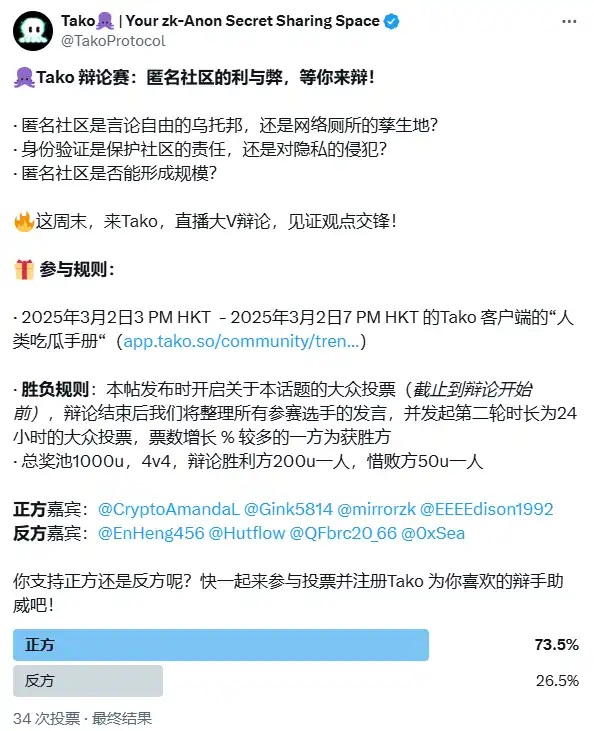
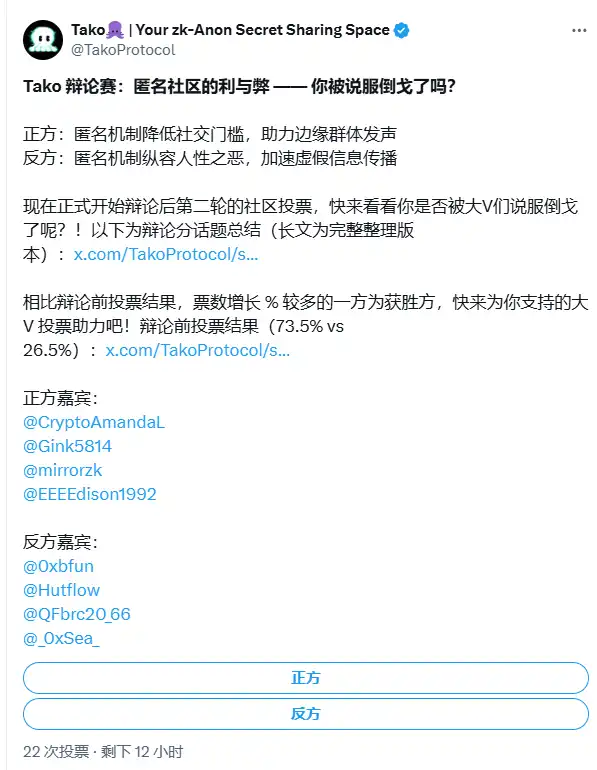
BlockBeats News, March 3rd, the "Pros and Cons of Anonymous Community" themed text debate hosted by Tako officially took place on the Tako platform yesterday, with the specific "circle" being "Human Spectator Handbook." The second round of community voting after the start of the debate has now begun, and the voting will last for 24 hours. The side with the higher percentage increase in votes will be the winning side. Users can click on the original article link to vote for their favorite participant.
On March 2nd, Tako invited 8 debaters on the platform to express their views and engage in a lively discussion on the following topic within the "Human Spectator Handbook" circle on Tako!
Affirmative Side: The Anonymous Mechanism Lowers Social Barriers, Empowering Marginalized Groups to Speak Out
Negative Side: The Anonymous Mechanism Encourages Human Nature's Dark Side, Accelerating the Spread of False Information
Affirmative Side Guests:
@CryptoAmandaL / @Gink5814 / @mirrorzk / @EEEEdison1992
Negative Side Guests:
@0xbfun / @Hutflow / @QFbrc20_66 / @_0xSea_
Once again, thank you to all the participating debaters for their active involvement, which has also sparked many community UGC discussions during the debate!
Below is a summary of the sub-topics of this debate. Come see if any side has convinced you to switch allegiances!
Topic One: Can Anonymity Lower Social Barriers and Help Marginalized Groups Speak Out
Amanda @CryptoAmandaL
(Affirmative)
She is straightforward, believing that the anonymity mechanism can break identity constraints, allowing vulnerable or marginalized groups to no longer be "silenced" due to factors such as gender or social status.
For example, sexual minorities and women are more willing to share sensitive topics in an anonymous environment, such as workplace sexual harassment and domestic violence; anonymous communities like "r/TwoXChromosomes" provide a safe space for speaking out.
Conclusion: Anonymity reduces social anxiety and allows more people to have equal opportunities for expression.
Duck @0xbfun
(Negative)
He questions whether an anonymous environment can truly help vulnerable groups: if the online atmosphere itself is toxic, anonymity is ineffective and may even perpetuate their "hidden" status.
He believes the fundamental issue lies in community culture rather than the level of anonymity.
Amanda @CryptoAmandaL
(Affirmative) response
She argues that anonymity is not the root of the problem; with proper regulation, malicious behavior can be deterred. In contrast, the threat of discrimination under real names makes the marginalized hesitant to speak out. She questions, "Are marginalized groups freer without anonymity?" and believes that anonymity is precisely their "safe haven."
Topic Two: Anonymity and "Human Nature's Dark Side," Rumors, and Information Authenticity
Amanda @CryptoAmandaL
(Affirmative)
She emphasizes that rumors and malice are not unique to anonymity; false information also exists under real names. The MeToo movement relied on anonymous disclosures to bring many truths to light.
She believes the focus should be on content moderation or verification, rather than a blanket ban on anonymity.
Duck @0xbfun
(Negative)
He repeatedly mentions that "anonymity does not control malice; human nature goes straight to 'cheat mode,'" suggesting that a large number of trolls and rumors are hard to trace, which can overwhelm the community with negative energy.
He proposes improvement mechanisms such as "AI patrols" or "online courts," but still insists that "simple anonymity" is more likely to lead to a breakdown of trust.
Amanda's and the Negative side's clash
Amanda refutes the notion that all rumors spreading can be attributed to anonymity, as false information can arise in a named environment as well. She is more concerned with "how to manage" rather than "what's wrong with anonymity."
Topic Three: The Impact of Anonymity on UGC Ecology and the Sustainable Development of Social Platforms
0xSea @_0xSea_
Expressed a strong "Death of Anonymity" viewpoint: successful social/community products often rely on a "healthy relationship chain" and positive UGC, requiring an ID to accumulate followers and content.
Pointed out that mainstream social platforms like Facebook and WeChat succeed based on real-name relationships and network effects; complete anonymity cannot foster valuable content or establish a fanbase or relationship chain.
Emphasized that a pseudonym is actually a form of "semi-real-name," as long as there is a continuous recognizable ID, one can build credibility. If every post is purely anonymous, without any traceable ID, reputation and content accumulation would not be possible.
Believed that a good community requires a traceable ID to allow high-quality UGC to continue to be produced and disseminated.
Amanda @CryptoAmandaL
(Pro side)
Responded: One cannot blanketly dismiss the value of anonymity based on worst-case scenarios.
Anonymity can be complemented by technological and rule-based management to meet the needs of specific users. She also cited examples of many people using "alt accounts" even on real-name platforms, proving that anonymity (or partial anonymity) is a practical necessity.
Topic Four: Satoshi Nakamoto and BTC: Anonymous Success or Pseudonymous Long-Term Credit?
Gink @Gink5814
(Pro side)
Viewed Satoshi Nakamoto as an "anonymous success model," where the Bitcoin revolution was brought about by the fact that "no one knows who he/she is." Also provided an example of the Reddit "wallstreetbets" anonymous group collectively disrupting Wall Street. Believed that true memes come from a community rather than a celebrity.
Believed that an anonymous community could potentially nurture "new wealth codes."
On the blockchain, through ZK technology, a balance between privacy and reputation can be achieved — anonymity does not equate to lack of credit.
In his view, the "on-chain footprint" is more valuable than an ID card, as through encryption, one can both conceal their real identity and retain performance or contribution records.
0xSea @_0xSea_
(Con side)
Argued that Satoshi Nakamoto was not a "random anonymous" figure but had an identifiable pseudonym "Satoshi," gaining community trust and attention through consistent posting and open-source code contributions. If completely anonymous with every post marked as anonymous, no influence would have been established.
Emphasized that an ID that can accumulate credit is not considered pure anonymity.
Hut @Hutflow
(Opposition)
Points out that the success of BTC does not equate to "anonymity inevitably succeeding," as anonymity has also fostered many scams and online violence. Not all anonymous entities can be as successful as Satoshi Nakamoto.
Topic Five: Anonymity and Personal Privacy, Psychological Unburdening
Mirror @mirrorzk
(Proponent)
Emphasizes that anonymity is a form of release and guidance for those with mental illnesses or violent fantasies. He gives the example that "intrusive thoughts" require a safe outlet, otherwise they may escalate to extremes.
He also references a study (CHI conference) indicating that anonymity can enhance self-disclosure and has a more significant promoting effect on negative content expression.
QingFeng @QFbrc20_66
Admits that in extremely rare circumstances, anonymity is appropriate, such as doing good deeds anonymously or protecting special groups. However, he believes that most people ultimately need to return to real life and, to some extent, need to provide some form of identification when going downstairs to buy things.
He says he "prefers to live openly in the sunshine," likening "complete anonymity" to a "sewer rat" that cannot stand the light.
Topic Six: Balancing the Freedom of Anonymity with Community Governance
EdisonChen (Proponent)
Argues that anonymity is part of freedom, and without anonymity, there is no real freedom of speech.
He mentions that technological means (ZK) can obtain group credit without revealing true identity, thus balancing privacy and credibility.
Pear @0xbfun
(Opposition)
Believes that anonymity is like a "nuclear reaction," capable of both generating power and causing destruction. There must be stronger regulations or filtering mechanisms; otherwise, malicious speech and rumors are likely to erode the system.
He emphasizes that "simple anonymity" often ruins the long-term development of a community.
0xSea @_0xSea_
Taking a product manager's perspective, he is concerned that anonymity cannot achieve scalable competition and user retention.
He further distinguishes between "government perspective real-name" and "community perspective real-name," stating that as long as users have a fixed ID and have established credit precipitation, it is not purely anonymous. He also believes that Wikipedia is mostly "PGC" rather than a true UGC community and cannot be likened to large-scale social media platforms.
Topic Seven: Defining the Boundaries of Anonymity (Pure Anonymity vs. Pseudonym vs. Pseudo-Real-Name)
Amanda @CryptoAmandaL
(Pro) defines "anonymity" as "users expressing opinions or interacting without revealing their real identity," emphasizing its ability to protect the vulnerable. However, she did not distinguish in detail between "single non-identifiable anonymity" and "continuously ID-ed pseudonym."
0xSea @_0xSea_
(Con) has repeatedly mentioned: if someone has a stable and accumulatable creditable ID, then from a community product perspective, this is already considered "quasi real-name" or pseudonym, rather than "purely anonymous."
He said, "If the speaking ID is always called anonymous, there is no way to distinguish who is who, making it impossible to establish fan relationships and credit."
Gink @Gink5814
(Pro) using Satoshi Nakamoto as an example, mentioned that Satoshi is a non-sovereign pseudonym; blockchain technology can also allow individuals to accumulate an on-chain footprint and record in an "anonymous" manner, equivalent to "pseudonym + reputation system." In his view, this is also a form of "anonymity" as it is not tied to a government ID or passport.
Qingfeng @QFbrc20_66
(Con) leans more towards dividing anonymity into a state of "truly invisible" and a state of "having a fixed online handle, but not equivalent to real-name identity verification." To him, the latter is not true anonymity but masked while still being traceable in terms of identity/credit.
Second Round of Community Voting
Intersection of Views and Reflection
From this debate, it is evident that whether "anonymity" in social contexts is a benefit or a harm does not have a single answer. There are also multiple forms such as "pure anonymity," "pseudonym/online handle," and "real name/quasi real name."
Proponents (Amanda, Gink, EdisonChen, Mirror, etc.) value anonymity for its positive impact on vulnerable groups, freedom of speech, emotional release, and innovation (blockchain). They also believe that through regulation and technology (such as AI filtering, ZK), malicious behavior can be mitigated, retaining the benefits of "anonymity lowering barriers."
Opponents (Dali, 0xSea, LittleHouse, Qingfeng, etc.), on the other hand, believe that "simple anonymity" tends to amplify human nature's evil and rumors, which are detrimental to the long-term operation of communities. They emphasize that the community needs an "identifiable or accumulable" ID to form a robust UGC ecosystem and user relationship chain.
In the Satoshi Nakamoto case, the two sides hold different views: proponents see it as an exemplary case of anonymity, while opponents see it as a classic case of pseudonymity/identifiable credit.
On the psychological and privacy levels, proponents point out that anonymity is crucial for emotional release and privacy protection, while opponents believe that ultimately people need to return to reality and that complete anonymity is not a universal need for most people.
Around the "boundary of anonymity," the two sides reached consensus or disagreement in their discussions: Consensus: There are not only the two extremes of "government real-name" and "absolute anonymity," but also an intermediate form like "pseudonym/username," which can accumulate credit and to some extent protect privacy. Disagreement: Proponents tend to consider "pseudonym" as part of anonymity, while opponents emphasize that "identifiable ID = not truly anonymous." This also determines their differing views on whether "anonymous community content can settle."
Perhaps these disagreements also reflect the multi-faceted nature of anonymity: it can bring true freedom of speech and a sense of security, but it can also drown communities in rumors and attacks. In the end, it depends on how platform design, technological support, and community culture work together to find a balance between "anonymous freedom" and "healthy governance." As many have said, anonymity itself is neither absolutely good nor bad; it is a form of freedom and a fundamental right. The key is how it is appropriately used and how the governance mechanism behind it operates.
This article is a contribution and does not represent the views of BlockBeats.
Original Article Link
You may also like

The other side of Musk's trillion-dollar fortune: 85% cannot be sold

Citibank releases "2030 Asset Tokenization Market Outlook": 6 major trends may create a $8.2 trillion market

The trillion-dollar valuation test: Are the three major super IPOs a celebration for tech stocks or a nightmare for the crypto market?

Morning Report | Digital Asset completes $355 million financing led by a16z Crypto; Meta completes operational separation from Manus

a16z Crypto Partner: Cash flow is the moat

Cryptocurrency market makers collectively seek change as it becomes increasingly difficult to make money

How TradeXYZ, xStocks, and Alpaca break down the SpaceX IPO into three different strategies

$75 billion in risk asset redistribution: How will SpaceX's IPO affect U.S. stocks and Bitcoin?

Why Is BlackRock Investing $5 Billion in the SpaceX IPO?
Morning News | CME Group launches Nasdaq Cryptocurrency Index futures; Asset management giant Janus Henderson strategically invests in Ethena

Bitcoin Layer 2 Network Botanix: Why Did We Choose to Dissolve?

Why did Oracle deliver the strongest financial report in history, yet its stock price fell?
When the P2P illicit funds from ten years ago turned into 60,000 bitcoins
Dialogue with OmenX Founder: Why does the prediction market need an evolution from "spot" to "derivatives"?
Galaxy in-depth report: Is Solana still worth paying attention to?
Young people in South Korea make a "final effort" in the epic bull market
The pricing controversy of Trade.xyz exposes the fatal weakness of Pre-IPO perpetual contracts

How much longer can Ethereum's last big buyer hold on?
The other side of Musk's trillion-dollar fortune: 85% cannot be sold
Citibank releases "2030 Asset Tokenization Market Outlook": 6 major trends may create a $8.2 trillion market
The trillion-dollar valuation test: Are the three major super IPOs a celebration for tech stocks or a nightmare for the crypto market?
Morning Report | Digital Asset completes $355 million financing led by a16z Crypto; Meta completes operational separation from Manus
a16z Crypto Partner: Cash flow is the moat
Cryptocurrency market makers collectively seek change as it becomes increasingly difficult to make money


