
Should I sell the Kaito airdrop, let's see what the community says?


On February 20, Kaito Airdrop was officially launched, a AI-driven crypto project backed by top VCs with a valuation of up to 17 billion USD, sparking widespread global community attention. As a representative of the "Yap-to-Earn" model, Kaito rewards users through social media interactions, aiming to take the InfoFi concept to new heights.
According to the information released by Kaito, the core mechanism of this airdrop revolves around "Yap Points." Tokenomics show that 10% of the tokens are initially allocated to the community (56.67% of the total supply is planned for community and ecosystem, 19.5% for long-term incentives), with the rest allocated to the team (35%) and early investors (8.3%). The officials emphasize support for long-term holders and incentivize users through the "HODLer badge" and Genesis NFT bonuses.
After the launch of KAITO, the market performance remained relatively stable. According to market data, compared to some airdrop projects that experienced over 50% price drops on the first day, Kaito's airdrop saw price fluctuations of around 30% on the same day.
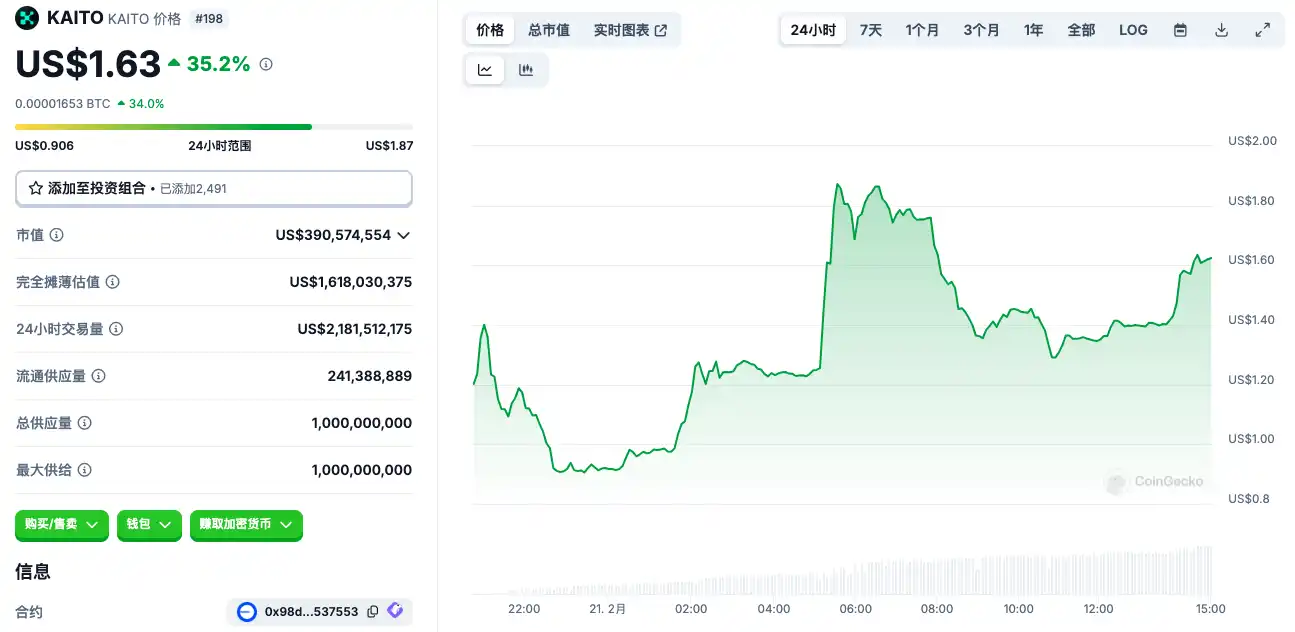
However, the community's views on the Kaito airdrop are divided, with both appreciation for the project's generosity and potential, as well as strong dissatisfaction with the expected gap and distribution rules. Based on user feedback on the X platform, BlockBeats summarized the positive and negative evaluations of the Kaito airdrop.
How Does the Community Perceive It?
For many users, the greatest appeal of the Kaito airdrop lies in its "high returns at zero cost" feature. X user @celiawan2 mentioned, "Most users received airdrops of 4-6 figures without spending a penny," making them feel that the Kaito team is more sincere. Especially for ordinary retail and mid-level users, rewards ranging from hundreds to thousands of dollars exceeded the expectations of many for a "zero-effort" project. Some even believe that "putting it into other projects would be praised as a team with courage." This view has gained some resonance in the community, especially among users who did not have high expectations for airdrops beforehand.
In addition, some users acknowledge Kaito's value, believing that Kaito has core value by optimizing information through AI. @BroLeonAus believes that, "As a protocol that is already generating revenue and has effectively changed the behavior of a part of the industry ecosystem, this is much more meaningful to me than most ghost chains that repeat the wheel." "Perhaps Kaito is not as good as everyone imagined before, but it should not be as bad as many people criticized tonight," tweeted @bee926cn, expressing optimism about Kaito's future and having already experienced its product, Kaito Pro.
On the other hand, there has also been a fair amount of negative feedback regarding the Kaito airdrop. The main focus of criticism has been on "expectation management" and "distribution rules."
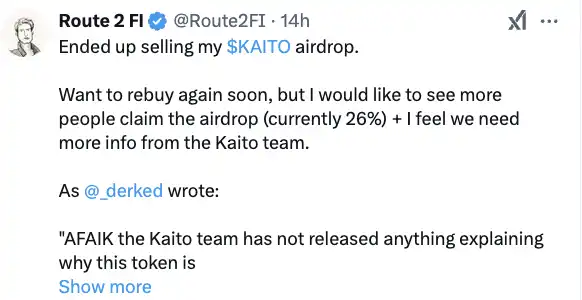
Many users expressed that their expectations were inflated by community discussions prior to the airdrop. @Route2FI mentioned that they were expecting to receive between $50 to $120 in the airdrop, and although it was possible to quickly buy back, they ultimately sold the KAITO airdrop.
@Cary_Zz noted that there was a pre-circulated expectation that "each Yap point would be worth $100 or Genesis NFT holders would receive additional rewards." However, the actual result was that each Yap was worth around $21, with an overall 10% airdrop ratio, far below expectations, leaving the eagerly anticipating community greatly disappointed.
In response, @zijingNFT stated that the expectations for Kaito were overly hyped, with many participating KOLs engaging in social mining for yap, "but now the price of the coin is far from ideal, leading to inevitable FUD." @BroLeonAus shared a similar view, pointing out in a tweet that "more of the backlash comes from the expectation gap," a sentiment that almost pervades all negative comments and has become the focal point of community discussion.
Additionally, netizen @waleswoosh directly shared a meme expressing that the airdrop did not meet expectations. In the image, the skewered lamb chop represents the airdrop expectation, while the puree being fed into the mouth symbolizes reality.

Not only did the returns fall short of expectations, but the "values consideration" set by the project team in the distribution rules of this airdrop has also sparked discontent.
Firstly, Sonic Labs founder Andre Cronje posted on social media saying, "For reasons I will never understand, Coinbase has refused to list S for 8 years. And because I refuse to do anything on Base, I cannot claim the Kaito airdrop."
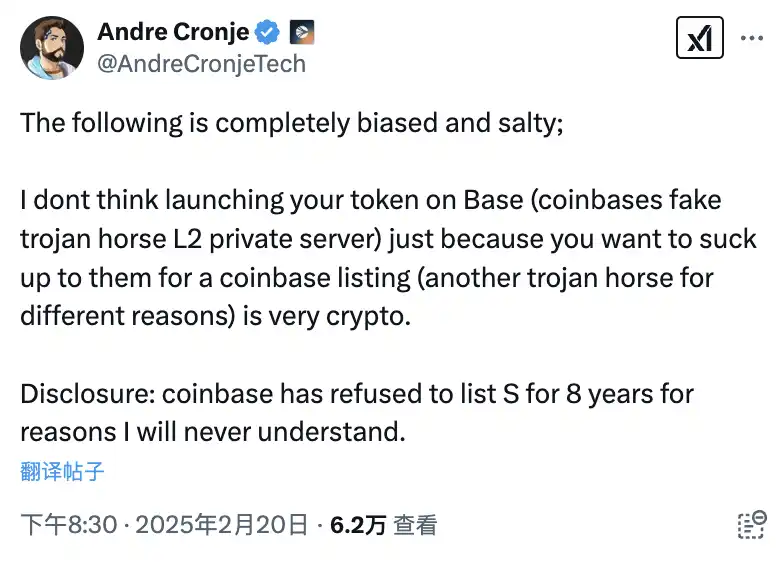

@hellosuoha pointed out that "consistency of values is a very interesting behavior, whether it is consistent or not, only oneself knows clearly. In the end, those who received a higher proportion are dissatisfied, and those who received less are even more dissatisfied, only those who received an airdrop immediately after registration are content." Furthermore, a netizen joked in the comments section: "How come I never thought that values could also be played with."
It is not just a values issue; the specific distribution ratio of the airdrop has also left the community dissatisfied.
@yuyue_chris posted, saying, "The differentiation in public opinion between top and mid-to-low-level KOLs is quite evident: most top KOLs are not very satisfied; the mid-to-low-level are very appreciative of $KAITO airdrop." @mdzzi also expressed a similar viewpoint, "The victory of mid-to-low-level KOLs; the influence of top-tier KOLs is being exploited," believing that there is a disproportionate return between top contributors and new users.
In response to this, some KOLs have shared their own data. @0xBreadguy mentioned, "It's a bit outrageous that I have to stake $120,000 worth of $KAITO to receive the same badge as someone staking $5 worth."
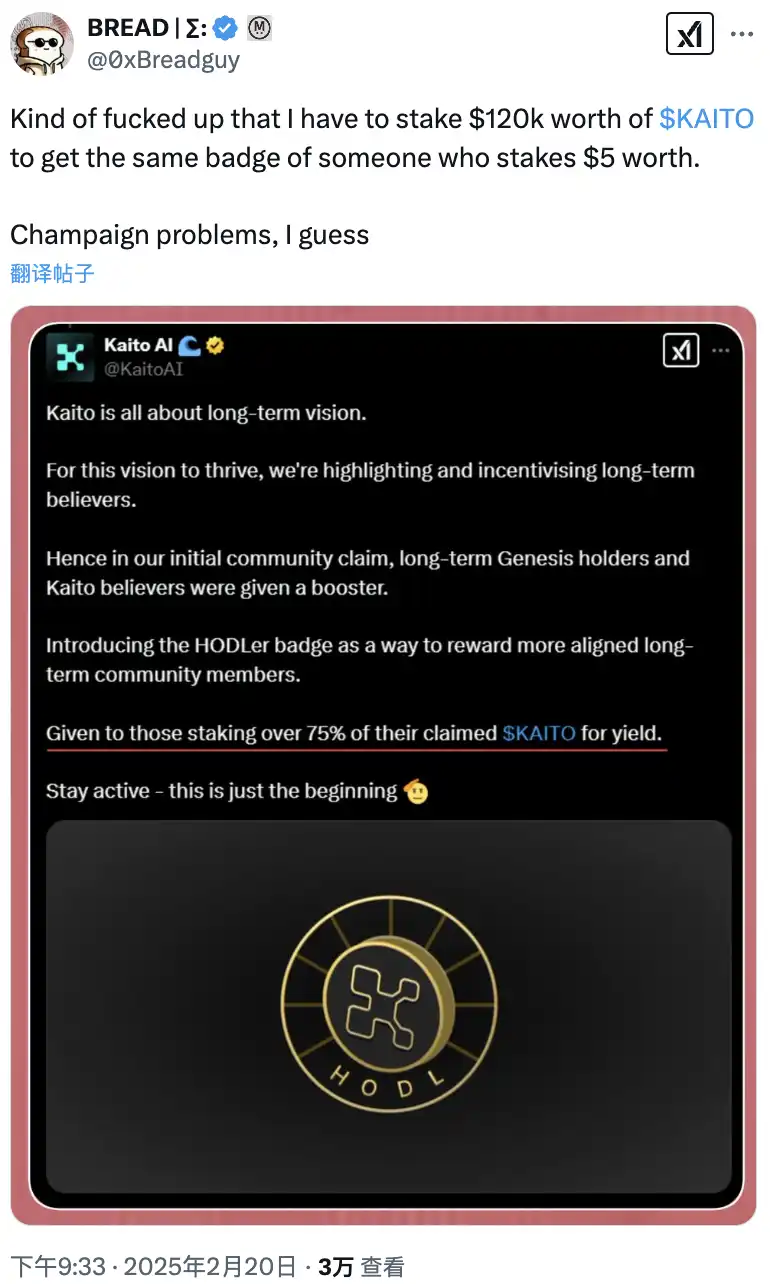
@0x0funky speculated, "The Yaps score does not scale linearly with the amount of Kaito received," noting that one Yaps point is around 7.5 Kaito, and many conversions of 20 points equate to giving 20 Kaito, "It seems like a basic income and then added based on the Yaps score."
@CyberPhilos speculated on the alignment of values between them and the Kaito team, combining it with a ratio, saying, "Those who flatter Kaito, yap: Kaito is 1:20 or even higher; those who are neutral, yap: Kaito is 1:10; those who have criticized Kaito in the past, yap: Kaito is 1:2."
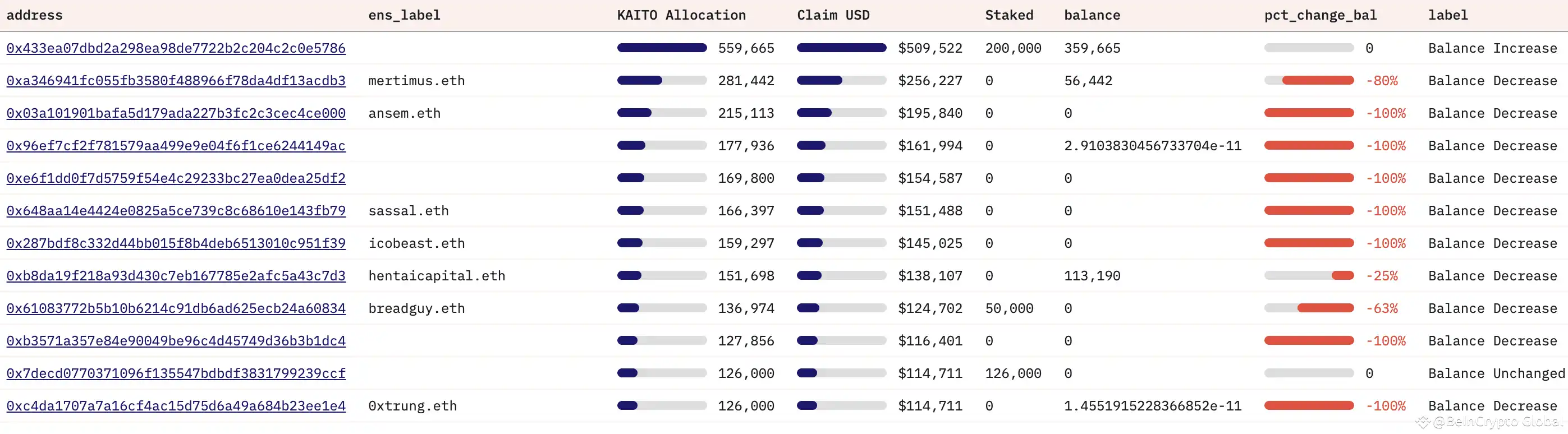
Furthermore, the rapid selling by airdrop whales (on-chain data shows 7 out of the top 12 have liquidated their holdings) and the lack of a lock-up period have raised concerns in the community about the project falling into a "hype-pump-dump" short-term speculative cycle.
AI Data Tool Token Launch: How's the Performance?
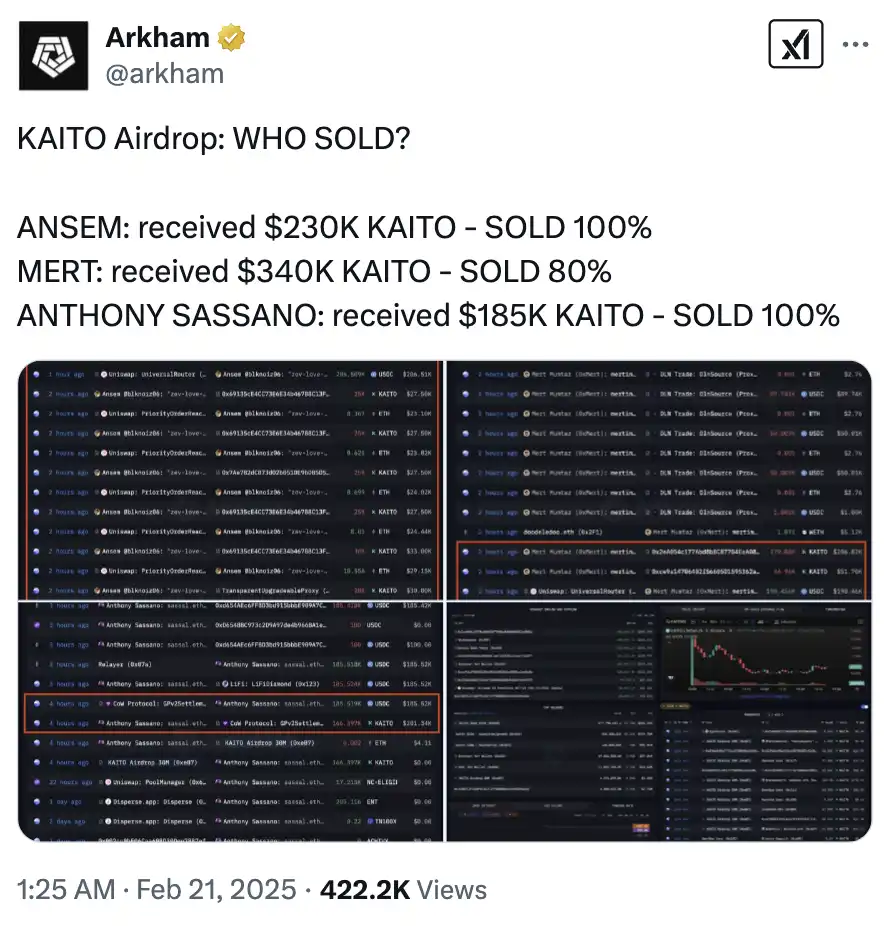
While the community was engrossed in heated discussions about the Kaito airdrop, another AI data tool that had launched its token revealed on the 21st a KOL's received Kaito airdrop amount and the sell-off ratio analyzed by their in-house AI tool. This isn't the first time a data tool has launched a token. Previously, Binance had launched the Launchpad project Crypto data analysis platform Arkham (ARKM), which is also an on-chain data intelligence analysis platform. Arkham uses AI (Ultra Engine) to associate blockchain addresses with real-world entities, offering insights and analysis on transaction behavior.
Read more: "After Arkham, which data tools have yet to launch a token?"
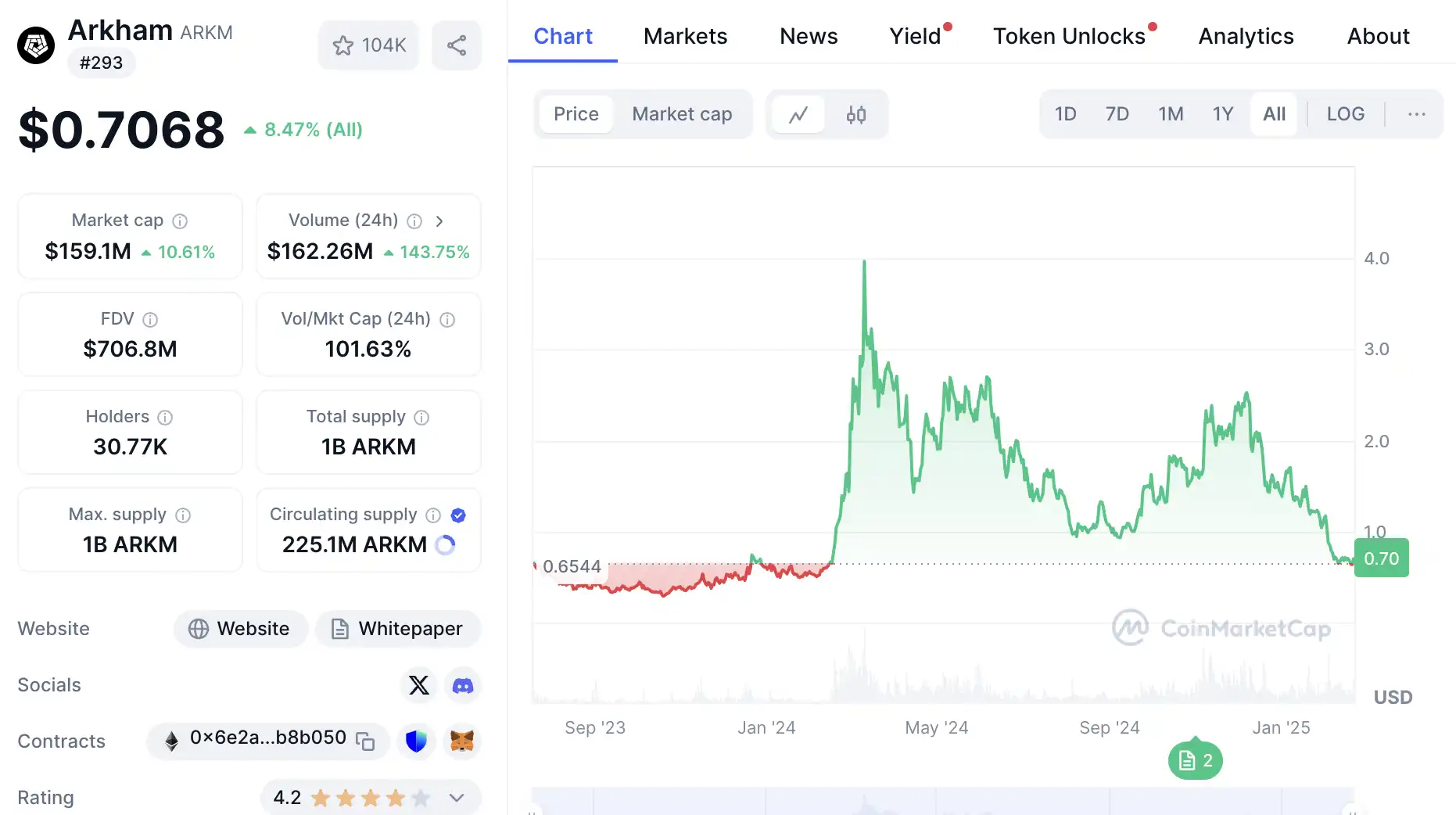
Similar to Kaito, Arkham is also classified as an AI data tool, aiming to tackle the issue of fragmented information in the crypto world through technological means and provide users with "Alpha opportunities." The difference is, Kaito leans more towards social data, while Arkham focuses on on-chain data. So, how is the current situation of Arkham, the first data tool to launch a token? In terms of price, according to market data, $ARKM is currently priced at $0.71, with its all-time high price being $3.12 on March 10, 2024, indicating a price drop of nearly 80%, showing significant volatility. Perhaps due to being categorized under AI projects, its price fluctuates in line with the overall rise and fall of the AI sector.
In the current market environment where the AI sector is performing averagely, can Kaito's TVL after its coin issuance break the silence seen in various AI projects and bring back market enthusiasm? Or will it follow Arkham's old path, experiencing the ups and downs of the entire sector? Alternatively, will it engage in a competition for the ecological niche belonging to AI tools with Arkham? All of this leaves us awaiting eagerly.
You may also like

How TradeXYZ, xStocks, and Alpaca break down the SpaceX IPO into three different strategies

Why Is BlackRock Investing $5 Billion in the SpaceX IPO?

Cryptocurrency market makers collectively seek change as it becomes increasingly difficult to make money

a16z Crypto Partner: Cash flow is the moat

Citibank releases "2030 Asset Tokenization Market Outlook": 6 major trends may create a $8.2 trillion market

The trillion-dollar valuation test: Are the three major super IPOs a celebration for tech stocks or a nightmare for the crypto market?

Morning Report | Digital Asset completes $355 million financing led by a16z Crypto; Meta completes operational separation from Manus
Morning News | CME Group launches Nasdaq Cryptocurrency Index futures; Asset management giant Janus Henderson strategically invests in Ethena

Bitcoin Layer 2 Network Botanix: Why Did We Choose to Dissolve?

Why did Oracle deliver the strongest financial report in history, yet its stock price fell?
When the P2P illicit funds from ten years ago turned into 60,000 bitcoins

Dialogue with OmenX Founder: Why does the prediction market need an evolution from "spot" to "derivatives"?
Galaxy in-depth report: Is Solana still worth paying attention to?

Young people in South Korea make a "final effort" in the epic bull market
The pricing controversy of Trade.xyz exposes the fatal weakness of Pre-IPO perpetual contracts
How much longer can Ethereum's last big buyer hold on?

World Cup 2026 Coming – WEEX Celebrates with $1M Prize Pool & Michael Owen Live

Morning Report | OpenAI has submitted an S-1 registration statement draft to the U.S. SEC; Morpho completes $175 million financing
How TradeXYZ, xStocks, and Alpaca break down the SpaceX IPO into three different strategies
Why Is BlackRock Investing $5 Billion in the SpaceX IPO?
Cryptocurrency market makers collectively seek change as it becomes increasingly difficult to make money
a16z Crypto Partner: Cash flow is the moat
Citibank releases "2030 Asset Tokenization Market Outlook": 6 major trends may create a $8.2 trillion market
The trillion-dollar valuation test: Are the three major super IPOs a celebration for tech stocks or a nightmare for the crypto market?


