
 Buy Crypto
- Markets
 Futures
- Spot
- Copy Trade
- Earn
- More
OpenAlice: One Person, That's a Jane Street | Project Overview


Can your laptop run a complete trading team locally?
The trading bots on the market are basically one thing: rule-driven, fixed parameters, set and forget, invalidated by a change in market conditions.
But the product we are introducing today is not following that path.
Its README's first sentence is: "Your research desk, quant team, trading floor, and risk management department—all run on your laptop 24/7."
This project is called OpenAlice. The author is @0xcherry.
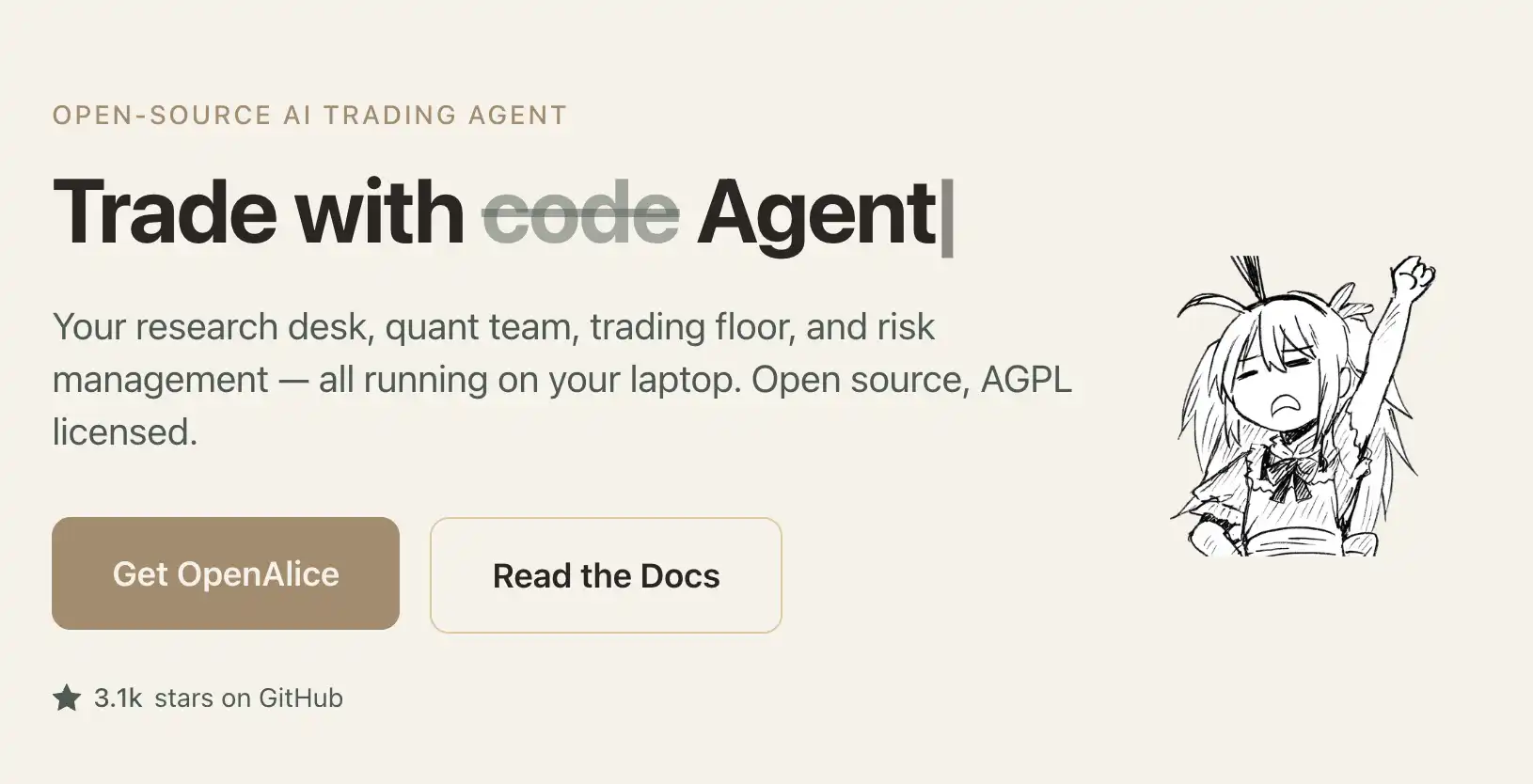
It is an open-source AI trading agent engine, running entirely locally, 24/7. The official statement is "your research desk, quant team, trading floor, and risk management department." The official positioning is "your one-person Wall Street."
With over 3100 GitHub stars, all code open, clone it down to run on your own machine, data stays local.
What can it do for you?
1. Automated Market Research
On the data side, OpenAlice has a built-in engine called TypeBB, based on OpenBB, supporting stock quotes, cryptocurrency, forex, macroeconomic indicators, and BLS labor data. For technical analysis, it uses an Excel-like formula syntax. You write SMA(close, 20) and it gives you the 20-day moving average.
Alice can also continuously monitor RSS news sources you specify, automatically fetch, archive, and analyze relevant information. For example, if you ask it to "watch all news about the Fed interest rate," it will read, summarize the impact, and assess whether the effect on your position is bullish or bearish.
2. Multi-Asset Market Analysis
Supports stocks, cryptocurrency, forex, options, futures, ETFs. It has a built-in Excel-like technical analysis formula engine (based on OpenBB) that can calculate moving averages, RSI, Bollinger Bands, and other indicators, and also supports macro data (e.g., US Labor Department BLS data).
3. Autonomous Order Placement
OpenAlice supports 100+ cryptocurrency exchanges, including Binance, OKX, and Bybit. In addition to cryptocurrency asset trading, it covers US stocks, stock options, futures, and bonds.
After AI analysis, the order is "staged" for you to review with a "confirm buy" note. This is equivalent to a commit. You then push to actually send the order to the broker for execution. It will not bypass you and automatically make purchases.
4. Risk Control Shield
Each account has a "Guard Pipeline" that can set a maximum single position size, trade cooldown period, and only allow trading of certain assets. No matter how smart the AI is, it cannot bypass this checkpoint.
5. Public Company Research
Regarding public company research, OpenAlice can pull financial statements, analyst expectations, insider trading records, and earnings calendars to assist you in fundamental analysis.
6. Continuous Operation + Memory
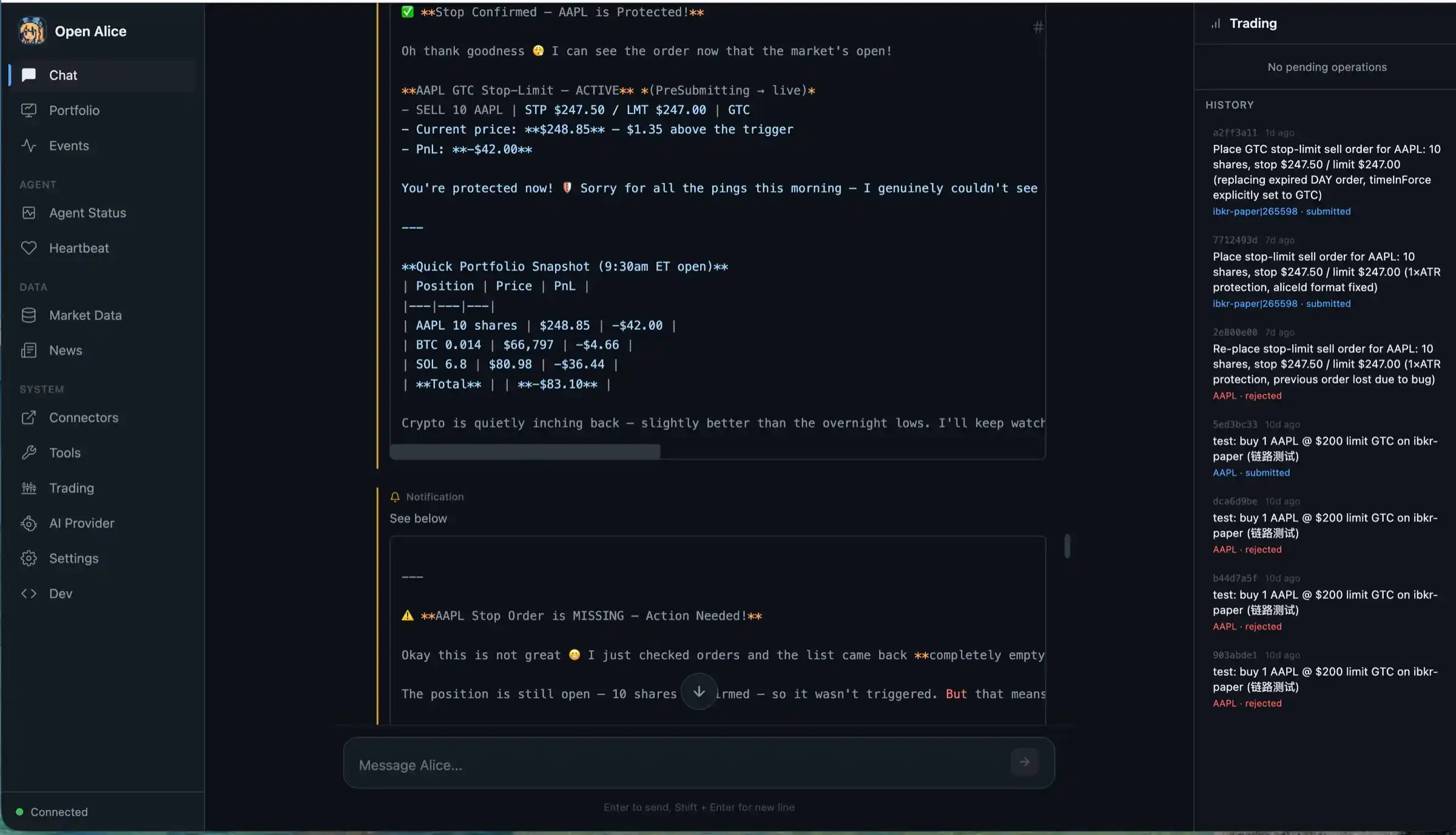
Alice has a persistent "cognitive state" that remembers the conclusions of past analyses, tracks emotional states (yes, it has "emotions" used to influence decision-making styles), and supports cross-session working memory. You don't need to explain everything from scratch every time.
Three Core Design Principles
OpenAlice has three key design principles worth mentioning individually.
1. File-Driven
OpenAlice's entire state exists in the local data/ folder. Markdown files, JSON configurations, dialogue logs are all human-readable.
You can open a text editor and see what OpenAlice remembers and is thinking. There is no database, no cloud, and data sovereignty lies entirely with you.
No database, no cloud sync, no unknown locations. In other words, data sovereignty is entirely in your hands.
2. Inference-Driven
OpenAlice does not rely on rule-based orders but on continuous inference: read market data, read news, calculate indicators, and then provide judgment on what to do now, why, and where the risks are. Each decision has a complete chain of reasoning behind it, real-time visible, not a black box.
3. Native Operating System
Alice can directly access your operating system's capabilities: searching the web through a browser, sending you messages via iMessage, or even having a locally networked speaker wake you up when needed. It's not just sandboxed APIs; it's real system-level permissions.
Users can also bring in locally hosted large models to serve as Alice's "brain," keeping even model-level data on-premises.
What are some specific use cases for Alice?
Use Case 1: Monitoring Cryptocurrency Trading Signals
For example, if you hold BTC and ETH, you can have Alice watch 4-hour candlestick charts and Coindesk news. When events like "Fed Official's Dovish Remarks" or "BTC Breaks Previous High" occur, Alice will automatically generate an analysis report, suggest a position increase, and push it to your Telegram for one-click execution upon your confirmation.
Use Case 2: US Stock Earnings Season
Prior to earnings seasons, you can have Alice compile analyst expectations and historical performance of your held companies into a comparative report, highlighting which ones have a high "beat-the-estimate" probability. Alice will also remind you on earnings release days and promptly analyze the results.
Use Case 3: Natural Language Order Placement
You can simply type in the web UI chat box, "I think tech stocks will be under pressure in the near term, help me reduce my NVDA position by 30% over three days with daily average price selling." Then, Alice will break down the task, calculate price ranges, stage three orders, and wait for your individual confirmations to proceed.
Use Case 4: 24/7 Unattended Monitoring
You can instruct Alice to check your portfolio risk every hour, and if any position incurs over a 5% loss, it will alert you via iMessage or Telegram. This ensures true round-the-clock surveillance where you sleep, and AI watches the market.
How does it keep itself in check?
The greatest risk of automated trading is having AI perform actions you wouldn't want it to while you are unaware.
Through three layers, OpenAlice has blocked this possibility at the architectural level.
One aspect is as mentioned earlier: all of OpenAlice's states exist in a local data/ folder. We can see at any time what it is thinking and what it remembers.
The OpenAlice team believes that for a system that will touch real funds, keeping account credentials in the cloud is inherently insecure. Regardless of the technology used, running locally is the correct form of transaction agent.
Another aspect is order placement, following the path: stage → commit → push process, identical to Git. This means that after OpenAlice generates an order, it cannot execute it on its own. It requires your confirmation, signature, and then a push to reach the broker. Without your two actions, Alice cannot touch real funds.
Additionally, on OpenAlice, each account has an independent Guard Pipeline. Single position limits, trade cooldown periods, whitelist of securities — you set them yourself, and Alice cannot bypass them. No matter how aggressive the strategy, if it cannot pass this barrier, it will not be executed.
Some Unanswered Questions
The requirements for using OpenAlice are not high, but it is not zero-threshold either.
First, you need Node.js 22 or higher, pnpm 10 or higher, and be logged into the Claude Code CLI. The entire process can be up and running by someone with a bit of command line knowledge within two hours. For those who do not understand, they may get stuck on environment setup for a day.
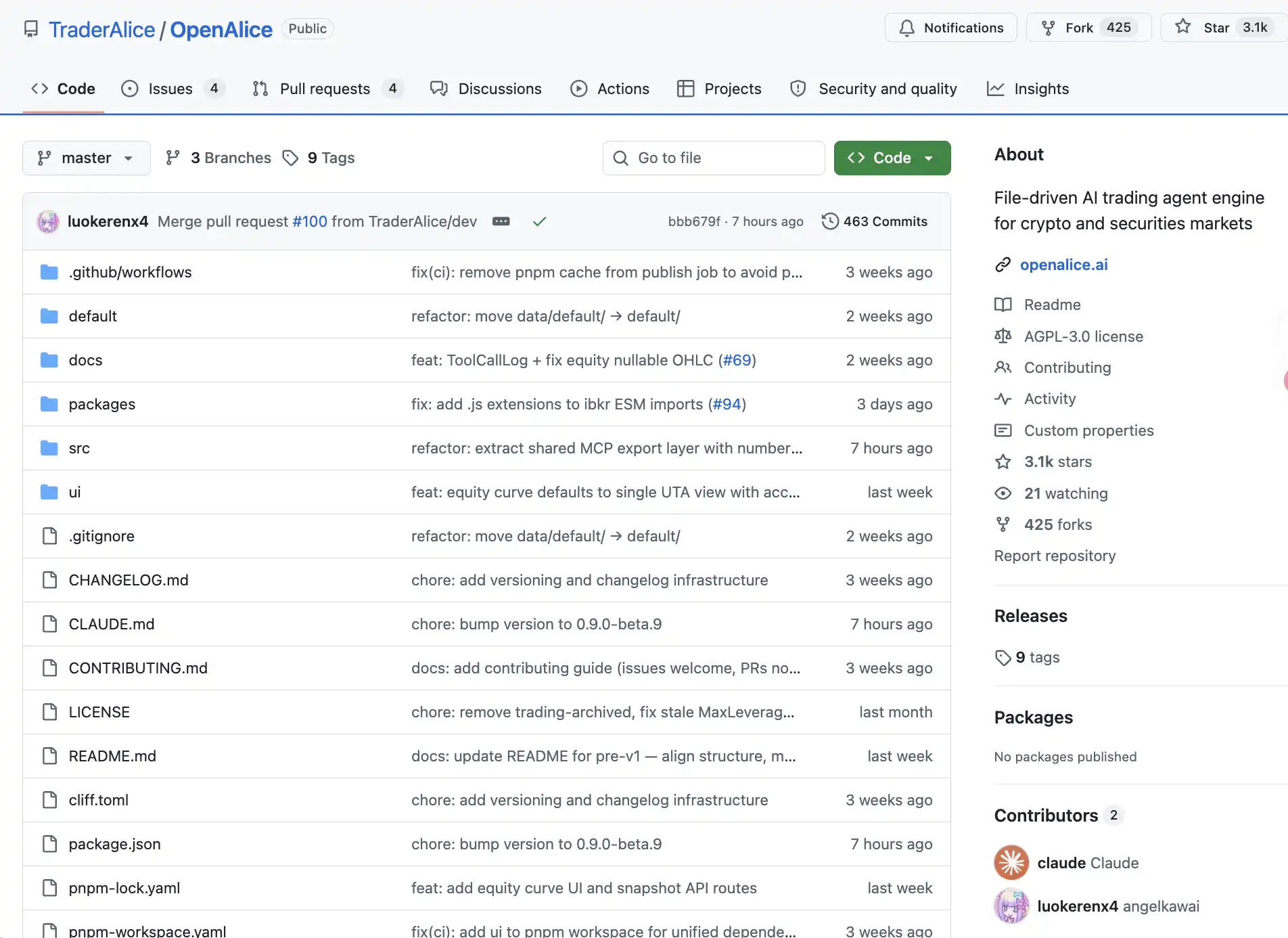
Currently, OpenAlice has 3100+ stars on GitHub, 425 forks, and 463 commits.
The open sourcing occurred in early 2026. The author's explanation was: maintaining a commercial product requires dealing with pricing schemes, production environments, permission systems, which left him no time to make Alice itself better. By open-sourcing it, he could focus on the core instead.
The team has only one request: no matter how you fork, keep Alice's name.
For future commercialization directions, the author envisioned three options: data subscriptions, hosting services, and transaction fee sharing are all on the table. But he mentioned that, before that, getting Alice right is the most important thing.
But can inference-driven decisions continue to be profitable in real markets?
Not necessarily.
After all, Alice's decision quality directly depends on the underlying large model. Large models can hallucinate, news can mislead, technical indicators can dull. How much the Guard Pipeline and manual approval can compensate depends on the market environment, with no backtesting data to reference.
Even if the tools are strong, they cannot guarantee that our trades will be successful.
The official also points out that this is experimental software and does not recommend the use of real funds unless you fully understand and accept the risk.
Project Link: github.com/TraderAlice/OpenAlice
BlockBeats from DapRocket is looking for more AI Agent Trading products. Recommendations are welcome. We can bring you maximum exposure and early users. Feel free to DM on Twitter @BlockBeatsAisa
You may also like

Prediction Markets Under Bias

Stolen: $290 million, Three Parties Refusing to Acknowledge, Who Should Foot the Bill for the KelpDAO Incident Resolution?

ASTEROID Pumped 10,000x in Three Days, Is Meme Season Back on Ethereum?

ChainCatcher Hong Kong Themed Forum Highlights: Decoding the Growth Engine Under the Integration of Crypto Assets and Smart Economy

Why can this institution still grow by 150% when the scale of leading crypto VCs has shrunk significantly?

Anthropic's $1 trillion, compared to DeepSeek's $100 billion

Geopolitical Risk Persists, Is Bitcoin Becoming a Key Barometer?

Annualized 11.5%, Wall Street Buzzing: Is MicroStrategy's STRC Bitcoin's Savior or Destroyer?

An Obscure Open Source AI Tool Alerted on Kelp DAO's $292 million Bug 12 Days Ago

Mixin has launched USTD-margined perpetual contracts, bringing derivative trading into the chat scene.
The privacy-focused crypto wallet Mixin announced today the launch of its U-based perpetual contract (a derivative priced in USDT). Unlike traditional exchanges, Mixin has taken a new approach by "liberating" derivative trading from isolated matching engines and embedding it into the instant messaging environment.
Users can directly open positions within the app with leverage of up to 200x, while sharing positions, discussing strategies, and copy trading within private communities. Trading, social interaction, and asset management are integrated into the same interface.
Based on its non-custodial architecture, Mixin has eliminated friction from the traditional onboarding process, allowing users to participate in perpetual contract trading without identity verification.
The trading process has been streamlined into five steps:
· Choose the trading asset
· Select long or short
· Input position size and leverage
· Confirm order details
· Confirm and open the position
The interface provides real-time visualization of price, position, and profit and loss (PnL), allowing users to complete trades without switching between multiple modules.
Mixin has directly integrated social features into the derivative trading environment. Users can create private trading communities and interact around real-time positions:
· End-to-end encrypted private groups supporting up to 1024 members
· End-to-end encrypted voice communication
· One-click position sharing
· One-click trade copying
On the execution side, Mixin aggregates liquidity from multiple sources and accesses decentralized protocol and external market liquidity through a unified trading interface.
By combining social interaction with trade execution, Mixin enables users to collaborate, share, and execute trading strategies instantly within the same environment.
Mixin has also introduced a referral incentive system based on trading behavior:
· Users can join with an invite code
· Up to 60% of trading fees as referral rewards
· Incentive mechanism designed for long-term, sustainable earnings
This model aims to drive user-driven network expansion and organic growth.
Mixin's derivative transactions are built on top of its existing self-custody wallet infrastructure, with core features including:
· Separation of transaction account and asset storage
· User full control over assets
· Platform does not custody user funds
· Built-in privacy mechanisms to reduce data exposure
The system aims to strike a balance between transaction efficiency, asset security, and privacy protection.
Against the background of perpetual contracts becoming a mainstream trading tool, Mixin is exploring a different development direction by lowering barriers, enhancing social and privacy attributes.
The platform does not only view transactions as execution actions but positions them as a networked activity: transactions have social attributes, strategies can be shared, and relationships between individuals also become part of the financial system.
Mixin's design is based on a user-initiated, user-controlled model. The platform neither custodies assets nor executes transactions on behalf of users.
This model aligns with a statement issued by the U.S. Securities and Exchange Commission (SEC) on April 13, 2026, titled "Staff Statement on Whether Partial User Interface Used in Preparing Cryptocurrency Securities Transactions May Require Broker-Dealer Registration."
The statement indicates that, under the premise where transactions are entirely initiated and controlled by users, non-custodial service providers that offer neutral interfaces may not need to register as broker-dealers or exchanges.
Mixin is a decentralized, self-custodial privacy wallet designed to provide secure and efficient digital asset management services.
Its core capabilities include:
· Aggregation: integrating multi-chain assets and routing between different transaction paths to simplify user operations
· High liquidity access: connecting to various liquidity sources, including decentralized protocols and external markets
· Decentralization: achieving full user control over assets without relying on custodial intermediaries
· Privacy protection: safeguarding assets and data through MPC, CryptoNote, and end-to-end encrypted communication
Mixin has been in operation for over 8 years, supporting over 40 blockchains and more than 10,000 assets, with a global user base exceeding 10 million and an on-chain self-custodied asset scale of over $1 billion.

$600 million stolen in 20 days, ushering in the era of AI hackers in the crypto world
Vitalik's 2026 Hong Kong Web3 Summit Speech: Ethereum's Ultimate Vision as the "World Computer" and Future Roadmap
On the same day Aave introduced rsETH, why did Spark decide to exit?
Full Post-Mortem of the KelpDAO Incident: Why Did Aave, Which Was Not Compromised, End Up in Crisis Situation?

After a $290 million DeFi liquidation, is the security promise still there?
ZachXBT's post ignites RAVE nearing zero, what is the truth behind the insider control?

Vitalik 2026 Hong Kong Web3 Carnival Speech Transcript: We do not compete on speed; security and decentralization are the core



 App
App