
 Buy Crypto
- Markets
 Futures
- Spot
- Copy Trade
- Earn
- More
Only Working 2 Hours a Day? This Google Engineer Got His Job Done Using Claude for 80% of It


Original Title: Google engineer automated 80% of his work with Claude Code. here's the exact system he built.
Original Author: @noisyb0y1
Translation: Peggy, BlockBeats
Editor's Note: As "AI coding" gradually becomes an industry consensus, what truly enhances productivity is not the model itself, but how you set rules for the model, organize processes, and embed it into a sustainable system.
Starting from a simple CLAUDE.md file, moving to multi-agent collaboration, and then to an automated development loop, this approach has transformed the development process from "human-AI dialogue" to "management of an AI engineering team." In this process, errors are constrained upfront, processes are structured, and code generation, testing, and review gradually move away from manual execution to being taken over by the system.
Of particular note, the article also revealed an overlooked detail: in long contexts and complex systems, model behavior is not entirely controllable. Whether it's hidden token consumption or diluted instructions, they will subtly affect output quality. This makes "how to manage AI," not just "how to use AI," a new core competency.
At this point, developers are no longer centered around coding but around rule design, process scheduling, and result verification. Those who are the first to complete this step have already begun to shift from "doing things themselves" to "letting the system do things for them."
Below is the original text:
A Google engineer with 11 years of experience automated 80% of his work using Claude Code and a simple .NET application.
Today, he only needs to work 2–3 hours a day instead of the original 8 hours, spending the rest of his time mostly in a "relaxed" state, with the system running on its own, bringing him a passive income of $28,000 per month.
What he has mastered is the set of methods that you have yet to understand.
Part 1—Write CLAUDE.md Following the Karpathy Principle
Andrej Karpathy—one of the world's most influential AI researchers—has systematically summarized the most common errors of large language models when writing code: overdesign, ignoring existing patterns, and introducing unnecessary additional dependencies.
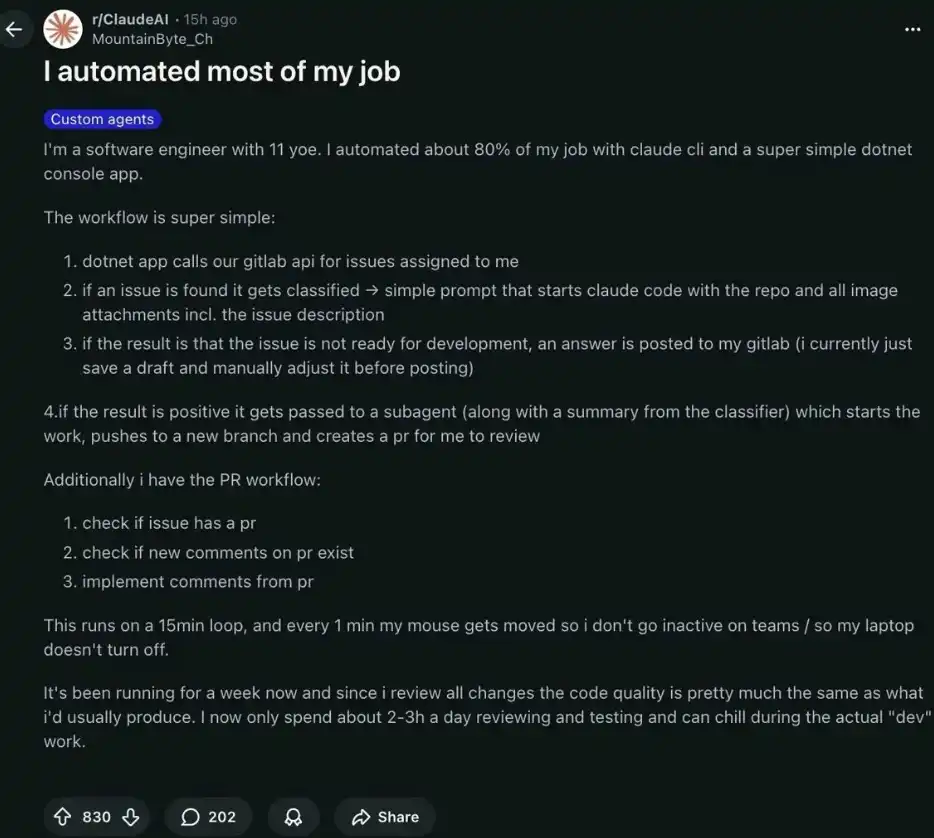
Andrej Karpathy used Claude Code and a simple .NET tool to automate the entire workflow, including task acquisition, feasibility assessment, code generation, PR submission, feedback incorporation, etc., delegating about 80% of the development work to the system. He only took care of final review and testing, reducing his work time from 8 hours a day to 2–3 hours, essentially transitioning from a "code writer" to a "manager of an automated development system."
Someone consolidated these observations into a unified CLAUDE.md file.
As a result, the project received 15,000 stars on GitHub within a week, implying that 15,000 individuals, in a way, altered their workflow because of this.
The core idea is actually quite simple: if errors are predictable, they can be preemptively avoided through explicit instructions. Just placing a markdown file in the code repository provides a structured set of behavioral rules for Claude Code, thereby standardizing decision-making and execution throughout the project.
Within this file, there are primarily four core principles:
· Think First, Code Later → Avoid mistaken assumptions and overlooked trade-offs
· Embrace Simplicity → Prevent over-engineering and bloated abstractions
· Surgical Modifications → Refrain from changing code that no one requested to change
· Goal-Driven Execution → Test first, then validate against clear success criteria
It doesn't rely on any framework, nor does it require complex tools—just one file can alter Claude's behavior at the project level.
The real difference lies in:
· Without using CLAUDE.md: Claude violated the standards in about 40% of cases
· With Karpathy's CLAUDE.md: Violation rate reduced to about 3%
· Setup time: Only 5 minutes
Command to auto-generate your own CLAUDE.md file:
claude -p "Read the entire project and create a CLAUDE.md based on:
Think Before Coding, Simplicity First, Surgical Changes, Goal-Driven Execution.
Adapt to the real architecture you see." --allowedTools Bash,Write,Read
It replaces what's known as a Claude: facing a simple task but overengineering it, introducing unnecessary dependencies, or even making arbitrary changes to files that should not be touched.
Part2 Everything Claude Code: A Full Engineering Team in a Repository
Everything Claude Code (with over 153k stars on GitHub)
This is not just a set of prompts but more like a complete AI operating system for building products.
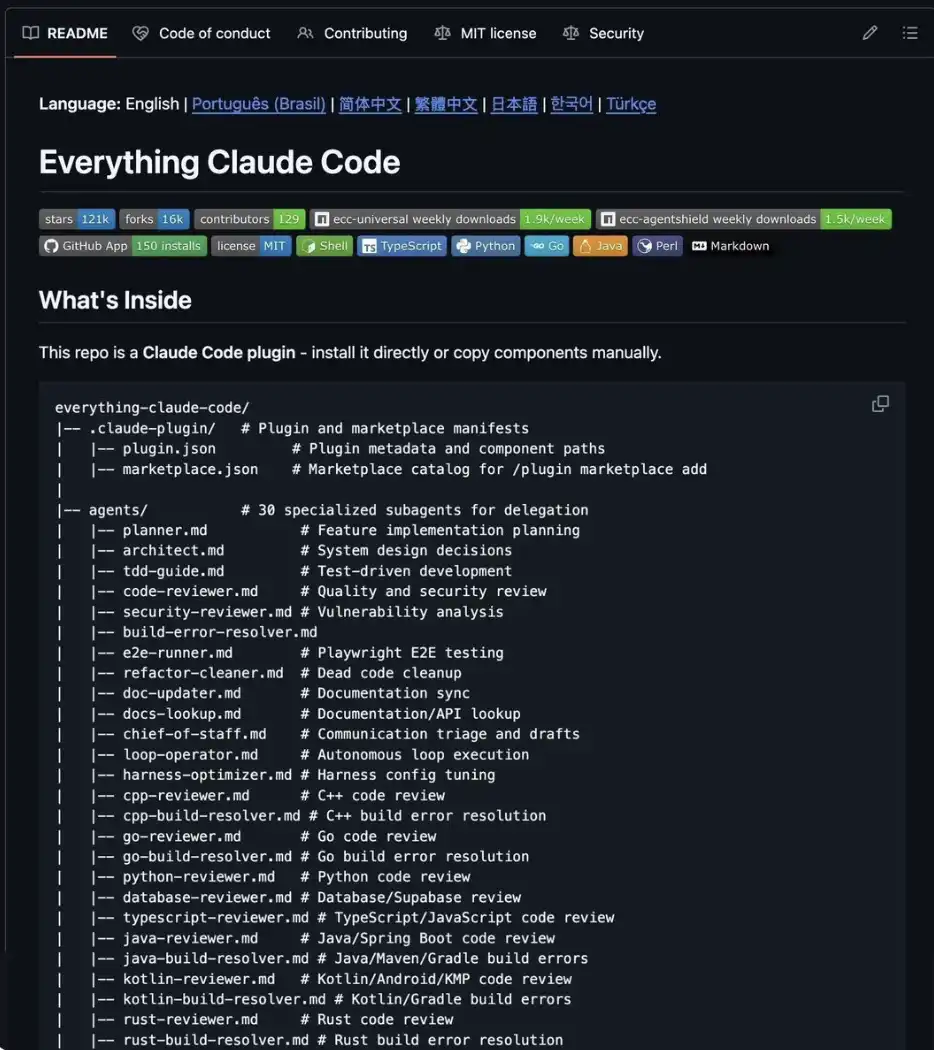
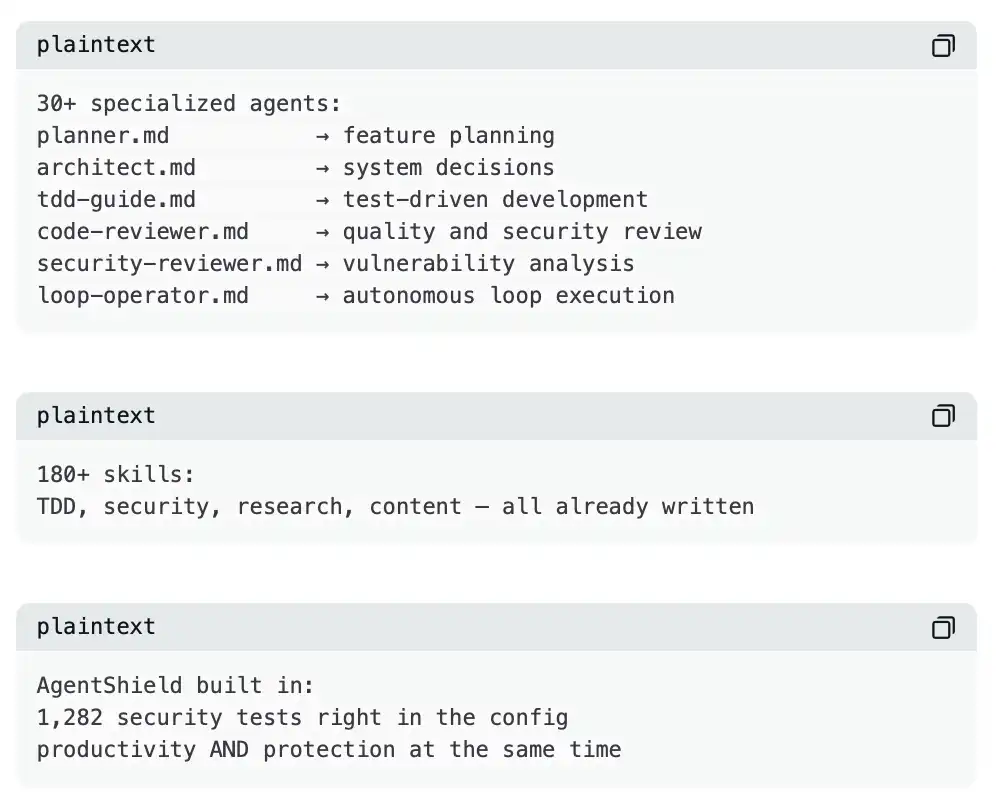
30+ specialized agents: planner.md → Feature Planning architect.md → System Design Decision tdd-guide.md → Test-Driven Development code-reviewer.md → Code Quality and Security Review security-reviewer.md → Vulnerability Analysis loop-operator.md → Automated Loop Execution
180+ skills: TDD, Security, Research, Content Generation—all preconfigured
Built-in AgentShield: Configuration directly integrates 1282 security tests
Works across different tools like Claude, Codex, Cursor, OpenCode, Gemini—a unified system, everywhere.
Installation:
/plugin marketplace add affaan-m/everything-claude-code
Alternatively, manual installation—just copy the components you need to the .claude/ directory of your project. Do not load everything at once—loading 27 agents and 64 skills simultaneously will likely deplete your contextual quota before you even input your first prompt. Only keep the parts you truly need.
The real difference is:
· Before: You're conversing with AI
· After: You're managing an autonomously running AI engineering team
It replaces: you used to need to spend several weeks setting up your own agent system, configuring different tools for planning/review/security, and paying $200–$500 per month for various AI services.
Part3 A Hidden “Scandal”: Claude Code v2.1.100 Secretly Eating Your Tokens
Someone intercepted and analyzed full API requests of 4 different versions of Claude Code by setting up an HTTP proxy.
They discovered:
v2.1.98: 169,514 bytes request → 49,726 tokens charged
v2.1.100: 168,536 bytes request → 69,922 tokens charged
difference: -978 bytes but +20,196 tokens
Although v2.1.100 sent fewer data bytes, it charged an extra 20,000 tokens. This “inflation” occurred entirely on the server side—you cannot see it or verify it through the /context interface.
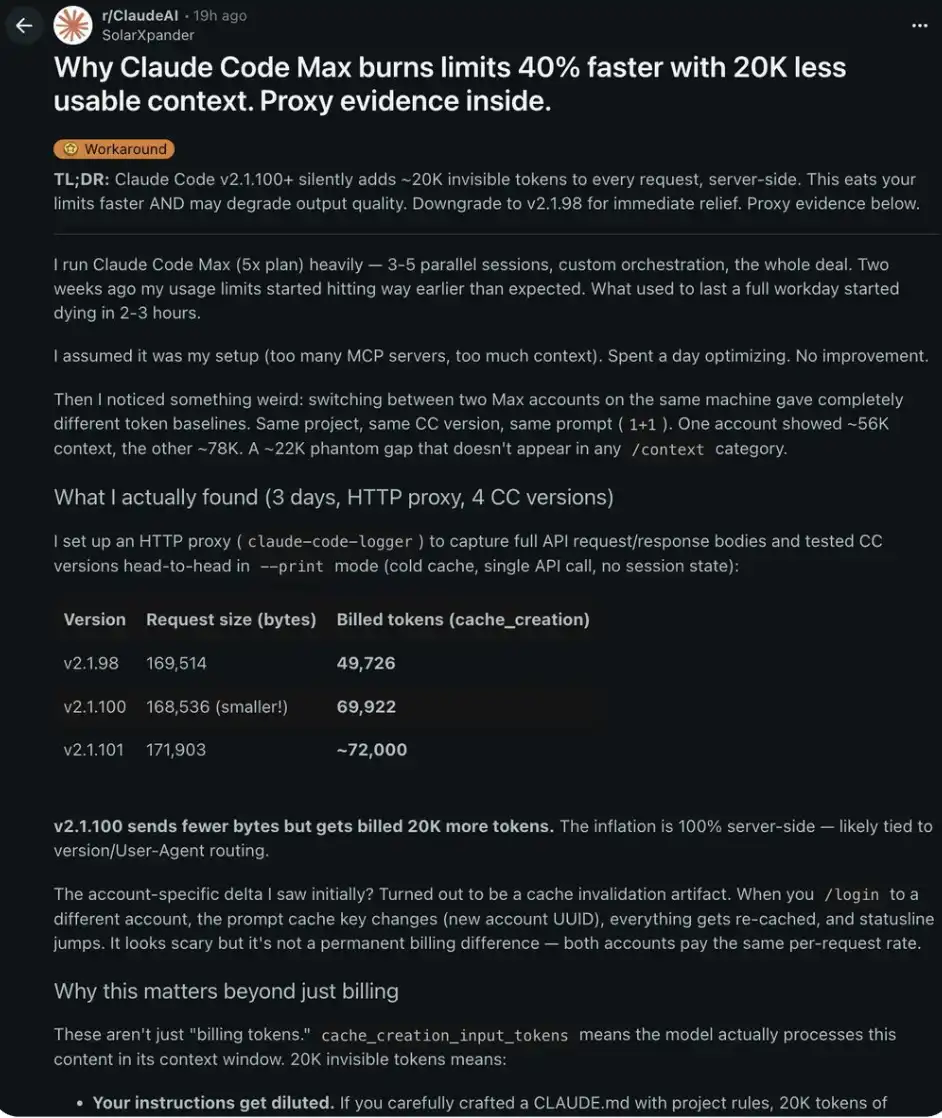
This image mainly reveals that certain versions of Claude Code (especially v2.1.100) exhibit “covert token consumption,” causing the usage quota to be abnormally depleted. Specifically, versions like Claude Code v2.1.100 quietly introduced around 20,000 “invisible tokens” on the server side. Even with less request data, the billing is higher, causing users’ context to be invisibly encroached upon, quotas to be consumed more quickly, and even weakening the model output. This issue was verified by comparing API requests using an HTTP proxy between different versions and fundamentally represents a type of “invisible consumption” that users find difficult to detect and self-audit.
Why this is more than just a billing issue is that the additional 20,000 tokens will be stuffed into Claude’s actual context window.
This means:
→ Your CLAUDE.md directives will be diluted by this additional 20,000 “hidden content”
→ In lengthy conversations, the output quality will deteriorate faster
→ When Claude disregards your rules, it’s hard to pinpoint the reason
→ Claude Max's usage quota will be consumed about 40% faster than normal
Fix in just 30 seconds: npx claude-code@2.1.98
This is a temporary solution before the official Anthropic fix, but in practical use, you can almost immediately feel the impact of the session.
It replaces the need to guess why Claude suddenly stopped following your commands.
Case Study: What a Full Automation System Looks Like
An engineer with 11 years of experience built a system consisting of three parts:
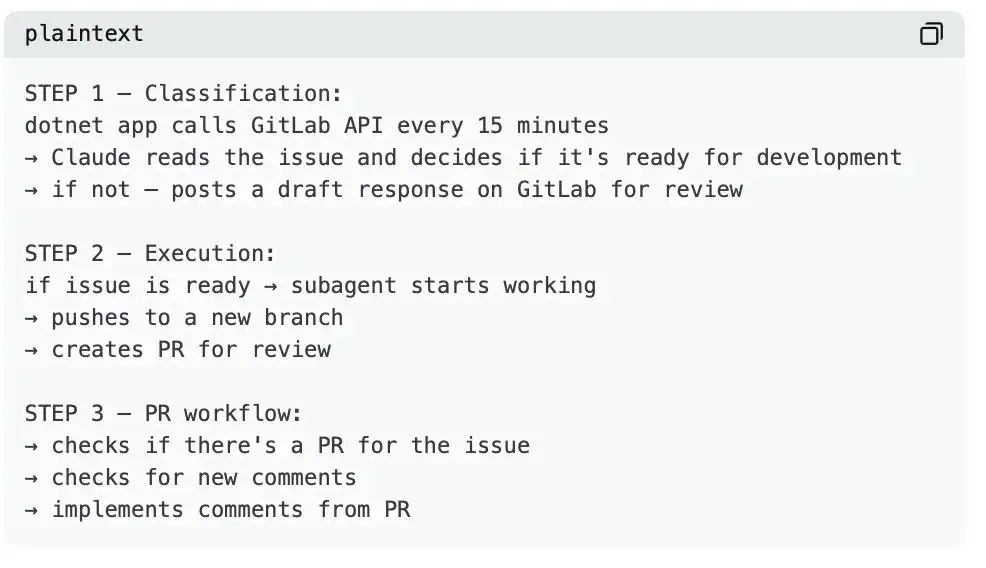
Result after one week:
· Before: Coding 8 hours a day
· After: Only needing 2–3 hours a day for code review and testing
· Code quality: Virtually unchanged—because he reviews each one
· Team status: Always online—mouse moves automatically every minute
· Remaining time: Free all day
It's not some "magic," but the result of CLAUDE.md + appropriate agents + a 15-minute loop cycle.
Full List:
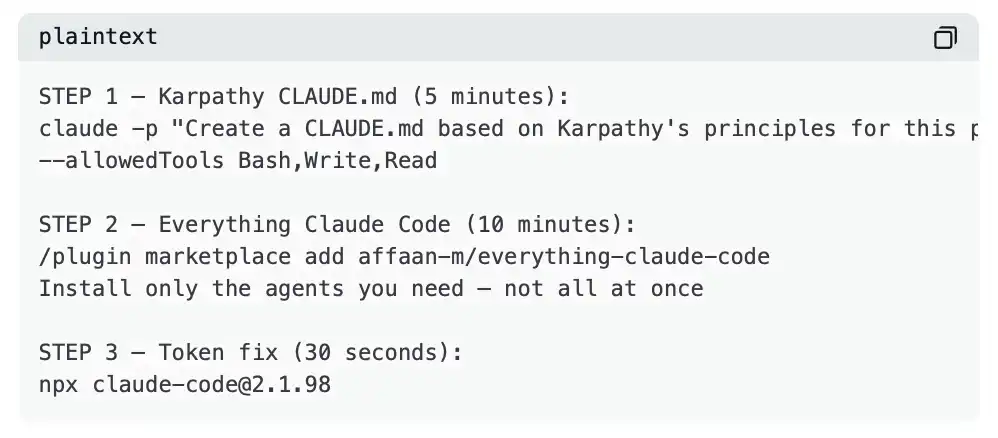
What You Gain After Reading:
· Before: Claude would deviate from existing norms 40% of the time
· After: With Karpathy's CLAUDE.md, the violation rate drops to 3%
· Before: It would take you weeks to set up agents
· After: 27 agents are ready to use out of the box
· Before: Claude Max would deplete the quota in 2–3 hours
· After: Reverting to v2.1.98 can restore about 40% of the usage cap
· Before: Needing 8 hours a day for coding
· After: Only needing 2–3 hours for review, with the rest being automated by the system
· Setup Time: 15–20 Minutes
· Daily Savings: 5–6 Hours
· Monthly Savings: 100–120 Hours
If your time is valued at $30 per hour — you're actually "losing invisibly" $3000–$3600 per month.
If it's $100 per hour — that's $10,000–$12,000 flowing away each month, just because you're still manually writing code that Claude could have done on his own.
Most developers never reach this level — not because they can't, but because they think it's complicated. In reality, between you and "full automation," there are just three commands and one file.
The engineer I mentioned at the beginning is not a genius or a senior Google engineer. He just spent one evening setting up the system — since then, the system does the work, and he just enjoys life.
You can do the same thing tonight. While others are still debating whether AI will replace developers, those who have set up the system are just making money and relaxing.
The choice is actually quite clear. You are building your own life — so choose the right path.
You may also like

Morning Report | Drift receives support from Tether and others to establish a $147.5 million recovery fund; Charles Schwab launches spot cryptocurrency trading services; Morgan Stanley lists asset tokenization as a growth priority

Beta, meet cash flow

How do tokenized stocks work? A conversation with the head of digital assets at BlackRock
Is the rebound an illusion? The bond market has already provided the answer

The End of Crypto Premium? Observing the Market Logic Shift from the Dilemma After Gemini's Listing

The third round of repurchase and destruction by JST has been completed as scheduled, with a repurchase and destruction scale exceeding 21 million USD

Will Bitcoin ETF Increase Bitcoin Price in 2026?
Will Bitcoin ETF increase BTC price in 2026? See what ETF inflows signal about institutional demand, market momentum, and Bitcoin’s long-term outlook.

How to Track Bitcoin ETF Flows in 2026: Best Free Trackers Used by Analysts
Since 2024, Bitcoin ETFs have become one of the main channels through which institutional capital enters the crypto market. Unlike traditional crypto exchange volume data, ETF flow data reflects portfolio allocation decisions from large investors, which often influence long-term price direction rather than short-term speculation.
How to Invest in Bitcoin ETF in 2026: Beginner's Step-by-Step Guide
For users who want the simplest way to follow Bitcoin price movements, ETFs can be a convenient starting point.

What Is a Bitcoin ETF? Is Bitcoin ETF a Good Investment Entry for Crypto Beginners in 2026?
What is a Bitcoin ETF and why does it matter in 2026? Learn how Bitcoin ETFs work, why institutions use them, and how they changed crypto market access worldwide.

Bitcoin ETF vs Ethereum ETF: What's the Difference in 2026?
Bitcoin ETF vs Ethereum ETF: What’s the difference and which should you choose in 2026? Compare risk, adoption trends, and portfolio roles before investing.
The Bounce is a Illusion? The Bond Market Has Answered

The Flip Side of the Stock Market Rally: Energy Reconfiguration, Bitcoin Short Squeeze, and Market Dislocation

Claude's Request for Identity Verification Prompts Reflection from a Relay Operator
PinPet × VELA: Solana's First Atomic Swap Engine and Yield Hedging Protocol, Reframing the DeFi Financial Paradigm

From Coinbase to OpenAI: When lobbying experts start to flee crypto

Understanding the Key Issues of Tokenization in One Article




 App
App