
On the eve of the Fed meeting, are traders starting to bet on a rate hike?

At the beginning of this year, the global financial market sentiment was actually quite positive.
Although the Federal Reserve was very cautious at its final meeting last year, hinting at only a symbolic rate cut for the whole year, Wall Street clearly had its own judgment system. Established institutions like Goldman Sachs, Morgan Stanley, and Bank of America almost unanimously gave a more "optimistic" answer: at least two rate cuts. Citigroup and some Chinese securities firms had even more aggressive projections, even betting on three cuts.
Analysts' consensus, besides economic data, also cited political reasons: the November midterm elections in the U.S.
For those in power, votes are everything, and to secure votes, they need to boost the economy. And interest rates are the most direct thermostat, but monetary policy takes time to have an effect. Doing the math, if the Trump administration wants to see results in November, the Fed must make significant rate cuts before October.
So at that time, major institutions scheduled the rate cuts for the first half of the year: Goldman Sachs favored March and June, while Nomura eyed June and September.
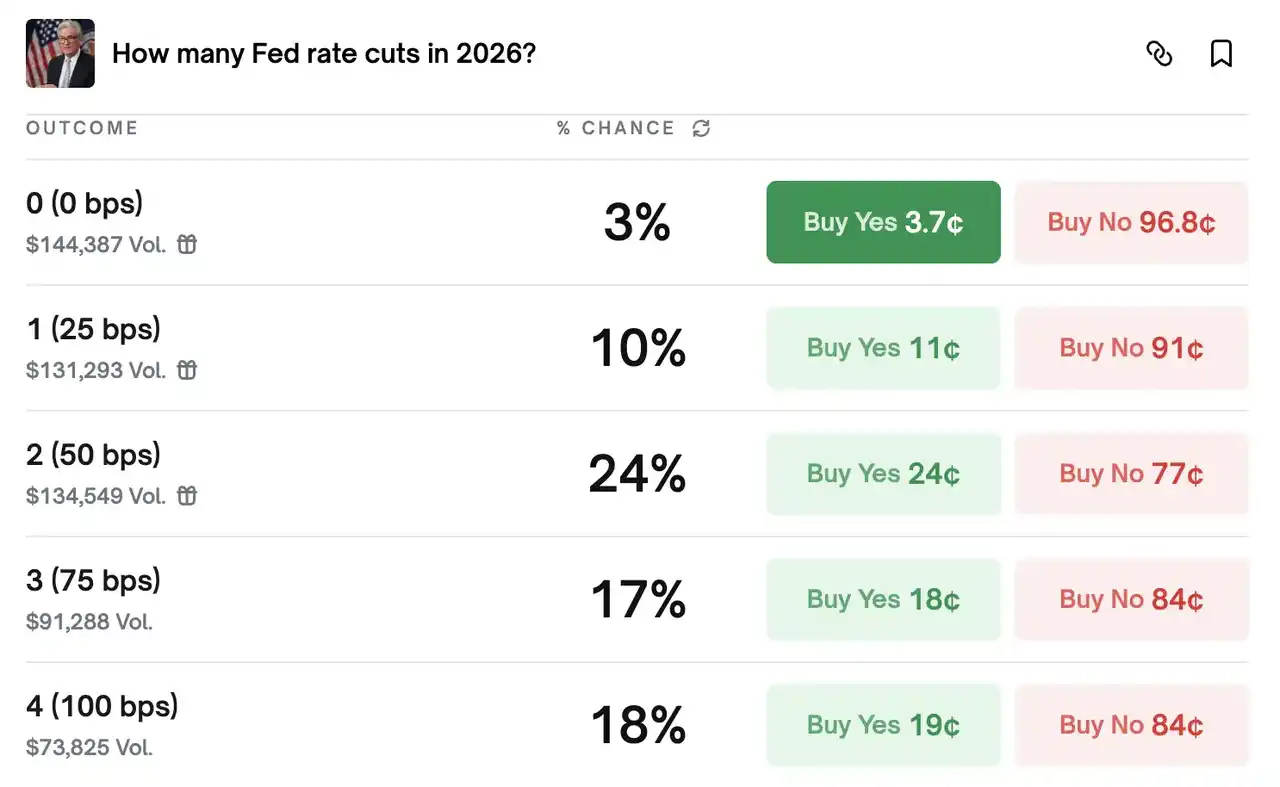
At the beginning of this year, the prediction on Polymarket for the number of rate cuts in 2026 with the highest probability was 2.
Everyone felt that a liquidity "downpour" was just around the corner.
Traders Start Betting on Rate Hikes
However, Trump has never been one to play by the rules and in mid-March, he started a war.
In mid-March, tensions in the Middle East escalated suddenly. The tense situation in the Strait of Hormuz quickly spread to the energy market, causing oil prices to soar by nearly 50% in just two weeks, with some grades briefly reaching $100. This surge in energy prices directly squeezed the Fed's room for rate cuts.
The CPI data for February already showed inflation above the 2% target, and now with the added fuel of oil prices, the Fed had to take a stronger stance.
The previously "100% rate cut" expectation has been shaken, with even a few discussions about "returning to rate hikes."
Originally expected to be the starting gun for rate cuts, today's interest rate meeting has now shifted to a "hawkish pause." According to the latest data, the market is almost 100% certain that the Fed will hold steady this time.
What's even more unsettling is that CME Group's FedWatch Tool shows that there is actually a 1.1% probability of a rate hike. While this percentage is very small, it sends a warning signal: the inflation monster may be back.
Analysts' sentiment has also shifted accordingly.
Goldman Sachs' Chief Economist, Jan Hatzius, revised the forecast on March 12, directly pushing back the expected rate cut from June to September, anticipating only 2 rate cuts this year.
Moreover, JPMorgan Chase bluntly stated that the current interest rates may have failed to contain the economy. If inflation continues to rise, the Fed's next move could indeed be a rate hike: the argument for "rate restraint" is becoming unsustainable. If the labor market remains strong, the Fed may maintain high rates in the long term.
More aggressive views come from strategists at EY-Parthenon and Carson Group. EY-Parthenon analyst Gregory Daco believes there may not be a single rate cut this year. Meanwhile, Carson Group analyst Sonu Varghese clearly points out that due to the surge in oil prices triggered by the Iran conflict, the Fed may not only refrain from cutting rates but may even discuss a rate hike later this year.
The latest forward-looking analyses from Caijing and Wall Street News also indicate that due to rising terminal rate expectations, the 2-year U.S. Treasury yield has surpassed 3.75%, which is usually a precursor to the market sensing policy tightening. Therefore, some traders believe that the possibility of a rate hike before the end of the year has increased from 0% to around 35%.
At 2:00 a.m. China time on Thursday night, the Fed will announce its final rate decision, whether to hike, cut, or hold rates.
Then at 2:30 a.m., Powell will hold a press conference to speak about monetary policy, the inflation path, and economic outlook.
It is worth noting that the Fed is currently in a delicate political window: Powell's term ends on May 15. This is his penultimate press conference as Fed Chair, and the market is currently in a policy vacuum waiting period. He himself is under significant political pressure, with Trump publicly criticizing Powell multiple times and calling for an emergency meeting for a substantial rate cut. This external pressure, along with the internal anti-inflation logic conflict, adds to the policy uncertainty.
In addition to the Fed, global central banks also have similar expectations.
This week, 21 central banks covering two-thirds of the global economy will announce their latest rate decisions. As this is the first "Super Central Bank Week" after the Middle East conflict broke out, the global market is closely watching to see if global central bank decisions will be influenced by the developments in the Middle East.
The Reserve Bank of Australia (RBA) just raised interest rates by 0.25 percentage points yesterday, making it the first major central bank this year among developed economies to tighten monetary policy.
In addition, the European Central Bank (ECB) is expected to keep rates unchanged at its meeting on March 19, with policymakers warning that global trade policy and geopolitical risks are limiting the outlook for future rate cuts. The Bank of England (BoE) is also expected to hold rates steady this Thursday, despite some internal voices supporting a rate cut, the focus remains on stability.
How Much Longer Will Oil Prices Rise?
If we peel back all the variables, we find an almost inescapable core: oil prices.
As long as oil prices keep rising, the room for rate cuts will be compressed; once oil prices fall back, monetary policy will have room to maneuver.
Therefore, the question becomes more direct: How much longer will oil prices rise?
From recent information released by the U.S. government, the answer seems less pessimistic than the market imagined.
On March 8, U.S. Energy Secretary Chris Wright gave a precise timeline in an interview: he believes the current oil price surge is just a temporary fear premium that will last "only a few weeks at most in the worst-case scenario, not months," before improving.
This is in line with White House Press Secretary Karoline Leavitt's statement a few days ago that "the rally in oil prices will only last another 2-3 weeks."
Similarly, Trump's statement on March 10 was more explicit. He said the action against Iran was much faster than expected, even stating, "I think this war is very close to being over." On the same day, the Energy Secretary's social media account was involved in a "post-deletion controversy."
Most intriguing is the adjustment in diplomatic timing.
Trump was scheduled to visit China in early April but suddenly announced a one-month postponement. The official reason was that the "war is too busy" and "the war needs him to stay in Washington." However, if we compare this one-month time difference with the "2-3 week recovery period" mentioned by the Energy Secretary, the one-month delay, which is around 4-5 weeks, conveniently covers the "2-3 week recovery period" and the post-war early handling time.
Therefore, we boldly speculate that the Trump administration's script may be as follows: end large-scale military operations by the end of March; in the following 2-3 weeks, in conjunction with the release of strategic oil reserves, forcibly push oil prices back below $80; by the time he visits in May, the Middle East situation is settled, inflation threats are removed, he can take on the posture of a "victor," not only demanding a substantial rate cut from the Federal Reserve but also seizing absolute initiative in the "U.S.-China" trade negotiations.
The optimism at the beginning of the year was built on the assumption of "manageable inflation + proactive policies"; however, the sudden change in the Middle East situation has shaken one of its key cornerstones—energy prices.
When the oil price loses its anchor, so does inflation; when inflation loses its anchor, the path of interest rates naturally becomes less clear.
In the coming period, what will determine global asset prices depends on those distant places, those oil tanker routes that have not yet come to a halt, and the gunfire that has not fully ceased.
You may also like

The other side of Musk's trillion-dollar fortune: 85% cannot be sold

The U.S. government prohibits foreigners from using Fable 5, Anthropic issues a rebuttal

Citibank releases "2030 Asset Tokenization Market Outlook": 6 major trends may create a $8.2 trillion market

The trillion-dollar valuation test: Are the three major super IPOs a celebration for tech stocks or a nightmare for the crypto market?

Morning Report | Digital Asset completes $355 million financing led by a16z Crypto; Meta completes operational separation from Manus

a16z Crypto Partner: Cash flow is the moat

Cryptocurrency market makers collectively seek change as it becomes increasingly difficult to make money

How TradeXYZ, xStocks, and Alpaca break down the SpaceX IPO into three different strategies
$75 billion in risk asset redistribution: How will SpaceX's IPO affect U.S. stocks and Bitcoin?

Why Is BlackRock Investing $5 Billion in the SpaceX IPO?
Morning News | CME Group launches Nasdaq Cryptocurrency Index futures; Asset management giant Janus Henderson strategically invests in Ethena

Bitcoin Layer 2 Network Botanix: Why Did We Choose to Dissolve?

Why did Oracle deliver the strongest financial report in history, yet its stock price fell?
When the P2P illicit funds from ten years ago turned into 60,000 bitcoins
Dialogue with OmenX Founder: Why does the prediction market need an evolution from "spot" to "derivatives"?
Galaxy in-depth report: Is Solana still worth paying attention to?
Young people in South Korea make a "final effort" in the epic bull market
The pricing controversy of Trade.xyz exposes the fatal weakness of Pre-IPO perpetual contracts
The other side of Musk's trillion-dollar fortune: 85% cannot be sold
The U.S. government prohibits foreigners from using Fable 5, Anthropic issues a rebuttal
Citibank releases "2030 Asset Tokenization Market Outlook": 6 major trends may create a $8.2 trillion market
The trillion-dollar valuation test: Are the three major super IPOs a celebration for tech stocks or a nightmare for the crypto market?
Morning Report | Digital Asset completes $355 million financing led by a16z Crypto; Meta completes operational separation from Manus
a16z Crypto Partner: Cash flow is the moat


