
On-chain Data Academy (Part 8): A Brand New Set of Ark-Involved Research on BTC's Magical Pricing Methodology (III)

![EverRise [old]](https://s2.coinmarketcap.com/static/img/coins/64x64/10548.png)


Original Article Title: "On-chain Data School (Eight): A Brand-New, #Ark-Involved, $BTC Magical Pricing Methodology (III)"
Original Article Author: Mr. Berg, On-chain Data Analyst
TLDR
- The Cointime Price series consists of three articles, and this is the third article
- It is recommended to read at least the first article first
- This article will introduce another way to observe tops using Cointime Price
- This article will also introduce the author's designed Distribution Rate Observation Indicator
1. Brief Review of Previous Two Articles
In the Cointime Price series of articles, the first article introduced the basic principles of Cointime Price and provided an application for buying the dip; "On-chain Data School (Six): A Brand-New, Ark-Involved, BTC Magical Pricing Methodology (I)"
The second article analyzed from the perspective of "the extent to which the price deviates from Cointime Price," shared the author's designed Cointime Price Deviation model, and used this model as a signal filter for tops observation. "On-chain Data School (Seven): A Brand-New, Ark-Involved, $BTC Magical Pricing Methodology (II)"
If you are reading this series of articles for the first time, it is recommended to at least read the first article first, otherwise the subsequent understanding may be a bit stuck
2. Escape Top Application Methodology: Cointime Price Daily Distribution Rate
1. The Law of Cointime Price
Before we continue, let's take a look at the chart of Cointime Price:
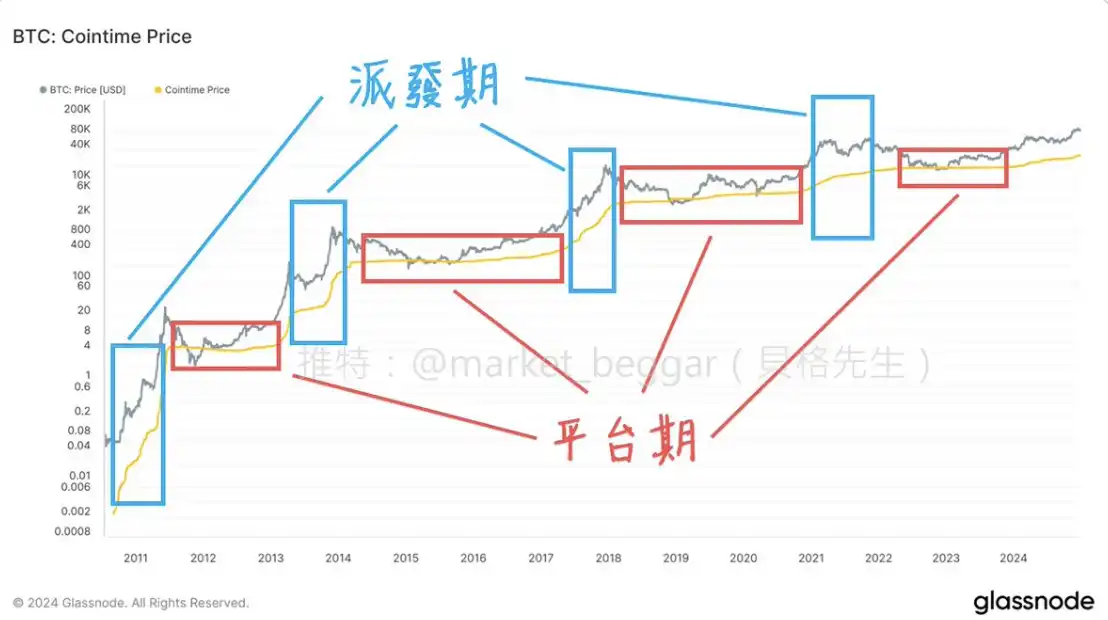
Attentive readers should have already noticed that the price trend of Cointime Price actually has a very distinct feature: "Sharp Rise — Plateau — Sharp Rise — Plateau..."
Based on the content of the first article in the series, we know that:
Cointime Price only experiences rapid increases when there is a large distribution by long-term holders, and Cointime Price essentially represents the "market chip time-weighted average cost." During the distribution phase, the remaining holders on the field accepting the distribution cause the holding cost to rise, which is reflected in the chart as a rapid increase in Cointime Price.
Utilizing this characteristic, the author has designed an indicator to observe the distribution rate, tentatively named the "Cointime Price Daily Distribution Rate."
2. Cointime Price Daily Distribution Rate Indicator
To measure the rate of change, the author has used the simplest formula: (Today's CP - Yesterday's CP) / Today's CP, then the calculated result is smoothed by a moving average (*Note: CP is an abbreviation for Cointime Price).
After inputting this formula into glassnode, the following chart can be obtained:
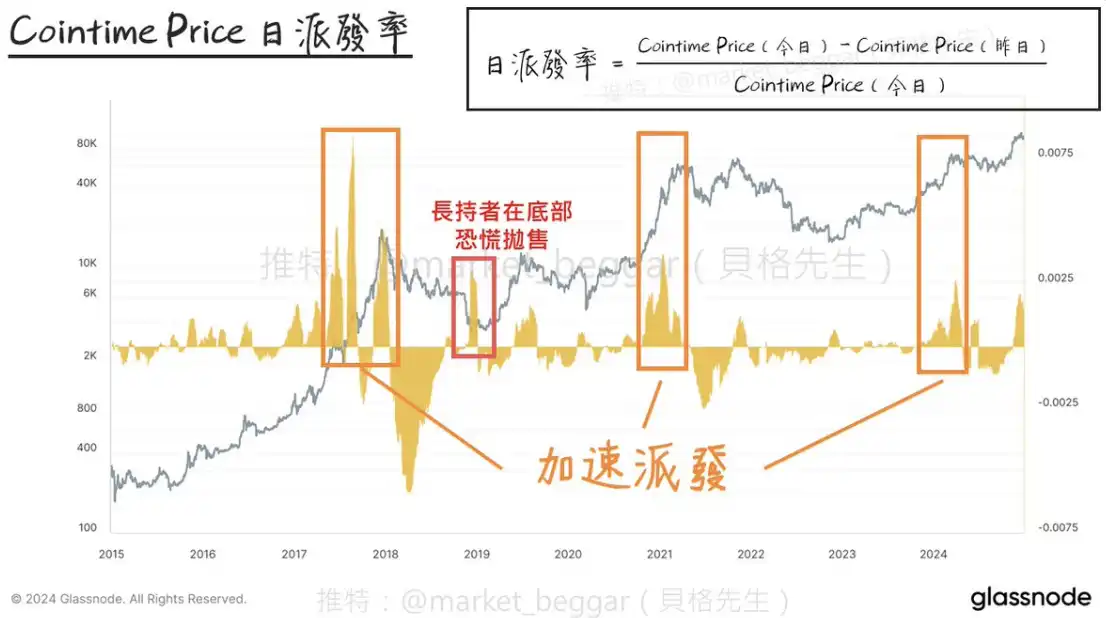
We can see that every occurrence of the bull market's main uptrend is accompanied by a high distribution rate of Cointime Price. Except for one high distribution rate that occurred in 2019 near the bottom, every other time a high distribution rate appears, it is usually a signal of accelerated distribution by long-term holders. As for that one time in 2019, it won't lead to misjudgment in practical operations because just looking at the price trend at that time could tell that it was unlikely to be the top.
3. Historical Top Distribution Rate Situation & Current Market Phase
By common sense, every time #BTC reaches a cyclical top, there usually won't be just one "distribution." This is evident from indicators like UPDR, Realized Profit, and so on, and it logically holds true because distribution is a process, not a one-time event.
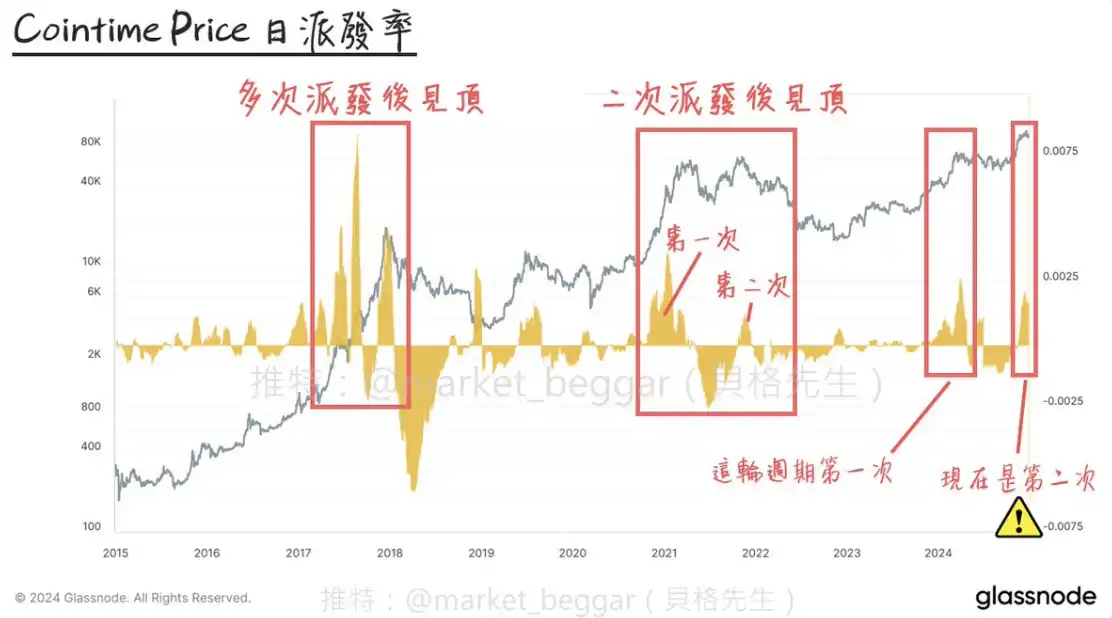
Readers can click on the above chart (Chart Three), and during the formation of the top, the daily distribution rate often shows more than one clear increase. In this current bull market cycle, the daily distribution rate experienced an acceleration in March of this year, which is also corroborated by Realized Profit data, indicating that indeed some long-term holders chose to take profits at that time.
If you are not yet familiar with what Realized Profit is, you can refer to this post: "On-chain Data School (Part 3): Have the Accumulators at the Bottom Cashed Out?"
March of this year was the first time in this cycle when the distribution rate significantly increased, and during the November rally after Trump's election, there was a second increase in the distribution rate.
This also corresponds to the Realized Profit data quoted by the author in the second top-selling weekly report: "On-chain Data School (Part 2): The Hodlers Who Keep Making Money, What is the Cost of Their BTC?"
From an on-chain data perspective, this is a warning signal worth continued attention.
III. Conclusion
This article is the third piece in the Cointime Price series, and for now, this series comes to a close. I hope it is helpful to everyone, and I also hope that readers can provide as much feedback and comments as possible. If you have any ideas, feel free to comment below and communicate with me! If you are not a glassnode user, you can also track the market trends in real-time by reading my weekly reports that I publish every week.
You may also like

The impossible triangle is simply a pseudo problem

Stablecoins Finally Find Real Returns: On-Chain Reinsurance Re Explained | Interview with Re Founder Karan Saroya

The AI gamble of mining companies: Valuations enter a phase of differentiation, and it's hard to turn the tide

A letter from Alliance to entrepreneurs: Written on the occasion of Cursor selling for 60 billion dollars

Will MicroStrategy fall into a death spiral? What will the macro trend be in the second half of the year?

Blockchain Capital Partner: The Core Secret of Arbitrage

STRC unanchored by 11%, can the perpetual motion machine of Strategy still operate?

Bitcoin Market Analysis 2026: Can BTC Reach $150K by Year-End?

Bitcoin ETF Outflows Hit a Record $4.4 Billion: What Are Traders Doing With Their Cash?

WEEX App Just Got Smarter – New Tabs for Faster Trades & Easy Asset Management

WEEX All-New Search Features: Find, Trade & Earn Faster Than Ever

Morning Report | Illinois signs the strictest digital asset tax law in the U.S.; RWA tokenization market size surpasses $43 billion, institutions accelerate the migration of on-chain assets

Full version of the debut Q&A! Federal Reserve Chairman Waller: Sticking to the 2% inflation target, establishing five special working groups, individual did not submit the dot plot

From Disruptor to Shadow Market: The Crypto Market is Becoming a Colony of Traditional Finance
Dalio's important long article: How to position in the current market environment?
OKX Star analyzes Binance's competitive advantages: when regulation levels the playing field, competition has just begun

New gameplay for participating in initial offerings on cryptocurrency exchanges
Why Is Bitcoin Down Today? What the Hawkish FOMC Means for SpaceX, Gold and Nasdaq
The impossible triangle is simply a pseudo problem
Stablecoins Finally Find Real Returns: On-Chain Reinsurance Re Explained | Interview with Re Founder Karan Saroya
The AI gamble of mining companies: Valuations enter a phase of differentiation, and it's hard to turn the tide
A letter from Alliance to entrepreneurs: Written on the occasion of Cursor selling for 60 billion dollars
Will MicroStrategy fall into a death spiral? What will the macro trend be in the second half of the year?
Blockchain Capital Partner: The Core Secret of Arbitrage


