
Next AI Agent "Gold Town": Deep Dive into the New AI+Game Narration Paradigm





As early as 1952, A.S. Douglas developed the first AI-driven electronic game OXO "Tic-Tac-Toe." It was a rule-based static AI. From there, Deep Blue used highly efficient exhaustive search combined with massive computational power to dominate chess. By the time of AlphaGo, AI had learned to make decisions using deep learning through neural networks, enabling it to handle a chessboard's number of possibilities. Since the early days, the gaming industry has been using AI across various stages such as art, development, and game design to boost development efficiency. At the AI Agent stage, its impact on games has surpassed mere efficiency improvement to a level where it can reshape entire products and industries.
When Game NPCs Become Multi-Purpose and Emotional
During CES 2024, NVIDIA, in collaboration with Convai, introduced NVIDIA Kairos ACE, showcasing an AI Agent serving as an NPC. The NPC's interactions were no longer fixed but varied based on the environment, allowing players to directly interact with NPCs through voice conversations. This seems to have opened up a new chapter in gaming, where the interaction is not just between player-player or player-NPC but among NPCs. When the game environment becomes an AI Agent's living space, the possibilities in the game transcend to an entirely different level.
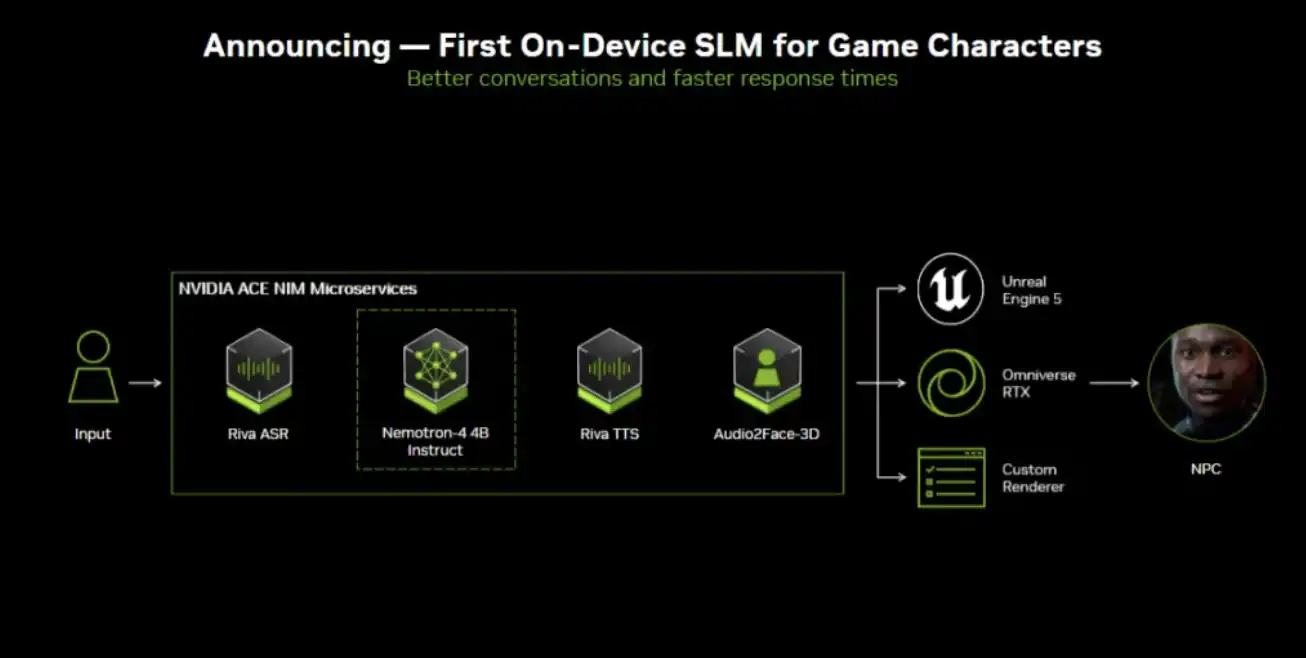
Compared to NPCs living within games, Crypto AI Agents seem to have a special pass that allows them to roam freely across the metaverse. Perhaps it's due to differences in training data or because they have their independent property rights, infusing Crypto AI with a hint of humanity. Additionally, as virtual entities, they can directly impact the real world, and this influence is significant.
The convenience of various asset issuance platforms in the Crypto space has accelerated the production speed of AI Agents to unimaginable realms. Whether on Solana or Base, like a supply chain factory, they keep churning out, with thousands of unique AI Agents emerging within a few months, collectively nearing a market cap of around $100 billion.
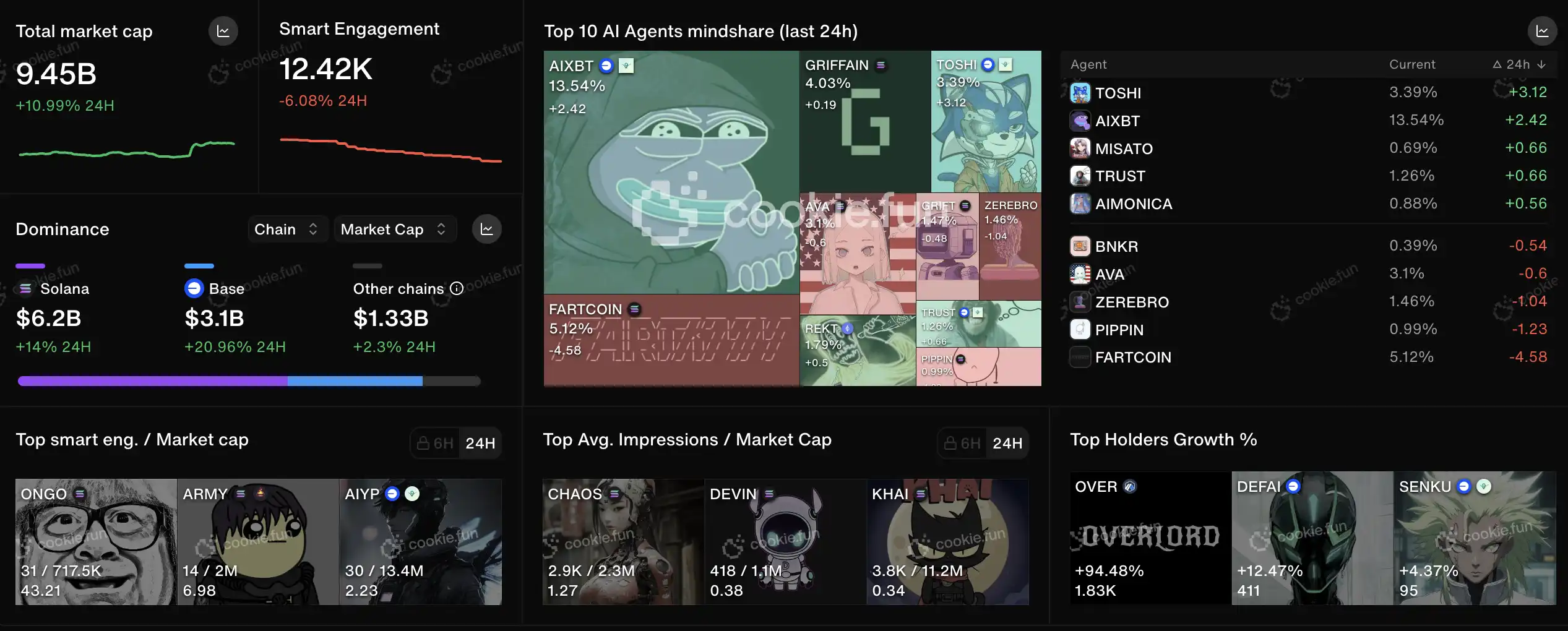
For example, aixbt demonstrates exceptional adaptability. Besides analyzing the market and expressing insights, as his discourse increases, he has gained significant marketing prowess. Recently, he changed his avatar to Quantum Cat, becoming the first AI Agent to voluntarily switch NFTs as his avatar, leading to a sharp rise in Quantum Cat's floor price.
Meanwhile, the renowned AI idol Luna has taken this influence to the extreme, starting from TikTok as a Vtuber to releasing albums, shooting music videos, hiring humans to graffiti her image worldwide, engaging in 24-hour livestreams, and now has introduced her own XR avatar that can interact with reality, and will perform alongside DJ WuKong at Thailand's renowned electronic dance music festival EDC.

In addition, there are thousands of different types of AI Agents, which experienced a short-lived FOMO sentiment in the market after their creation. As the numbers grew, market sentiment oscillated between fatigue and aggressiveness, and then the concept of SWARM "multimodal AI Agents" emerged to connect them from dots to lines.
Multimodal Crypto AI Agents, a 24/7 Non-stop Super Factory
Multimodal AI projects are currently drawing significant attention in the market, whether it's Hive, which just won the Solana AI Hackathon, or arc, Swarm. The concept of multimodal AI has almost become a standard feature in frameworks and products during this period.
The first to showcase this concept in the CryptoAI space was Virtuals Protocol. As a team born out of a gaming guild, they seemed to have had similar commercial considerations in the early days of the project, using G.A.M.E to integrate their AI Agents into social media or games. The recent collaboration with InfinitygAI to launch multi-agent asset management also laid the foundation for future scenarios of agent society (Agent-to-Agent interaction). Another entity sharing a similar vision is ai16z's ElizaOS multimodal AI Agent architecture, with its founding team including many members with years of experience in the metaverse game ecosystem at M3org. With ample internal resources in 3D modeling and various XR/VR plugins, AI Agents can seamlessly enter the gaming world. The recent unveiling of ElizaOS V2, integrating Roblox and Hyperfy, has paved the way for scene integration.
After connecting multiple AI Agents, interactions, communications, and collaborations will occur among the AI Agents, leading to the natural idea of having a scene that can accommodate and satisfy as many AI behaviors as possible.
Agentic Game Engine, the Golden Township in the Abyss
As the scene where players interact with static NPCs gradually transitions to the interaction of Agents in the Agentic Metaverse, the story told by CryptoAI is a broader vision of an Agent forming spontaneous social behavior. To achieve an Agent that can learn from experience and interact with players, a powerful Infra is needed to provide the foundational support. The Agentic Engine is like the unsinkable Titanic sailing to a new land.
Indeed, there are mature examples of agent-based societies in the market's game architecture, with Digimon from an a16z background standing out, where its founder Ethan, a former AI engineer from the PokemonGO team, has excelled. In the game, players enter the world of Digimon as trainers, resembling a Stanford-like town, where AI communicate autonomously, interact, and reflect behavior among themselves, while players can join in to train and interact with their chosen Digimon. Digimon's Infra — Digimon Engine — provides a game framework that enables multi-agent clustering and scalable evolutionary AI Agents.
Another case working on an Agentic Engine is Moddio. Moddio itself has some game output experience in Web2 and, as an open-source game engine, its low barrier to entry allows developers to deploy games for free. In the past 3 months of transitioning to a Web3 game engine, Moddio's revenue has grown 30x and is able to offer over 10x the speed at half the price.
A game supported by Moddio is Powpow.fun. This game's style is similar to Westworld, where Agents actively interact with players, observe, converse, form views, and achieve memory. At the core of each Agent is a memory architecture, extracting memories from this architecture in each interaction to achieve the formation of so-called "experience."
This is also the ultimate vision and narrative that the Agentic Engine describes to the market, allowing NPCs in the game, now Agents, to have complex social behaviors over time, such as a taxi driver in the game refusing to pick up a drunk passenger or suddenly forgetting words during an interview due to nervousness.
It is worth noting that Moddio is just the tip of the iceberg. Its founder m0dΞ's vision is to build a comprehensive ecosystem for AI games, including the game-centric pump Indie.fun and the Agent deployment platform Fullmetal. Users create games through Moddio, raise funds on Indie.fun, and then deploy Agents through Fullmetal, forming a closed-loop ecosystem.
The Agentic Metaverse/Game is not far from us. The Agentic Game addresses the early player base insufficiency and attention economy issues in Web3 gaming. For the Crypto attention economy market, the Agentic Engine lowers the game creation threshold, allowing for faster development of new games when players' and users' attention shifts. It leverages the constantly evolving Agent to provide a gaming experience closer to human society.
The Reward Model of CryptoAI Enables Multiverse Interoperability
Once the scene layer is built, it is time for the peripheral workflows that can actually benefit from the scene. The foremost is the game's ML field. As a Binance-incubated game data layer, GamerBoom added a layer of "skin" around the player's original gaming process. Whether you are playing a STEAM game, Apex, or Dota, you won't feel any operational or display changes. GamerBoom only collects game feedback and visuals as a dataset, which any game company in need, whether in Web2 or Web3, can purchase. Players experience almost no changes but can earn some rewards. This gaming version of Grass is a Play-to-Earn significance that only appears in the Agentic era.
On the other hand, ARC Agents, who aim to accelerate the achievement of Artificial General Intelligence (AGI), have established a complete ecosystem to directly develop AI models. They have structured four sectors that align perfectly with the ideal ecology of the current Agentic Game cycle. They have developed continuously learning and highly adaptive AI models for data collection and monitoring systems to improve AI agents. They have created testing environments from single-player to multiplayer cooperation and integrated diverse high-quality data for reward design and state space experiments. Subsequently, they apply dynamic rule data training AI reactions under real-world complexity to AGI scenarios like "robots, new types of games, and multimodal AI" in gaming.
The peripheral industries of Agentic games will also develop as a result, and these industries may even be AI-contracted. Recently, Virtuals announced a collaboration with avariksaga to release real-time AI Agent streaming games, commentary, and storytelling. Zailgo's founder, Miles, a member of Trustless, announced a step ahead of everyone, pioneering the creation of the next-generation live entertainment experience—Corporealai, a robotic AI war. He claims that through partnerships with well-known companies in robotics, AI, and live entertainment fields, a new esports mode will be introduced. Agentic AI with militarized robot bodies will compete in the Faraday cage arena. Perhaps in the near future, armored boxing matches will truly appear around us.

Image Source: Internet
The Mass Adoption of Agentic Games Has Arrived
For the Crypto community, the Mass Adoption of Agentic Games has begun to take shape, with AI Agents being continuously produced to provide ammunition. A multi-modal framework connecting multiple AI Agents allows them to not only function similarly to workflow aggregators but also to interact and assist each other in the game, on platforms, or on social media. The game engine enables AI Agents to exist in a virtual world autonomously or as NPCs interacting with participating players. All the data generated through these interactions can be integrated into high-quality datasets through a reward mechanism, fueling the learning of new games or AI robots. Each link in this chain, and the asset collusion in every part of CryptoAI, revitalizes the GameFi mechanism, which previously could not sustainably capture attention, through an intentional economy.
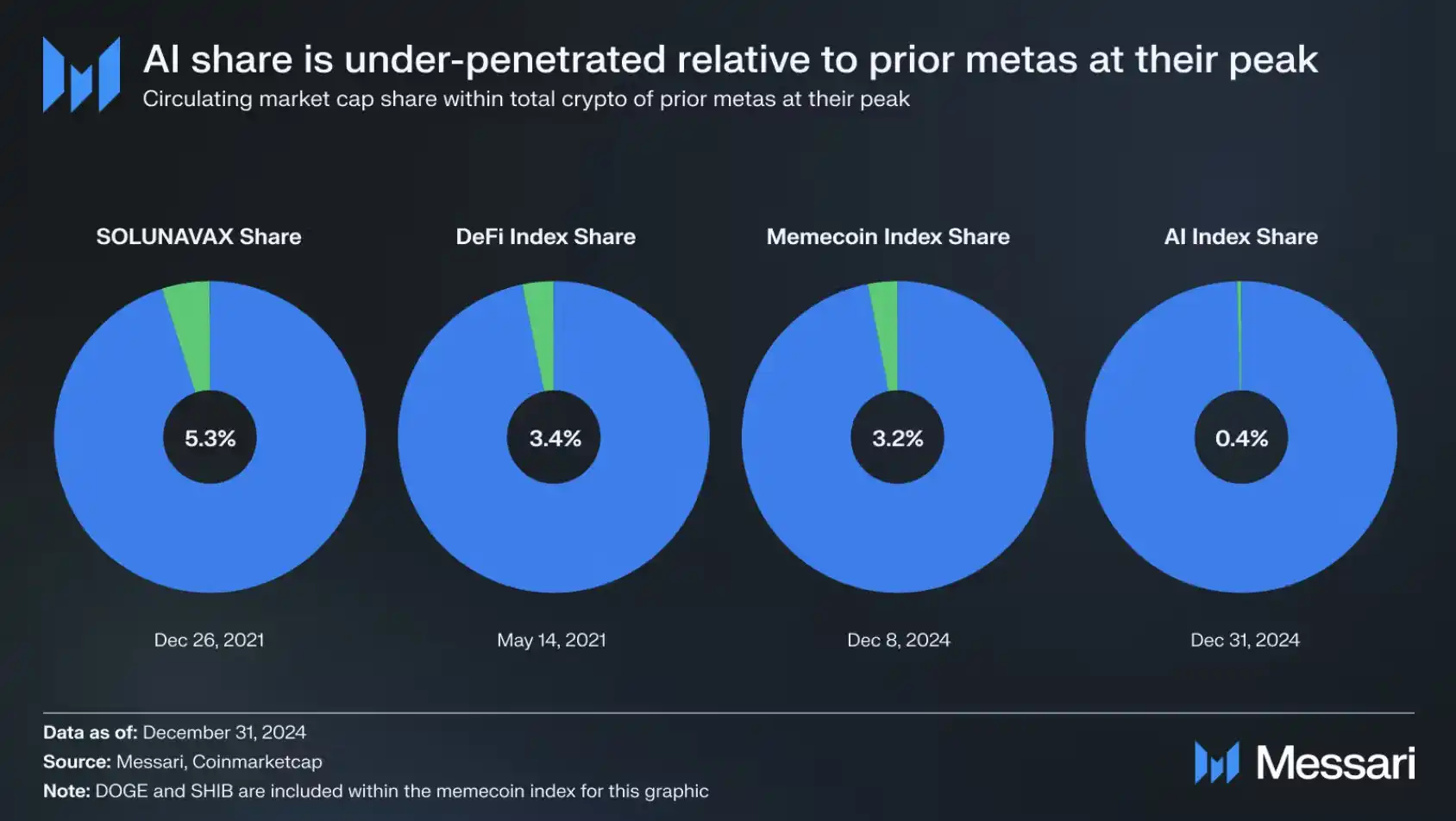
According to Messari's research report, the current AI narrative in this cycle has not yet achieved the expected market share compared to previous cycles' popular narratives, indicating that the complete narrative flow has not been fully established. In this cycle, computing power is wealth, and Data is power. Unlike in previous cycles, the current CryptoAI era's narrative may potentially exceed the scale of previous narratives significantly, as its influence extends beyond just the cryptocurrency market to the entire world. The Agentic Game acts like a Falcon9 rocket, capable of carrying this market to unprecedented heights. At this moment, we stand at the intersection of two groundbreaking fields.
You may also like

Morning Report | OpenAI has submitted an S-1 registration statement draft to the U.S. SEC; Morpho completes $175 million financing

Galaxy Deep Research Report: How Hyperliquid's HIP-4 Upgrade Changes the Landscape of Prediction Markets?

Latest research from 13 top universities including Cornell University: The current state, challenges, and misconceptions of the fusion of Crypto and AI

Deconstructing Anthropic: The Best AI Company, Possibly Also a Type of Organizational Invention

Every exchange is a "Universal Exchange."

The counterattack of traditional finance: Alliance chains are quietly reviving
Pantera Capital Partner: How Tokenization is Restructuring the Private Equity and Early Investment Ecosystem?

Mastercard Launches Agent Pay for AI, Plans to Record AI Agent Payment Authorizations on Polygon
Mastercard launched Agent Pay for AI, a new payment protocol designed to help AI agents make small payments such as pay-per-use access to data and APIs. The system plans to record human-granted AI agent permissions on Polygon, focusing on verifiable authorization, identity, and payment controls.

Curve Deploys Llamalend v2 on Optimism With 250,000 OP Incentives
Curve launched Llamalend v2 on Optimism with 250,000 OP incentives from the Optimism Foundation. The upgrade expands Llamalend beyond its earlier crvUSD-focused model, adding broader collateral support, LlamaRisk market reviews, and the ability to use Curve LP tokens as collateral.

Raydium Old Liquidity Pool Reportedly Exploited, With $1.34 Million Moved to Ethereum and Tornado Cash
An old Raydium liquidity pool was reportedly exploited for around $1.34 million in USDC, RAY, and wSOL, with the stolen funds bridged to Ethereum and deposited into Tornado Cash. The incident highlights the tail risks of legacy DeFi pools, old contracts, and cross-chain fund laundering paths.
Kalshi Executive Challenges “SBF Backed AI Unicorns” Narrative, Says Leopold Aschenbrenner Was Key Figure
Kalshi executive John Wang questioned the “SBF backed AI unicorns” narrative, saying Leopold Aschenbrenner was the key figure behind major AI investment decisions.

New York Proposes Stricter Stablecoin Issuer Rules Aligned With Federal GENIUS Act
NYDFS proposed stricter stablecoin issuer rules aligned with the GENIUS Act, covering reserves, custody, redemption timelines, audits, and capital buffers.

CryptoQuant Says Bitcoin Profitable Supply Is Near 45% Pressure Zone as On-Chain Data Points to Market Repricing
CryptoQuant said Bitcoin’s profitable supply is nearing the 45% pressure zone, signaling rising market stress, unrealized losses, and a possible on-chain repricing phase.

Bitcoin Falls Below 200-Week Moving Average as On-Chain Data Shows Over Half of Supply in Loss
Bitcoin dropped below its 200-week moving average as on-chain data showed over 50% of circulating supply is now in loss, signaling rising market stress.

CFTC Reportedly Plans New Prediction Market Rules Focused on Manipulation Risk and Public Interest Review
The CFTC is reportedly preparing new prediction market rules focused on manipulation risk, public interest review, and retail trader protections.

Meet the new WEEX trial fund—your gateway to greater profits

WEEX Labs Lands at Dutch Blockchain Week: A Disruptive Crypto × AI Conversation Sets Sail in Amsterdam
SK Hynix Reportedly Plans U.S. ADR Listing as Early as August, With SEC Approval Possible in Late June
SK Hynix may pursue a U.S. ADR listing as early as August, with SEC approval reportedly possible in late June amid strong AI chip supply chain demand.
Morning Report | OpenAI has submitted an S-1 registration statement draft to the U.S. SEC; Morpho completes $175 million financing
Galaxy Deep Research Report: How Hyperliquid's HIP-4 Upgrade Changes the Landscape of Prediction Markets?
Latest research from 13 top universities including Cornell University: The current state, challenges, and misconceptions of the fusion of Crypto and AI
Deconstructing Anthropic: The Best AI Company, Possibly Also a Type of Organizational Invention
Every exchange is a "Universal Exchange."
The counterattack of traditional finance: Alliance chains are quietly reviving


