
 Buy Crypto
- Markets
 Futures
- Spot
- Copy Trade
- Earn
- More
Nearly $300M Targeting U.S. Midterm Elections, Tether Exec Leads Crypto Industry's Second-Largest Political Fund


Original Article Title: "Nearly $300 Million Targeting U.S. Midterms, Tether Exec Leads Crypto Industry's 2nd-Largest Political Fund"
Original Article Author: DeepTech TechFlow
DeepTech Summary: The crypto super PAC Fellowship, founded seven months ago and claiming to have raised over $100 million but not spent a penny to date, announced on Wednesday the appointment of Jesse Spiro, Tether's Vice President of Regulatory Affairs, as chairman. This marks the first formal public association between Tether and the PAC. Meanwhile, another major crypto PAC, Fairshake, has a war chest of $193 million, with a total of nearly $300 million in political funds targeting the November midterms, while congressional wrangling over stablecoin regulation remains unresolved.
A political arms race is escalating within the crypto industry.
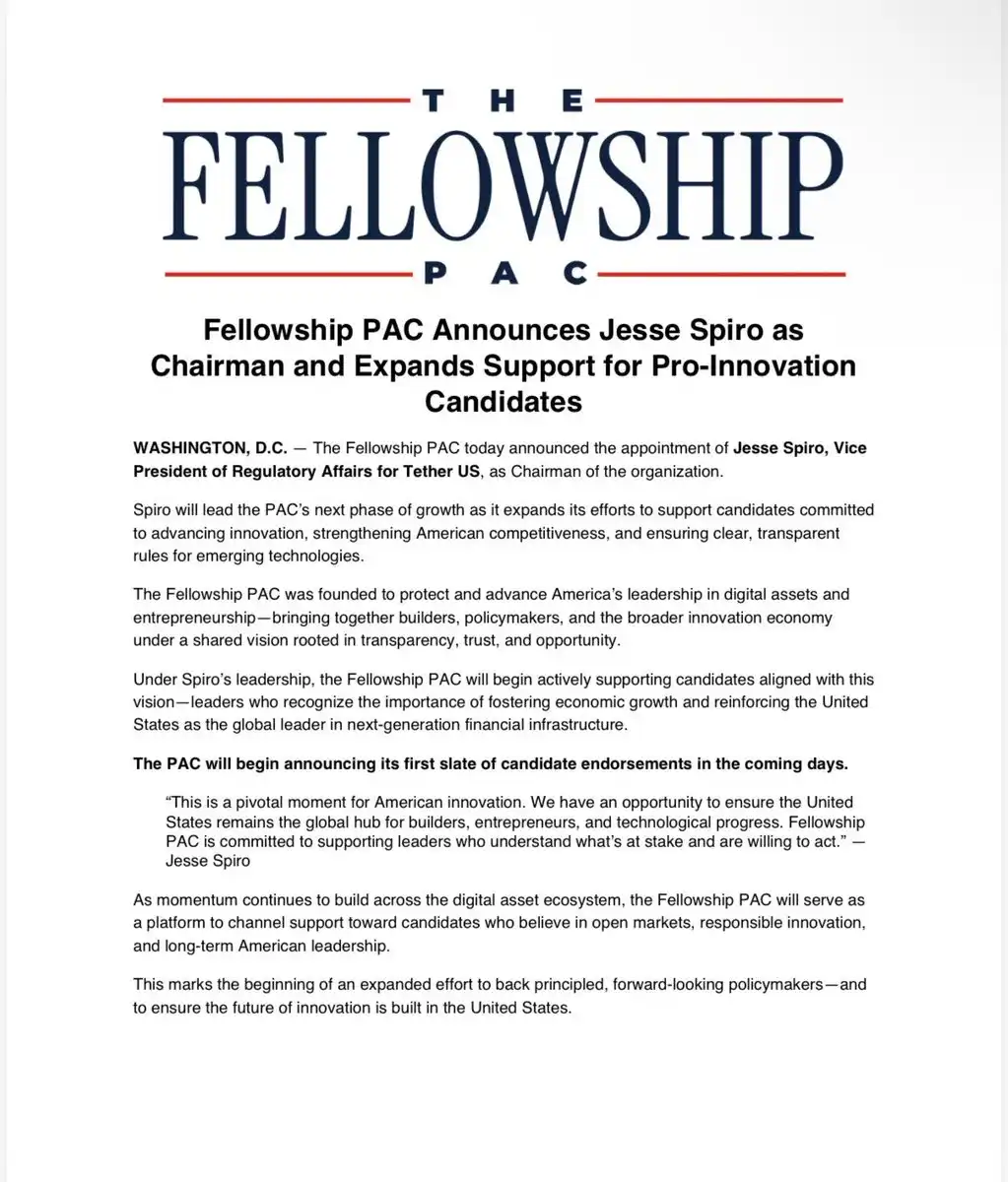
As reported by Cointelegraph on April 1, the Fellowship PAC announced on Wednesday that Jesse Spiro, Tether's Vice President of Regulatory Affairs, will serve as the organization's chairman, leading its next stage of expansion and endorsing a first slate of candidates in the coming days. Fellowship is a super PAC founded in August 2025, claiming last September to have raised "over $100 million" from an undisclosed donor aligned with the crypto industry.
Spiro stated in a press release: "This is a critical moment for American innovation. We have the opportunity to ensure that the United States remains a global center for builders, entrepreneurs, and technological progress. Fellowship PAC is committed to supporting leaders who understand the stakes and are willing to take action."
From "Deny Association" to "Executive Leadership," Tether's Relationship with Fellowship Comes to Light
Since its high-profile debut in September last year, the identity of Fellowship PAC's backers has been one of the industry's biggest mysteries.
When the PAC was formed, no executives, donors, or key employees were disclosed. Early reports listed Tether as an expected supporter, but Tether International subsequently officially denied any association with the PAC. According to CoinDesk's February report, a Tether International spokesperson explicitly stated that "Tether International has no affiliation with Fellowship."
But FEC records tell a different story. Fellowship's registered finance director, Mitchell Nobel, is an executive at Cantor Fitzgerald, the very entity that serves as the custodian for Tether's multi-billion-dollar reserves. The PAC's registered address is in Bethesda, Maryland.
Now, a current Tether US executive has formally taken on the role of PAC chair, putting an end to various speculations as public records confirm the ties. According to BeInCrypto, this marks the first formal, public association between Fellowship PAC and Tether officials.
Spiro joined Tether in 2024 as the Head of Government Affairs, previously working at PayPal on blockchain and digital asset regulatory issues and earlier holding a government affairs leadership role at blockchain analytics firm Chainalysis.
A $100 Million "War Chest" Still Untapped, FEC Records Show Zero Expenditure
Despite Fellowship's claim of possessing a $100 million fund, FEC records reveal that as of December 31 last year, the PAC reported no donation income or expenditure. Since its launch event in September last year, Fellowship has only made three public statements on X platform, operating almost in "stealth" mode.
This contrast has sparked widespread scrutiny. CoinDesk highlighted in an investigative report on February 25 that Fellowship, established seven months ago, has "yet to show up," with no trace of its promised $100 million fund in Federal Election Commission disclosures.
Spiro's appointment is seen as a signal of Fellowship resurfacing from its quiet period into the public eye. The PAC stated that it would announce its first round of candidate endorsements in the coming days, with over seven months remaining until the November midterm elections.
Bo Hines, Executive Director of the White House Digital Asset Advisory Committee, expressed support for this appointment on X platform, stating, "The battle for American innovation needs dedicated advocates. Looking forward to seeing leaders elected who truly understand the stakes."
Crypto PAC Arms Race: Fairshake Holds $193 Million, Drops $8.6 Million in Illinois
Fellowship is not the only political funding machine in the crypto industry. Supported by Coinbase, Ripple, and a16z, the Fairshake PAC and its affiliates reported holding $193 million in cash as of January this year, making it the largest super PAC in the crypto industry to date.
Fairshake has begun to take concrete action. According to Cointelegraph, the PAC and its affiliated organizations have spent around $8.6 million in the Illinois state races, six times more than what they spent in the state in 2024. In the March Illinois primary, some Fairshake-backed candidates failed to win, but the midterms are still seven months away.
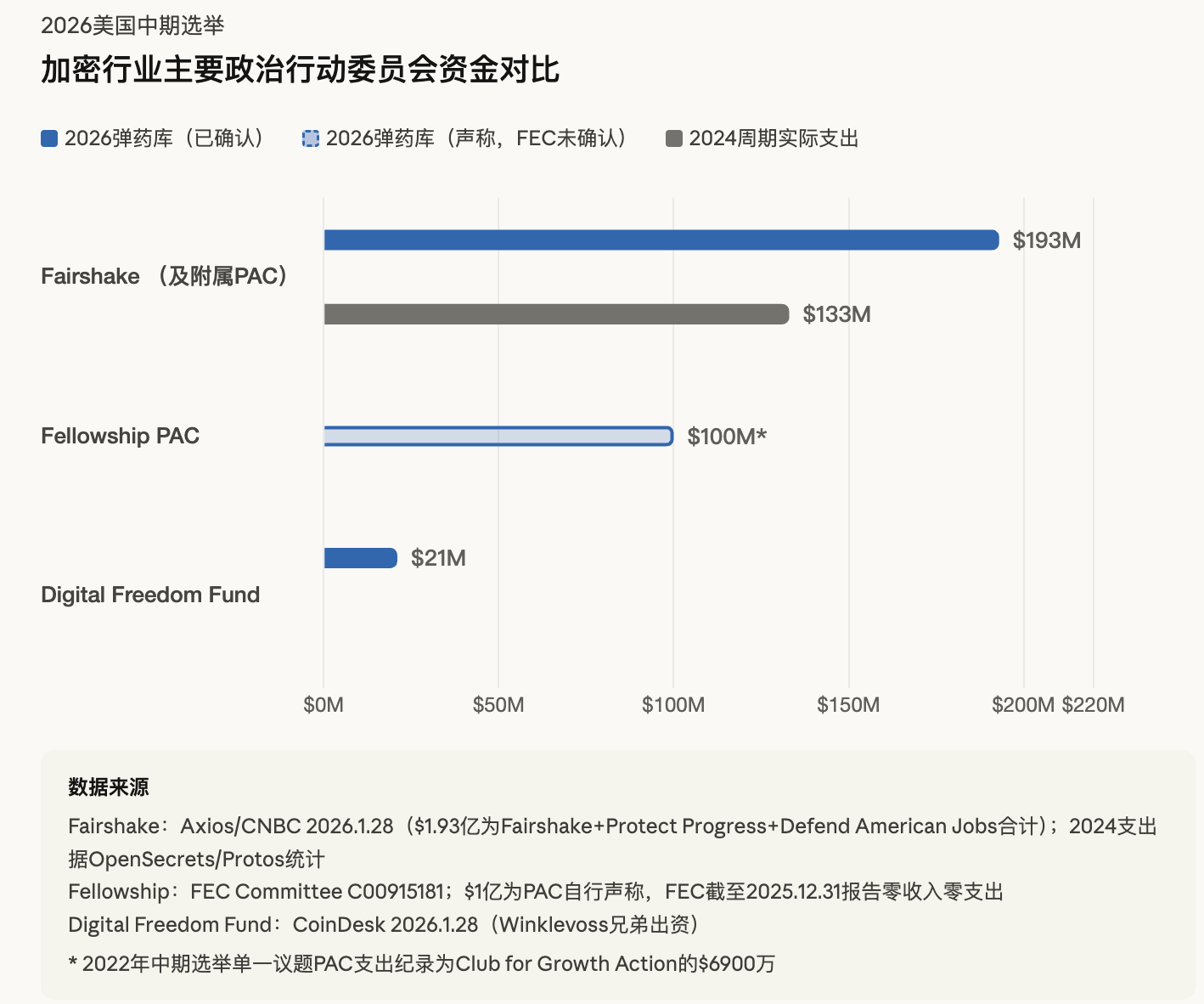
During the 2024 election cycle, Fairshake spent over $130 million on media buys, supporting over 50 candidates, the majority of whom were successful. Nearly half of the corporate funds flowing into the 2024 elections, according to the nonprofit watchdog organization Public Citizen, came from the crypto industry.
Today, with a combined war chest of nearly $3 billion between Fellowship and Fairshake PACs, along with other political donation forces from the crypto industry, the 2026 midterms are poised to set a new record for industry political spending.
Legislative Shadow War: Stablecoin Yield Dispute Stalls CLARITY Bill, Tether's Interests at Stake
The timing of Spiro's appointment was no accident. The core legislative priority of the crypto industry, the "Crypto Market Clarity Act" (CLARITY Act), is now mired in a Senate standoff, with one of the key issues being stablecoin yields, directly impacting Tether's business model.
The CLARITY Act passed the House in July 2025 by a vote of 294 to 134, and went through markup in the Senate Agriculture Committee in January of this year. However, at the Senate Banking Committee level, a fierce battle has unfolded between the banking sector and the crypto industry over whether stablecoins can offer yield to users.
On March 20, Senator Thom Tillis and Angela Alsobrooks reached a fundamental compromise on stablecoin yields: banning passive yield payments based on holdings but allowing reward programs based on transaction activity. According to CoinDesk, after crypto industry representatives reviewed the latest language behind closed doors on Capitol Hill on March 23, they found the wording too restrictive and ambiguous. Coinbase has twice stated its non-support for the current draft.
The Senate Banking Committee markup is currently scheduled to occur in late April after the Easter recess. Senator Bernie Moreno has cautioned that if the bill does not progress by May, crypto legislation may not receive serious consideration during the midterm election cycle.
To make matters worse, White House AI and Crypto Czar David Sacks confirmed on March 26 that his 130-day term has expired, with no successor being named by the government. The most critical legislative push for the crypto industry will proceed without the White House's chief advocate.
USDT issued by Tether is the world's largest stablecoin, with a market cap of around $184 billion, but it is not available to U.S. residents. Tether introduced the compliant stablecoin USAT for the U.S. market last year. The final direction of stablecoin yield terms will directly impact Tether and its competitors' operational space in the U.S. market.
Against this backdrop, Tether, by appointing executives to the PAC chair, is moving its political influence-building efforts from behind the scenes to the forefront, sending a clear signal: during a critical legislative window, using political funding to safeguard industry interests.
You may also like

Consumer-grade Crypto Global Survey: Users, Revenue, and Track Distribution

Prediction Markets Under Bias

Stolen: $290 million, Three Parties Refusing to Acknowledge, Who Should Foot the Bill for the KelpDAO Incident Resolution?

ASTEROID Pumped 10,000x in Three Days, Is Meme Season Back on Ethereum?

ChainCatcher Hong Kong Themed Forum Highlights: Decoding the Growth Engine Under the Integration of Crypto Assets and Smart Economy

Why can this institution still grow by 150% when the scale of leading crypto VCs has shrunk significantly?

Anthropic's $1 trillion, compared to DeepSeek's $100 billion

Geopolitical Risk Persists, Is Bitcoin Becoming a Key Barometer?

Annualized 11.5%, Wall Street Buzzing: Is MicroStrategy's STRC Bitcoin's Savior or Destroyer?

An Obscure Open Source AI Tool Alerted on Kelp DAO's $292 million Bug 12 Days Ago

Mixin has launched USTD-margined perpetual contracts, bringing derivative trading into the chat scene.
The privacy-focused crypto wallet Mixin announced today the launch of its U-based perpetual contract (a derivative priced in USDT). Unlike traditional exchanges, Mixin has taken a new approach by "liberating" derivative trading from isolated matching engines and embedding it into the instant messaging environment.
Users can directly open positions within the app with leverage of up to 200x, while sharing positions, discussing strategies, and copy trading within private communities. Trading, social interaction, and asset management are integrated into the same interface.
Based on its non-custodial architecture, Mixin has eliminated friction from the traditional onboarding process, allowing users to participate in perpetual contract trading without identity verification.
The trading process has been streamlined into five steps:
· Choose the trading asset
· Select long or short
· Input position size and leverage
· Confirm order details
· Confirm and open the position
The interface provides real-time visualization of price, position, and profit and loss (PnL), allowing users to complete trades without switching between multiple modules.
Mixin has directly integrated social features into the derivative trading environment. Users can create private trading communities and interact around real-time positions:
· End-to-end encrypted private groups supporting up to 1024 members
· End-to-end encrypted voice communication
· One-click position sharing
· One-click trade copying
On the execution side, Mixin aggregates liquidity from multiple sources and accesses decentralized protocol and external market liquidity through a unified trading interface.
By combining social interaction with trade execution, Mixin enables users to collaborate, share, and execute trading strategies instantly within the same environment.
Mixin has also introduced a referral incentive system based on trading behavior:
· Users can join with an invite code
· Up to 60% of trading fees as referral rewards
· Incentive mechanism designed for long-term, sustainable earnings
This model aims to drive user-driven network expansion and organic growth.
Mixin's derivative transactions are built on top of its existing self-custody wallet infrastructure, with core features including:
· Separation of transaction account and asset storage
· User full control over assets
· Platform does not custody user funds
· Built-in privacy mechanisms to reduce data exposure
The system aims to strike a balance between transaction efficiency, asset security, and privacy protection.
Against the background of perpetual contracts becoming a mainstream trading tool, Mixin is exploring a different development direction by lowering barriers, enhancing social and privacy attributes.
The platform does not only view transactions as execution actions but positions them as a networked activity: transactions have social attributes, strategies can be shared, and relationships between individuals also become part of the financial system.
Mixin's design is based on a user-initiated, user-controlled model. The platform neither custodies assets nor executes transactions on behalf of users.
This model aligns with a statement issued by the U.S. Securities and Exchange Commission (SEC) on April 13, 2026, titled "Staff Statement on Whether Partial User Interface Used in Preparing Cryptocurrency Securities Transactions May Require Broker-Dealer Registration."
The statement indicates that, under the premise where transactions are entirely initiated and controlled by users, non-custodial service providers that offer neutral interfaces may not need to register as broker-dealers or exchanges.
Mixin is a decentralized, self-custodial privacy wallet designed to provide secure and efficient digital asset management services.
Its core capabilities include:
· Aggregation: integrating multi-chain assets and routing between different transaction paths to simplify user operations
· High liquidity access: connecting to various liquidity sources, including decentralized protocols and external markets
· Decentralization: achieving full user control over assets without relying on custodial intermediaries
· Privacy protection: safeguarding assets and data through MPC, CryptoNote, and end-to-end encrypted communication
Mixin has been in operation for over 8 years, supporting over 40 blockchains and more than 10,000 assets, with a global user base exceeding 10 million and an on-chain self-custodied asset scale of over $1 billion.

$600 million stolen in 20 days, ushering in the era of AI hackers in the crypto world
Vitalik's 2026 Hong Kong Web3 Summit Speech: Ethereum's Ultimate Vision as the "World Computer" and Future Roadmap
On the same day Aave introduced rsETH, why did Spark decide to exit?
Full Post-Mortem of the KelpDAO Incident: Why Did Aave, Which Was Not Compromised, End Up in Crisis Situation?

After a $290 million DeFi liquidation, is the security promise still there?
ZachXBT's post ignites RAVE nearing zero, what is the truth behind the insider control?




 App
App