
Litecoin Aims for the Next ETF, Shiba ETF Application May Speed Up Due to Trump Taking Office

Original Article Title: "Litecoin Curve Speeds Toward Next ETF, Altcoin ETF Application May Accelerate Due to Trump Administration"
Original Article Author: Weilin, PANews
On January 17th, Nasdaq has submitted a 19b-4 form for Canary Funds' Litecoin spot ETF, marking the official entry of the application into a 240-day review period. During this process, the Securities and Exchange Commission (SEC) will have the authority to approve, reject, or request more information. Meanwhile, Bloomberg analyst James Seyffart revealed that Canary Funds has submitted a revised version of the S-1 document for the Litecoin ETF, implying that the SEC may have started to participate in the review. The Litecoin ETF has seen new developments in the two-step approval process required for an ETF.
With the Trump administration about to take office, the market is full of expectations for the regulatory direction of future Altcoin ETFs, especially regarding the approval of Litecoin, Solana, and XRP ETFs.
Nasdaq Submits 19b-4 Form for Canary's Litecoin ETF
On January 17th, Nasdaq submitted a 19b-4 form for Canary Funds' Litecoin ETF application. The filing indicates that U.S. Bancorp Fund Services, LLC will serve as the manager, and U.S. Bank N.A. will be responsible for cash custodianship of the ETF. According to the document, Coinbase Custody Trust Company LLC will custody the Litecoin for the ETF.
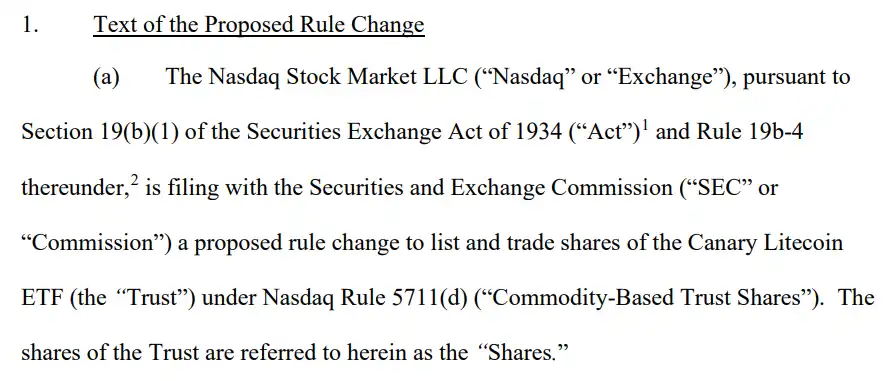
Under SEC regulations, this form initiates a 240-day approval cycle. During this period, the SEC will decide whether to approve the application or request further information. "This 19b-4 filing from Nasdaq pushes the internal processes at the SEC forward, but the SEC still needs to acknowledge the filing, which typically happens within weeks," said James Seyffart, Bloomberg's ETF analyst. "If and when the SEC acknowledges this filing, we'll be able to get a clearer picture of the potential timelines for rejection or approval."
"Bitcoin, 'Lite' Silver," a slogan from the early days of the crypto world. Litecoin is a fork of Bitcoin, meaning its protocol follows the same basic rules as Bitcoin; for example, it uses the Proof-of-Work consensus mechanism. Initially created by Charlie Lee in 2011, Litecoin is primarily aimed at small transactions. The relatively limited direct intervention by its core developers has made its "decentralization" feature more prominent. It is worth noting that the SEC has never considered Litecoin a security, unlike larger market cap cryptocurrencies like SOL and XRP that the SEC has deemed "securities," indicating that LTC has some facilitation in the approval process.
As of 2:00 p.m. on January 17, Litecoin's market capitalization was $10.48 billion. According to CMC data, it is currently ranked 19th in the cryptocurrency market by market capitalization, with a price increase of 16% in the past 24 hours. This growth trend has made the approval of a Litecoin ETF more attractive, especially in the case where the SEC has not deemed Litecoin a security.
The 19b-4 form is the second part of the ETF's two-step approval process, following the amended S-1 form submitted by Canary Capital on Wednesday. On January 16, Canary Funds submitted an amended S-1 filing for a Litecoin ETF application. Analyst James Seyffart stated that, while not guaranteed, this may indicate SEC involvement in this filing, which is a positive sign for predicting the increased likelihood of a Litecoin ETF approval.
Bloomberg analyst Eric Balchunas also mentioned hearing some rumors that feedback from the SEC has been received on the Litecoin S-1 filing, and the revised filing is a good sign for our prediction that Litecoin is likely to be the next approved cryptocurrency ETF.
3 Altcoin ETFs Could Attract $14.6 Billion in Inflows
On January 17, Bloomberg ETF analyst James Seyffart tweeted that the recent Solana ETF application has not yet been acknowledged by the SEC but believes that approval for a Solana or XRP ETF is only a matter of time.
As early as December 18, Bloomberg analyst Eric Balchunas stated, "We expect a wave of cryptocurrency ETFs to arrive in 2025, though not all at once. The first may be a Bitcoin + Ethereum combo ETF, followed by a Litecoin (as it's a Bitcoin fork = commodity), then HBAR (as it's not classified as a security), and finally XRP/Solana (both of which have been classified as securities in pending lawsuits)."
Last year, the SEC received multiple applications for ETFs tracking cryptocurrencies other than Bitcoin, from XRP to Solana and Litecoin, but ultimately only approved an ETF related to Ethereum. With the crypto-supportive Trump administration set to take office next week, according to Bloomberg's ETF analysts Eric Balchunas and James Seyffart, Litecoin (LTC) may be the first cryptocurrency to receive approval.
JPMorgan analysts expect that if multiple altcoin ETFs receive SEC approval, it could attract inflows of up to $14 billion. According to JPMorgan's analysis, a Solana ETF is expected to attract $3 billion to $6 billion in funds within 6 to 12 months, while an XRP ETF could attract $4 billion to $8 billion. This forecast is based on the "adoption rates" of existing cryptocurrency ETFs. For example, a Bitcoin ETF has already attracted around $108 billion in assets one year after launch, with a penetration rate of 6% of Bitcoin's market cap. Similarly, an Ethereum ETF attracted $12 billion in assets within six months, with a penetration rate of 3% of Ethereum's market cap.
In the case of Solana and XRP, JPMorgan analysts predict that at a 3% penetration rate, Solana could attract $2.7 billion and XRP could attract $430 million. At a 6% penetration rate, Solana's inflows could reach $5.2 billion, and XRP could reach $8.4 billion.
For Litecoin, if estimated using this method and if it were to be embraced by Wall Street at the same rate as Bitcoin, demand for the product could skyrocket to $580 million based on a 6% penetration rate of a Bitcoin ETF.
Multiple Crypto ETF Applications in the Pipeline, Grayscale Solana ETF Receives Preliminary Response on January 23
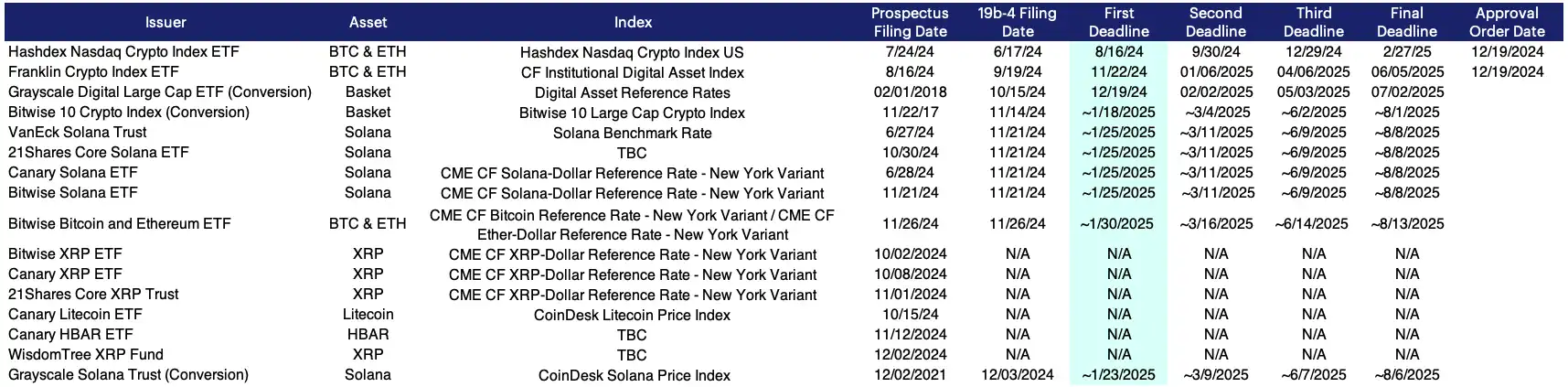
A list of crypto ETF applications as of mid-December 2024, including two recently approved applications. ("N/A" indicates the proposed listing exchange has not submitted Form 19b-4.) Source: Bloomberg, CF Benchmarks
On December 19, last year, the SEC officially approved the first batch of "Bitcoin + Ethereum" mixed exchange-traded funds (ETFs), namely the Hashdex Nasdaq Crypto Index US ETF (Nasdaq Exchange) and the Franklin Crypto Index ETF (Cboe BZX Exchange), expected to launch for trading in January 2025. These moves set the stage for new ETF approvals after Bitcoin and Ethereum spot ETFs.
As of mid-December 2024, multiple altcoin ETF applications are awaiting SEC approval. Among them, Grayscale's Solana ETF is expected to receive a preliminary response from the SEC by January 23, with other Solana ETF applications expiring on January 25. Meanwhile, Ripple's XRP ETF application is also under review, with multiple companies including WisdomTree, Bitwise, 21Shares, and Canary Capital having submitted applications.
Comparing Three Types of ETFs, Katalin Tischhauser, Investment Research Director of Crypto Bank Sygnum, pointed out that the likelihood of Solana becoming the third crypto asset to receive approval for a US spot ETF by the end of January is slim. She stated that the SEC has not yet begun to assess the market for Solana as an underlying asset, meaning that the approval of a Solana ETF may require more time.
With the Trump administration taking office in just four days, the market is full of anticipation for the approval prospects of a cryptocurrency ETF. On January 17, according to foreign media reports, US President-elect Trump expressed willingness to establish a US-preferred strategic reserve and prioritize cryptocurrencies such as Solana (SOL) and XRP, bringing positive news that also boosted the overall market sentiment.
Currently, ETF applications for altcoins like LTC, Solana, and XRP may see more opportunities in a new policy environment. With the assumption that the new SEC Chairman Paul Atkins will reverse the SEC's previous regulatory and approval approach, it is expected that approval of altcoin ETFs will become a significant topic in the crypto market in the coming months, and the development of this process is worth close attention.
You may also like

Morning Report | OpenAI has submitted an S-1 registration statement draft to the U.S. SEC; Morpho completes $175 million financing

Galaxy Deep Research Report: How Hyperliquid's HIP-4 Upgrade Changes the Landscape of Prediction Markets?

Latest research from 13 top universities including Cornell University: The current state, challenges, and misconceptions of the fusion of Crypto and AI

Deconstructing Anthropic: The Best AI Company, Possibly Also a Type of Organizational Invention

Every exchange is a "Universal Exchange."

The counterattack of traditional finance: Alliance chains are quietly reviving
Pantera Capital Partner: How Tokenization is Restructuring the Private Equity and Early Investment Ecosystem?

Mastercard Launches Agent Pay for AI, Plans to Record AI Agent Payment Authorizations on Polygon
Mastercard launched Agent Pay for AI, a new payment protocol designed to help AI agents make small payments such as pay-per-use access to data and APIs. The system plans to record human-granted AI agent permissions on Polygon, focusing on verifiable authorization, identity, and payment controls.

Curve Deploys Llamalend v2 on Optimism With 250,000 OP Incentives
Curve launched Llamalend v2 on Optimism with 250,000 OP incentives from the Optimism Foundation. The upgrade expands Llamalend beyond its earlier crvUSD-focused model, adding broader collateral support, LlamaRisk market reviews, and the ability to use Curve LP tokens as collateral.

Raydium Old Liquidity Pool Reportedly Exploited, With $1.34 Million Moved to Ethereum and Tornado Cash
An old Raydium liquidity pool was reportedly exploited for around $1.34 million in USDC, RAY, and wSOL, with the stolen funds bridged to Ethereum and deposited into Tornado Cash. The incident highlights the tail risks of legacy DeFi pools, old contracts, and cross-chain fund laundering paths.
Kalshi Executive Challenges “SBF Backed AI Unicorns” Narrative, Says Leopold Aschenbrenner Was Key Figure
Kalshi executive John Wang questioned the “SBF backed AI unicorns” narrative, saying Leopold Aschenbrenner was the key figure behind major AI investment decisions.

New York Proposes Stricter Stablecoin Issuer Rules Aligned With Federal GENIUS Act
NYDFS proposed stricter stablecoin issuer rules aligned with the GENIUS Act, covering reserves, custody, redemption timelines, audits, and capital buffers.

CryptoQuant Says Bitcoin Profitable Supply Is Near 45% Pressure Zone as On-Chain Data Points to Market Repricing
CryptoQuant said Bitcoin’s profitable supply is nearing the 45% pressure zone, signaling rising market stress, unrealized losses, and a possible on-chain repricing phase.

Bitcoin Falls Below 200-Week Moving Average as On-Chain Data Shows Over Half of Supply in Loss
Bitcoin dropped below its 200-week moving average as on-chain data showed over 50% of circulating supply is now in loss, signaling rising market stress.

CFTC Reportedly Plans New Prediction Market Rules Focused on Manipulation Risk and Public Interest Review
The CFTC is reportedly preparing new prediction market rules focused on manipulation risk, public interest review, and retail trader protections.

Meet the new WEEX trial fund—your gateway to greater profits

WEEX Labs Lands at Dutch Blockchain Week: A Disruptive Crypto × AI Conversation Sets Sail in Amsterdam
SK Hynix Reportedly Plans U.S. ADR Listing as Early as August, With SEC Approval Possible in Late June
SK Hynix may pursue a U.S. ADR listing as early as August, with SEC approval reportedly possible in late June amid strong AI chip supply chain demand.
Morning Report | OpenAI has submitted an S-1 registration statement draft to the U.S. SEC; Morpho completes $175 million financing
Galaxy Deep Research Report: How Hyperliquid's HIP-4 Upgrade Changes the Landscape of Prediction Markets?
Latest research from 13 top universities including Cornell University: The current state, challenges, and misconceptions of the fusion of Crypto and AI
Deconstructing Anthropic: The Best AI Company, Possibly Also a Type of Organizational Invention
Every exchange is a "Universal Exchange."
The counterattack of traditional finance: Alliance chains are quietly reviving
Popular coins
Latest Crypto News


