
 Buy Crypto
- Markets
 Futures
- Spot
- Copy Trade
- Earn
- More
Is Altcoin Season Starting in 2026? What Traders Should Watch Now

 TL;DR
TL;DR
- Altcoin season signals in 2026 are increasingly linked to capital rotation from BTC into broader crypto assets
- Institutional participation is reshaping how liquidity spreads across major and mid-cap tokens
- Strategy-based participation is becoming more important than directional timing alone
- Structured engagement across trading actions and campaign mechanics can improve participation efficiency during rotation cycles
What Is Altcoin Season in Crypto Markets?
Altcoin season typically refers to a market phase when capital rotates from Bitcoin into mid-cap and smaller digital assets, allowing a wider range of tokens to outperform BTC over a sustained period. Instead of a single asset leading the market, liquidity begins spreading across multiple sectors, including infrastructure tokens, DeFi assets, and emerging narratives.
Historically, altcoin seasons tend to appear after Bitcoin establishes price stability following strong directional moves. In previous market cycles such as 2017 and 2021, Bitcoin dominance declined from above 70% toward the 40% range as capital rotated beyond BTC into alternative crypto sectors.
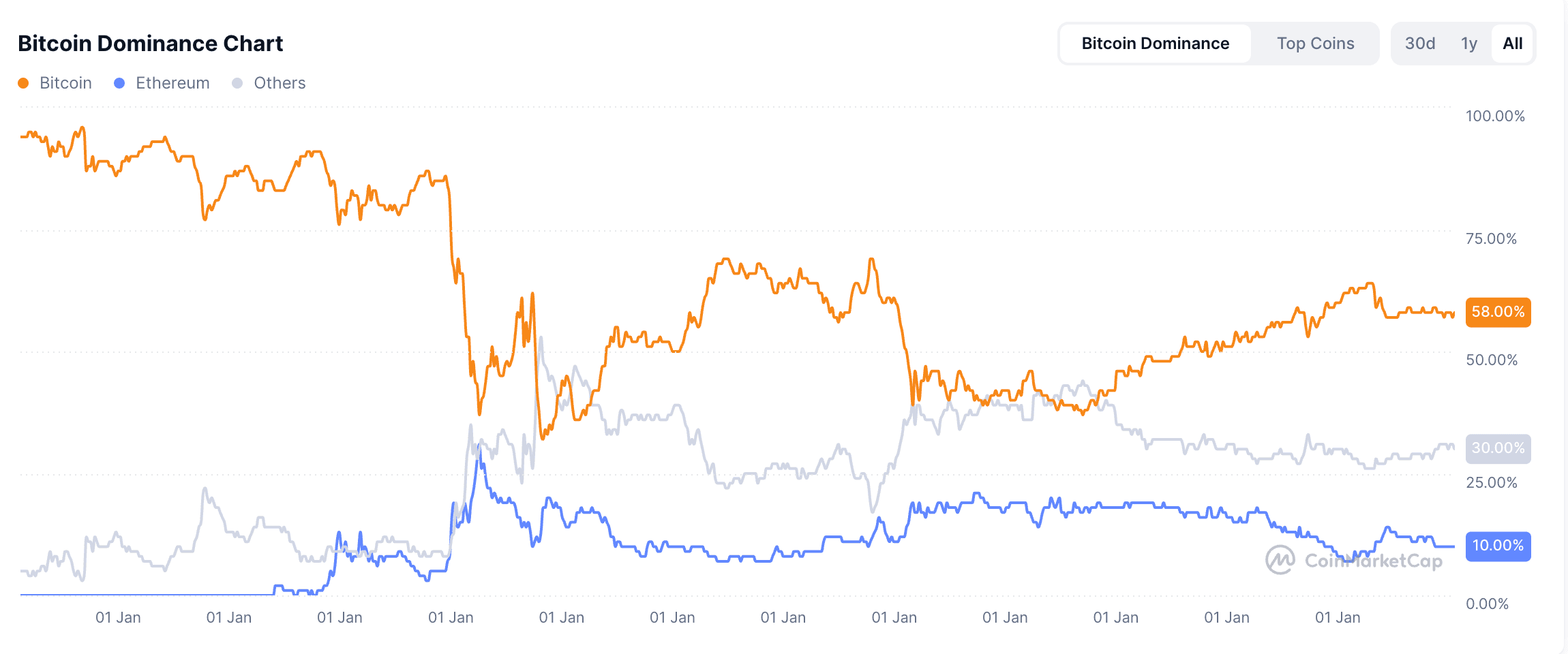
At the time of writing, Bitcoin dominance remains near the 58% level according to CoinMarketCap historical data. This suggests that the market is still in an early rotation phase rather than a full altcoin expansion cycle, where dominance typically falls below 45% during broader participation across mid-cap and emerging assets.
Unlike short-term speculative rallies, rotation-driven altcoin phases usually reflect broader shifts in market participation and capital allocation behavior across multiple sectors rather than isolated price spikes.
Are There Signs Altcoin Season Is Returning in 2026?
Recent market behavior in early 2026 suggests that capital rotation patterns are gradually evolving compared with the late-cycle volatility seen in previous years. Instead of rapid directional swings concentrated in Bitcoin alone, liquidity conditions are beginning to stabilize while participation across multiple asset categories is gradually recovering rather than expanding rapidly.
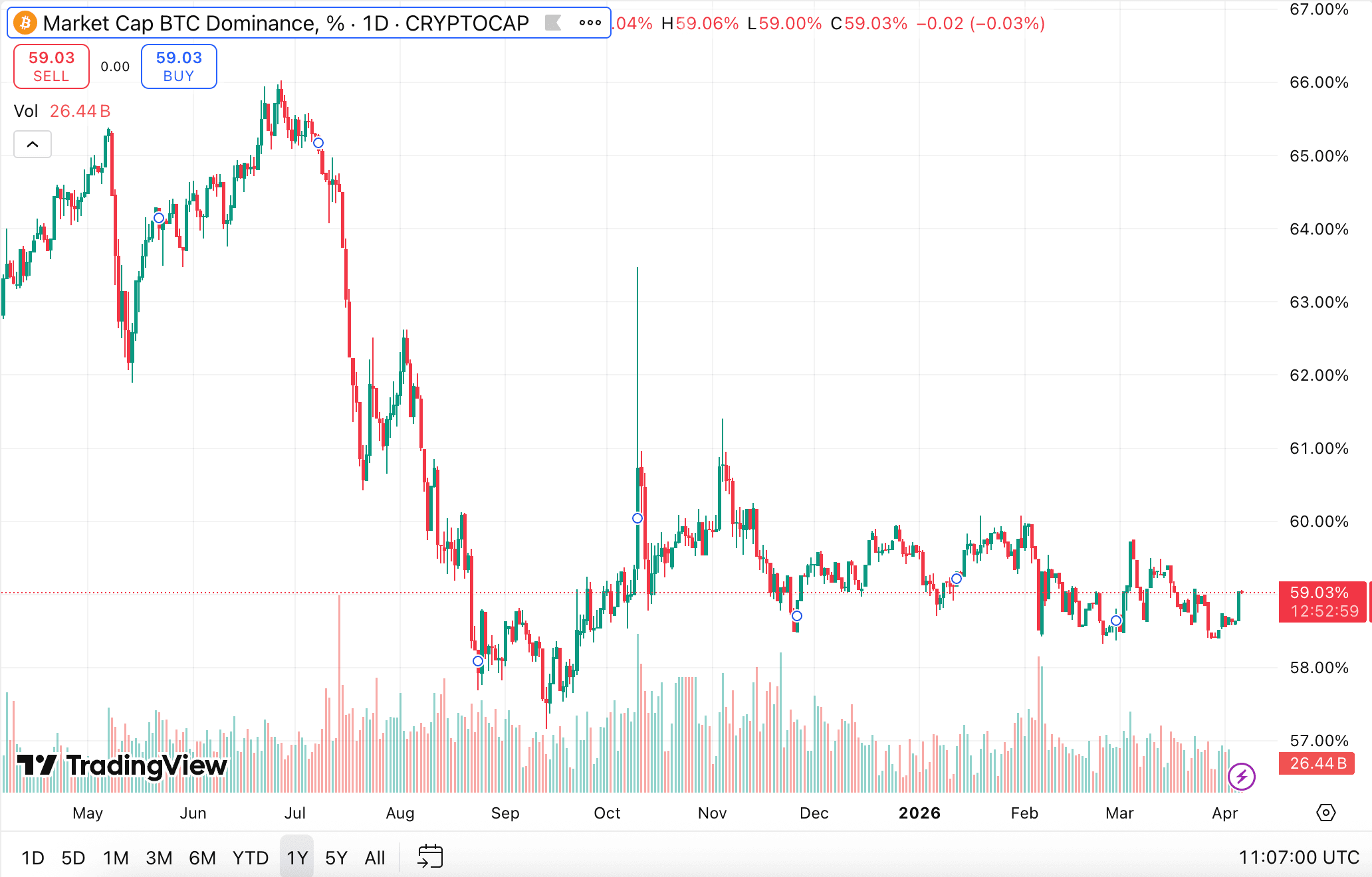
Over the past 12 months, Bitcoin dominance declined from above 65% to approximately 59% according to TradingView BTC.D data. This shift suggests that capital rotation beyond Bitcoin has already begun, although dominance remains well above the historical 45% threshold that has typically marked the transition into broad altcoin participation phases in previous cycles.
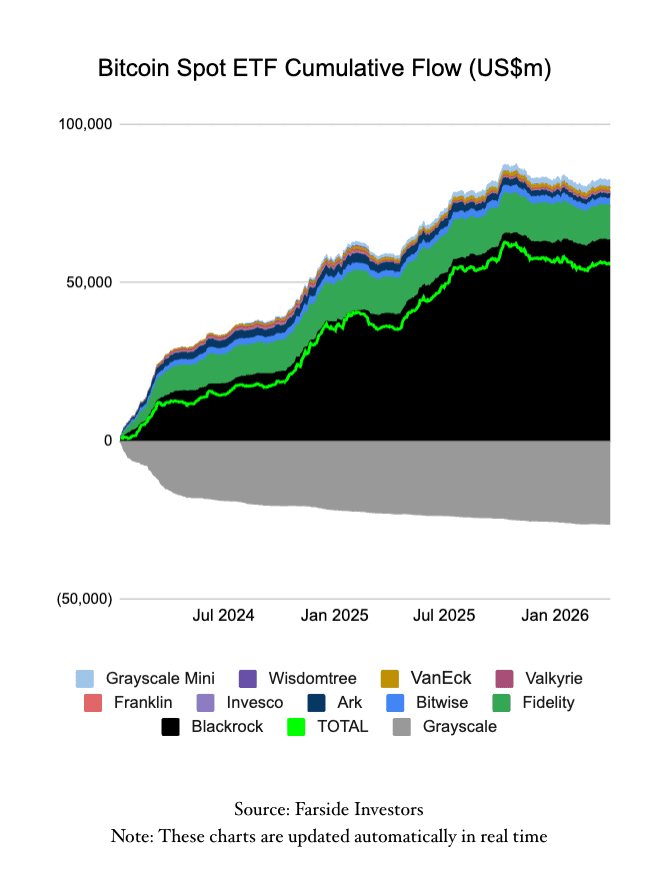
At the same time, spot Bitcoin ETF demand remains structurally positive. Cumulative ETF flow data from Farside Investors shows continued allocation led primarily by major issuers such as BlackRock and Fidelity, suggesting institutional exposure to Bitcoin remains intact despite periods of short-term flow volatility.
Market breadth indicators are also stabilizing rather than fully expanding. The TOTAL2 index, which tracks crypto market capitalization excluding Bitcoin, declined earlier in 2026 but has since consolidated near the $1 trillion level, suggesting that capital is no longer exiting altcoins aggressively even though a broad participation phase has not yet fully developed.
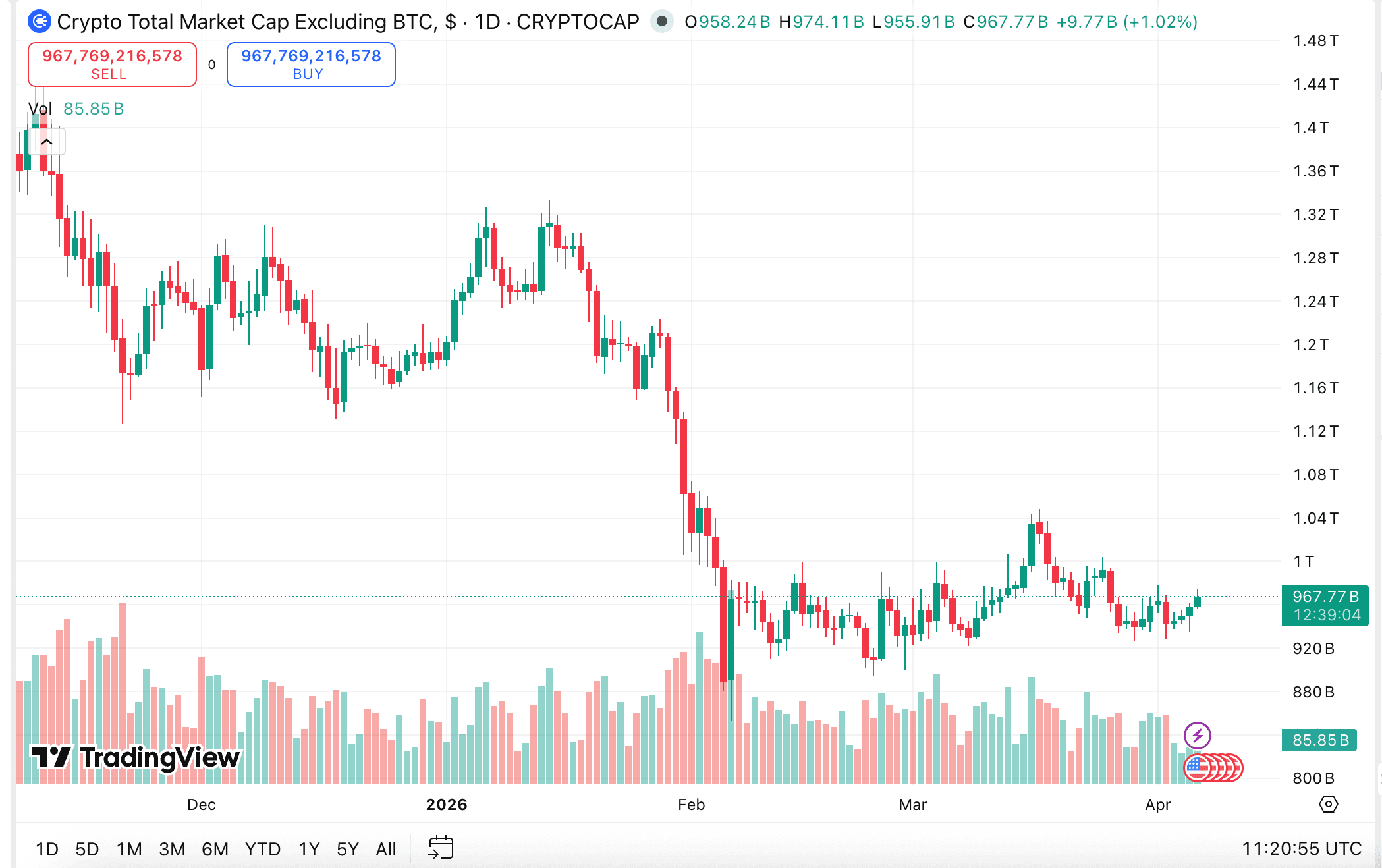
As Bitcoin volatility compresses and institutional allocation becomes more consistent, historical market cycles suggest that broader participation across alternative crypto sectors often follows during the later stages of the rotation process.
What Signals Traders Should Watch During Altcoin Rotation Cycles
Traders typically monitor several structural indicators when evaluating whether an altcoin rotation phase is forming. These signals help distinguish between short-term speculative rallies and broader liquidity expansion cycles across the digital asset market.
Key indicators include:
Bitcoin dominance trends
A gradual decline in Bitcoin dominance often signals that capital is beginning to spread beyond a single leading asset into the wider crypto market. While short-term fluctuations are common, sustained dominance stabilization or downward movement has historically preceded periods of broader participation across large-cap and mid-cap digital assets.
Sector-level liquidity expansion
Rotation-driven market environments typically show improving participation across multiple sectors rather than isolated token-specific rallies. Infrastructure tokens, Layer-2 ecosystems, and DeFi-related assets often begin to move alongside each other during early rotation phases, reflecting wider capital distribution rather than speculative concentration.
Derivatives positioning shifts
Changes in derivatives positioning can also provide useful context. Stabilizing funding rates and reduced reliance on directional leverage often suggest that traders are transitioning toward more diversified exposure strategies rather than short-term momentum-driven positioning. This type of behavior has historically appeared during the early stages of broader market rotation cycles.
Monitoring these indicators together can help traders better assess whether improving altcoin performance reflects temporary volatility-driven movements or the early formation of a more sustained participation cycle across the crypto market.
Why Strategy Matters More During Altcoin Season
During altcoin rotation cycles, market participation becomes less dependent on predicting the direction of a single leading asset and is more influenced by how traders manage exposure across multiple opportunities emerging across the broader crypto market.
Unlike Bitcoin dominated phases, where performance is often closely tied to a single macro trend, rotation driven environments typically reward traders who diversify their activity across sectors, timing windows, and participation structures rather than relying purely on directional positioning.
Instead of focusing exclusively on entry timing, many market participants gradually shift toward structured participation approaches that combine flexible allocation, diversified engagement across multiple tokens, and responsiveness to evolving liquidity conditions. This reflects a broader evolution in trading behavior as crypto markets mature and institutional capital plays a more consistent role in shaping participation patterns.
As participation expands across multiple sectors during early rotation phases, trading outcomes increasingly depend not only on what traders choose to trade, but also on how they structure their activity across different opportunities across the market.
For this reason, participation frameworks that reward diversified engagement rather than single direction positioning are becoming increasingly relevant for traders navigating rotation driven environments.
How Strategy-Based Participation Is Becoming More Important in 2026
As crypto market structure continues evolving in 2026, participation strategies are increasingly shifting toward structured engagement models rather than purely volume driven trading behavior.
During rotation driven environments, traders often interact with multiple opportunities across sectors instead of relying on a single directional setup. As a result, participation frameworks that reward consistency, timing awareness, and diversified activity patterns are becoming more relevant for navigating expanding market participation cycles.
Campaign formats that incorporate combination based participation mechanics reflect this broader shift in how traders engage with market opportunities during rotation phases. Instead of emphasizing isolated trading actions, these models encourage users to optimize how they structure their activity across multiple interactions within the market environment.
For example, structured engagement events such as the Poker Party Series structured engagement campaign introduce combination based mechanics that reward users for participating across different activity paths rather than relying on a single trade outcome. This type of participation framework reflects a wider transition toward strategy oriented engagement models that align more closely with how traders operate during multi asset rotation cycles.
What Altcoin Season Could Mean for Traders in the Months Ahead
As liquidity distribution becomes more balanced across the crypto market, altcoin rotation phases may create additional opportunities for traders who adapt their participation strategies beyond simple directional positioning.
Rather than focusing only on entry timing, combining allocation flexibility, trading activity consistency, and structured engagement planning may become increasingly important as market structure continues evolving through 2026.
Rotation driven environments often reward traders who remain active across multiple sectors instead of concentrating exposure within a single asset trend. As participation expands beyond Bitcoin centered positioning, strategy based interaction with market opportunities may play a larger role in shaping trading outcomes during upcoming rotation cycles.
This shift suggests that traders who adjust how they participate across changing liquidity environments may be better positioned to navigate the next phase of market expansion as capital continues spreading across the broader digital asset ecosystem.
About WEEX
Founded in 2018, WEEX has developed into a global crypto exchange with over 6.2 million users across more than 150 countries. The platform emphasizes security, liquidity, and usability, providing over 1,200 spot trading pairs and offering up to 400x leverage in crypto futures trading. In addition to the traditional spot and derivatives markets, WEEX is expanding rapidly in the AI era — delivering real-time AI news, empowering users with AI trading tools, and exploring innovative trade-to-earn models that make intelligent trading more accessible to everyone. Its 1,000 BTC Protection Fund further strengthens asset safety and transparency, while features such as copy trading and advanced trading tools allow users to follow professional traders and experience a more efficient, intelligent trading journey.
Follow WEEX on social media
X: @WEEX_Official
Instagram: @WEEX Exchange
Tiktok: @weex_global
Youtube: @WEEX_Official
Discord: WEEX Community
Telegram: WeexGlobal Group
You may also like

Consumer-grade Crypto Global Survey: Users, Revenue, and Track Distribution

Prediction Markets Under Bias

Stolen: $290 million, Three Parties Refusing to Acknowledge, Who Should Foot the Bill for the KelpDAO Incident Resolution?

ASTEROID Pumped 10,000x in Three Days, Is Meme Season Back on Ethereum?

ChainCatcher Hong Kong Themed Forum Highlights: Decoding the Growth Engine Under the Integration of Crypto Assets and Smart Economy

Why can this institution still grow by 150% when the scale of leading crypto VCs has shrunk significantly?

Anthropic's $1 trillion, compared to DeepSeek's $100 billion

Geopolitical Risk Persists, Is Bitcoin Becoming a Key Barometer?

Annualized 11.5%, Wall Street Buzzing: Is MicroStrategy's STRC Bitcoin's Savior or Destroyer?

An Obscure Open Source AI Tool Alerted on Kelp DAO's $292 million Bug 12 Days Ago

Mixin has launched USTD-margined perpetual contracts, bringing derivative trading into the chat scene.
The privacy-focused crypto wallet Mixin announced today the launch of its U-based perpetual contract (a derivative priced in USDT). Unlike traditional exchanges, Mixin has taken a new approach by "liberating" derivative trading from isolated matching engines and embedding it into the instant messaging environment.
Users can directly open positions within the app with leverage of up to 200x, while sharing positions, discussing strategies, and copy trading within private communities. Trading, social interaction, and asset management are integrated into the same interface.
Based on its non-custodial architecture, Mixin has eliminated friction from the traditional onboarding process, allowing users to participate in perpetual contract trading without identity verification.
The trading process has been streamlined into five steps:
· Choose the trading asset
· Select long or short
· Input position size and leverage
· Confirm order details
· Confirm and open the position
The interface provides real-time visualization of price, position, and profit and loss (PnL), allowing users to complete trades without switching between multiple modules.
Mixin has directly integrated social features into the derivative trading environment. Users can create private trading communities and interact around real-time positions:
· End-to-end encrypted private groups supporting up to 1024 members
· End-to-end encrypted voice communication
· One-click position sharing
· One-click trade copying
On the execution side, Mixin aggregates liquidity from multiple sources and accesses decentralized protocol and external market liquidity through a unified trading interface.
By combining social interaction with trade execution, Mixin enables users to collaborate, share, and execute trading strategies instantly within the same environment.
Mixin has also introduced a referral incentive system based on trading behavior:
· Users can join with an invite code
· Up to 60% of trading fees as referral rewards
· Incentive mechanism designed for long-term, sustainable earnings
This model aims to drive user-driven network expansion and organic growth.
Mixin's derivative transactions are built on top of its existing self-custody wallet infrastructure, with core features including:
· Separation of transaction account and asset storage
· User full control over assets
· Platform does not custody user funds
· Built-in privacy mechanisms to reduce data exposure
The system aims to strike a balance between transaction efficiency, asset security, and privacy protection.
Against the background of perpetual contracts becoming a mainstream trading tool, Mixin is exploring a different development direction by lowering barriers, enhancing social and privacy attributes.
The platform does not only view transactions as execution actions but positions them as a networked activity: transactions have social attributes, strategies can be shared, and relationships between individuals also become part of the financial system.
Mixin's design is based on a user-initiated, user-controlled model. The platform neither custodies assets nor executes transactions on behalf of users.
This model aligns with a statement issued by the U.S. Securities and Exchange Commission (SEC) on April 13, 2026, titled "Staff Statement on Whether Partial User Interface Used in Preparing Cryptocurrency Securities Transactions May Require Broker-Dealer Registration."
The statement indicates that, under the premise where transactions are entirely initiated and controlled by users, non-custodial service providers that offer neutral interfaces may not need to register as broker-dealers or exchanges.
Mixin is a decentralized, self-custodial privacy wallet designed to provide secure and efficient digital asset management services.
Its core capabilities include:
· Aggregation: integrating multi-chain assets and routing between different transaction paths to simplify user operations
· High liquidity access: connecting to various liquidity sources, including decentralized protocols and external markets
· Decentralization: achieving full user control over assets without relying on custodial intermediaries
· Privacy protection: safeguarding assets and data through MPC, CryptoNote, and end-to-end encrypted communication
Mixin has been in operation for over 8 years, supporting over 40 blockchains and more than 10,000 assets, with a global user base exceeding 10 million and an on-chain self-custodied asset scale of over $1 billion.

$600 million stolen in 20 days, ushering in the era of AI hackers in the crypto world
Vitalik's 2026 Hong Kong Web3 Summit Speech: Ethereum's Ultimate Vision as the "World Computer" and Future Roadmap
On the same day Aave introduced rsETH, why did Spark decide to exit?
Full Post-Mortem of the KelpDAO Incident: Why Did Aave, Which Was Not Compromised, End Up in Crisis Situation?

After a $290 million DeFi liquidation, is the security promise still there?
ZachXBT's post ignites RAVE nearing zero, what is the truth behind the insider control?




 App
App