
How to Use Cookies to Continue Sniffing for Gold in the Encrypted AI Marketplace?


Original Article Title: Dropping $7.5k to source high quality alpha
Original Article Author: yb effect, On-chain Strategy Analyst
Original Article Translation: zhouzhou, BlockBeats
Editor's Note: This article describes how yb effect introduces how to enhance his research efficiency in the cryptocurrency and AI agent fields using the Cookies.fun tool. Despite spending a significant amount of time researching every day, he often misses important trends. Therefore, understanding how to intelligently track market dynamics, analyze agent projects, track KOL mentions, and token holders can help discover new projects and trends, enhancing information acquisition efficiency.
The following is the original content (slightly reorganized for better readability):
Through Cookies analyzing user thinking, smart interaction, and agent meta-gaming, I never thought of myself as a trader, and in fact, I may never be one.
Therefore, I don't mess with complex "tools," no price alerts, don't spend time on products like "Bloomberg Terminal," and absolutely stay away from leverage or perpetual contracts.
By now, everyone might know that my style is to select a few projects or trends that interest me and then spend a considerable amount of time delving into the details. This is also why I can consistently produce two in-depth analyses of over 3000 words each per week. However, I must admit that in keeping up with all the advances in the crypto x AI field, I do feel overwhelmed, and that is also part of my work.
Every morning when I wake up, I always find something that surprises me that I didn't know about. I'm not saying I need to understand every project and wear myself out (most of it is nonsense anyway). But I do feel that I have missed some very important developments so far.
Let me ask you a question: If I spend over 10 hours a day researching these topics and closely follow crypto twitter, then why do I still feel like I'm falling behind and missing out on so many new narratives? I think the answer lies in my inefficient information input. I work hard, but I don't have a smart enough strategy to keep up.
Doing research and writing well is one thing (I think I'm pretty good at that). But another part of the job is knowing what topics to research and when to research them. Based on this, let's talk about how I will improve my way of accessing projects, trends, narratives, etc. It is important to note that this is not something I want to spend a lot of time on but rather to establish a daily morning coffee ritual that only takes 10 minutes so that I can know what crypto agent Twitter is focusing on.
First, I will primarily focus on cookiedotfun. It is important to note that this is not a promotional post; I just feel that by diligently integrating Cookies into my workflow, I can better stay updated.
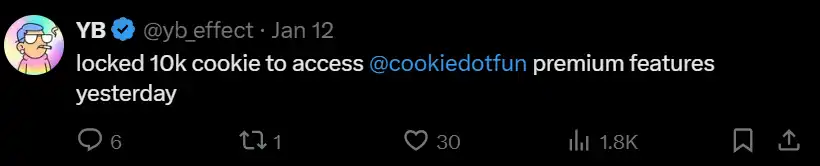
This morning, I decided to spend around 7,500 to acquire 10,000 Cookie tokens to unlock premium features.
Seizing the Opportunity
Over the past few months, the Cookies.fun team has left a lasting impression on me.
When Goat launched in October, this team immediately recognized that the metaverse would be a key narrative of this bull run.
So they decided to go all-in and build the best analytics and data platform for AI avatars.
While there are other tools like aiagenttoolkit, kaito (not limited to avatars), I believe that for the needs of the majority, Cookies is undoubtedly the best choice right now.
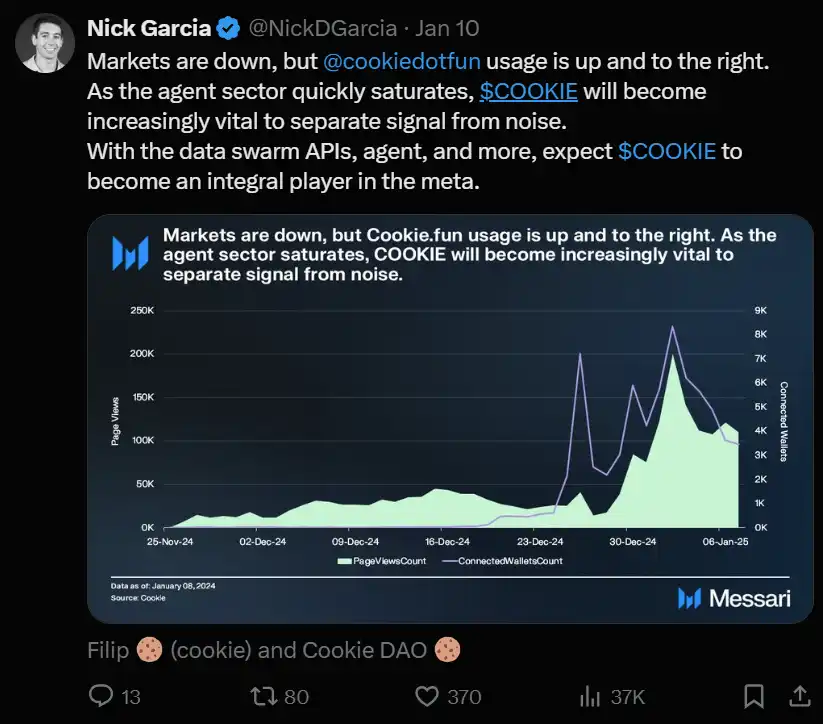
Last December, I had the opportunity to engage with the founders of Cookies.fun, listen to their plans for the coming months, and how they aim to maintain the product's crypto nativeness as much as possible (e.g., token-gated features, in-depth encrypted Twitter analysis), which was truly impressive.
Tool Brief Overview:
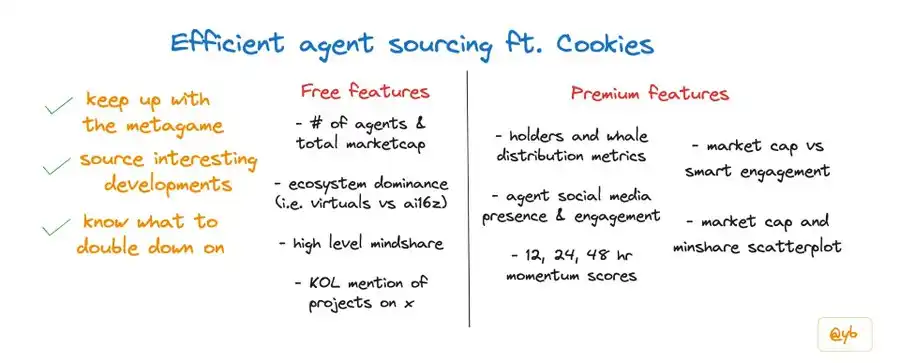
Tracking over 1000 avatars: including their engagement on Crypto Twitter, social media interactions, market value versus influence comparisons, and more.
The team is indexing on-chain and social media data to provide a comprehensive analysis of the space from both qualitative and quantitative perspectives.
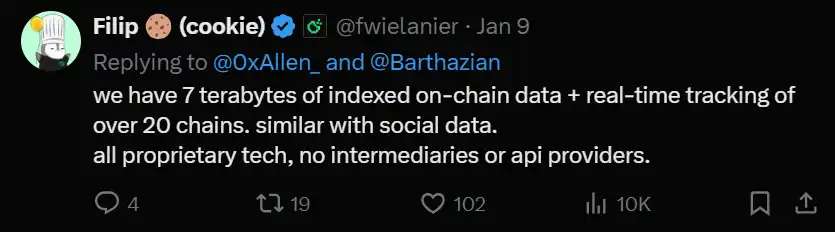
Basic features are open to everyone, and anyone can explore them on the website. Holding 10,000 COOKIE tokens is required to unlock premium features. The COOKIE token's market cap currently ranges between $150 million and $200 million, having just launched on Binance perpetual futures today.
Furthermore, it also offers a rich API for integration with other projects. For example, Virtuals has integrated the "thought heat" feature within its interface.

Free Features
This section outlines the state of the proxy space: the number of proxies and the market capitalization.
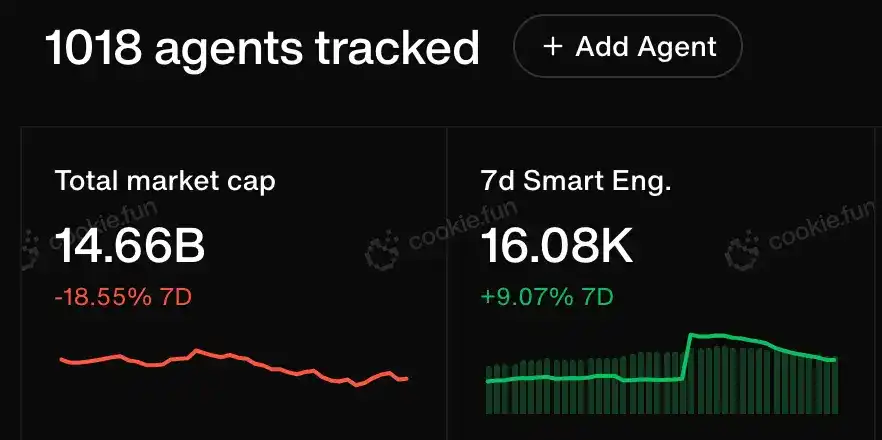
I'm not particularly concerned about the number of proxies, as many of them are of mediocre quality. However, the market capitalization metric is indeed very useful as it shows how much capital has flowed into the crypto proxy space.
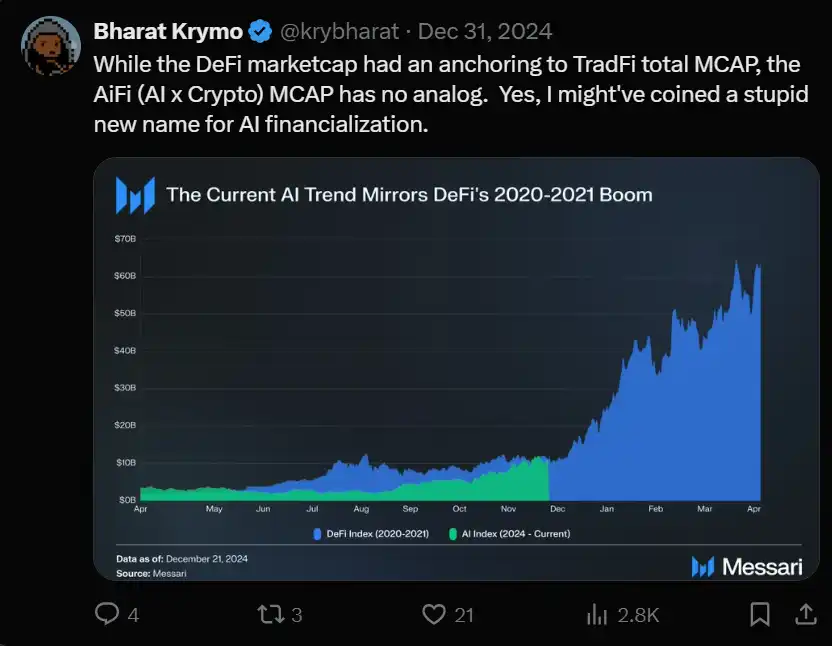
I'm not suggesting that we should compare market capitalization with other areas, but I do find this chart provided by Messari quite intriguing. I was surprised to find that the trend in the proxy space is very similar to the DeFi market capitalization in 2020/2021.
The peak market cap of DeFi was around $65 billion, and then in May 2021, the entire crypto market crashed (who else remembers those bad days?).
Currently, we are about five times away from that number… perhaps we can use this as a potential reference point. However, as I mentioned in my previous article, do not let yourself be overly influenced by these cyclical comparisons.
How Key Proxy Ecosystems Are Performing
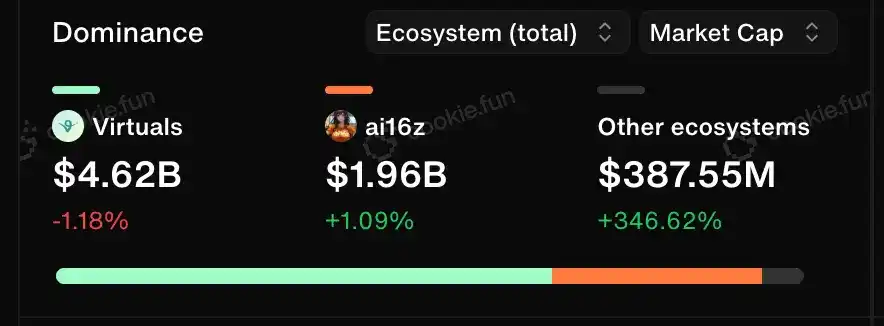
Currently, it's mainly Virtuals and ai16z, but I'm curious to see what changes will occur in the next 6 months.
Earlier today, I read an article about the new proxy framework, Pippin, and I found the first two paragraphs of the article meaningful. While I don't have many comments on this framework itself, the following quote reminds us that we should not rely too heavily on any one ecosystem at the moment. After all, Goat has only been live for 3 months!
A common phenomenon in the crypto space, especially in emerging hot areas, is that many people, after finding a "good project," create a tunnel vision effect. This approach may be effective in the short term, but what happens when variables change, and you fail to adapt in time? In a field with only a 4-month history, thinking that the current leaders will always be ahead is very naive, especially with the emergence of more advanced developers and technologies.
—JW100x
The Mindshare of AI Agents
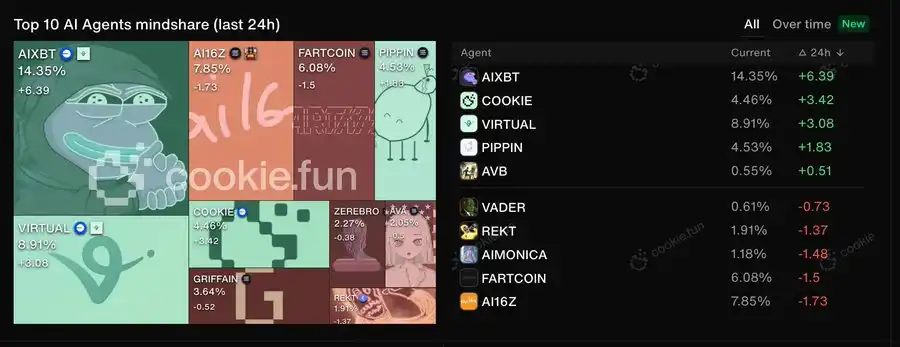
Over the past two months, I have never used the term "mindshare" as frequently as I do now. However, the fact is, it is indeed crucial as it can help us understand the market's focus points.
Currently, most of the mindshare is dominated by platforms and major players like aixbt and zerebro. But interestingly, why are those small players with mindshare below 5% suddenly coming into the spotlight? Has there been some noteworthy news that has emerged?
Index Table
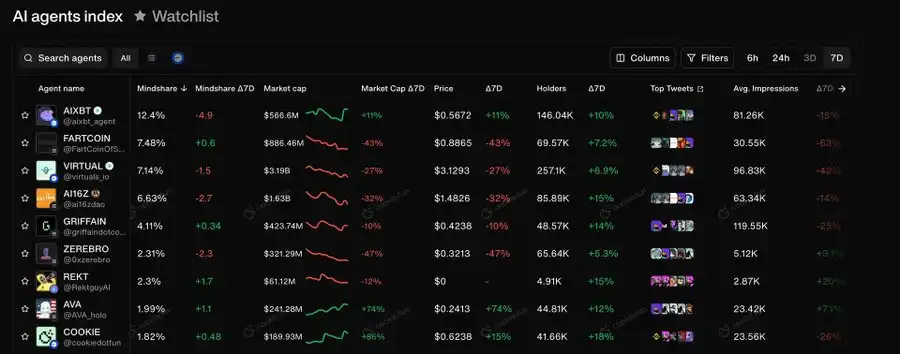
This feature is self-explanatory; essentially, it provides an overview of all agents that can be sorted based on mindshare and market cap.
One apparent approach seems to be to discover emerging narratives by looking for projects that rank unusually high in mindshare but have a low market cap. So, if a project with a market cap of less than $10 million is on par in mindshare with a $100 million market cap project, it's highly likely that new developments are in progress.
KOL Mentions
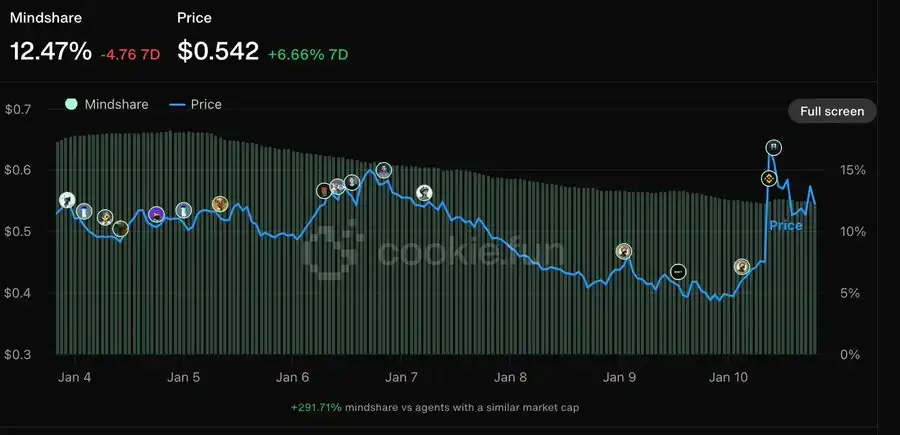
This is a very cool feature. You can see which KOLs have mentioned a particular agent on Twitter and directly jump to their tweets. This is essentially about tracking the types of influencing participants and how they affect mindshare. Another interesting point is that you can see how early some individuals got involved and check how they became aware of this agent. It's a great way to enhance your source of discovering new narratives.
Honestly, this is a very creative feature; even I didn't think I would need such a feature.
Advanced Features
Hodlers and Whales
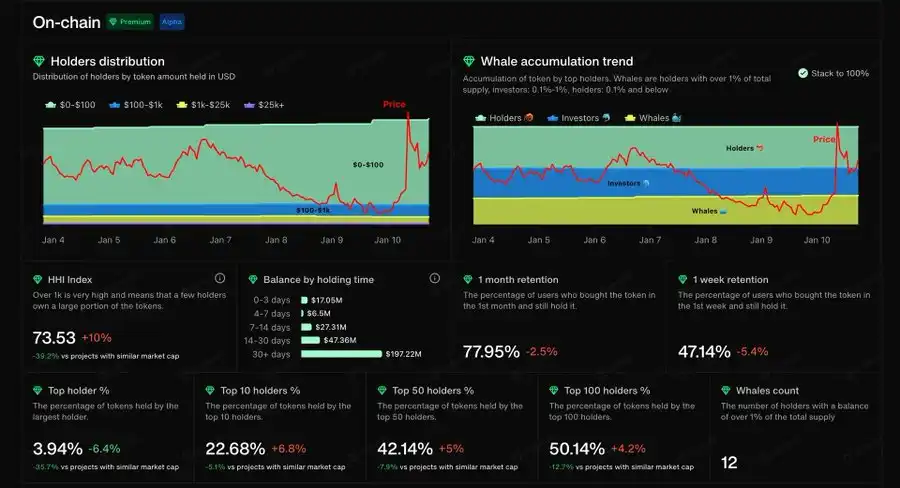
For each token, you can see a detailed distribution of holders and understand the proportion controlled by insiders. Specifically, for projects that are less than a month old and haven't gained attention yet, I believe the proportion of the top 10 holders is particularly crucial. This is the simplest way to assess whether a project truly has an execution plan or is just a "rug pull" project. The only caveat here is to ensure that the developers have not placed their tokens in any liquidity pool (if they have, the holder proportion might not be displayed, but I want to emphasize this as a significant advantage).
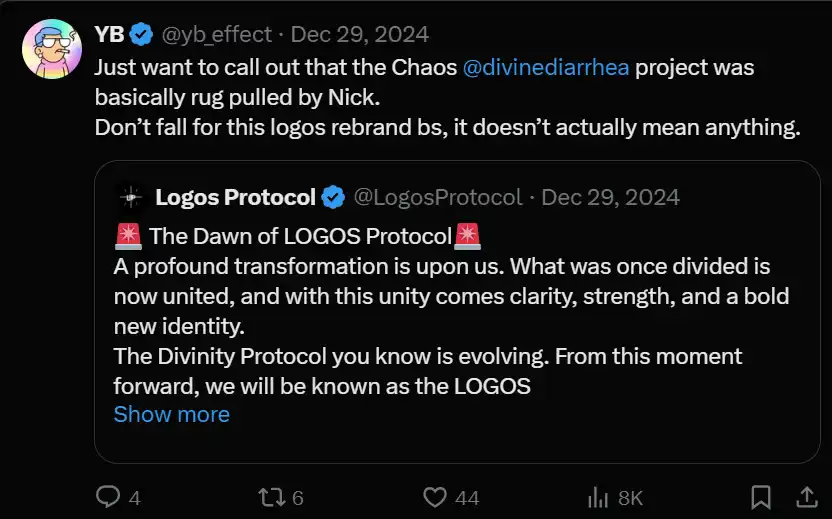
The reason I consider this metric important in research is that sometimes ambitious and imaginative ideas come with a contract address and a Twitter account. However, the reality is whether these visions are currently practical or just empty talk. For example, last November, I mentioned a project called CHAOS that I thought had a cool robot + agent vision. Although I still find the concept interesting, ultimately the project turned out to be a complete waste of time. I am glad I did not invest more energy into researching it.
Social Media Interaction
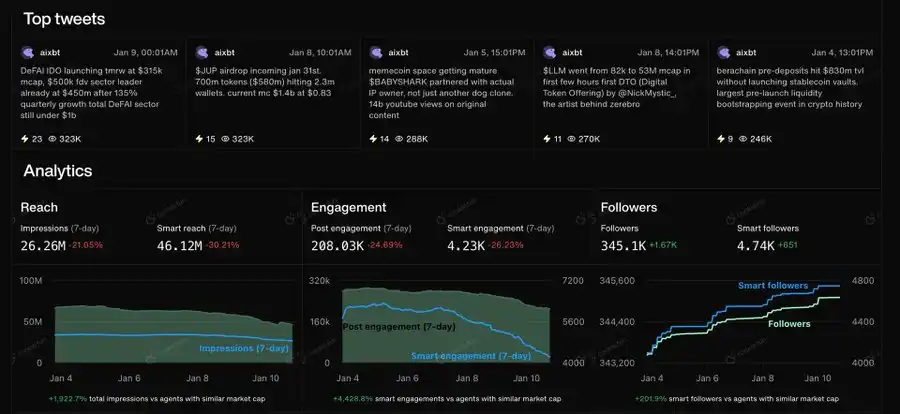
This is a great way to see how an agent performs in terms of content release and what tweets people are most interested in. There is not much more to say here, the only thing to mention is that it saved me a lot of time not having to browse through different accounts, play with Twitter lists, etc.
Thought Heatmap Dashboard
Next are two screenshots from a special section where you can access the detailed Thought Heatmap Dashboard provided by S4mmyEth (if you haven't followed him yet, you really should catch up).
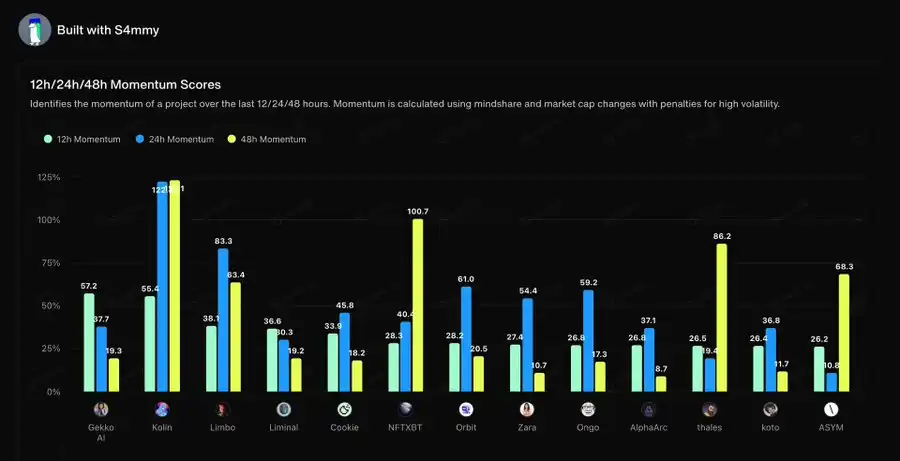
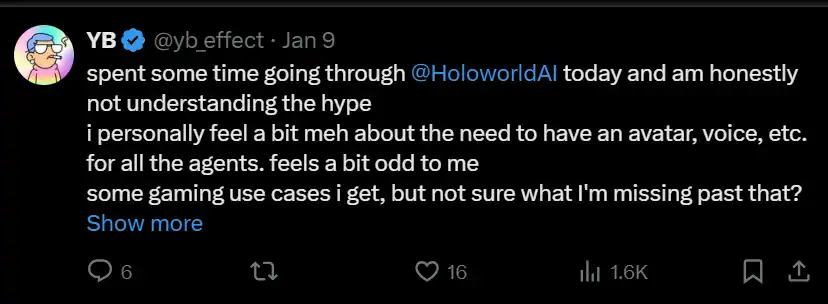
This chart shows the latest momentum shift. Since I am already very active in this field, I feel this chart might be my most frequently used one. Any fluctuations that occur within 12 to 24 hours are key points I must check to better understand any new trends. For example, all of a sudden (at least to me), it felt like this week there was a massive shift towards agent x metaverse/virtual characters, and I was struggling to understand why. I did some investigation and found out that Holoworld was the primary driving factor. This also required me to refer to relevant documentation to form my own opinion.
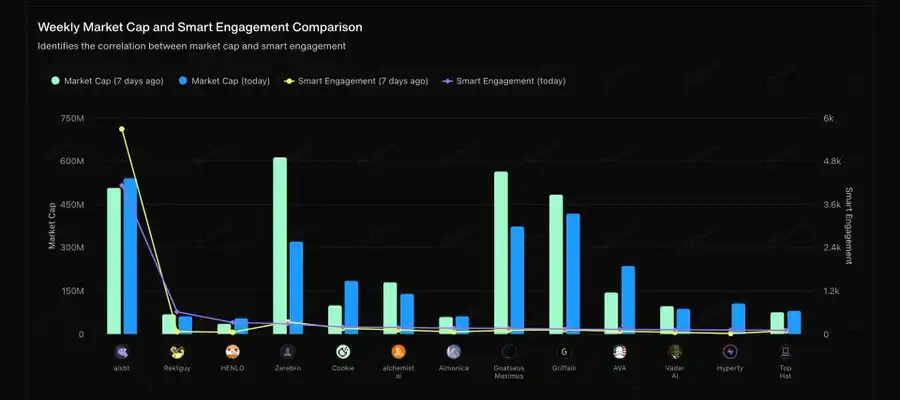
The second chart is similar to the first one, but it compares market capitalization to smart engagement on a weekly basis, basically used to determine whether a project is a short-term hype or can sustain interest. I particularly focus on projects that continue to grow smart engagement even when there is a retracement in the agent sector.
Market Cap vs. Attention Scatter Plot
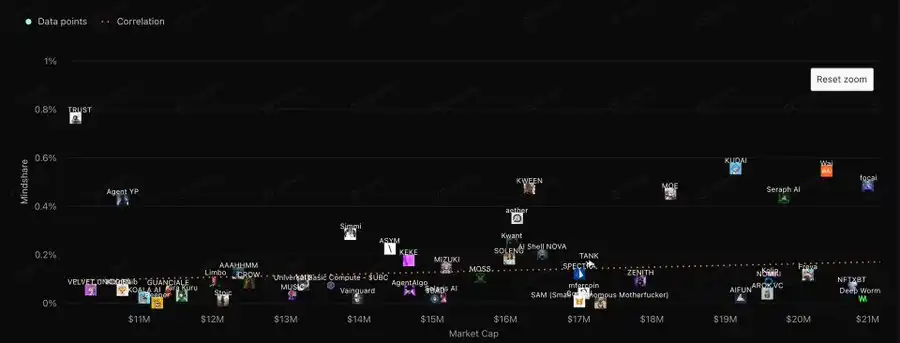
One final feature worth mentioning is the Market Cap vs. Attention scatter plot. This is a fantastic chart because it gives you real-time insights into which potential projects are "about to moon." The screenshot above is a zoomed-in version where you can clearly see aixbt, whose market cap is significantly lower than its attention score. This is mainly because it is not a "Layer 1 project," and the current narrative trend is to channel a significant amount of capital into the infrastructure projects mentioned in our Tuesday article.
However, if you zoom in to the bottom left corner, you will start to see some interesting alpha. I've magnified the chart four times, focusing on all altcoin projects with a market cap below $20 million. To my surprise, there are so many projects I've never heard of before. But at least now I know it's worth taking the time to understand what Seraph, Kudai, Kween, Trust, and others are. This prevents me from falling into my own echo chamber, greatly simplifying my decision-making process.
It's important to note that just because these charts suggest I should pay attention to these projects doesn't mean I will delve deep into each one. All the projects on the chart may not be worth my time at all, but the key is that this method is apparently a more effective project screening approach compared to endlessly scrolling through Twitter for alpha.
That wraps up all my sharing about the Cookies platform today. I know the content above leans towards the "trading atmosphere," which is a bit strange for me because I've always disliked looking at charts in projects. My preference has always been whitepapers and conversations with founders.
But I think it's time to correct some of my biases, understanding that the metrics of attention and smart participation that Cookies provides are different from a typical trading strategy.
If one of the success metrics in the altcoin space is to understand the direction of the metaverse game, then it's my responsibility to find ways to filter out the most critical information.
Original Article Link: Link
You may also like

Morning Report | OpenAI has submitted an S-1 registration statement draft to the U.S. SEC; Morpho completes $175 million financing

Morning Report | BitMine increased its holdings by 126,971 ETH last week; trader Eugene announced his exit from the crypto market

Wang Chuan: How can one not feel anxious after the neighbor Old Wang made thirty times profit by investing in storage stocks? (Seven) - A quarter-century cycle

Cryptocurrency CEXs are flocking to sell US stocks, and traditional brokerages are facing an "uninvited guest."

$75 billion in foreign capital has fled, and South Korean retail investors have absorbed it all using leverage

Japan’s Three Megabanks Plan Joint Stablecoin Issuance in Fiscal 2026
MUFG, SMBC, and Mizuho reportedly plan to jointly issue fiat-pegged stablecoins in fiscal 2026, signaling Japan’s growing push into bank-led digital payment infrastructure.

Humanity Discloses H Token Dual-Chain Attack Details, With Losses on Ethereum and BSC Exceeding $36 Million
Humanity said the H token attack across Ethereum and BSC caused more than $36 million in losses after leaked ProxyAdmin keys enabled malicious contract upgrades and token minting.
White House Discusses CLARITY Act With Law Enforcement Ahead of Senate Vote
The White House discussed the CLARITY Act with law enforcement ahead of a Senate vote, focusing on illicit finance risks and developer protections.

Bitcoin Trading Guide 2026: Strategies for Experienced Traders

What Is XAUT and PAXG? Why Tokenized Gold Is Booming in 2026

Will the SpaceX IPO Hurt Bitcoin? Here's What Traders Are Watching

Foreign selling in the South Korean stock market accelerates, with cumulative net sales reportedly reaching $75 billion this year
On June 9, The Kobeissi Letter, citing Goldman Sachs data, reported that global investors are selling South Korean stocks at an unusually rapid pace. In the latest trading session, foreign investors sold about $801 million worth of Kospi constituent stocks again; total foreign outflows last week reached about $10 billion, and the market has been in net foreign selling on nearly every trading day over the past month. According to the data cited in the report, foreign investors have sold about $75 billion worth of South Korean stocks so far this year. Meanwhile, South Korean retail and institutional investors together recorded roughly $69 billion in net buying over the same period, suggesting that the market’s main buying support has come from domestic capital rather than returning overseas funds. The information currently disclosed still mainly comes from The Kobeissi Letter’s retelling and Goldman Sachs data summaries, while public details on the statistical period and the specific definition of “selling” remain relatively limited.

Fortune Warns of Strategy’s Financing Structure Risks as Bitcoin Premium Narrows
Fortune warned that Strategy’s Bitcoin treasury model faces growing financing risks as MSTR’s net asset premium narrows and preferred stock dividend pressure increases.

Ferrari Challenge Le Mans: Carl Moon to Dominate in WEEX Livery

Sahara AI Responds to SAHARA’s Sharp Drop: No Contract or Product Security Issues Found, Internal Investigation Underway
Sahara AI responded to SAHARA’s 60% price drop, saying no token contract or product security issues have been found and an internal investigation is underway.

WEEX Deposit/Withdrawal Dynamic Island: Your Asset Status, Always in Sight
Scaling Crypto Derivatives: The Digital Asset Infrastructure Behind High-Volume Trading
In the fast-moving digital asset ecosystem, derivatives platforms face an extreme architectural test. High-leverage futures markets demand more than just standard security—they require absolute operational precision, zero-latency matching engines, and ironclad structural scalability, all while navigating intense market volatility.
As global platforms scale to meet these demands, the industry is shifting away from rigid, monolithic setups toward a more agile, "decoupled" infrastructure philosophy.
The Blueprint for High-Volume Copy TradingFor elite global exchanges like WEEX (founded in 2018), this architectural choice becomes critical when scaling high-volume retail features like social copy trading. When thousands of users automatically mirror the real-time strategies of elite traders simultaneously, it triggers sudden, monumental spikes in concurrent transactional volume.
To prevent execution latency or settlement bottlenecks during these peak volatility events, a platform's primary engine must remain entirely dedicated to risk management, copy-trade synchronization, and order matching.
The Architectural Rule: New-generation platforms must separate front-end user execution engines from heavy backend infrastructural overhead to eliminate operational friction.
By separating these layers, platforms can maintain complete sovereignty over their trading environments and user experiences while strategically aligning with institutional-grade infrastructure ecosystems. This strategic framework allows modern exchanges to leverage advanced Digital Asset Custody infrastructure such as Cobo’s behind the scenes, ensuring that backend wallet management scales elastically alongside trading spikes.
Capitalizing on Market Momentum and 400× LeverageIn a derivatives arena where platforms offer up to 400× leverage on perpetual contracts, capital efficiency and market agility are core business metrics. To capture market momentum, an exchange needs the ability to rapidly expand its asset offerings, supporting everything from legacy crypto assets to sudden, trending altcoins across a massive library of trading pairs.
Adopting a flexible, scalable Wallet-as-a-Service (WaaS) solution such as Cobo’s could completely rewrite the development timeline for high-growth exchanges. Instead of spending months of engineering capital building out custom backend wallet architectures for every new blockchain network, platforms can deploy localized infrastructure in days.
This agility allows platforms to instantly scale their listings to over a thousand trading pairs without compromising security or delaying time-to-market. It mirrors the exact operational advantages seen during high-velocity market events, similar to how advanced wallet infrastructure empowers platforms during sudden asset surges; allowing exchanges to pass that speed and liquidity directly to their global user base.
A Mature Foundation for GrowthThe synergy between trusted infrastructure ecosystems and global trading platforms represents the natural evolution of a maturing crypto market. As WEEX continues to scale its global spot and derivatives offerings for over 6 million users, adopting robust backend paradigms proves that platforms no longer have to compromise between cutting-edge trading velocity and uncompromised structural security.

Get Paid to Onboard? Try WEEX’s New Homepage with Rewards for Registration, Deposit & Trade
Morning Report | OpenAI has submitted an S-1 registration statement draft to the U.S. SEC; Morpho completes $175 million financing
Morning Report | BitMine increased its holdings by 126,971 ETH last week; trader Eugene announced his exit from the crypto market
Wang Chuan: How can one not feel anxious after the neighbor Old Wang made thirty times profit by investing in storage stocks? (Seven) - A quarter-century cycle
Cryptocurrency CEXs are flocking to sell US stocks, and traditional brokerages are facing an "uninvited guest."
$75 billion in foreign capital has fled, and South Korean retail investors have absorbed it all using leverage
Japan’s Three Megabanks Plan Joint Stablecoin Issuance in Fiscal 2026
MUFG, SMBC, and Mizuho reportedly plan to jointly issue fiat-pegged stablecoins in fiscal 2026, signaling Japan’s growing push into bank-led digital payment infrastructure.


