How to Make Money on Polymarket Using AI?

 Prefer us on Google


Original Title: How Perplexity + Claude Replace an Entire Analyst Team on Polymarket
Original Author: @0xwhrrari
Translation: Peggy, BlockBeats
Editor's Note: This article introduces a method to identify arbitrage opportunities on Polymarket and systematically execute them: using Perplexity for research to pinpoint discrepancies between data and market pricing; using Claude to build trading logic, manage risk, and automate execution; ultimately completing trades and realizing gains on Polymarket.
The author's key insight is that profits come from "structured information asymmetry." Market prices more so reflect group intuition, while data (such as weather forecasts) provides a probability distribution. When these two are misaligned and continually captured by a system, they can be transformed into stable trading opportunities. Claude is the brain, Polymarket is the wallet, and Perplexity is the eye, all working together to form a complete arbitrage loop.
This model not only lowers the barrier to entry, allowing individuals to possess close to a "team-level" capability, but also raises the competitive standard. With research, analysis, and execution compressed into a single continuous chain, relying solely on experience or manual operation will increasingly struggle to compete with systematic strategies.
For the average participant, a more realistic path is to first find certainty through research and then leverage systems to amplify gains. Those who can validate this method earlier are more likely to consistently earn stable returns in these seemingly straightforward markets.
The following is the original text:
Among the top 20 traders on Polymarket, 14 of them are actually bots. One AI-powered entity based on Claude turned $1,000 into $14,216 within 48 hours; while another AI entity based on OpenClaw was liquidated to zero on the same platform in the same timeframe.
The difference lies not in code quality but in preparedness.
One AI was simply fed a generic prompt to "trade on Polymarket," while behind the other was a complete research apparatus: which niche track to trade in, who's already profiting, where the data is coming from, and how the underlying math checks out.
Perplexity AI handles research, Claude handles coding, and Polymarket handles payout.
This is the full breakdown, recommended for bookmarking.
You can try:
· Perplexity: perplexity.ai
· Strategy View: polymarket.com
· Copy Trading Bot: t.me/PolyGunSniperBot
· Telegram Channel: rari lr
Research Layer: From Zero to Strategy in 10 Minutes
There are dozens of trading categories on Polymarket: politics, crypto, sports, weather. Most people choose based on intuition, which is the beginning of losses.
With just one in-depth research query, Perplexity can scan over 47 information sources in less than 3 minutes: including Polymarket's API documentation, traders' profit and loss screenshot-sharing posts on Reddit, and Twitter analyses breaking down wallet behavior.
Most importantly, each conclusion comes with citations and source links—not unverifiable raw text, but clickable, verifiable "data-backed evidence."
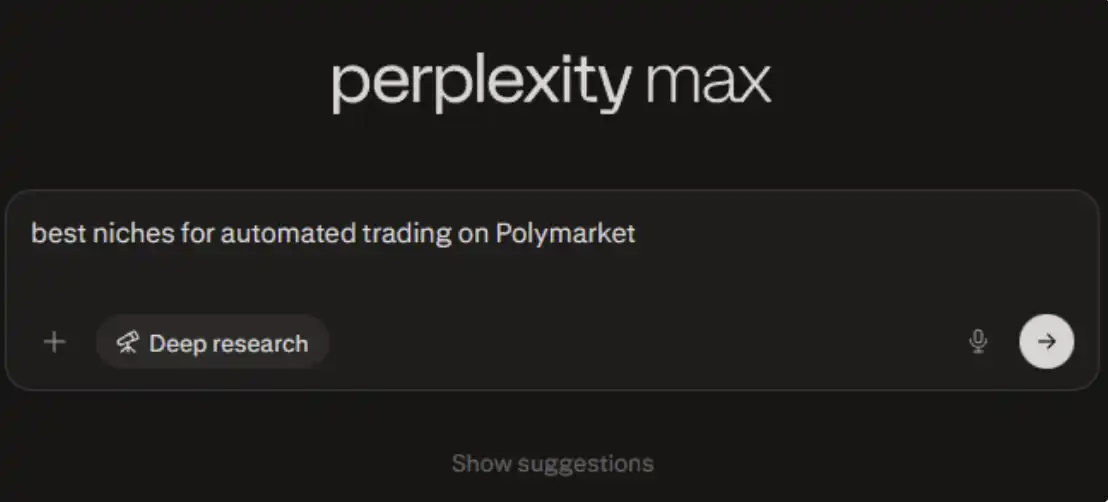
The breakdown is almost immediate:
BTC 5-Minute Market: Arbitrage window is only 2.7 seconds, entering the realm of High-Frequency Trading (HFT). You need co-located servers and a budget of at least six figures.
Sports Arbitrage: Profit margins typically range from 1-3%, requiring a capital of at least $5,000 to justify execution risk.
Weather Market: Profit margins are over 3-4 times, with an entry of $100. Most participants are retail traders pricing based on intuition.
After the initial response, Perplexity AI will also proactively suggest follow-up research questions:
"Should you compare NOAA and other weather forecast providers?"—Yes
“Should we take a look at Polymarket's fee structure?” — Yes
“How does the historical accuracy of weather forecasts vary across different time spans?” — Yes
It further unearthed multiple transaction wallet profiles. The system even automatically extracted data not present in the API: entry timing patterns, average position sizes, trade frequency distribution. Such analysis, if done manually tracking wallets one by one, would probably take a junior analyst a whole day.
And the common traits among these wallets are very clear: fully automated, running 24/7 all year round, making emotionless decisions. No one is sitting in front of the computer clicking the mouse — these bots are mathematically trading.
The third query then delved deeper: What is the best data source for the U.S. weather market?
Perplexity compared NOAA, OpenWeatherMap, and AccuWeather, conducting a systematic evaluation from multiple dimensions such as accuracy, cost, update frequency, and API availability.
NOAA excelled in all truly critical metrics. Free, 24–48-hour forecast accuracy of 94%, based on decades of satellite data and supercomputer modeling, updated hourly, open API, with almost no rate limits within reasonable usage.
With just three queries and ten minutes, a comprehensive strategy map was obtained: which niche market to focus on, who is already profitable, and where the data sources are located.
Without Perplexity, the same research would often take 4 to 5 hours, flipping back and forth between Twitter, Reddit, various documentation pages, and academic papers, with no guarantee of finding the right sources.
The Mathematical Logic Behind the Advantage
Polymarket's temperature market is a binary market: “Will the temperature in New York be above 72°F this Saturday?” The answer is only two: yes or no. The final settlement is either $1 or $0.
But who prices these markets? Retail traders. They will check the weather app on their phones, maybe glance at the 7-day weather forecast. They won't delve into NOAA's probability distribution data.
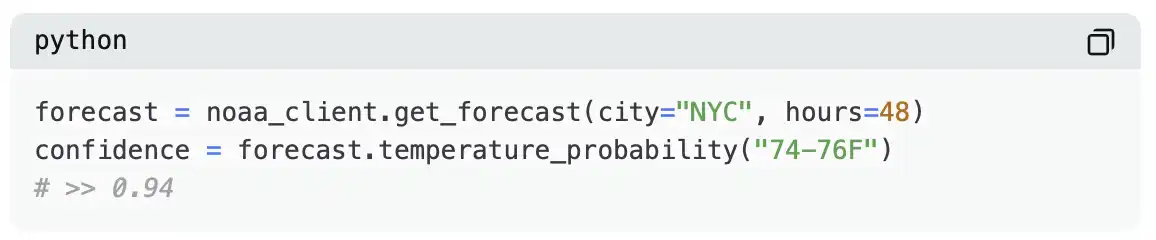
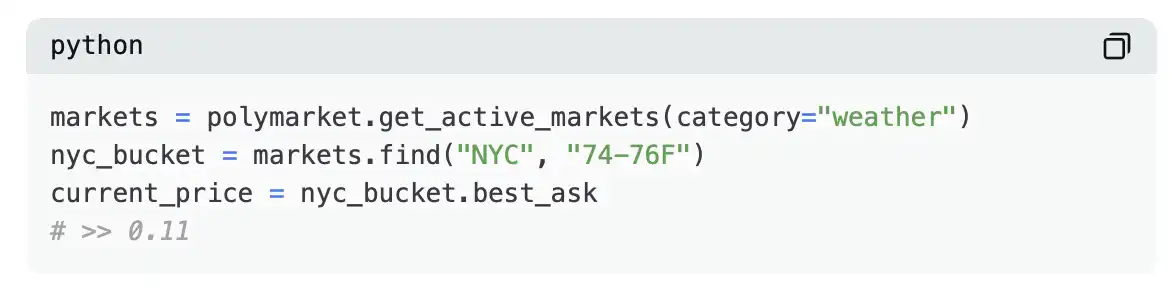
The result is this: while NOAA gives a 94% confidence interval for a temperature range, the market only prices it at 11 cents.
This is the result shown by the data, indicating a structural disconnect with the market's collective perception.
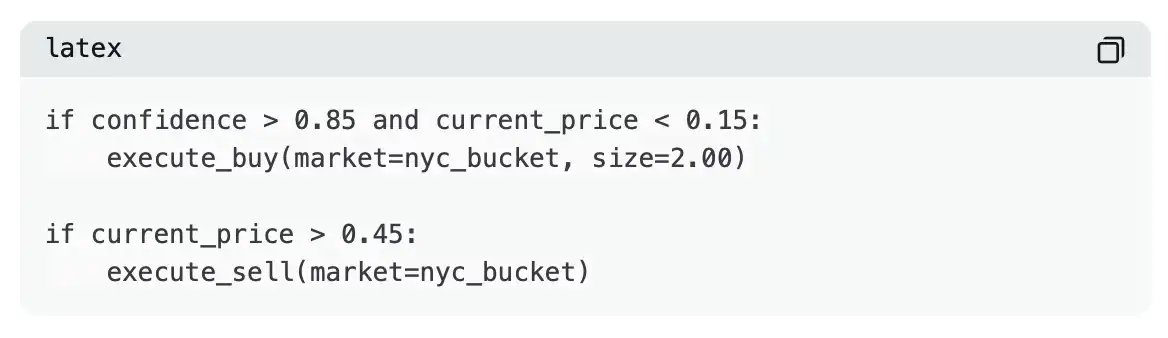
For example, NOAA believes there is a 94% probability that New York will experience temperatures between 74–76°F on Saturday, but on Polymarket, the price for this range is only 11 cents. So, the bot buys in at 11 cents. As more information is gradually absorbed by the market in the following hours, the price rises to 45–60 cents. The bot sells at 47 cents. Profit per share: +36 cents.
If operating on a $2 position, the gain is +$6.50. Running 10 trades like this a day results in $65.
A single trade may not seem remarkable. What truly excites is the outcome at scale.
This is also why the model council of Perplexity is crucial. The query regarding "optimal position size" is not handled by a single model—it is run concurrently by Claude, GPT, and Gemini.
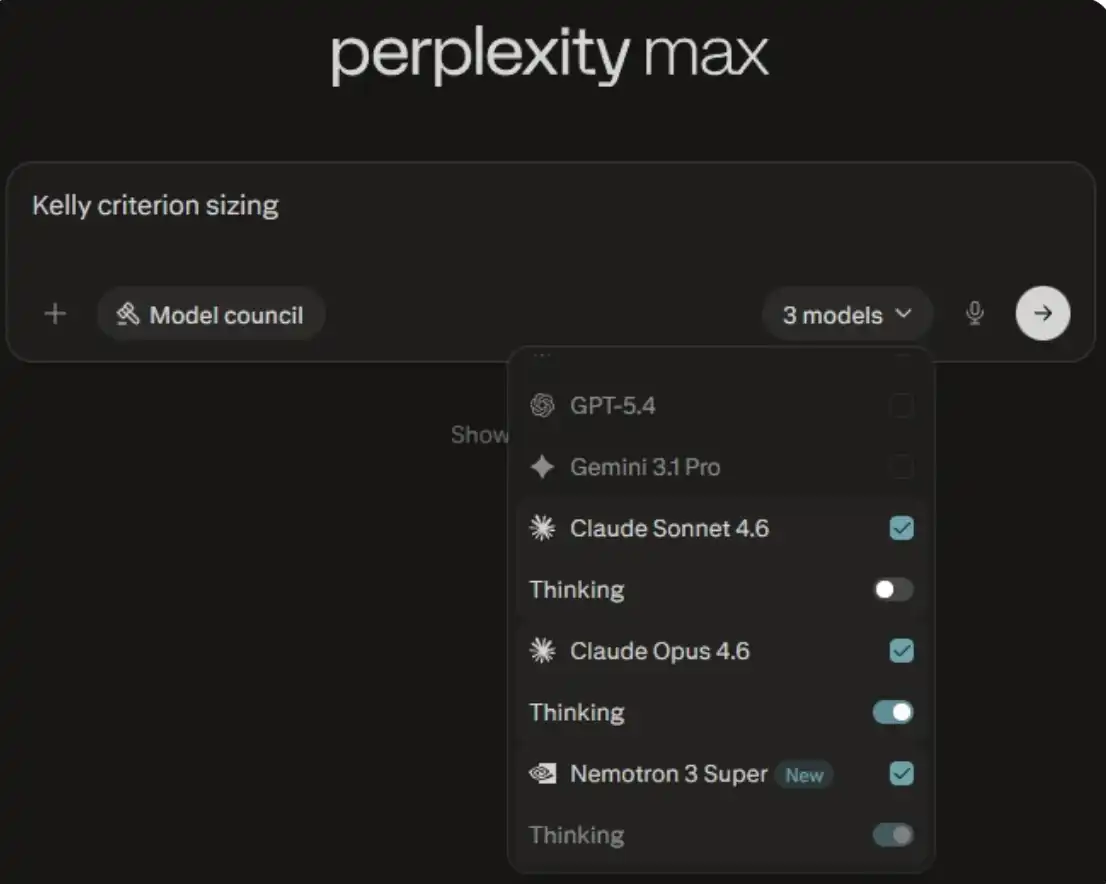
The ultimate answer provided is not the "view" of a single model, but the result of convergence from the three major models.
When Claude, GPT, and Gemini independently calculate and reach a unanimous conclusion on the same Kelly position ratio, it is no longer a possible "illusionary output" but a cross-validated result.
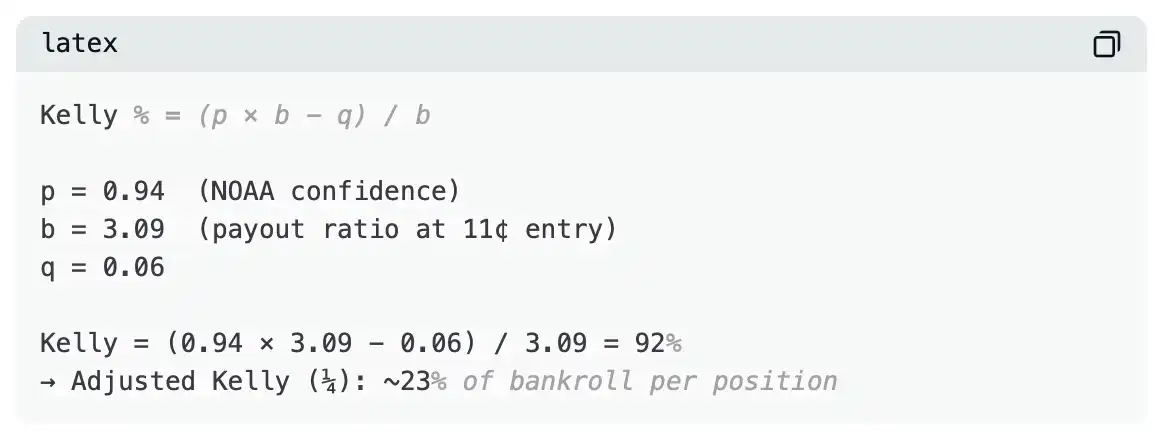
In practical operation, if the capital is only $100, each position should not exceed $2.
Is this conservative? Certainly. However, NOAA still has an error rate of about 6%. Without proper position control, one erroneous trade is enough to wipe out all the day's profits. With 6 cities, each with over 10 temperature ranges—this means there are over 60 markets to scan every day.
Perplexity's multisource analysis further consolidates three independent meteorological studies, confirming that NOAA's 94% forecast accuracy within 24 hours is actually a conservative estimate—especially for core metropolitan areas with denser weather station coverage, the accuracy is often higher.
And this bot scans the market every 2 minutes. By this calculation, it completes 720 scans across over 60 markets each day. This coverage intensity is simply unsustainable for humans.
Claude as the "Brain"
The entire system is divided into three modules: Scanner, Parser, Executor.
NOAA Scanner:
Polymarket Parser:
Decision Logic:
Telegram Reporting Module:

A regular script would only execute if/then logic: condition met → buy. It's that simple. Whereas an agent based on Claude would read the "context."
For example, if a hurricane is approaching? The NOAA data, originally updated hourly, is now updated every 30 minutes. The agent will recognize the increasing forecast instability and automatically reduce position size. It will also read news flows, monitor sentiment on Twitter, cross-validate multiple data sources—adjusting its confidence dynamically before actually placing an order.
That's the difference between a calculator and an analyst.
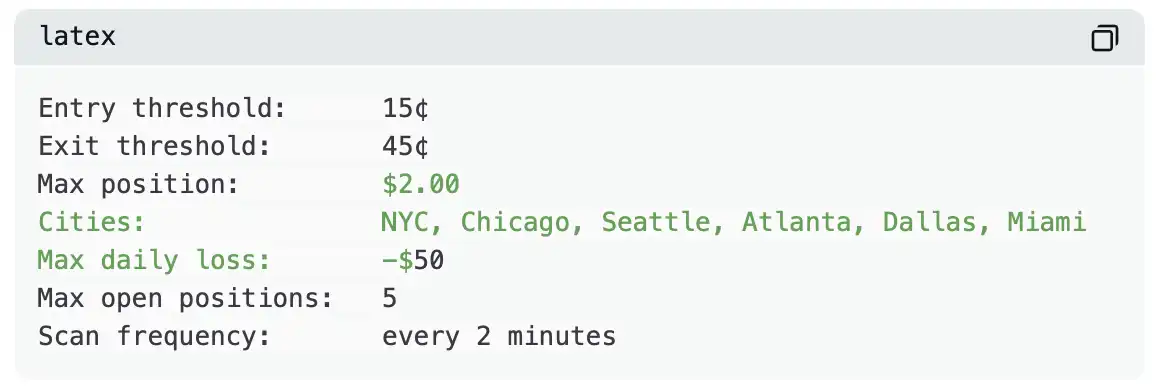
Entering at 15 cents with NOAA confidence above 85% means there is at least a 5.6x discrepancy between true probability and market pricing.
Exiting at 45 cents would allow locking in 3x gains on each successful trade.
Setting the daily loss limit at $50 means the worst-case scenario for a day is losing half the principal—at which point the bot automatically shuts down, resuming the next day.
The Stack
Perplexity AI addresses the research layer gap: niche market selection, data source identification, mathematical validation, risk assessment—all based on verifiable references and sources.
Claude addresses the execution layer gap: code generation, logic implementation, and real-time adaptive decision-making.
Polymarket represents the monetization layer.
Why Perplexity is an Asymmetric Advantage
Most people underestimate the "research" step. They jump straight to writing code, directly executing strategies—and then are puzzled why the bot starts losing money on day one.
Perplexity is not a search engine disguised as a chat interface; it is fundamentally a research infrastructure.
Multi-Model Consensus Mechanism
Your query is not handed to just one model but simultaneously run on Claude, GPT, and Gemini. When the three models independently converge on an answer, you are no longer facing a "potential illusion" but a cross-validated signal.
All Conclusions Are Sourced
Every judgment can be traced back to its origin. It's not "I think NOAA's accuracy is 94%," it's: here are research papers, API documentation, and Reddit discussions where traders have verified real P&L. You can fact-check every single point.
The Depth of Deep Research
Analyzing over 47 information sources in less than 3 minutes: academic papers, API documentation, trading forums, Twitter data analysis. The output is not a bunch of links but actionable strategies.
Auto-Generation of Follow-Up Questions
It doesn't just answer questions; it also tells you what to ask next: "Should you compare different forecast sources?" "Should you break down the cost structure?" It constructs a complete research path for you.
Compound Effect of Speed
10 minutes of research replacing 4–5 hours of manual retrieval. This is not just a convenience improvement but a structural advantage. While others are still scrolling Reddit, your bot has already started running and generating returns.
Claude is the brain; Polymarket is the wallet; and Perplexity is the eye.
Without it, you are trading blindly; with it, before placing a bet, you have already seen the entire chessboard.
Research Layer → Strategy Layer → Execution Layer → Returns, Perplexity is the first step. And the first step is precisely where 90% of traders fail.
Do not skip it.
Most people read through these, nod, and then go back to manual trading. The ones who take real action, however, have already opened Perplexity in another tab and launched the first Deep Research query: Market Segmentation, Profitable Wallets, Data Sources, Kelly Criterion Position Sizing...
The distance from 'knowing' to 'doing' is just a prompt.
Wait until you make your first $6.50 in some Weather market, then come back and read this again—your understanding will be completely different.
Disclaimer: This content is provided for general branding and informational purposes only and doesn't constitute financial, investment, legal, or tax advice. Any events, rewards, online events, or related information mentioned herein should not be considered a recommendation, solicitation, or invitation to purchase, sell, trade, or otherwise deal in any crypto assets or to use any services. Crypto assets are highly volatile and may result in loss. WEEX services and online events may not be available in all regions and are subject to applicable laws, regulations, and eligibility requirements. You are responsible for ensuring that your use of WEEX services complies with local laws and for carefully assessing the risks before participating in any crypto-related activities.
You may also like

Grayscale Introduces Quarterly Cash Distribution for Solana ETF Staking Rewards

This Week's Highlights: South Korea Tightens Regulations on Single Stock Leveraged ETFs; US Inflation Cools; US-Iran Conflict Escalates

New Tool Aims to Improve Energy Efficiency in Bitcoin Mining
Who Will Become Pump.fun on the Robinhood Chain?
Uweb In-Depth Report: Global AIDC Transformation Cycle and Valuation Reconstruction Logic of Listed Companies
Bitcoin Leaves Extreme Fear Behind After Months of Pessimism
Ripple wins EU-wide access as ESMA adds it to MiCA register
![[New York Gold, Bonds, Dollar] Dollar and Gold Rise Amid Middle East Tensions... 10-Year Bonds Decline](/public-static/37_d544230b33.png?format=avif)
[New York Gold, Bonds, Dollar] Dollar and Gold Rise Amid Middle East Tensions... 10-Year Bonds Decline

Augur returns with decentralized layer for disputed prediction markets
Anthropic turns to Meta for $10B in computing power before IPO

CryptoQuant says Strategy still needs disciplined bitcoin buying and selling framework
Giant from Wall Street Bets on Altcoins. The First Actively Managed Crypto ETF Chooses These Tokens
Bitcoin Among the 10% Most Discounted in History: Is It Time to Buy?

UnitedHealth Surprises Wall Street and Signals Turnaround

Cardano Tests Support As ADA Traders Look For A Better Catalyst
Chainlink Holds Support As CCIP Adoption Becomes A Longer-Term Test

Solana Tests $77 Support As Risk-Off Pressure Spreads Across Layer 1s
XRP Stalls Below Resistance As Traders Wait For Regulatory Relief To Turn Into Demand

Ethereum Weakens As ETF Optimism Runs Into A Cooler Policy Backdrop
SEC Pushes Ahead with Plan to Eliminate Quarterly Earnings Reports Despite 200,000 Opposition Comments
"AI should not be the solo of one country": Xi Jinping mobilizes the Global South against American restrictions
Summer Vacation Season Sees Continued Gasoline Supply Crisis and Price Surge in the U.S.
Stripe and Swift race to control the next generation of global payments infrastructure
SEC E-Delivery Plan Could Change How Crypto Fund Disclosures Reach Investors
Kraken Borrow Update Turns Idle Collateral Into A More Flexible Trading Tool
Kraken Options Push Gives US Traders Another Route Into Regulated Crypto Risk

Bitcoin Could Reach $1 Million if Banks Allocate 1%, Says Creator of Latin America's First Bitcoin ETF
Kraken Institutional Adds Upshot Valuation Tools For A Harder-To-Price Crypto Market
SEC-CFTC Commodity Stance Faces Its First Real Political Stress Test
T. Rowe Price Active Crypto ETF Opens A New Lane For Multi-Asset Exposure
Grayscale Introduces Quarterly Cash Distribution for Solana ETF Staking Rewards
This Week's Highlights: South Korea Tightens Regulations on Single Stock Leveraged ETFs; US Inflation Cools; US-Iran Conflict Escalates
New Tool Aims to Improve Energy Efficiency in Bitcoin Mining
Who Will Become Pump.fun on the Robinhood Chain?
Uweb In-Depth Report: Global AIDC Transformation Cycle and Valuation Reconstruction Logic of Listed Companies
Bitcoin Leaves Extreme Fear Behind After Months of Pessimism