
 Buy Crypto
- Markets
 Futures
- Spot
- Copy Trade
- Earn
- More
How to Determine the Reliability of a Crypto Dev Through GitHub?

How Important Is a Reliable Dev?
Waking up from a nap, SKYAI holders were shocked to find their once-promising AI Alpha project had suffered a 99% market crash with no recovery in sight.
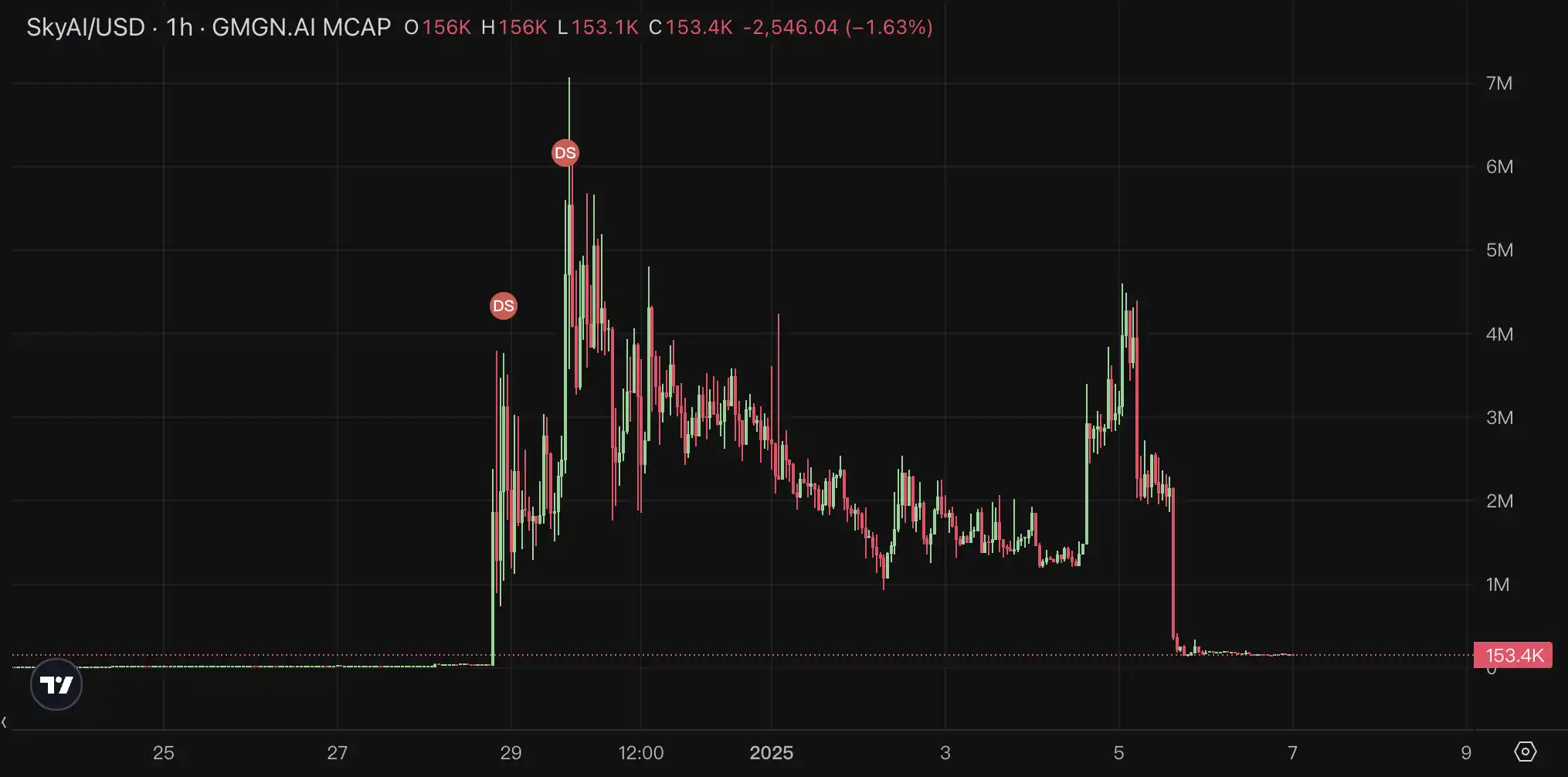
The reason for this situation was revealed when SKYAI's developer, Bob (@futuristfrog), announced on January 5th that his experiment had failed, stating, "Bad news. I have failed." Following this, SKYAI's price plummeted, leading many previously optimistic investors to demand a reliable project team, emphasizing the crucial role a founder plays in a project's success.
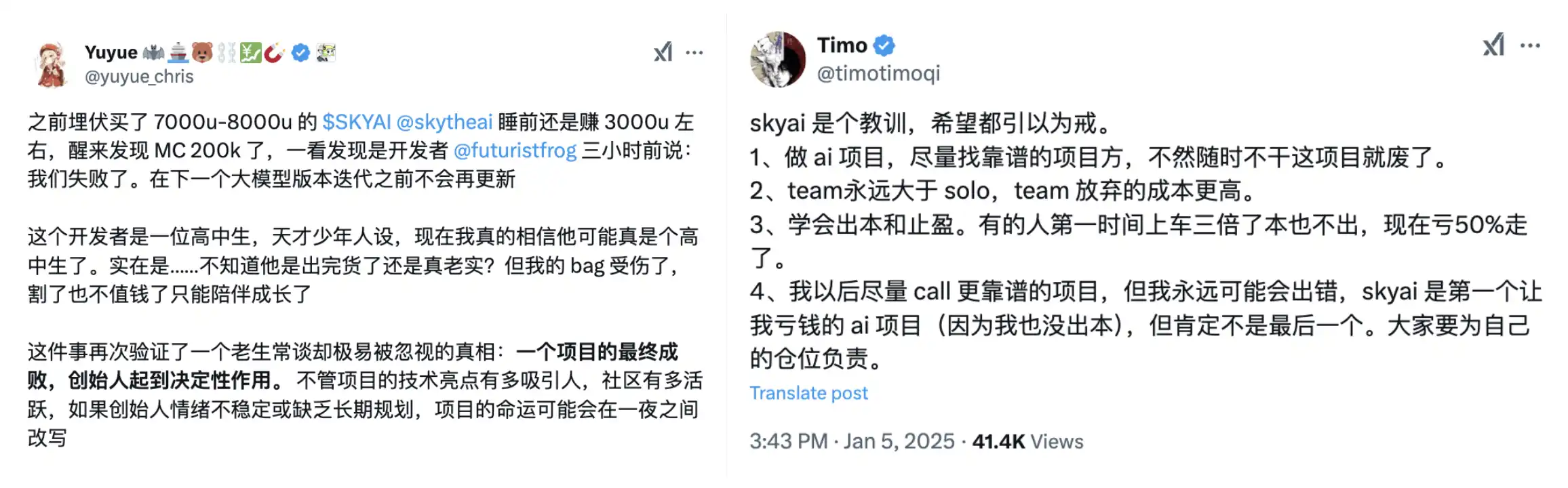
Bob was later exposed as a high school student in 2022, and SKYAI was initially touted as a practical token by a genius Dev. In his final statement, Bob admitted, "Up to now, I have only created very narrow, overfitted computer applications AI agents, and even so, these agents have had little to no effectiveness." Consequently, he decided not to make any updates to SkyAI until the release of the next-generation large model.
Would this behavior be considered responsible Dev behavior? From an investor's profitability perspective, clearly, he cannot be deemed a good Dev.
Similarly, on January 5th, the native token of The Hive, a DeFi AI Agent that participated in the Solana AI hackathon, called BUZZ, saw its market cap soar to over $80 million within two days. The reason for this FOMO was that the community discovered that its Dev, Jason Hedman, had almost always taken first place in every project he participated in, being a 9-time hackathon winner. His GitHub contributions are also very dense, with a complete resume and a clear development history.
Related Read: "BUZZ Market Cap Soars to $40M, Is the 'DeFi Agent' Making Waves?"
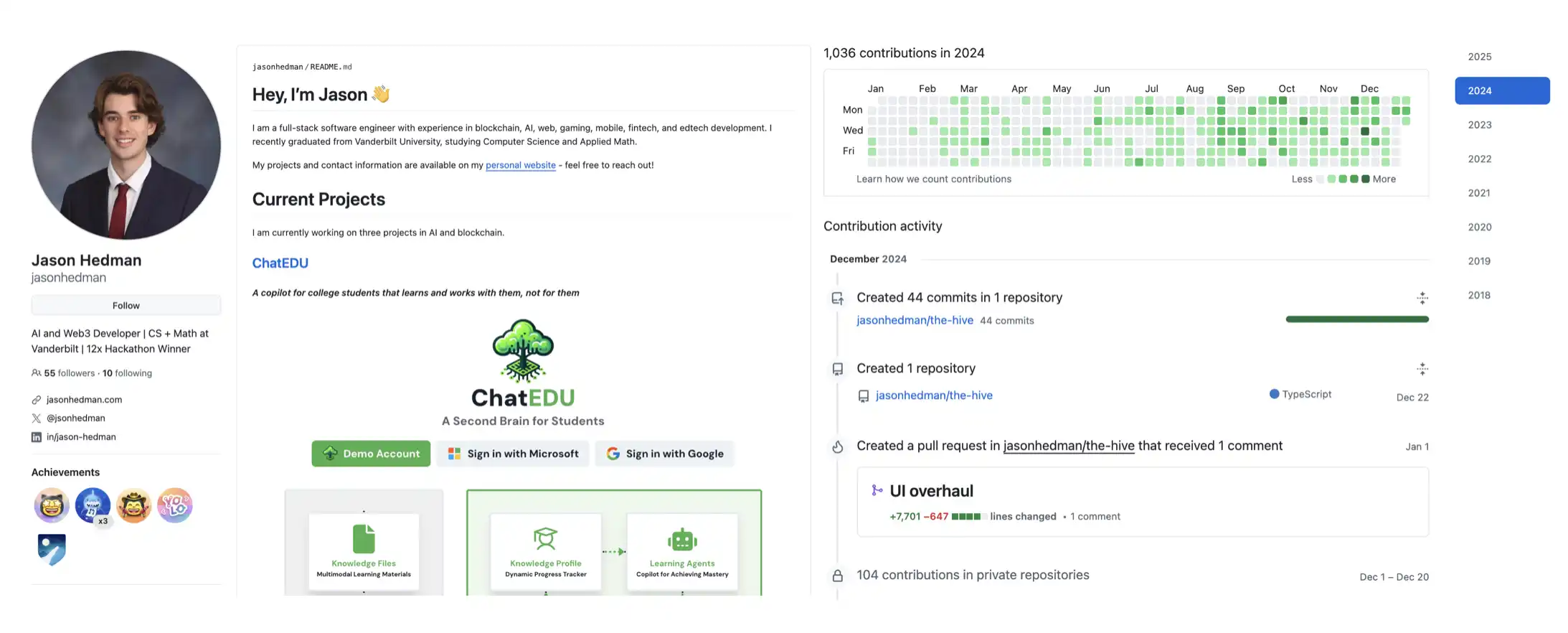
Jason's GitHub Profile
Furthermore, Jason holds 5% of BUZZ's token supply, but to enhance the project's transparency and market trust, he decided to lock this portion of the tokens for a year, also known as part of BUZZ's upward potential.
From the failure of SKYAI to the explosion of BUZZ, it is not difficult to see the importance of a reliable Dev to a project — technical expertise, sense of responsibility, and the developer's personal reputation are often closely linked to the project's future value-added space.
How to Find a Good AI Dev or Project on GitHub?
Once we recognize the importance of developers to a project, the next question is how to efficiently identify potential "Bob" and "Jason" among the many AI+Crypto projects, and find the technical teams that are truly worth tracking and investing in?
GitHub is undoubtedly the best "transit station." As the world's largest open-source code collaboration and version control platform, it not only showcases developers' technical skills and continuous output capabilities but also provides valuable insights into community interaction, version iteration, and more. BlockBeats has compiled several key tips for GitHub "treasure hunting" to help everyone better understand project quality and Dev level.
Make Good Use of Search and Trending Pages
GitHub's Trending page focuses on recent popular projects, usually sorted by language, time span, and Star increments. By selecting AI and its related languages (such as Python, C++, Go, etc.), you can quickly discover which projects have higher popularity and a broader range of applications. Projects with a higher number of Stars, Forks, and Watches often indicate a high level of community recognition and more abundant resources and discussions.
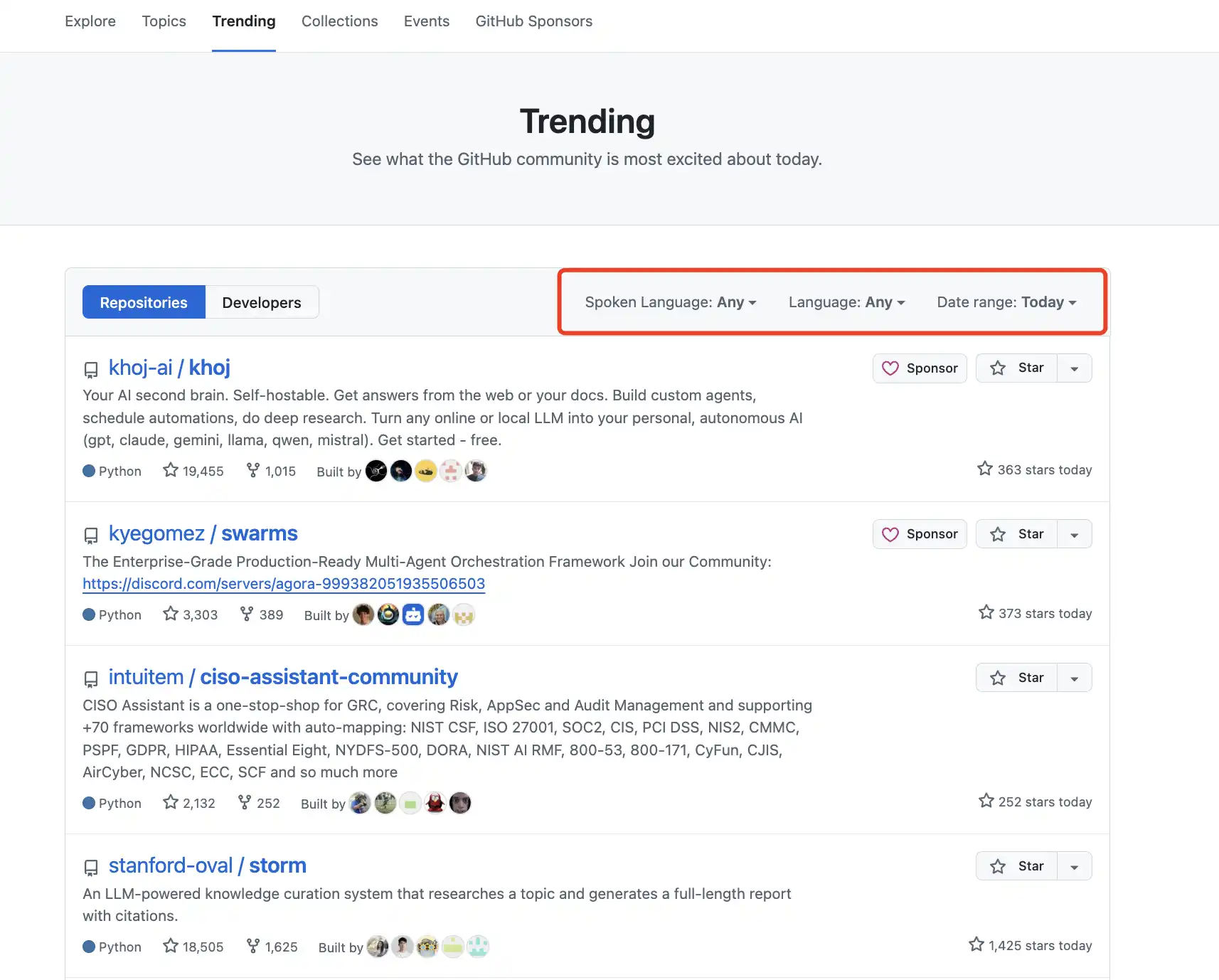
In addition to the Trending page, you can also use GitHub's advanced search function to filter by the number of Stars, programming language, update time, etc. For example, entering stars:>100 language:Python topic:AI in the search bar can help you find projects with more than 100 Stars, that use Python, and are related to "AI," laying the foundation for accurately targeting suitable Devs in the future.
In addition to checking the AI Dev's contributions on GitHub, you can also visit their profile page to see which projects they have participated in and whether they have submitted high-quality code to well-known AI frameworks. You can also learn about their truly impressive core projects in the "Pinned Repositories" section of their profile page.
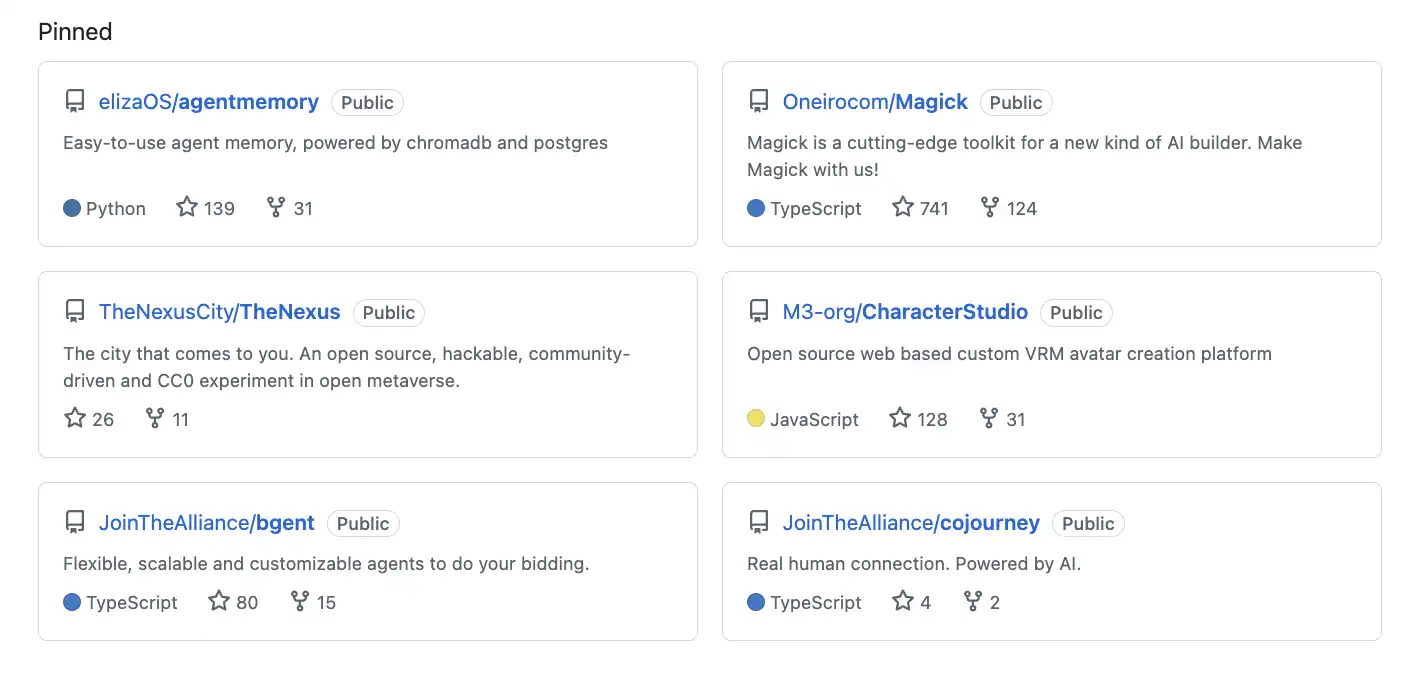
ai16z Founder Shaw's GitHub Profile
Additionally, third-party services like CodersRank, Sourcegraph, etc., analyze developers' public code to provide scores or skill tree analysis. If you want to have a more comprehensive understanding of a developer's coding habits and tech stack, you can also look into the data provided by these tools.
View README, Code, and Commit History
A project's README file usually contains the project's goals, feature overview, usage instructions, and required libraries. A detailed and logically organized README not only helps you quickly get started with the project but also reflects the developer's professionalism and friendliness to community users. If the README includes architecture diagrams, performance benchmarks, links to related papers, etc., it is a bonus to the project's professionalism.
Thoroughly read through the project's code structure, module divisions, and naming conventions, which can give you a preliminary assessment of the developer's maturity in software engineering. If you frequently see them using non-Git standard commits like "Add files via upload," it likely means that the project lacks continuous development management capability and real technical support. Conversely, if the commit messages are concise and the feature divisions are clear, it indicates a more professional and traceable development process.
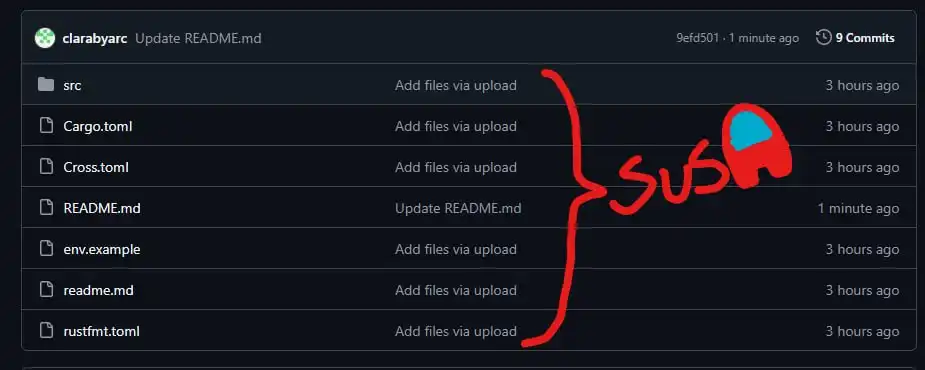
Image Source: @onlyzhynx
In AI projects, whether there are unit tests set up, continuous integration (Travis CI, GitHub Actions, etc.) is also a key indicator of whether developers care about quality. A high-level AI Dev usually combines automated testing methods to ensure the correctness and stability of the project's functionality.
Issues, Pull Requests, and Contributors Interface
In a project's Issues and Pull Requests, we can intuitively understand the developer's working style and the community's interaction level. For example, whether Issues are responded to promptly, if PRs go through a rigorous review process, and if there are sufficient reviews and tests during code merges. Excellent AI Devs usually guide new contributors through Code Reviews or provide more technical background and implementation logic in PR descriptions to help the project community quickly understand and validate new features.
If a project has a large number of Contributors that are evenly distributed, it indicates that the project has broad community support and ongoing development momentum. If only one or two people are frequently committing code, then it is necessary to delve deeper into their background and the project's scalability.
Some high-quality projects may link to external forums, Slack channels, Discord servers, etc., in their README or Issues section for discussions on the project's feature evolution, bug fixes, etc. If the user interaction in these forums is very active, it indicates that the project has a certain community foundation, which is also one of the standards to test the team.
Lastly, although reliable developer skills are crucial, emotional intelligence is also a necessary factor for a project to succeed. In the midst of the bubble brewing between AI and Crypto, if one cannot hold onto their assets due to a developer's outrageous actions overnight, perhaps we can consider a different approach. By tracking reliable Developer projects in the medium to long term, profiting from the token's cyclical uptrend can also be a more stable operational method.
You may also like

ChainCatcher Hong Kong Themed Forum Highlights: Decoding the Growth Engine Under the Integration of Crypto Assets and Smart Economy

Why can this institution still grow by 150% when the scale of leading crypto VCs has shrunk significantly?

Anthropic's $1 trillion, compared to DeepSeek's $100 billion

Geopolitical Risk Persists, Is Bitcoin Becoming a Key Barometer?

Annualized 11.5%, Wall Street Buzzing: Is MicroStrategy's STRC Bitcoin's Savior or Destroyer?

An Obscure Open Source AI Tool Alerted on Kelp DAO's $292 million Bug 12 Days Ago

Mixin has launched USTD-margined perpetual contracts, bringing derivative trading into the chat scene.
The privacy-focused crypto wallet Mixin announced today the launch of its U-based perpetual contract (a derivative priced in USDT). Unlike traditional exchanges, Mixin has taken a new approach by "liberating" derivative trading from isolated matching engines and embedding it into the instant messaging environment.
Users can directly open positions within the app with leverage of up to 200x, while sharing positions, discussing strategies, and copy trading within private communities. Trading, social interaction, and asset management are integrated into the same interface.
Based on its non-custodial architecture, Mixin has eliminated friction from the traditional onboarding process, allowing users to participate in perpetual contract trading without identity verification.
The trading process has been streamlined into five steps:
· Choose the trading asset
· Select long or short
· Input position size and leverage
· Confirm order details
· Confirm and open the position
The interface provides real-time visualization of price, position, and profit and loss (PnL), allowing users to complete trades without switching between multiple modules.
Mixin has directly integrated social features into the derivative trading environment. Users can create private trading communities and interact around real-time positions:
· End-to-end encrypted private groups supporting up to 1024 members
· End-to-end encrypted voice communication
· One-click position sharing
· One-click trade copying
On the execution side, Mixin aggregates liquidity from multiple sources and accesses decentralized protocol and external market liquidity through a unified trading interface.
By combining social interaction with trade execution, Mixin enables users to collaborate, share, and execute trading strategies instantly within the same environment.
Mixin has also introduced a referral incentive system based on trading behavior:
· Users can join with an invite code
· Up to 60% of trading fees as referral rewards
· Incentive mechanism designed for long-term, sustainable earnings
This model aims to drive user-driven network expansion and organic growth.
Mixin's derivative transactions are built on top of its existing self-custody wallet infrastructure, with core features including:
· Separation of transaction account and asset storage
· User full control over assets
· Platform does not custody user funds
· Built-in privacy mechanisms to reduce data exposure
The system aims to strike a balance between transaction efficiency, asset security, and privacy protection.
Against the background of perpetual contracts becoming a mainstream trading tool, Mixin is exploring a different development direction by lowering barriers, enhancing social and privacy attributes.
The platform does not only view transactions as execution actions but positions them as a networked activity: transactions have social attributes, strategies can be shared, and relationships between individuals also become part of the financial system.
Mixin's design is based on a user-initiated, user-controlled model. The platform neither custodies assets nor executes transactions on behalf of users.
This model aligns with a statement issued by the U.S. Securities and Exchange Commission (SEC) on April 13, 2026, titled "Staff Statement on Whether Partial User Interface Used in Preparing Cryptocurrency Securities Transactions May Require Broker-Dealer Registration."
The statement indicates that, under the premise where transactions are entirely initiated and controlled by users, non-custodial service providers that offer neutral interfaces may not need to register as broker-dealers or exchanges.
Mixin is a decentralized, self-custodial privacy wallet designed to provide secure and efficient digital asset management services.
Its core capabilities include:
· Aggregation: integrating multi-chain assets and routing between different transaction paths to simplify user operations
· High liquidity access: connecting to various liquidity sources, including decentralized protocols and external markets
· Decentralization: achieving full user control over assets without relying on custodial intermediaries
· Privacy protection: safeguarding assets and data through MPC, CryptoNote, and end-to-end encrypted communication
Mixin has been in operation for over 8 years, supporting over 40 blockchains and more than 10,000 assets, with a global user base exceeding 10 million and an on-chain self-custodied asset scale of over $1 billion.

$600 million stolen in 20 days, ushering in the era of AI hackers in the crypto world
Vitalik's 2026 Hong Kong Web3 Summit Speech: Ethereum's Ultimate Vision as the "World Computer" and Future Roadmap
On the same day Aave introduced rsETH, why did Spark decide to exit?
Full Post-Mortem of the KelpDAO Incident: Why Did Aave, Which Was Not Compromised, End Up in Crisis Situation?

After a $290 million DeFi liquidation, is the security promise still there?
ZachXBT's post ignites RAVE nearing zero, what is the truth behind the insider control?

Vitalik 2026 Hong Kong Web3 Carnival Speech Transcript: We do not compete on speed; security and decentralization are the core
In-depth Analysis of RAVE Events: Short Squeeze, Crash, and Quantitative Financial Models of Liquidity Manipulation

Eve of Ceasefire, US Military Fires on Iranian Vessel | Rewire News Morning Brief

Figma's stock price drops over 7%, will Claude Design be the terminator?




 App
App