
 Buy Crypto
- Markets
 Futures
- Spot
- Copy Trade
- Earn
- More
How Does Supra Build an Integrated Future?

The Stage of Public Blockchains Is Far From Over.
Over the past year, the public blockchain space has witnessed a series of revitalizations, sparking renewed interest and discussion. The reincarnation journey led by Solana, Sui's role in the rise of the Move ecosystem, and the pre-mainnet success of Hyperliquid have all reignited the market's imagination in their own ways.
Simultaneously, usability and liquidity have reached unprecedented levels of importance in this process. Consequently, Supra, which promotes an "integrated design" and has quickly garnered significant attention, has also stepped into the spotlight.
From Oracle to Public Blockchain: Supra's Vision
If Supra is unfamiliar to you, then you may have heard of the renowned oracle project SupraOracles. Supra has evolved from SupraOracles because of the team's in-depth research and unique design in on-chain data and cross-chain capabilities. As the project's technical scope continued to expand, the team gradually realized that focusing solely on the oracle module would not fundamentally solve the pain points of blockchain applications in liquidity, randomness, security, and scalability. Thus, the vision of extending from an oracle to a truly high-throughput and highly secure L1 public blockchain began to take shape. According to the official introduction, Supra is steadfastly entering the public blockchain arena because they believe that only by deeply integrating key modules such as oracles, on-chain randomness (dVRF), and cross-chain communication at the base layer can performance and security achieve a "win-win" situation. Once oracles and automation services are unified at the L1 layer, developers will no longer need to connect to multiple networks or numerous external protocols, nor will they need to consider various cross-chain or data security risks, which greatly facilitates the implementation of applications. In pursuit of this goal, in addition to strengthening oracle capabilities, Supra has also made substantial technical preparations at the underlying blockchain and consensus layers, striving to create an "integrated future."
How Does Supra Build an Integrated Future?
The market is no longer interested in the cliché of composability like LEGO but rather values a system that is secure, reliable, and stable. "Integration" often means integrating functions from multiple layers and modules into the same network to achieve a balance between security, performance, and usability. For Supra, the core goal is to allow developers to fulfill various needs such as oracles, cross-chain communication, random numbers (dVRF), and automation on the same public blockchain, eliminating the hassle of frequent integration of external protocols or deploying sidechains. In specific terms, Supra has laid a solid technical and economic foundation for an "integrated future" through the following key modules.
Vertical Integration
In traditional blockchain projects, the underlying layer often only provides core consensus, execution, and data availability, while other functions—such as oracle, cross-chain bridge, automated network, on-chain random number generation, etc.—are handled by external third-party networks or protocols. While this approach provides flexibility, it also leads to various integration issues. Developers may need to switch between multiple networks, ensure compatibility and security audits, resulting in extended development cycles and increased security risks.
Supra, through the concept of "Vertical Integration," embeds these key functions directly into the L1 layer: sharing security guarantees in the same consensus environment, reducing cross-network call latency and vulnerability risks. For developers, this means that applications can easily call services such as random numbers, oracle data, cross-chain communication, etc., in a highly unified ecosystem without the need to repeatedly integrate with external protocols. More importantly, these services all "originate" on the same blockchain, sharing the same security mechanism at the consensus layer, greatly reducing the probability of a "weakest link" leading to systemic risk.
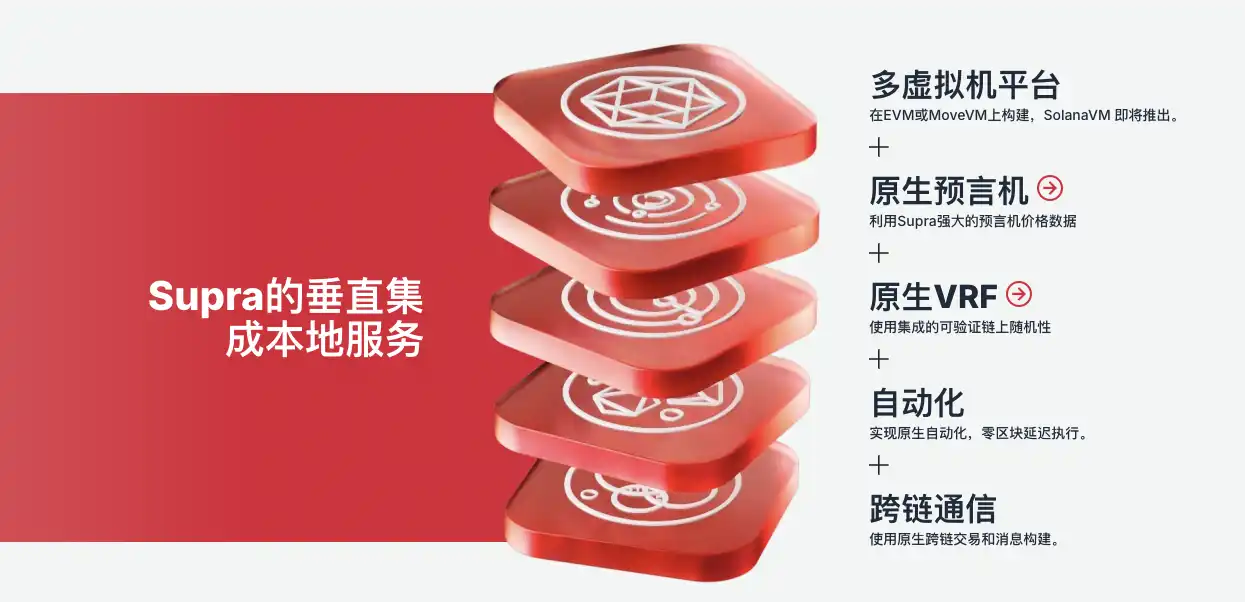
In terms of specific implementation, Supra not only provides a complete set of native cross-chain and oracle solutions but also deeply optimizes data availability and automated execution. By using its proprietary parallelized consensus protocol (Moonshot) to ensure high throughput and sub-second confirmation, Supra's Vertical Integration can bring more feasibility and security guarantees to complex multi-contract interactions, cross-chain transfers, and decentralized autonomous organization (DAO) operations as the functionality continues to expand.
Supra Containers
With the rise of blockchain application chains and Layer2 trends, more and more teams are looking to have autonomous governance models and economic systems. However, the traditional approach often requires building a separate sidechain or application chain, meaning that the project team has to bear the costs of node operation, security audits, and liquidity maintenance. Even with AVS and RaaS, for many small teams, it is still a "thankless task" and easily leads to the "walled garden effect," making it difficult to share liquidity with other applications. Not to mention the dispute between the Degen team and Conduit that led to the migration of the entire Degen L3 chain.
To address these challenges, Supra has introduced the concept of "Containers." A container is like a "microchain attached to the mainnet," where project teams can customize their token model, governance mechanism, or economic incentive scheme within the container, maintaining a relatively independent operational space. At the same time, containers and the Supra mainnet maintain a high level of interoperability: on the one hand, they can share liquidity pools and secure consensus with the mainnet, and on the other hand, containers can also leverage the main chain's built-in oracle, cross-chain communication, and other features in a "plug-and-play" manner.
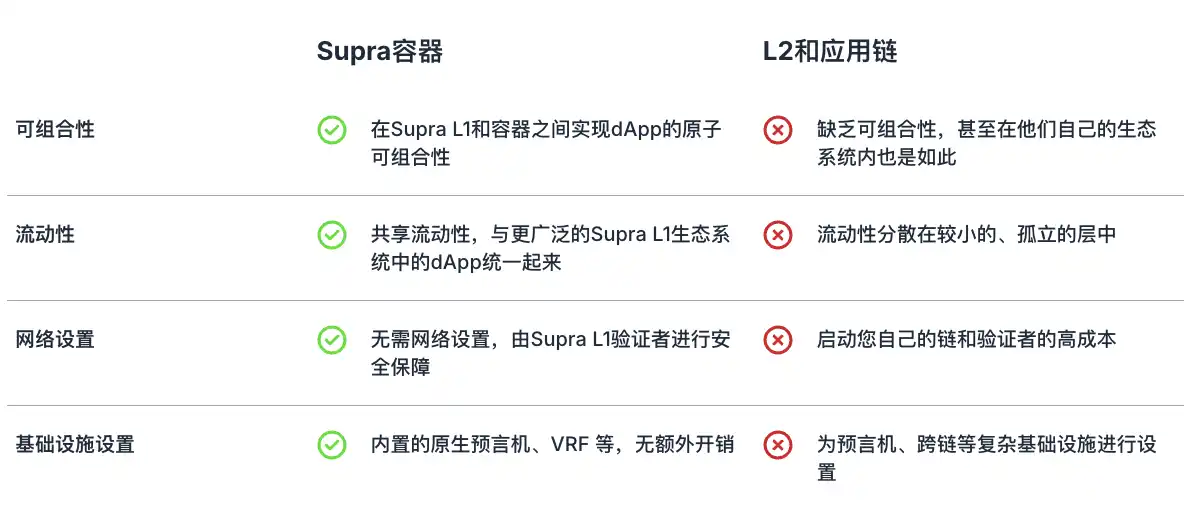
This container mode balances flexibility and security, meeting the project's pursuit of independence without splitting liquidity across multiple chains. For developers, this means they can achieve customized operation similar to an "application chain" without having to bear the heavy burden of node maintenance or security responsibilities, thus eliminating a lot of the cost of reinventing the wheel.
IntraLayer: Decentralized Autonomous Agent
Blockchain applications often require an "unattended" automatic execution method: for example, liquidation logic in a collateralized lending platform, exercise triggers in options protocols, or even random drops in games. Traditionally, these functions may rely on an external keeper network or scripts deployed by developers to monitor contract states and execute operations. While this approach is feasible, it still carries potential centralization dependencies or network failure risks, and also increases the developers' integration burden.
To address this, Supra has introduced the concept of a "Decentralized Autonomous Agent" called IntraLayer, aiming to embed Keeper/Executor-like functions directly on-chain. In other words, nodes in the network can in a decentralized manner detect trigger conditions set by the application on-chain and then automatically execute the corresponding contract logic. In this way, a dApp only needs to register its automated tasks on Supra, without handing over the logic to external scripts or centralized servers for processing.
Because both triggering and execution are done on L1 and combined with Supra's unified security and consensus mechanism, IntraLayer excels in both reliability and security. Once an application entrusts complex automation workflows to IntraLayer, it can maintain a "never-offline" self-running system with fewer manpower and resources, eliminating worries about issues with external keepers.
Proof of Economic Liquidity (PoEL) and Dynamic Function Market Maker (DFMM)
In addition to highly integrating on the technical stack, a public chain's "integration" is also reflected in the linkage between the economic model and the application ecosystem. Through the PoEL (Proof of Economic Liquidity) mechanism, Supra organically combines network security, node staking, and liquidity, encouraging quality capital to enter Supra's mainnet and liquidity pool. As a result, node security and application funding support each other, forming a "win-win" cycle.
Specifically, PoEL allows holders to stake various digital assets into the Supra network, earning corresponding rewards based on asset type and risk exposure. This not only helps the mainnet maintain better liquidity in various scenarios but also enhances the robustness of the network's consensus. With this fund aggregation effect, developers deploying new applications can more easily access liquidity and users, expanding their business scale.
Complementing PoEL is the "Dynamic Functioning Market Maker" (DFMM), which serves as the core matching mechanism provided by Supra for on-chain trading and resource exchange. Unlike traditional AMMs, DFMM places more emphasis on dynamically adjusting market-making parameters based on the network's actual needs and real-time status, thereby more effectively balancing capital utilization and liquidity distribution, reducing impermanent loss or excessive slippage. When combined with Supra's low-latency, high-throughput consensus layer, DFMM has the opportunity to support more complex DeFi scenarios, such as derivative trading and options market making. The integration of PoEL and DFMM can help new projects quickly access the mainnet's liquidity and user resources. Compared to public chain environments that are "rich in technology but lack financial incentives," Supra's financially integrated design may provide developers with more comprehensive support.
Overall, leveraging vertical integration, Moonshot consensus engine, containerized design, IntraLayer decentralized proxy, as well as a series of innovations such as PoEL and DFMM, Supra has built a highly integrated blockchain from underlying technology to economic model. For developers, this means being able to easily utilize key functions such as oracles, cross-chain, automation, and random numbers in a secure and efficient environment, without the need to introduce third-party services or deploy cumbersome cross-chain bridges. For funders and nodes, PoEL provides good returns and security for quality capital, while the dynamic market-making mechanism can drive the prosperity of more DeFi scenarios.
Tokenomics
For any public chain, the tokenomics model is crucial. Supra's token is called SUPRA, and the official statement indicates that its main uses include paying transaction fees, network staking, and applications in various scenarios such as data access. According to the official introduction, SUPRA will also play a significant role under the network's PoEL (Proof of Economic Liquidity) mechanism, encouraging more high-quality assets to enter Supra's liquidity pool to ensure the network's stability and security. PoEL encourages participants to stake various digital assets into the Supra network, receive corresponding incentive rewards, enhance node resilience to risks, and make the token not only a payment and governance tool but also a core element of network liquidity.
Team with Strong Academic Background
If the technical architecture showcases Supra's engineering prowess, then the academic background further strengthens its authority in the cutting-edge cryptography field. The project's Chief Research Officer is Dr. Aniket Kate, one of the inventors of KZG commitments and a cryptographer. The KZG commitment technology plays a key role in Ethereum's scalability roadmap and is also a crucial piece of zero-knowledge proofs. The addition of this scholarly founder has provided solid academic support for Supra's cutting-edge research and foundational innovation. According to the official introduction, the team also comprises other researchers with deep expertise in cryptography, distributed systems, decentralized storage, and other fields, enabling Supra's technical development to maintain a high level both in algorithm and implementation.
Top-tier Backing
In terms of funding, Supra has already received over $42 million in funding and attracted participation from several well-known institutions, including Coinbase, Hashed, UBO, and Animoca. These investors have extensive resources and industry influence in the blockchain field, providing support for Supra's community building, ecosystem development, and future marketing efforts. Additionally, according to official sources, Supra has also partnered with many well-known projects such as Apechain and Pulme Network to offer support.
Abundant Community Activities
To promote industry development, Supra has launched a $100 million Super dApp Contest, with the team setting aside tokens worth $100 million to support top-tier dApps built on the Supra platform. All winners of the contest will receive a portion of this fund to assist in launching and succeeding in their projects.
While focusing on building core technology and a community ecosystem, Supra also places great emphasis on industry collaboration and promotion. According to official information, the team has participated in or hosted multiple blockchain summits and hackathons in 2024 and has conducted several AMAs in the community. Through these offline and online activities, Supra has not only attracted developers and community members from around the world but has also gained insights into various application scenarios' pain points through real conversations, enabling better iteration of the project roadmap.
Looking across the entire public chain landscape, a high-performance, scalable, and highly secure single-chain solution remains the ideal answer for many developers and users. However, in recent times, various implementation approaches and solutions have made the competition fierce and complex. Supra's emergence has injected new imagination into this track, as they have chosen to directly integrate at the L1 level in a full-stack manner, enabling oracles, cross-chain communication, random numbers, and automation to be natively implemented on the mainnet, aiming to simplify development costs and integration risks. As the Supra mainnet gradually matures, whether this integrated framework can truly become a new benchmark for public chains remains to be tested by more real-world applications and the community. But at least from the current design philosophy and architectural approach, Supra is embarking on a path of innovation that emphasizes both technical integration and economic linkage.
Further Reading: "Technical Guide: A Comprehensive Explanation of the Supra Blockchain Technology Stack"
You may also like

Why can this institution still grow by 150% when the scale of leading crypto VCs has shrunk significantly?

Anthropic's $1 trillion, compared to DeepSeek's $100 billion

Geopolitical Risk Persists, Is Bitcoin Becoming a Key Barometer?

Annualized 11.5%, Wall Street Buzzing: Is MicroStrategy's STRC Bitcoin's Savior or Destroyer?

An Obscure Open Source AI Tool Alerted on Kelp DAO's $292 million Bug 12 Days Ago

Mixin has launched USTD-margined perpetual contracts, bringing derivative trading into the chat scene.
The privacy-focused crypto wallet Mixin announced today the launch of its U-based perpetual contract (a derivative priced in USDT). Unlike traditional exchanges, Mixin has taken a new approach by "liberating" derivative trading from isolated matching engines and embedding it into the instant messaging environment.
Users can directly open positions within the app with leverage of up to 200x, while sharing positions, discussing strategies, and copy trading within private communities. Trading, social interaction, and asset management are integrated into the same interface.
Based on its non-custodial architecture, Mixin has eliminated friction from the traditional onboarding process, allowing users to participate in perpetual contract trading without identity verification.
The trading process has been streamlined into five steps:
· Choose the trading asset
· Select long or short
· Input position size and leverage
· Confirm order details
· Confirm and open the position
The interface provides real-time visualization of price, position, and profit and loss (PnL), allowing users to complete trades without switching between multiple modules.
Mixin has directly integrated social features into the derivative trading environment. Users can create private trading communities and interact around real-time positions:
· End-to-end encrypted private groups supporting up to 1024 members
· End-to-end encrypted voice communication
· One-click position sharing
· One-click trade copying
On the execution side, Mixin aggregates liquidity from multiple sources and accesses decentralized protocol and external market liquidity through a unified trading interface.
By combining social interaction with trade execution, Mixin enables users to collaborate, share, and execute trading strategies instantly within the same environment.
Mixin has also introduced a referral incentive system based on trading behavior:
· Users can join with an invite code
· Up to 60% of trading fees as referral rewards
· Incentive mechanism designed for long-term, sustainable earnings
This model aims to drive user-driven network expansion and organic growth.
Mixin's derivative transactions are built on top of its existing self-custody wallet infrastructure, with core features including:
· Separation of transaction account and asset storage
· User full control over assets
· Platform does not custody user funds
· Built-in privacy mechanisms to reduce data exposure
The system aims to strike a balance between transaction efficiency, asset security, and privacy protection.
Against the background of perpetual contracts becoming a mainstream trading tool, Mixin is exploring a different development direction by lowering barriers, enhancing social and privacy attributes.
The platform does not only view transactions as execution actions but positions them as a networked activity: transactions have social attributes, strategies can be shared, and relationships between individuals also become part of the financial system.
Mixin's design is based on a user-initiated, user-controlled model. The platform neither custodies assets nor executes transactions on behalf of users.
This model aligns with a statement issued by the U.S. Securities and Exchange Commission (SEC) on April 13, 2026, titled "Staff Statement on Whether Partial User Interface Used in Preparing Cryptocurrency Securities Transactions May Require Broker-Dealer Registration."
The statement indicates that, under the premise where transactions are entirely initiated and controlled by users, non-custodial service providers that offer neutral interfaces may not need to register as broker-dealers or exchanges.
Mixin is a decentralized, self-custodial privacy wallet designed to provide secure and efficient digital asset management services.
Its core capabilities include:
· Aggregation: integrating multi-chain assets and routing between different transaction paths to simplify user operations
· High liquidity access: connecting to various liquidity sources, including decentralized protocols and external markets
· Decentralization: achieving full user control over assets without relying on custodial intermediaries
· Privacy protection: safeguarding assets and data through MPC, CryptoNote, and end-to-end encrypted communication
Mixin has been in operation for over 8 years, supporting over 40 blockchains and more than 10,000 assets, with a global user base exceeding 10 million and an on-chain self-custodied asset scale of over $1 billion.

$600 million stolen in 20 days, ushering in the era of AI hackers in the crypto world
Vitalik's 2026 Hong Kong Web3 Summit Speech: Ethereum's Ultimate Vision as the "World Computer" and Future Roadmap
On the same day Aave introduced rsETH, why did Spark decide to exit?
Full Post-Mortem of the KelpDAO Incident: Why Did Aave, Which Was Not Compromised, End Up in Crisis Situation?

After a $290 million DeFi liquidation, is the security promise still there?
ZachXBT's post ignites RAVE nearing zero, what is the truth behind the insider control?

Vitalik 2026 Hong Kong Web3 Carnival Speech Transcript: We do not compete on speed; security and decentralization are the core
In-depth Analysis of RAVE Events: Short Squeeze, Crash, and Quantitative Financial Models of Liquidity Manipulation

Eve of Ceasefire, US Military Fires on Iranian Vessel | Rewire News Morning Brief

Figma's stock price drops over 7%, will Claude Design be the terminator?

Plunge by 10% Followed by Rebound, Weekend Oil Market Watch

SpaceX Mascot ASTEROID Fast Track $170 million, Stemming from an Unfinished Space Dream
Why can this institution still grow by 150% when the scale of leading crypto VCs has shrunk significantly?
Anthropic's $1 trillion, compared to DeepSeek's $100 billion
Geopolitical Risk Persists, Is Bitcoin Becoming a Key Barometer?
Annualized 11.5%, Wall Street Buzzing: Is MicroStrategy's STRC Bitcoin's Savior or Destroyer?
An Obscure Open Source AI Tool Alerted on Kelp DAO's $292 million Bug 12 Days Ago
Mixin has launched USTD-margined perpetual contracts, bringing derivative trading into the chat scene.
The privacy-focused crypto wallet Mixin announced today the launch of its U-based perpetual contract (a derivative priced in USDT). Unlike traditional exchanges, Mixin has taken a new approach by "liberating" derivative trading from isolated matching engines and embedding it into the instant messaging environment.
Users can directly open positions within the app with leverage of up to 200x, while sharing positions, discussing strategies, and copy trading within private communities. Trading, social interaction, and asset management are integrated into the same interface.
Based on its non-custodial architecture, Mixin has eliminated friction from the traditional onboarding process, allowing users to participate in perpetual contract trading without identity verification.
The trading process has been streamlined into five steps:
· Choose the trading asset
· Select long or short
· Input position size and leverage
· Confirm order details
· Confirm and open the position
The interface provides real-time visualization of price, position, and profit and loss (PnL), allowing users to complete trades without switching between multiple modules.
Mixin has directly integrated social features into the derivative trading environment. Users can create private trading communities and interact around real-time positions:
· End-to-end encrypted private groups supporting up to 1024 members
· End-to-end encrypted voice communication
· One-click position sharing
· One-click trade copying
On the execution side, Mixin aggregates liquidity from multiple sources and accesses decentralized protocol and external market liquidity through a unified trading interface.
By combining social interaction with trade execution, Mixin enables users to collaborate, share, and execute trading strategies instantly within the same environment.
Mixin has also introduced a referral incentive system based on trading behavior:
· Users can join with an invite code
· Up to 60% of trading fees as referral rewards
· Incentive mechanism designed for long-term, sustainable earnings
This model aims to drive user-driven network expansion and organic growth.
Mixin's derivative transactions are built on top of its existing self-custody wallet infrastructure, with core features including:
· Separation of transaction account and asset storage
· User full control over assets
· Platform does not custody user funds
· Built-in privacy mechanisms to reduce data exposure
The system aims to strike a balance between transaction efficiency, asset security, and privacy protection.
Against the background of perpetual contracts becoming a mainstream trading tool, Mixin is exploring a different development direction by lowering barriers, enhancing social and privacy attributes.
The platform does not only view transactions as execution actions but positions them as a networked activity: transactions have social attributes, strategies can be shared, and relationships between individuals also become part of the financial system.
Mixin's design is based on a user-initiated, user-controlled model. The platform neither custodies assets nor executes transactions on behalf of users.
This model aligns with a statement issued by the U.S. Securities and Exchange Commission (SEC) on April 13, 2026, titled "Staff Statement on Whether Partial User Interface Used in Preparing Cryptocurrency Securities Transactions May Require Broker-Dealer Registration."
The statement indicates that, under the premise where transactions are entirely initiated and controlled by users, non-custodial service providers that offer neutral interfaces may not need to register as broker-dealers or exchanges.
Mixin is a decentralized, self-custodial privacy wallet designed to provide secure and efficient digital asset management services.
Its core capabilities include:
· Aggregation: integrating multi-chain assets and routing between different transaction paths to simplify user operations
· High liquidity access: connecting to various liquidity sources, including decentralized protocols and external markets
· Decentralization: achieving full user control over assets without relying on custodial intermediaries
· Privacy protection: safeguarding assets and data through MPC, CryptoNote, and end-to-end encrypted communication
Mixin has been in operation for over 8 years, supporting over 40 blockchains and more than 10,000 assets, with a global user base exceeding 10 million and an on-chain self-custodied asset scale of over $1 billion.



 App
App