
 Buy Crypto
- Markets
 Futures
- Spot
- Copy Trade
- Earn
- More
GRIFT Doubling Down: Why is DeFAI the Best Post-Crash Bounce-back Bet?

Original Article Title: Everything is Fine with DeFAI
Original Article Author: Defi0xJeff, Head of Steak Studio
Original Article Translation: zhouzhou, BlockBeats
Editor's Note: DeFAI is attracting market attention, especially in the abstraction layer and automated trading agent space. Despite facing challenges such as limited research tools and user onboarding issues, with a strong vision and professionalism, it is expected to lead the 2025 AI agent bull market, focusing on analytical tools and practical agents to avoid emotional trading.
Below is the original content (slightly reorganized for readability):
Market sentiment has become extremely bearish across all AI agent subcategories, with one narrative being the exception: DeFAI.
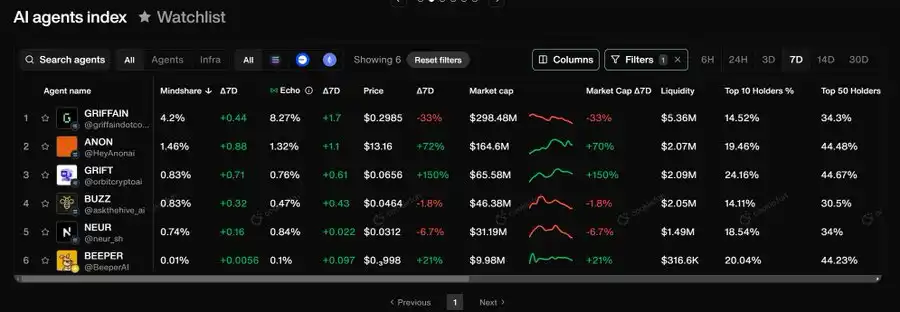
DeFAI is primarily focused on the abstraction layer category and has performed well during market downturns, with two projects showing particularly strong performance in the past week:
· GRIFT / orbitcryptoai—Market Cap $65M (Past 7 Days +150%)
· ANON / HeyAnonai—Market Cap $161M (Past 7 Days +70%)
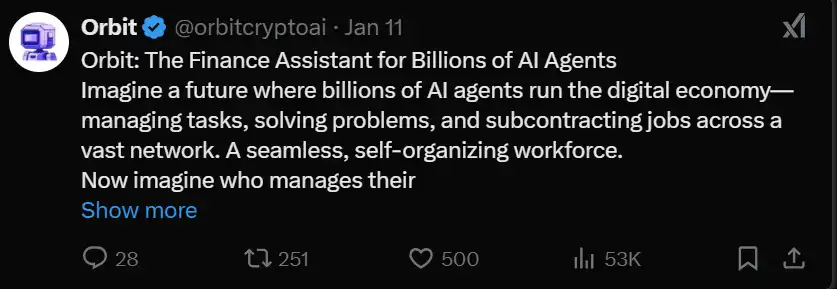
Orbit
Orbit continues to show strong momentum, with its unique features setting it apart from its peers. The latest features include:
· USDC Transfer Agent: Consolidates USDC balances from multiple chains into a unified balance and transfers to a designated wallet for payments (future support for any token).
· Data Hooks: Users can automate trades and on-chain tasks, such as "swap [x] USDC every minute on Solana until SOL market cap reaches [x]."
With integration capabilities covering 117+ chains and 200+ protocols, Orbit is positioning itself as the "financial assistant for billions of AI agents"—aiding agents and humans in seamless payments, task completion, and interaction through the Orbit tech stack protocols.
The market is beginning to equate GRIFT's pricing with other major competitors.
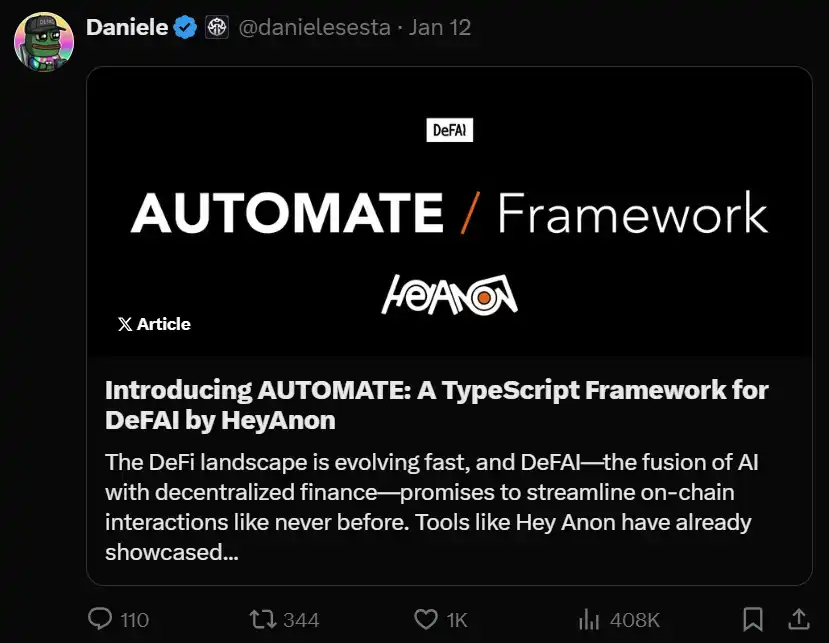
HeyAnon
HeyAnon, led by danielesesta, has recently taken a differentiated path through some new announcements:
· Gemma: a Research Assistant Agent aimed at transforming massive on-chain and social data into actionable visual elements.
· AUTOMATE: a TypeScript framework developed specifically for DeFAI to accelerate the HeyAnon ecosystem's development process.
HeyAnon's vision is to become a universal intelligence layer supporting multi-step transactions, governance, and data analysis while ensuring on-chain transaction security and transparency. AUTOMATE emphasizes pattern-based typed interactions to prevent developers from deploying misconfigurations.
Partners include arbitrum, base, avax, BNBCHAIN, iota, KAVA CHAIN, and SonicLabs. The team has also initiated a grant program through a DAO proposal, utilizing 2% of ANON and a $1 million USDC treasury reserve to drive integrations and developer activities.
Although ANON quickly surpassed a $100 million market cap, the current slow uptrend reflects a cautious pricing attitude during the market downturn.
Griffain
griffaindotcom remains the largest project by market cap in the abstraction layer space ($330 million), despite a 21% pullback in the past 7 days. Why is this happening? It is currently uncertain... it could be that capital is rotating from higher market cap DeFAI projects to lower-cap projects, or it could be because Griffain focuses on a universal abstraction layer rather than the DeFi and transaction-focused solutions like its peers.
Feature/Focus Differences Summary
· Orbit ➔ Tailored for cross-chain transactions and DeFi operations (currently with the highest number of integrations).
· Anon ➔ Focuses on data (signals/insights), transactions, and DeFi operations, driving developer community building through L1/L2 partnerships and grants.
· Griffain ➔ Provides a universal abstraction layer for Solana, positioned as the "agent of agents," and features dedicated agents such as an airdrop tool, token launcher, burn mechanism, coffee robot, and NFT agent.
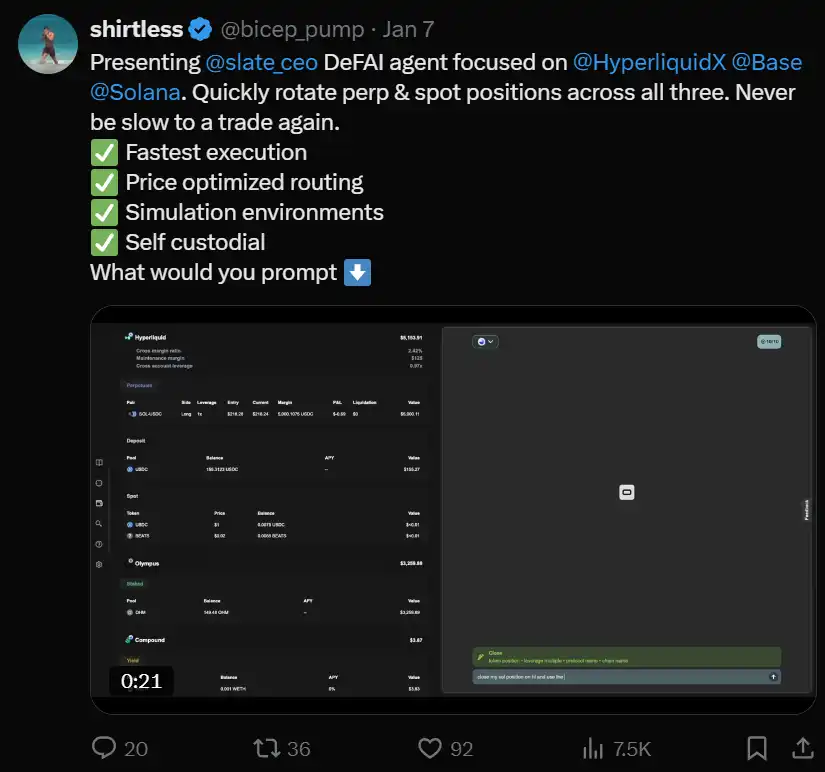
After testing these protocols, my favorite is still slate ceo.
The use cases I rely on for this abstraction layer include:
· Basic on-chain operations: transfers and swaps.
· Automation: sell [x] every hour until the next 10 days.
· Advanced conditional trades: when A reaches [x] market cap and B reaches [x] market cap, swap $5,000 worth of A and B.
Slate does not have a native token, but I really like its product. The downside is that it only supports EVM chains and requires manually depositing gas fee tokens to use. Currently, I am using it to automate trades on Base.
Abstraction Layer Challenges
· Limited research tools: Many platforms offer a "research agent," but the functionality is limited compared to a real analytics dashboard.
· Token recognition issues: Some platforms fail to recognize token symbols, forcing users to manually input token addresses.
· Limited DeFi use cases: High-quality DeFi protocols are often not integrated or lack fundamental data like TVL, APR%, or risk assessment for users to make informed decisions.
· Poor user onboarding: The interface and instructions are unclear, sometimes requiring users to manually select agents to execute commands rather than providing a seamless centralized interface.
Conclusion on Abstraction Layer
For most use cases, traditional tools are still superior. Here are my recommendations:
· Use professional analytics tools for research: Make better use of these tools.
· Use DefiLlama to get metrics, yields, and DeFi-related insights.
· Use AcrossProtocol for L2 bridging.
· Use wormhole for bridging between Non-EVM and EVM ecosystems.
Despite the somewhat clumsy experience, I still have high hopes for DeFAI, especially the abstraction layers, as their vision is to simplify the DeFi user experience. This vision (and its execution) is crucial for achieving mass adoption and attracting mainstream users.
Automated Trading Agents
The Automated Trading Agent category is experiencing a significant drawdown, with TONY only dropping by 8%, performing the best in the last 7 days.
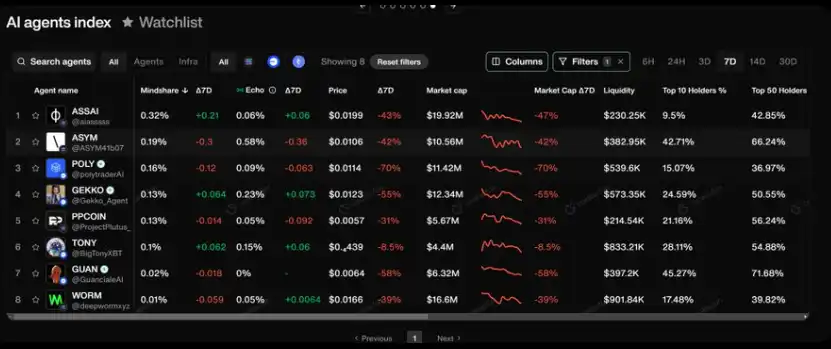
Highlights Beyond the cookiedotfun Dashboard:
·CATG / boltrade ai—Focuses on analyzing intelligent trader signals and trading agents.
·LAY / loomlayai—Provides an agent ecosystem with a no-code building tool aimed at API/skill integration, focusing on trading strategies.
·BULLY / dolion ai—Expands from personalized agents to trading strategies.
The performance of these projects has all experienced significant drawdowns. The most worthy projects to buy into will have the following characteristics:
·Performance: Capable of generating alpha returns and possessing a robust PnL.
·Verifiability: Performance data tied to wallet addresses.
·Participation: Users can share in the benefits gained by the agent.
This narrative is still in its early stages. Currently, the only agent with verified performance is BigTonyXBT. Other agents are either still in the backtesting phase or operating behind the scenes, lacking transparency.
Summary
The current pricing of DeFAI is higher than other subdomains because it is fresh, has a strong vision, and benefits from danielesesta's promotional expertise. However, there are still challenges in practice. To achieve alpha returns, it is recommended to focus on analytical tools (like the five tools mentioned) and utility-focused agents such as:
·aixbt agent
·unit00x0
·kwantxbt
·AgentScarlett
·tri sigma
Automated trading agents have not yet gained enough momentum, and major trading agent ecosystems like Almanak have not yet launched. When the market bounces back, DeFAI (Layer of Abstraction and Automated Trading Agents) may lead the market due to its strong narrative positioning.
Prepare ahead, stay secure, avoid emotional trading. Focus on long-term strategies, and most importantly, be prepared to seize opportunities when the rebound comes. The 2025 AI agent bull market is on the horizon, destined for brilliance!
You may also like

Consumer-grade Crypto Global Survey: Users, Revenue, and Track Distribution

Prediction Markets Under Bias

Stolen: $290 million, Three Parties Refusing to Acknowledge, Who Should Foot the Bill for the KelpDAO Incident Resolution?

ASTEROID Pumped 10,000x in Three Days, Is Meme Season Back on Ethereum?

ChainCatcher Hong Kong Themed Forum Highlights: Decoding the Growth Engine Under the Integration of Crypto Assets and Smart Economy

Why can this institution still grow by 150% when the scale of leading crypto VCs has shrunk significantly?

Anthropic's $1 trillion, compared to DeepSeek's $100 billion

Geopolitical Risk Persists, Is Bitcoin Becoming a Key Barometer?

Annualized 11.5%, Wall Street Buzzing: Is MicroStrategy's STRC Bitcoin's Savior or Destroyer?

An Obscure Open Source AI Tool Alerted on Kelp DAO's $292 million Bug 12 Days Ago

Mixin has launched USTD-margined perpetual contracts, bringing derivative trading into the chat scene.
The privacy-focused crypto wallet Mixin announced today the launch of its U-based perpetual contract (a derivative priced in USDT). Unlike traditional exchanges, Mixin has taken a new approach by "liberating" derivative trading from isolated matching engines and embedding it into the instant messaging environment.
Users can directly open positions within the app with leverage of up to 200x, while sharing positions, discussing strategies, and copy trading within private communities. Trading, social interaction, and asset management are integrated into the same interface.
Based on its non-custodial architecture, Mixin has eliminated friction from the traditional onboarding process, allowing users to participate in perpetual contract trading without identity verification.
The trading process has been streamlined into five steps:
· Choose the trading asset
· Select long or short
· Input position size and leverage
· Confirm order details
· Confirm and open the position
The interface provides real-time visualization of price, position, and profit and loss (PnL), allowing users to complete trades without switching between multiple modules.
Mixin has directly integrated social features into the derivative trading environment. Users can create private trading communities and interact around real-time positions:
· End-to-end encrypted private groups supporting up to 1024 members
· End-to-end encrypted voice communication
· One-click position sharing
· One-click trade copying
On the execution side, Mixin aggregates liquidity from multiple sources and accesses decentralized protocol and external market liquidity through a unified trading interface.
By combining social interaction with trade execution, Mixin enables users to collaborate, share, and execute trading strategies instantly within the same environment.
Mixin has also introduced a referral incentive system based on trading behavior:
· Users can join with an invite code
· Up to 60% of trading fees as referral rewards
· Incentive mechanism designed for long-term, sustainable earnings
This model aims to drive user-driven network expansion and organic growth.
Mixin's derivative transactions are built on top of its existing self-custody wallet infrastructure, with core features including:
· Separation of transaction account and asset storage
· User full control over assets
· Platform does not custody user funds
· Built-in privacy mechanisms to reduce data exposure
The system aims to strike a balance between transaction efficiency, asset security, and privacy protection.
Against the background of perpetual contracts becoming a mainstream trading tool, Mixin is exploring a different development direction by lowering barriers, enhancing social and privacy attributes.
The platform does not only view transactions as execution actions but positions them as a networked activity: transactions have social attributes, strategies can be shared, and relationships between individuals also become part of the financial system.
Mixin's design is based on a user-initiated, user-controlled model. The platform neither custodies assets nor executes transactions on behalf of users.
This model aligns with a statement issued by the U.S. Securities and Exchange Commission (SEC) on April 13, 2026, titled "Staff Statement on Whether Partial User Interface Used in Preparing Cryptocurrency Securities Transactions May Require Broker-Dealer Registration."
The statement indicates that, under the premise where transactions are entirely initiated and controlled by users, non-custodial service providers that offer neutral interfaces may not need to register as broker-dealers or exchanges.
Mixin is a decentralized, self-custodial privacy wallet designed to provide secure and efficient digital asset management services.
Its core capabilities include:
· Aggregation: integrating multi-chain assets and routing between different transaction paths to simplify user operations
· High liquidity access: connecting to various liquidity sources, including decentralized protocols and external markets
· Decentralization: achieving full user control over assets without relying on custodial intermediaries
· Privacy protection: safeguarding assets and data through MPC, CryptoNote, and end-to-end encrypted communication
Mixin has been in operation for over 8 years, supporting over 40 blockchains and more than 10,000 assets, with a global user base exceeding 10 million and an on-chain self-custodied asset scale of over $1 billion.

$600 million stolen in 20 days, ushering in the era of AI hackers in the crypto world
Vitalik's 2026 Hong Kong Web3 Summit Speech: Ethereum's Ultimate Vision as the "World Computer" and Future Roadmap
On the same day Aave introduced rsETH, why did Spark decide to exit?
Full Post-Mortem of the KelpDAO Incident: Why Did Aave, Which Was Not Compromised, End Up in Crisis Situation?

After a $290 million DeFi liquidation, is the security promise still there?
ZachXBT's post ignites RAVE nearing zero, what is the truth behind the insider control?




 App
App