
 Buy Crypto
- Markets
 Futures
- Spot
- Copy Trade
- Earn
- More
Global Stablecoin Regulation Update Overview

Original Article Title: "WOO X Research: Stablecoins: An Overview of New Regulatory Dynamics"
Original Source: WOO
In recent years, the rapid development of stablecoins has attracted the attention of regulatory agencies worldwide. As a type of cryptocurrency pegged to fiat currency or other assets, stablecoins possess the characteristic of price stability and have been widely used in areas such as cross-border payments and DeFi. Particularly in this cycle, Real World Assets (RWAs) have performed well, with both traditional financial institutions (such as BlackRock) and web3-native institutions/organizations (such as Sky, formerly MakerDAO) entering the space. More and more investors are also paying attention to this sector, leading to a trend of ranging growth.
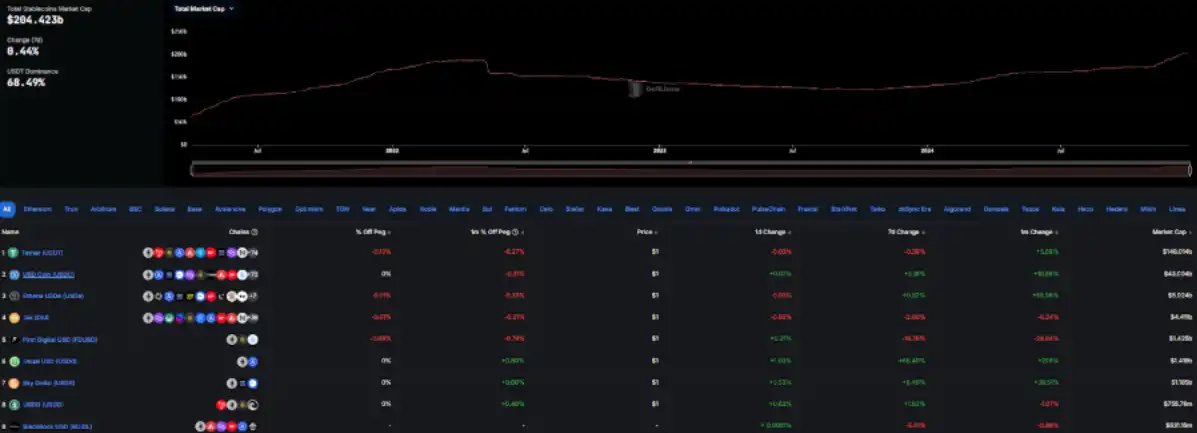
(Image Source: https://defillama.com/stablecoins)
"Regulations are necessary for orderly development," and consequently, governments and international organizations have begun to introduce policies to regulate stablecoins. This article provides a brief summary of the current regulatory landscape.
United States (North America)
The United States is one of the primary markets for stablecoin development, and its regulatory policies are relatively complex. The U.S. stablecoin regulatory framework is mainly implemented by multiple agencies, including the Treasury Department, the Securities and Exchange Commission (SEC), and the Commodity Futures Trading Commission (CFTC).
For certain stablecoins, the SEC may deem them to have securities attributes, requiring compliance with the relevant securities laws. The Office of the Comptroller of the Currency (OCC) under the Treasury Department has proposed allowing national banks and federal savings associations to provide services to stablecoin issuers, subject to anti-money laundering and compliance requirements. Recently, the U.S. Congress has been discussing legislative proposals such as the "Stablecoin Transparency Act" in an attempt to establish a unified regulatory framework for stablecoins. With the election of Donald Trump, often referred to as the "Crypto President," although the policies have not yet been implemented, cryptocurrency regulation seems to be generally trending positively.
European Union (Europe)
Stablecoin regulation in the European Union primarily relies on the Markets in Crypto-Assets Regulation (MiCA).
MiCA categorizes stablecoins into Asset-Referenced Tokens (ARTs) and Electronic Money Tokens (EMTs). Electronic Money Tokens (EMTs) refer to tokens pegged to a single fiat currency, such as stablecoins pegged to the Euro or the Dollar. Meanwhile, Asset-Referenced Tokens (ARTs) refer to tokens pegged to certain assets (such as fiat currency, commodities, or cryptocurrencies). MiCA sets out corresponding regulatory requirements for each category. Entities issuing stablecoins must obtain a license from an EU member state and meet requirements such as capital reserve and transparency disclosure.
Hong Kong (Asia)
On July 17, 2024, the Hong Kong Monetary Authority and the Financial Services and the Treasury Bureau jointly issued a consultation summary outlining the key features of the upcoming stablecoin regulatory regime. Under this regime, companies looking to issue or promote fiat-backed stablecoins to the Hong Kong public will need to obtain a license from the HKMA. The regulatory requirements include asset reserves management, corporate governance, risk controls, disclosure, and measures to combat money laundering and terrorist financing.
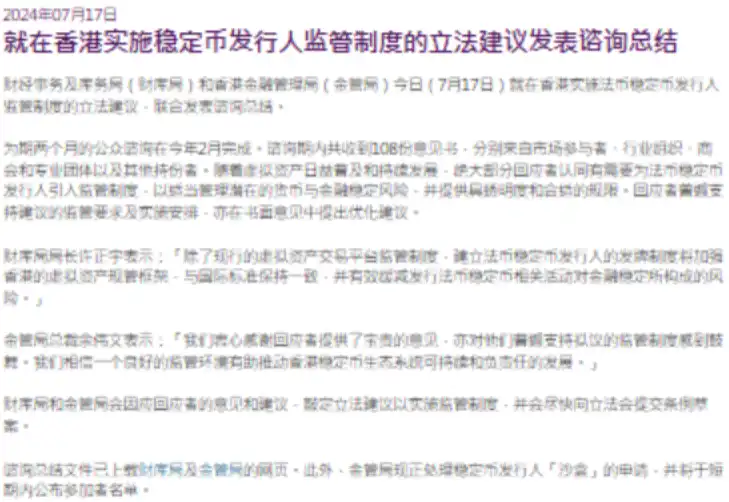
(Image Source Link: https://www.hkma.gov.hk/eng/news-and-media/press-releases/2024/07/20240717-3/?utm_source=chatgpt.com)
In addition, the HKMA has introduced a stablecoin issuer sandbox scheme to engage with the industry on the proposed regulatory requirements. The first list of participants was announced on July 18, 2024, including JD Coinchain Technology (Hong Kong) Limited, Roundcoin Innovation Technology Limited, and a consortium composed of Standard Chartered Bank (Hong Kong) Limited, Animoca Brands Limited, and Hong Kong Telecom Limited.
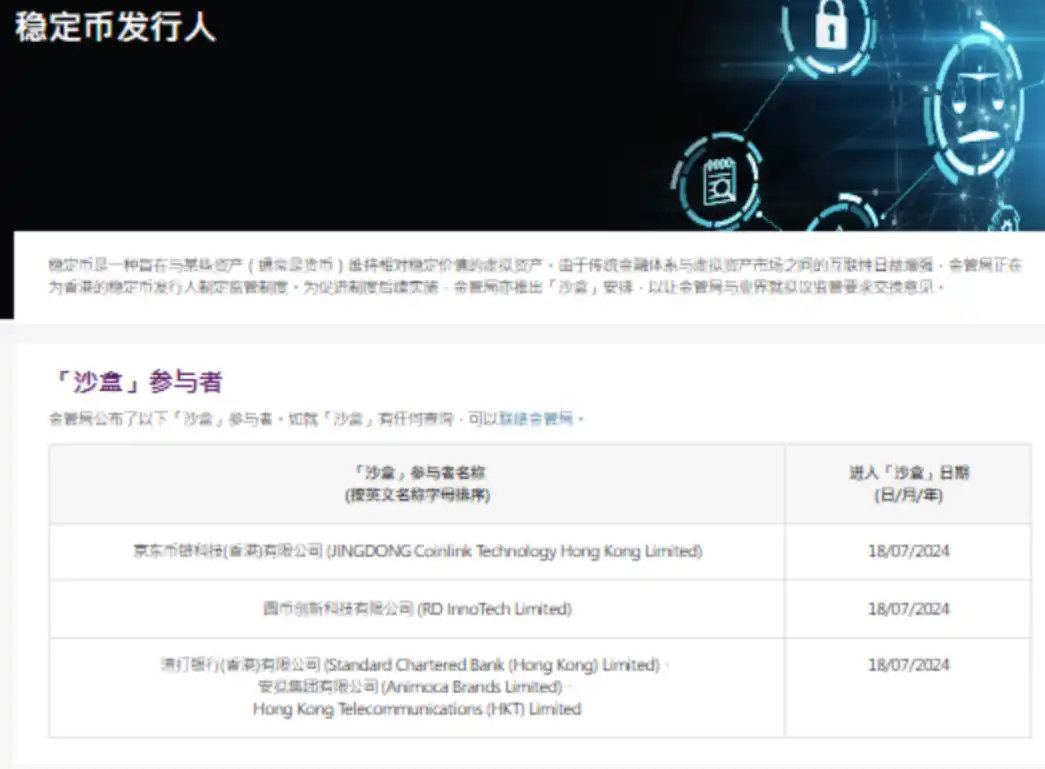
(Image Source Link: https://www.hkma.gov.hk/eng/key-functions/international-financial-centre/stablecoin-issuers/?utm_source=chatgpt.com)
Recently, on December 6, 2024, the government published the "Stablecoin Bill" in the Gazette, aiming to introduce a regulatory regime for fiat-backed stablecoin issuers in Hong Kong to enhance the oversight framework for virtual asset activities.
Singapore (Asia)
Under Singapore's Payment Services Act, stablecoins are considered digital payment tokens, and their issuance and circulation require approval from the Monetary Authority of Singapore (MAS). MAS provides a regulatory sandbox for startups to test business models related to stablecoins.
Japan (Asia)
In June 2022, Japan revised the Payment Services Act (PSA), establishing a regulatory framework for the issuance and trading of stablecoins. Under the amended PSA, stablecoins fully backed by fiat currency are defined as "Electronic Payment Instruments" (EPI) that can be used to pay for goods and services. There are specific requirements for the issuing entities: only three types of institutions can issue stablecoins: banks, funds transfer service providers, and trust companies. Institutions wishing to engage in stablecoin-related activities must first register as Electronic Payment Instrument Service Providers (EPISP) to obtain the necessary licenses to provide services.
Brazil (South America)
In October 2024, BCB President Roberto Campos Neto announced plans to regulate stablecoins and asset tokenization in 2025. In November 2024, BCB proposed a regulatory measure suggesting a ban on users withdrawing stablecoins from centralized exchanges to self-custody wallets. Additionally, in December, BCB's Deputy Director of the Financial System stated that the central bank might lift the ban if key issues such as transaction transparency are addressed.
Conclusion
Furthermore, Russia, a BRICS country, is also considering using cryptocurrency as a settlement method for cross-border financing. Overall, whether it's creating regulatory sandboxes for crypto companies or defining categories based on stablecoins' different characteristics, more and more stablecoin regulatory policies will be introduced in the future. Cross-border payments seem to be one of the most widely applicable scenarios for stablecoins.
This article is a contributed piece and does not represent the views of BlockBeats.
You may also like

The organization has accessed the prediction market, but is stuck at the third stage

Head of crypto VC collective shrinks: a16z crypto fund management scale plummets by 40%, Multicoin cut in half

Arthur Hayes New Post: It's "No Trade" Time Now

Claude Opus 4.7 Review: Is It Worthy of the Title of Strongest Model?

DWF In-Depth Report: AI Outperforms Humans in Yield Farming Optimization in DeFi, But Complex Transactions Still Lag Behind 5x
The financial tricks of the crypto giant Kraken

When proactive market makers start to take initiative

Massive Whale Movement: Unstaking $84.96 Million in HYPE Tokens
Key Takeaways A crypto whale, known as TechnoRevenant, has unstaked approximately $84.96 million in HYPE tokens. The tokens…

ListaDAO Addresses Third-Party Contract Vulnerability Concerns
Key Takeaways GoPlus Security revealed a vulnerability in a contract resembling those of ListaDAO. ListaDAO confirmed that their…

Security Risks of Fake Ledger Nano S+ Devices Emerging Through Chinese E-Commerce
Key Takeaways Counterfeit Ledger Nano S+ devices are being sold on Chinese e-commerce platforms, posing significant risks to…

Wave of Cyber Attacks Hits DeFi Protocols Post-Drift Hack
Key Takeaways A significant $280 million attack on Drift Protocol set off a chain of security breaches across…
Tom Lee Says ‘Mini Crypto Winter’ Is Over, Sees Ether Above $60K
Key Takeaways: Tom Lee predicts Ether’s resurgence, projecting it to surpass $60,000 in the coming years. Bitmine suffered…

French Government Tackles Rising Crypto Safety Concerns
Key Takeaways: France is intensifying measures to counter the surge in crypto kidnappings and wrench attacks. Since early…
Europe’s Bitcoin Treasury Playbook Unlikely to Mirror US Strategy: PBW 2026
Key Takeaways: European firms are adapting unique Bitcoin treasury strategies due to distinct financial regulations and market dynamics…
Circle Confronts Lawsuit Over $280M Drift Protocol Hack
Key Takeaways: Circle faces a lawsuit for allegedly aiding in the transfer of $230 million in stolen USDC.…
Bitcoin Faces ‘Near-Term Selling Pressure’ Following Surge to $76K: CryptoQuant
Key Takeaways: Bitcoin reaches a multi-month high of $76,000, prompting increased deposits to exchanges. CryptoQuant identifies a peak…

Ethereum Foundation Unveils North Korean Infiltration in Web3
Key Takeaways: The Ethereum Foundation’s ETH Rangers program exposed 100 North Korean operatives infiltrating Web3 companies. The Ketman…

Crypto in Sustained Winter as CEX Volumes Drop 39% in Q1
Key Takeaways: Centralized crypto exchange trading volume fell by 39% in Q1 2026 to $2.7 trillion. March saw…




 App
App