
 Buy Crypto
- Markets
 Futures
- Spot
- Copy Trade
- Earn
- More
Founder's BIO New Article: From Science Fiction to Science Finance, How Does Desci Drive the Biotech Revolution?


Original Article Title: From Science Friction to Science Finance: A Community-Driven Revolution in Biotech
Original Article Author: Paul Kohlhaas, Founder of BIO Protocol
Original Article Translation: zhouzhou, BlockBeats
Editor's Note: This article introduces how the BIO Protocol addresses funding, R&D, and market issues in the biotechnology field through the decentralized BioDAO network. By tokenizing intellectual property, implementing decentralized governance, and providing real-time liquidity, BIO enables patients, scientists, and investors to participate in decision-making together, supporting neglected areas such as rare diseases and long-haul COVID. BIO breaks through traditional fund structures, drives innovation in biotechnology, accelerates the research process, achieves more efficient and equitable capital flow and results transformation, ultimately promoting scientific advancement and global impact.
The following is the original content (reorganized for better readability):
“We live in a society exquisitely dependent on science and technology, in which hardly anyone knows anything about science and technology.” — Carl Sagan
TL;DR
· The Broken Biopharma System: Science Hits a Bottleneck
· Andrew Lo's Mega Fund Theory: A Milestone in Biotech Finance
· Beyond Mega Funds: Emergence of the BIO Protocol
· From Fund to Ecosystem: Advancing Lo's Vision in the BioDAO Network
· Practice of the BIO Protocol
· Orphan Drugs, Rare Diseases, and Long-Haul COVID: Ethical and Economic Alignment
· Lessons from Mega Fund-Inspired Biotech Holding Companies
· From Science Friction to Science Finance
· Bottom-Up Financial Evolution
A universal truth shrouds our modern era where scientific knowledge is exploding, yet life-changing therapies — from long-haul COVID to rare autoimmune diseases — remain elusive for millions. This stark contrast reveals a distorted paradox: the issue is not scientific impossibility but rather inefficiencies in market structure.
Big Pharma pours billions into incrementally improving existing drugs (like enhancing existing PD-1 cancer drugs or GLP-1 anti-obesity drugs) through strategies such as patent lifecycle management, chasing after the latest and hottest clinically validated drug targets in a fiercely competitive market — while research into patient-driven needs languishes.
What is the result? An industry mired in scientific friction, with escalating costs, capital bottlenecks, and intellectual property islands that slow down potential transformative innovations, even leading to their complete abandonment.
1. Fragmented Biopharma System, Science Hitting a Roadblock
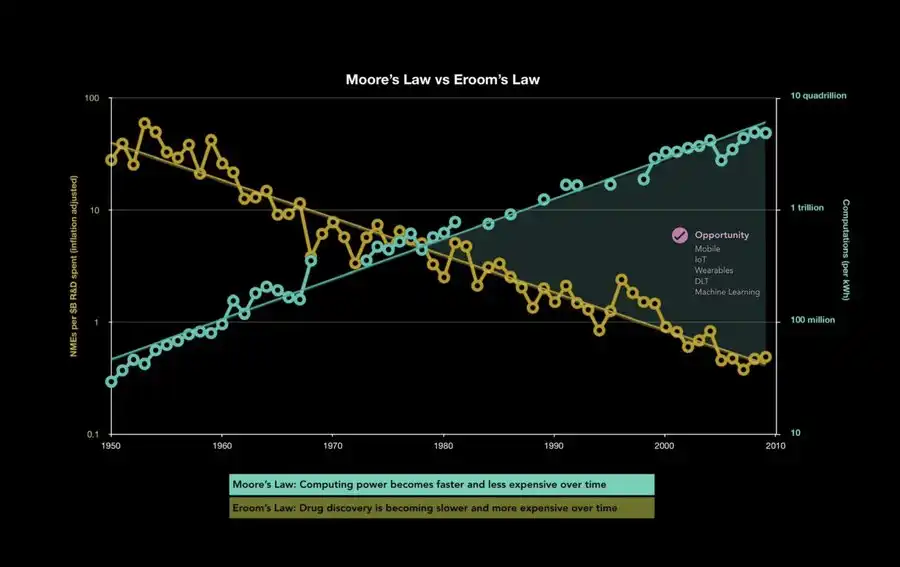
Every day, millions of people are battling long-term, complex, fragile, and underfunded diseases like COVID-19. Many find that the research to help them is not "hard" in a scientific sense but rather "hard" in terms of the return on investment (ROI) for traditional pharma. This is just a symbol of a broader crisis, as revealed by Eroom's Law: as biotech R&D spending has soared, the productivity of discovering new drugs has plummeted. How did we get here?
1.1 Valley of Death and the "Safe Bet"
Promising discoveries made in academia often struggle to transition to early clinical research because no one is willing to fund the risky transition stage between animal studies and human trials. This infamous "Valley of Death" hinders potential treatments that, in the eyes of major pharmaceutical companies, lack profit potential and are too high-risk.
Many venture capitalists and pharma companies take a "fast follower" approach, waiting and hoping that other companies will successfully navigate these risks. These risks may include understanding the pathophysiology of a disease, addressing regulatory challenges (such as a lack of clear clinical endpoints), the uncertain commercial viability of a pharma M&A, or the dynamics of health insurers in reimbursing treatments. It is a minefield of incentives and constraints with no collective mechanism empowering the patient voice.
1.2 Overconcentration of Capital
The primary funding channels for biotech—large pharma companies and major venture capital firms—often concentrate investment in "blockbuster" categories. Over 90% of biotech capital is concentrated in highly competitive, minimally differentiated areas, causing once-promising breakthrough research (such as longevity, complex immune system diseases, or neuroscience) to stagnate.
While these clinically lower-risk and commercially appealing therapy areas are attractive to pharma companies and venture capitalists, many areas also represent the most expensive failures, as only 5% of approved and marketed drugs achieve blockbuster sales potential.
Otherwise, it is a waste of substantial R&D funding. In Bruce Booth's renowned "Atlas 2024 Review," Bruce commented that less than 15% of biotech financing rounds have captured over 66% of available venture capital funding, a significant shift from the situation ten years ago. We need more meritocratic mechanisms to address public health challenges and the impending Western societal demographic tsunami.
1.3 Intellectual Property Lock-In and Data Silos
Under the current business model, knowledge is trapped behind thick walls of patents and closed-door deals, slowing down progress. Global labs often repeat the same high-cost experiments due to a lack of shared insights, adding unnecessary friction. Patient data and clinical insights are so fragmented that under a unified data architecture, they could hold significant inferential value, but are plagued by bureaucratic hurdles from institutions like hospital administrators, data aggregators, and biobanks.
Intellectual property may be time-bound and only certain forms (like composition of matter patents) hold significant value for venture capitalists and pharmaceutical companies, which goes against the longevity community's enthusiasm for repurposing drugs such as rapamycin, metformin, and spermidine. Overall, inefficient resource allocation and commercial constraints hinder real-world health transformation, where real-time transparency can help alleviate some of these issues.
1.4 Opaque R&D and Limited Accountability
The R&D pipeline's unfolding process is slow and convoluted. Flow of funds is opaque; external parties cannot see whether (or why) trials have failed until it's too late. There is limited accountability, leaving patients and the public in the dark.
Executive management and R&D teams are in constant flux, with the pipeline changing along with the team. Companies like Roivant have built successful large enterprises by strategically shelving drugs through licensing and development agreements.
1.5 Over 10-Year Funding Lock-In Suppresses Innovation
Traditional biotech investments often require a decade or more to see returns—which is almost an eternity in the fast-paced market. This illiquidity leads to early-stage research lacking funding, especially in cases of uncertain outcomes.
Biotech competes for capital allocation against other asset classes such as more easily understandable revenue/EBITDA growth. In this scenario, an open community helps bridge the relative value gap of these therapies in terms of education and socialization.
Biotech is at a disadvantage in attracting investors and gaining market share, while other health-related themes (such as longevity) have become cultural phenomena. Some biomedical breakthroughs (like statins, PD-1 inhibitors, or anti-obesity drugs) demonstrate remarkable commercial potential (e.g., the 2024 Obesity 5 (NONO, LLY, AMGN, ZEAL, and VKTX) yielded a 93% return), but the investment structure needs significant revision to ensure the value of these transformative innovations is not diluted and to ensure better investor access—this is where tokenization will bring about transformative change.
Eroom's Law is at odds with the tremendous scientific advances we are currently experiencing — such as DeepMind's AlphaFold2, the 2024 Nobel Prize in Chemistry, mRNA therapy, GLP-1, cell and gene therapy, and more. The commercial and vested interest models of the pharmaceutical and biotech industries have hardly been questioned, and if there are operational structures that can help improve efficiency, they will be warmly welcomed.
Andrew Lo's Mega-Fund Theory: A Milestone in Biotech Finance
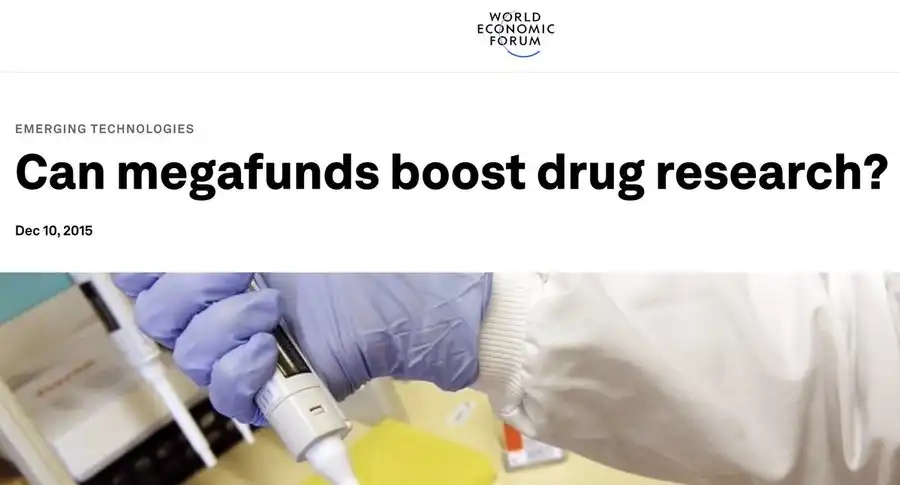
In 2012, Professor Andrew Lo from MIT and his collaborators proposed the concept of a "mega-fund" — a large, diversified early-stage drug candidate pool. Having 50 to 200 relatively unrelated assets can spread risk: while a single biotech startup may fail if its sole treatment approach falters, a portfolio can withstand multiple failures as long as a few successful projects can bring returns.
This theory groundbreaking pointed out the structural inefficiency in funding life science research. However, Lo's approach is still top-down: large checks from institutional investors, top-down fund allocation, with little opportunity for ordinary scientists or patients to participate in meaningful decisions.
3. Moving Beyond the Mega-Fund: Introducing the BIO Protocol
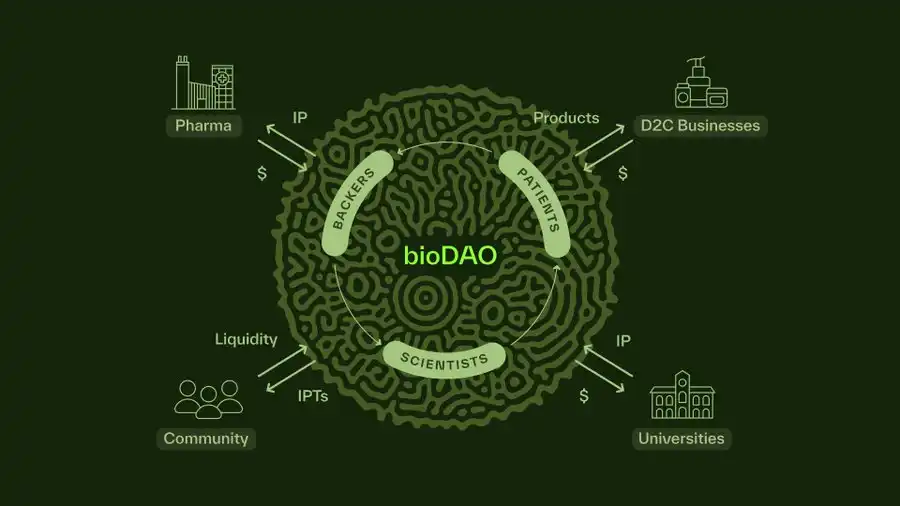
Now, a new wave of decentralized science has emerged, furthering Lo's vision. The BIO Protocol has drawn on the core concept of the mega-fund — managing risk through broad diversification — but reimagined the way this diversification, governance, and capital formation occur. The BIO Protocol is not like a centrally managed single massive fund but:
· Serves as a decentralized token-holder-governed protocol planning and incubating BioDAO. These are dedicated bottom-up communities guiding research through on-chain research portfolios.
· Tokenizes intellectual property and data through IPT (Intellectual Property Tokens) to make them tradable liquid assets, enabling BioDAO researchers and communities earlier access to liquidity than the conventional biotech industry setup.
· Deploys capital in real-time, directly into the "valley of death."
· Places patients, scientists, and laypeople at the center, akin to Reddit communities having a shared bank account.
3.1 Permissionless Stakeholders
In BioDAO, anyone directly linked to a particular disease — be it patients, clinicians, or scientists — can join through on-chain governance. Instead of passively hoping for "someone" to fund their endeavors, they collectively crowdfund capital through encrypted funds, form a DAO, collectively source research ideas from internal and global scientists, and decide on resource allocation and priority development.
3.2 Tokenized Intellectual Property and Data
BioDAO has released IP Tokens (IPT) through @molecule_dao, representing decentralized governance rights over research. These tokens can be licensed, traded, or pooled, effectively providing a new way for DAOs to gradually de-risk early-stage science based on milestone-based fund deployment. Shared data and data replication are no longer an afterthought but a core, liquid asset that can drive scientific discovery. Bonuses can also be issued to various researchers, creating incentives for decentralized science and drug discovery.
3.3 Bottom-Up Capital Formation
Unlike giant funds relying on large institutional investors, the BIO protocol coordinates community-driven fundraising. Through its launchpad, BioDAO founders can showcase their research, set up private or public token sales, and reward early supporters with governance rights—without the need for VC or Big Pharma scrutiny.
4. From Fund to Ecosystem: Advancing Luke's Vision in the BioDAO Network
4.1 Decentralized Center of the "Meta Portfolio"
The BIO protocol does not hold 200 assets like a single entity but facilitates a governance treasury with thousands of BioDAOs, each focusing on a scientific subfield. This significantly expands the space of possibilities while enabling community self-governance. There is no single manager making decisions; instead, the protocol guides asset development, risk management, and synergies for all these DAOs through its token holder community.
4.2 Permissionless Launchpad and Acceleration
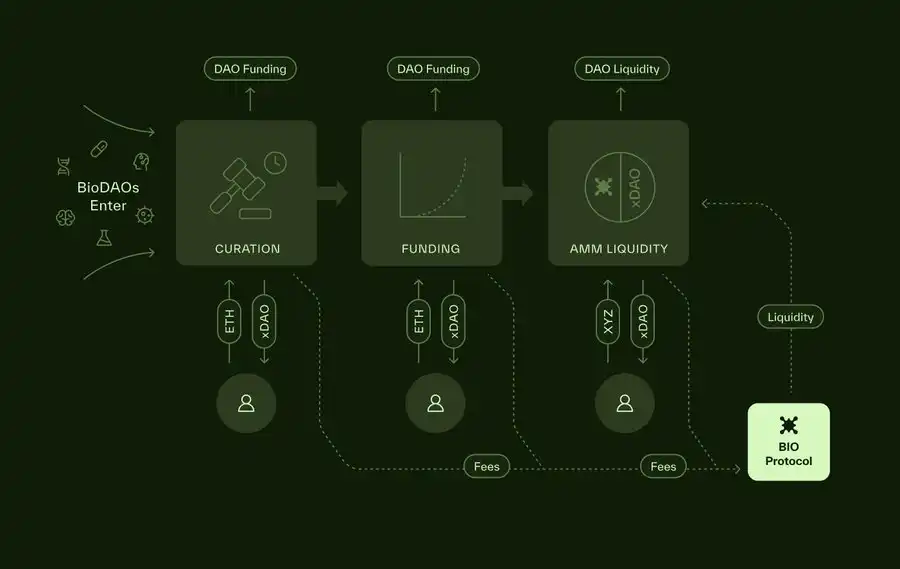
BIO’s real-time decentralized launchpad mechanisms—such as bonding curves or auctions—enable new BioDAOs to launch quickly. Early stakers or token holders can signal which areas are worth investing in. This approach democratizes biotech funding and accelerates capital flow to overlooked areas like long COVID or rare autoimmune diseases.
4.3 On-Chain Risk Management
Just as giant funds use portfolio theory to reduce risk, BioDAO does the same, but on-chain analytics enable them to share standardized reports on clinical milestones, intellectual property valuations, and treasury data. This facilitates real-time insights, allowing the protocol to diversify risk across multiple DAOs or rebalance further through research-based obligations.
4.4 Continuous Liquidity and Evergreen Capital
Traditional funds lock capital for ten years, while BioDAO's tokens and intellectual property tokens maintain liquidity, allowing participants to exit or reallocate capital. If a BioDAO's therapy begins to show promise, it naturally attracts more liquidity. The game theory here is that the treatment will naturally become a capital "Schelling point." Meanwhile, revenue from successful therapies flows back to the protocol treasury (BIObank), recycling capital into new or existing DAOs.
5. Protocol in Action: A Holistic, Bottom-Up Ecosystem
Imagine a team of scientists proposing a new "NeuroDAO" aimed at developing innovative therapies for traumatic brain injury. They upload preclinical data and a funding roadmap to BIO's user-friendly launchpad. The global BIO community approves or rejects the proposal through token staking—no closed-door operations by a small committee behind the scenes. Upon approval:
· NeuroDAO mints its intellectual property tokens (IPTs).
· These tokens are sold through bonding curves or auctions to raise initial capital.
· As milestones (e.g., preclinical endpoints) are met, more capital automatically unlocks.
· The broader community can track progress, further invest, and accelerate the flywheel effect.
If NeuroDAO reaches a significant breakthrough moment—like discovering a new molecule that accelerates brain recovery—the intellectual property licensing agreement can channel revenue back into the treasury to fund further research. This mechanism creates a sustainable flywheel effect, driving an evergreen, self-reinforcing cycle.
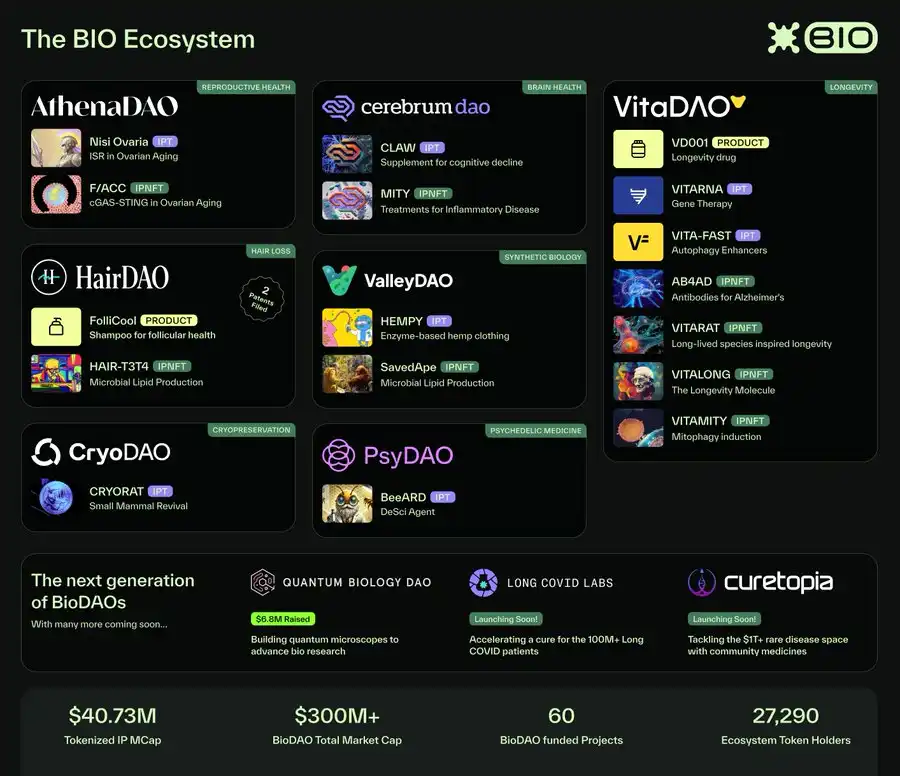
Since its inception, the BIO ecosystem has experienced rapid growth. In less than two years:
· 8 BioDAOs have been funded
· $30 million has been raised for research
· Total value of tokenized intellectual property exceeds $50 million
· Funds in the BIO treasury (AUM) exceed $60 million
· $8 million has been allocated to scientific projects funded by BioDAOs to date
· 60 active research projects
· 34,000 ecosystem token holders (3,716 of whom hold BIO governance tokens)
Several BioDAOs have rapidly progressed from the seed stage of research to advanced preclinical research, validating that decentralized capital plus open collaboration can accelerate biotechnology innovation.
Orphan Drugs, Rare Diseases, and Long COVID: The Ethical and Economic Intersection
Long COVID is just one example of a "niche" yet urgent condition. Similarly, orphan diseases—those affecting smaller patient populations—are often overlooked by major pharmaceutical companies because they see limited profit potential.
However, within networks like BIO, patient-led or family-led BioDAOs can be established around any disease, using novel structures to fund research that large companies are unwilling to sponsor. Smaller patient populations can accelerate clinical trials, shorten timelines, and unlock substantial returns without the "blockbuster or bust" mindset. The ethical alignment is clear: this is not about market size but about impact.
7. Real-World Momentum: Insights from Company Models Inspired by Mega Funds
Prior to decentralized science, the multi-asset risk-sharing model has been attempted in various forms:
· BridgeBio (NASDAQ: BBIO): Focused on rare diseases, employing a hub-and-spoke pipeline.
· Roivant Sciences: Introducing separate "Vants" for each therapeutic area, integrating management fees and capital.
· Royalty Pharma: A portfolio with billions in diversified royalty income streams, demonstrating securitization can stably fund drug IP.
These companies reflect Lo's principle of diversification. The BIO protocol further extends this principle through democratizing access, distributing governance, and achieving ongoing liquidity through tokenization.
8. From Scientific Fricton to Science Finance (SciFi)
Close your eyes and imagine it's now 2026. Within the BIO framework, there are already hundreds of BioDAOs spanning various diseases from pancreatic cancer to autoimmune alopecia. Each DAO is a "community collective intelligence" composed of patients, researchers, and philanthropic supporters. They:
· Access real-time research data shared across networks, accelerating progress at each clinical inflection point.
· Coordinate clinical trial participants and best practices (if multiple BioDAOs are addressing related domains, BIO can facilitate shared trial participant pools, data registries, and best practices governance, reducing management overhead).
·Using AI to assess risk, potential synergy, and capital allocation.
No longer are decade-long capital lockups or fortress-like institutional barriers holding back breakthroughs. Instead, the entire network acts like a living, breathing organism—fluid, adaptive, open.
8.1 The Golden Age of Biotech
Through "tokenizing everything," from preclinical data to late-stage IP, coupled with decentralized governance, BIO exposes industry's greatest friction points. Suddenly, drug development feels more like science fiction than a drawn-out marathon.
8.2 Inclusive Community, Global Impact
This revolution isn't confined to the lab. Everyday investors—those with loved ones suffering from rare diseases—can stake tokens to support new research and witness transparent progress along the way. Collaboration is no longer a buzzword but an on-chain reality, propelling the formation of multinational research teams.
8.3 Reversing the Eroom Law
With friction removed, communities from any region can access global funding, and we might finally see the cost/time curve of drug development bend downward rather than upward—achieving the promised exponential scientific progress.
9. Grassroots Evolution of Biotech Financing
Andrew Lo's mega-fund theory points us to a crucial path: large, diversified portfolios can tame biotech's high risk and attract greater capital. However, top-down structures and institutional inertia still hinder the realization of certain innovations. In contrast, the BIO protocol disrupts this playbook:
· Community-Driven: Anyone with a stake—patients, scientists, or curious funders—can participate in governance, propose new BioDAOs, and collectively shape research directions.
· Tokenized IP: Data and IP become fluid, paving the way for new funding and collaboration models.
· Real-Time Liquidity: Breaking free from decadelong capital lockups, capital can swiftly flow into groundbreaking innovations.
· AI-Driven Risk Management: On-chain analytics continuously track performance, synergy effects, and correlations, allowing capital to flow efficiently across multiple BioDAOs.
By stacking decentralized scientific solutions (via BioDAOs) coordinated at the top layer of BIO (launchpad, funding, liquidity, meta-governance), the most daunting challenges in the science and pharmaceutical industries can be addressed in a community-driven, transparent, and continuously flowing environment.
Placing families, patients, and scientists at the heart of decision-making, BIO aims to 「boil the ocean」, tackling the dilemma of early-stage innovation. No longer shall half of the world's great ideas perish in the 「valley of death.」 Instead, we are witnessing the dawn of a science era unshackled from old gatekeepers and friction-filled pipelines.
So the next time your family faces a rare disease, the deciding factor will no longer be a boardroom's analysis of market size. It will be a global network—scientists, patients, and ordinary believers—collaborating, funding, and accelerating those therapies that truly matter. In short, we are back in a sci-fi world, where humanity unites to turn the impossible into the inevitable.
You may also like

Why can this institution still grow by 150% when the scale of leading crypto VCs has shrunk significantly?

Anthropic's $1 trillion, compared to DeepSeek's $100 billion

Geopolitical Risk Persists, Is Bitcoin Becoming a Key Barometer?

Annualized 11.5%, Wall Street Buzzing: Is MicroStrategy's STRC Bitcoin's Savior or Destroyer?

An Obscure Open Source AI Tool Alerted on Kelp DAO's $292 million Bug 12 Days Ago

Mixin has launched USTD-margined perpetual contracts, bringing derivative trading into the chat scene.
The privacy-focused crypto wallet Mixin announced today the launch of its U-based perpetual contract (a derivative priced in USDT). Unlike traditional exchanges, Mixin has taken a new approach by "liberating" derivative trading from isolated matching engines and embedding it into the instant messaging environment.
Users can directly open positions within the app with leverage of up to 200x, while sharing positions, discussing strategies, and copy trading within private communities. Trading, social interaction, and asset management are integrated into the same interface.
Based on its non-custodial architecture, Mixin has eliminated friction from the traditional onboarding process, allowing users to participate in perpetual contract trading without identity verification.
The trading process has been streamlined into five steps:
· Choose the trading asset
· Select long or short
· Input position size and leverage
· Confirm order details
· Confirm and open the position
The interface provides real-time visualization of price, position, and profit and loss (PnL), allowing users to complete trades without switching between multiple modules.
Mixin has directly integrated social features into the derivative trading environment. Users can create private trading communities and interact around real-time positions:
· End-to-end encrypted private groups supporting up to 1024 members
· End-to-end encrypted voice communication
· One-click position sharing
· One-click trade copying
On the execution side, Mixin aggregates liquidity from multiple sources and accesses decentralized protocol and external market liquidity through a unified trading interface.
By combining social interaction with trade execution, Mixin enables users to collaborate, share, and execute trading strategies instantly within the same environment.
Mixin has also introduced a referral incentive system based on trading behavior:
· Users can join with an invite code
· Up to 60% of trading fees as referral rewards
· Incentive mechanism designed for long-term, sustainable earnings
This model aims to drive user-driven network expansion and organic growth.
Mixin's derivative transactions are built on top of its existing self-custody wallet infrastructure, with core features including:
· Separation of transaction account and asset storage
· User full control over assets
· Platform does not custody user funds
· Built-in privacy mechanisms to reduce data exposure
The system aims to strike a balance between transaction efficiency, asset security, and privacy protection.
Against the background of perpetual contracts becoming a mainstream trading tool, Mixin is exploring a different development direction by lowering barriers, enhancing social and privacy attributes.
The platform does not only view transactions as execution actions but positions them as a networked activity: transactions have social attributes, strategies can be shared, and relationships between individuals also become part of the financial system.
Mixin's design is based on a user-initiated, user-controlled model. The platform neither custodies assets nor executes transactions on behalf of users.
This model aligns with a statement issued by the U.S. Securities and Exchange Commission (SEC) on April 13, 2026, titled "Staff Statement on Whether Partial User Interface Used in Preparing Cryptocurrency Securities Transactions May Require Broker-Dealer Registration."
The statement indicates that, under the premise where transactions are entirely initiated and controlled by users, non-custodial service providers that offer neutral interfaces may not need to register as broker-dealers or exchanges.
Mixin is a decentralized, self-custodial privacy wallet designed to provide secure and efficient digital asset management services.
Its core capabilities include:
· Aggregation: integrating multi-chain assets and routing between different transaction paths to simplify user operations
· High liquidity access: connecting to various liquidity sources, including decentralized protocols and external markets
· Decentralization: achieving full user control over assets without relying on custodial intermediaries
· Privacy protection: safeguarding assets and data through MPC, CryptoNote, and end-to-end encrypted communication
Mixin has been in operation for over 8 years, supporting over 40 blockchains and more than 10,000 assets, with a global user base exceeding 10 million and an on-chain self-custodied asset scale of over $1 billion.

$600 million stolen in 20 days, ushering in the era of AI hackers in the crypto world
Vitalik's 2026 Hong Kong Web3 Summit Speech: Ethereum's Ultimate Vision as the "World Computer" and Future Roadmap
On the same day Aave introduced rsETH, why did Spark decide to exit?
Full Post-Mortem of the KelpDAO Incident: Why Did Aave, Which Was Not Compromised, End Up in Crisis Situation?

After a $290 million DeFi liquidation, is the security promise still there?
ZachXBT's post ignites RAVE nearing zero, what is the truth behind the insider control?

Vitalik 2026 Hong Kong Web3 Carnival Speech Transcript: We do not compete on speed; security and decentralization are the core
In-depth Analysis of RAVE Events: Short Squeeze, Crash, and Quantitative Financial Models of Liquidity Manipulation

Eve of Ceasefire, US Military Fires on Iranian Vessel | Rewire News Morning Brief

Figma's stock price drops over 7%, will Claude Design be the terminator?

Plunge by 10% Followed by Rebound, Weekend Oil Market Watch

SpaceX Mascot ASTEROID Fast Track $170 million, Stemming from an Unfinished Space Dream
Why can this institution still grow by 150% when the scale of leading crypto VCs has shrunk significantly?
Anthropic's $1 trillion, compared to DeepSeek's $100 billion
Geopolitical Risk Persists, Is Bitcoin Becoming a Key Barometer?
Annualized 11.5%, Wall Street Buzzing: Is MicroStrategy's STRC Bitcoin's Savior or Destroyer?
An Obscure Open Source AI Tool Alerted on Kelp DAO's $292 million Bug 12 Days Ago
Mixin has launched USTD-margined perpetual contracts, bringing derivative trading into the chat scene.
The privacy-focused crypto wallet Mixin announced today the launch of its U-based perpetual contract (a derivative priced in USDT). Unlike traditional exchanges, Mixin has taken a new approach by "liberating" derivative trading from isolated matching engines and embedding it into the instant messaging environment.
Users can directly open positions within the app with leverage of up to 200x, while sharing positions, discussing strategies, and copy trading within private communities. Trading, social interaction, and asset management are integrated into the same interface.
Based on its non-custodial architecture, Mixin has eliminated friction from the traditional onboarding process, allowing users to participate in perpetual contract trading without identity verification.
The trading process has been streamlined into five steps:
· Choose the trading asset
· Select long or short
· Input position size and leverage
· Confirm order details
· Confirm and open the position
The interface provides real-time visualization of price, position, and profit and loss (PnL), allowing users to complete trades without switching between multiple modules.
Mixin has directly integrated social features into the derivative trading environment. Users can create private trading communities and interact around real-time positions:
· End-to-end encrypted private groups supporting up to 1024 members
· End-to-end encrypted voice communication
· One-click position sharing
· One-click trade copying
On the execution side, Mixin aggregates liquidity from multiple sources and accesses decentralized protocol and external market liquidity through a unified trading interface.
By combining social interaction with trade execution, Mixin enables users to collaborate, share, and execute trading strategies instantly within the same environment.
Mixin has also introduced a referral incentive system based on trading behavior:
· Users can join with an invite code
· Up to 60% of trading fees as referral rewards
· Incentive mechanism designed for long-term, sustainable earnings
This model aims to drive user-driven network expansion and organic growth.
Mixin's derivative transactions are built on top of its existing self-custody wallet infrastructure, with core features including:
· Separation of transaction account and asset storage
· User full control over assets
· Platform does not custody user funds
· Built-in privacy mechanisms to reduce data exposure
The system aims to strike a balance between transaction efficiency, asset security, and privacy protection.
Against the background of perpetual contracts becoming a mainstream trading tool, Mixin is exploring a different development direction by lowering barriers, enhancing social and privacy attributes.
The platform does not only view transactions as execution actions but positions them as a networked activity: transactions have social attributes, strategies can be shared, and relationships between individuals also become part of the financial system.
Mixin's design is based on a user-initiated, user-controlled model. The platform neither custodies assets nor executes transactions on behalf of users.
This model aligns with a statement issued by the U.S. Securities and Exchange Commission (SEC) on April 13, 2026, titled "Staff Statement on Whether Partial User Interface Used in Preparing Cryptocurrency Securities Transactions May Require Broker-Dealer Registration."
The statement indicates that, under the premise where transactions are entirely initiated and controlled by users, non-custodial service providers that offer neutral interfaces may not need to register as broker-dealers or exchanges.
Mixin is a decentralized, self-custodial privacy wallet designed to provide secure and efficient digital asset management services.
Its core capabilities include:
· Aggregation: integrating multi-chain assets and routing between different transaction paths to simplify user operations
· High liquidity access: connecting to various liquidity sources, including decentralized protocols and external markets
· Decentralization: achieving full user control over assets without relying on custodial intermediaries
· Privacy protection: safeguarding assets and data through MPC, CryptoNote, and end-to-end encrypted communication
Mixin has been in operation for over 8 years, supporting over 40 blockchains and more than 10,000 assets, with a global user base exceeding 10 million and an on-chain self-custodied asset scale of over $1 billion.






 App
App