
 Buy Crypto
- Markets
 Futures
- Spot
- Copy Trade
- Earn
- More
Evaluate Solana's new proposal SIMD-0228, what does it mean for SOL validators?

Original Author: David Grid, Partner at FinalityCap
Original Translation: zhouzhou, BlockBeats
Editor's Note: This article discusses the impact of Solana's SIMD-0228 proposal on validator profitability. It estimates the number of Solana validators and their profitability in different scenarios, including changes in inflation, fees, MEV, and other factors. The model also analyzes validator profitability and suggests that Solana could lose a significant number of validators if income decreases.
The following is the original content (reorganized for better readability):
The solana SIMD-0228 has sparked a lot of discussion, but I haven't seen much data on its impact, so I built a model.
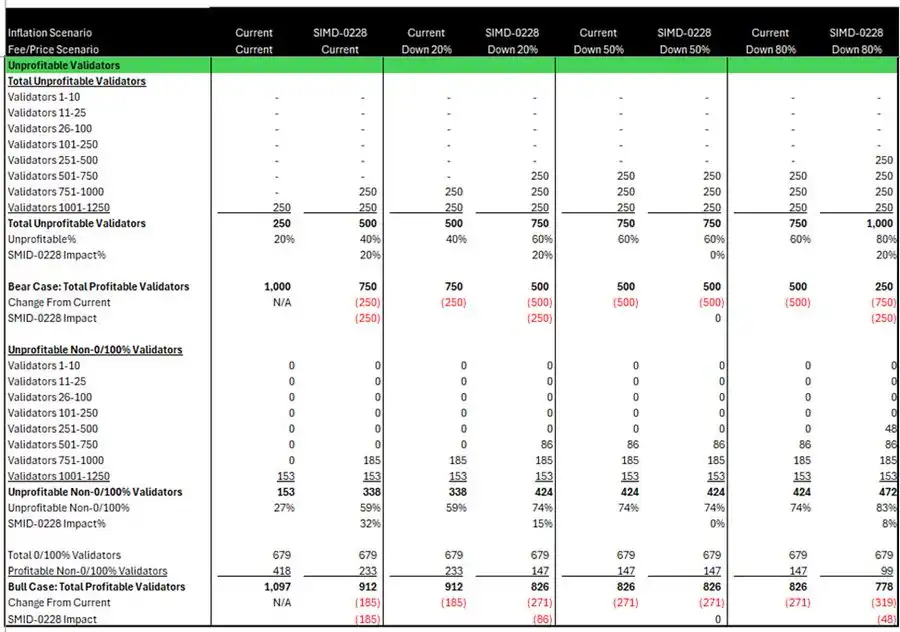
After the implementation of SIMD-0228, Solana could lose an additional 50 to 250 validators under different revenue adjustment scenarios.
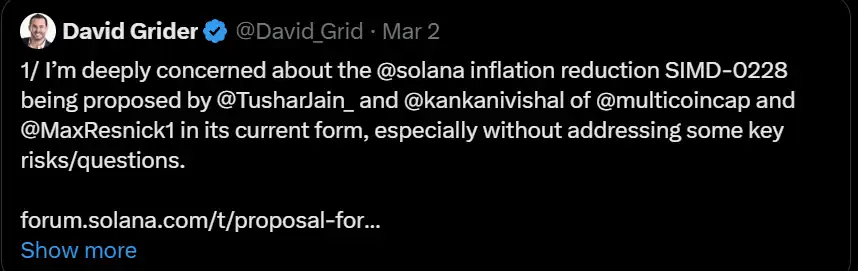
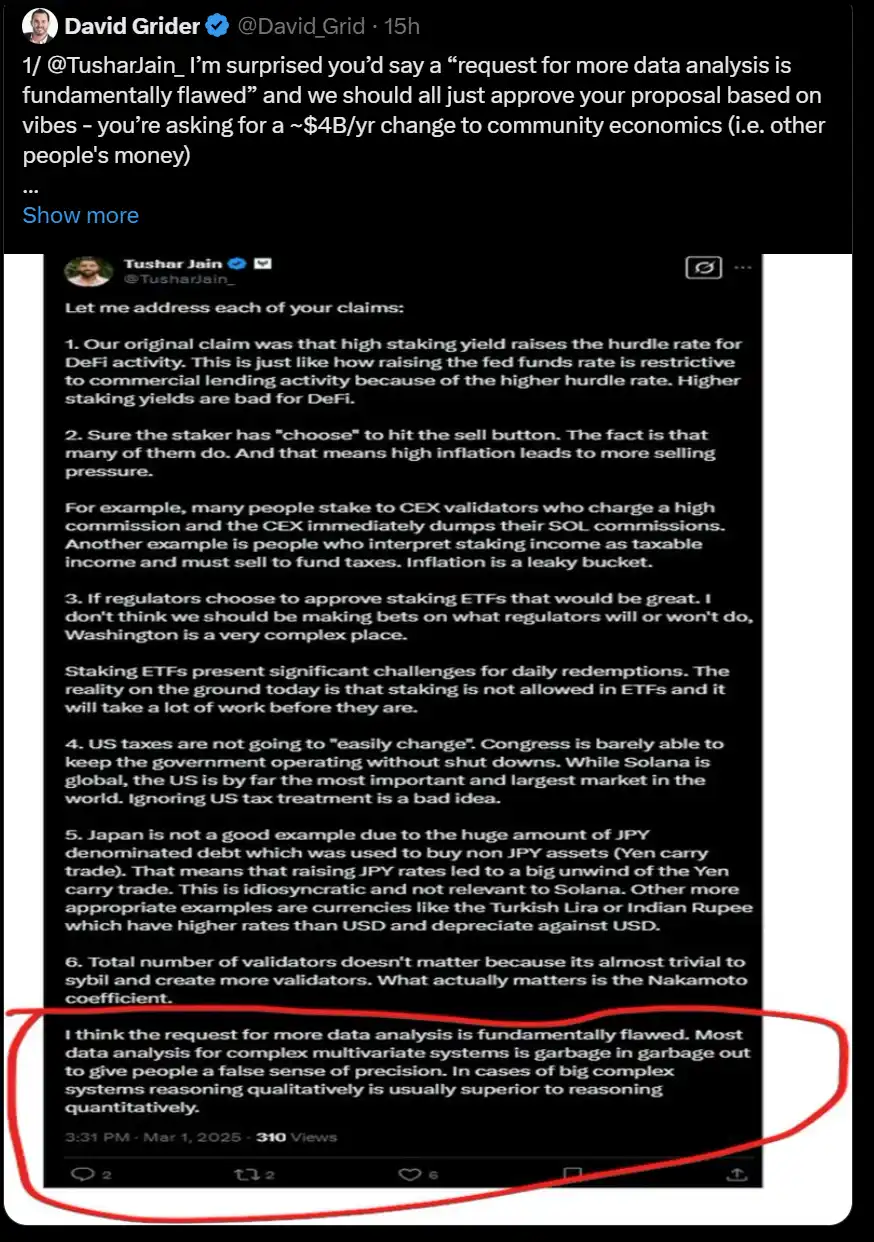
But first, why did I build this model? Because I believe the direction of this proposal is right, but I am very concerned that supporters pushing it forward may think that data is irrelevant.
Here is the link to the model. There is no single correct answer here, and I believe many aspects can be improved, and the assumptions can be further scrutinized. But this is a starting point, and I welcome community feedback.
What is the goal of this model?
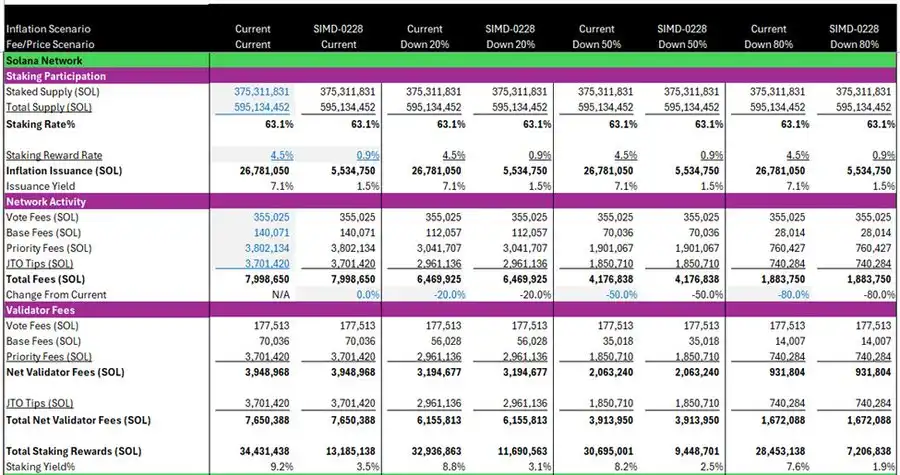
It aims to estimate the number of validators that can remain profitable in various Solana fee/price decline scenarios under the current and proposed SIMD-0228 inflation rates.
The model starts from the current staking and FDV supply, using the current staking reward rate and the reward rate provided by the SIMD-0228 calculator. Anyone can replicate this model and adjust the staking rate for stress testing.
Next, it analyzed the assumption of network fees. I used the 2024 actual fees provided by Blockworks as a starting point and adjusted it down by 20%, 50%, and 80% respectively (voting fees remained unchanged). The model then calculated the burned portion to derive the final validator fee.
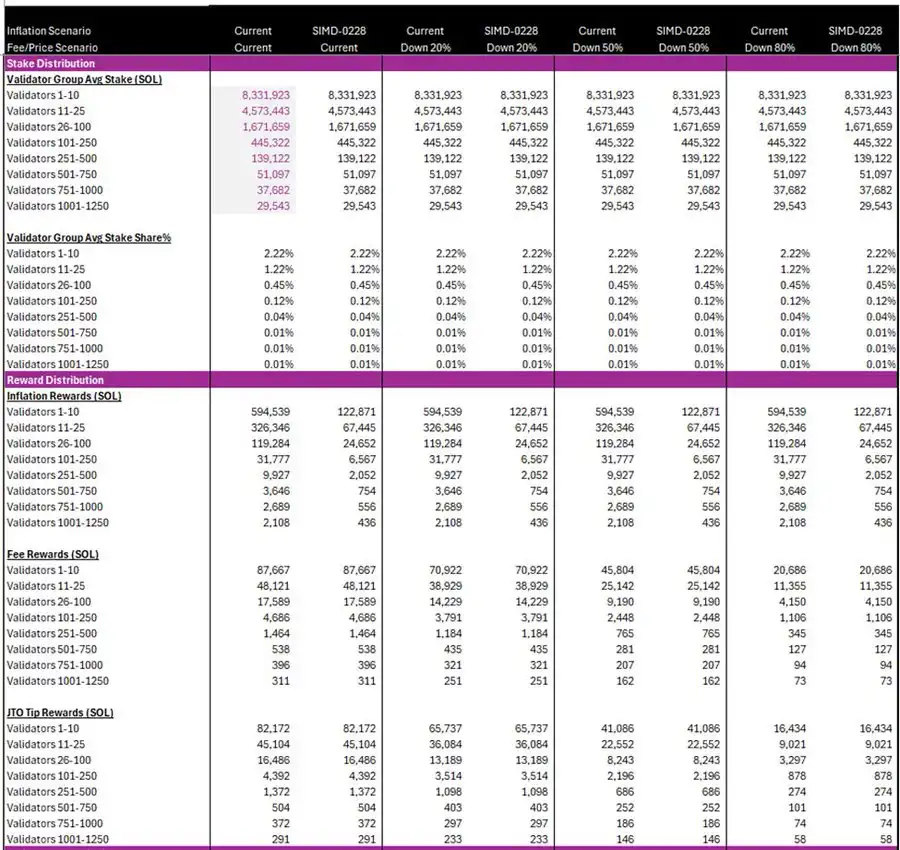
The staking distribution data is from Solana Beach, and the model takes the average stake amount in each validator ranking range, assuming that the distribution remains unchanged in all scenarios. However, I believe that under SIMD-0228, staking may become more concentrated.
Then, the model uses the average stake share to estimate the typical validator's SOL fee and inflation reward within that range.
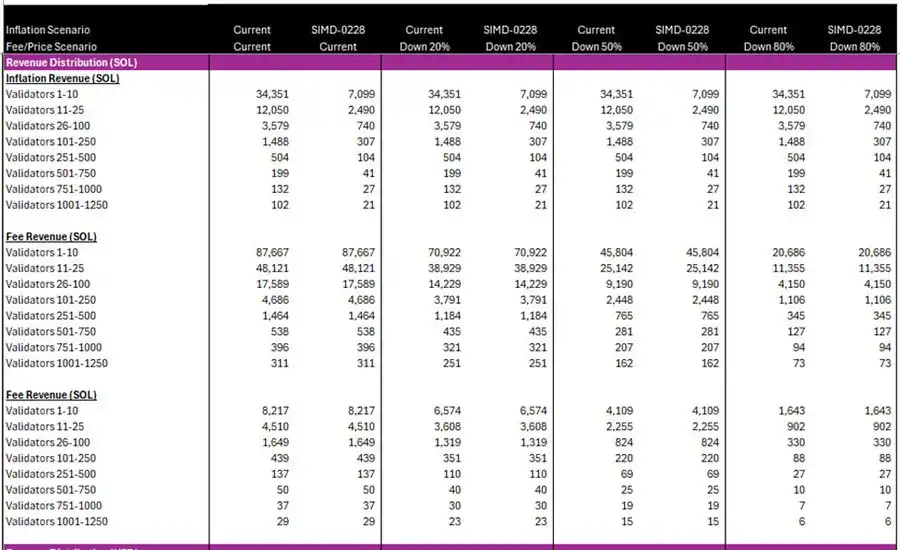
Subsequently, the model analyzed validators within each range with actual non-0% and non-100% commission rates (validators with 100% commission may be private validators) to estimate the optimistic scenario impact of SIMD-0228. It assumes that validators receive commissions from delegators through the following three aspects:
1. Inflation Reward: The model uses the actual average commission per validator group provided by Solana Beach (excluding validators with 0% or 100% commission).
2. Transaction Fees (Voting Fee, Base Fee, Priority Fee): The model assumes 100% goes to the validator.
3. Jito MEV Tips: The model assumes that validators receive 10% of MEV profits.
Are these data completely accurate? No. But they are based on discussions with validators. I highly welcome further community feedback.
One more thing to note: The reduction in the inflation rate by SIMD-0228 may indirectly affect fee allocation. After the inflation reduction, delegators may further compress validator fees and MEV profit shares to compensate for the revenue decrease. Therefore, I believe that validator profitability may have more downside risk than shown in the model.

The commission rate directly affects the SOL income that validator operators receive from various sources (inflation rewards, transaction fees, MEV).
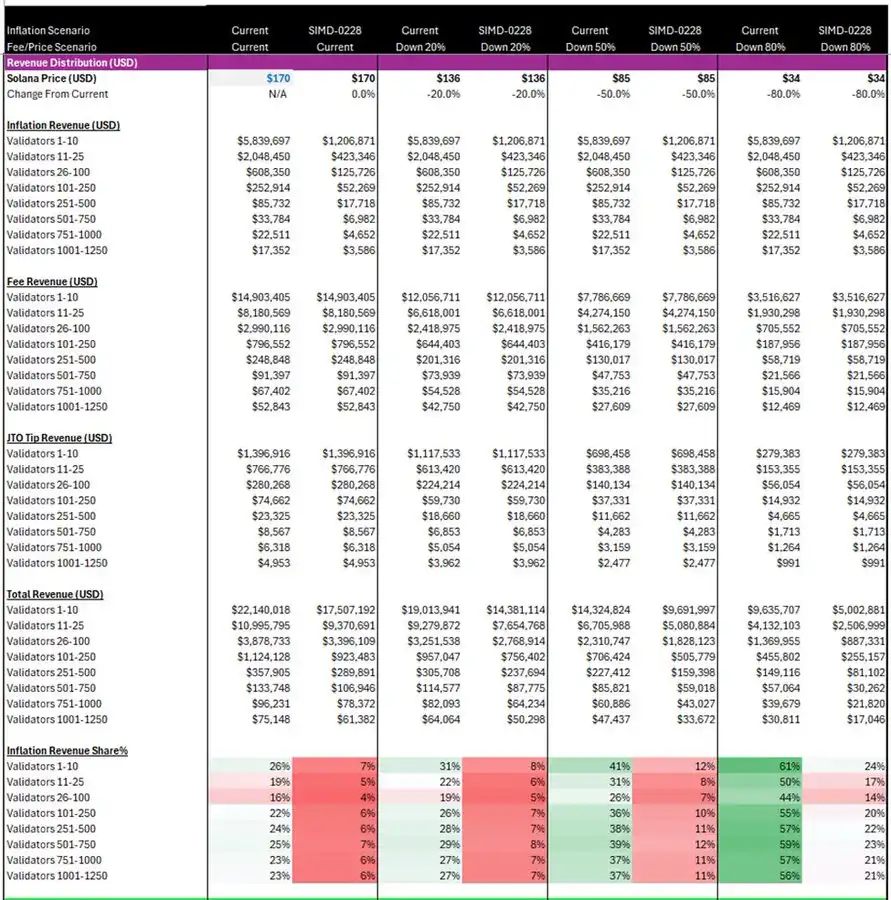
Next, the model takes various SOL price (USD) assumptions and, using the same fee scenario as before, calculates the USD value of the validator's income from various sources. Please note the data at the bottom, where the change in the percentage of inflation rewards in total income is compared between the current inflation curve and SIMD-0228. This illustrates how the importance of inflation is heightened under different scenarios.
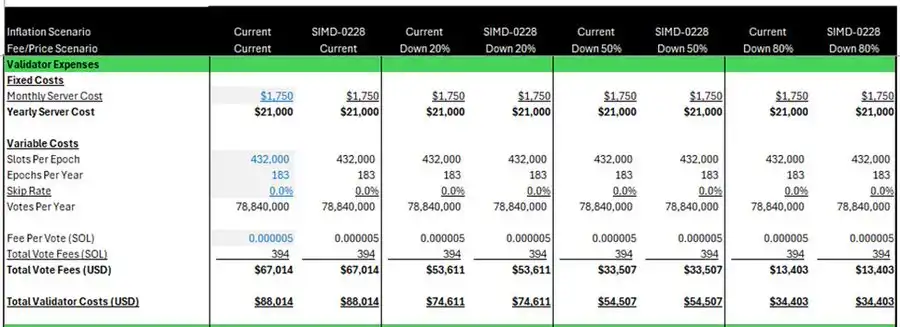
Next, the model estimates the annual cost of running a Solana validator to be approximately $85,000.
The fixed cost comes from the validator's infrastructure, with them running two servers along with bandwidth, resulting in monthly costs between $1,500 and $2,000. The model also estimates the variable voting cost based on different SOL prices and current transaction fees.
Currently, the community is discussing adjusting the voting fee to help reduce costs for small validators. You can adjust different levels of the voting fee in the model to observe its impact.
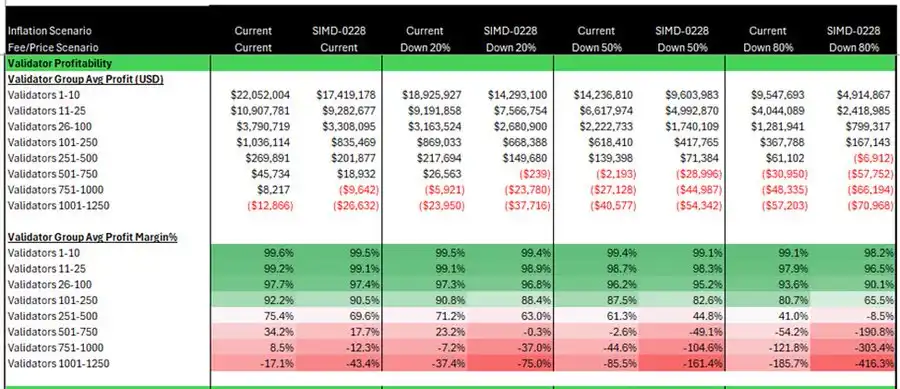
Then, the model derives the average validator profitability segmented by tier. What does the data tell us?
· The smallest 250 validators are still not profitable but remain online, which may be related to the Solana Foundation's delegation program.
· At the current price and fee levels, validators in the 751-1000 tier may no longer be profitable under SIMD-0228.
· If income decreases by 20%, under SIMD-0228, the Solana network could lose an additional 250 validators (validators in the 501-750 tier), who should have been profitable under other circumstances.
· Similarly, validators in the 501-750 tier may continue to remain profitable/online under the current model until their income drops by -50%.
· In the scenario where income drops by 80%, only the top 250 validator tier of Solana may remain profitable under SIMD-0228, while the top 500 validators may still be profitable if inflation remains unchanged.
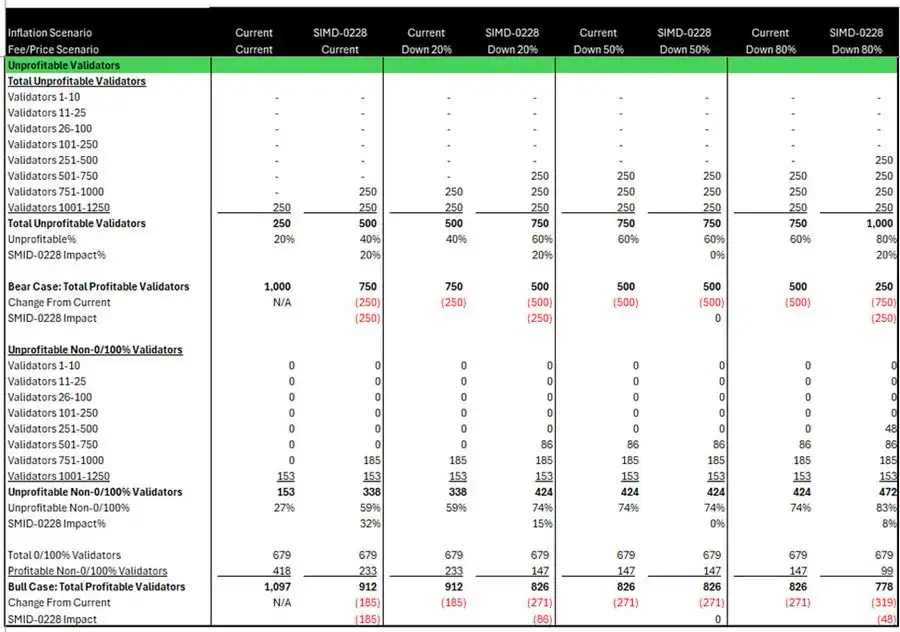
The model analyzed the network's potential validator count under optimistic and pessimistic scenarios by validating profitability level.
· The pessimistic scenario assumes all non-profitable validators leave the network.
· The optimistic scenario assumes only validators with non 0% and 100% commission leave the network.
How Many Validators Should Solana Have?
I don't know the answer. This question is left for the community to decide. I hope this model can help everyone think about SIMD-0228's impact through data rather than intuition.
What Is My Opinion on SIMD-0228?
Right now, I might be neutral. I was previously against it mainly because I felt that not enough analysis had been done to understand its impact. What could make me support it?
Lowering voting fees before implementing SIMD-0228
Adding an adjustment factor targeting not only the staking rate but also the validator count
You may also like

Why a Million-Follower Crypto KOL Chooses WEEX VIP?
Discover why top crypto KOL Carl Moon partnered with WEEX. Explore the WEEX VIP ecosystem, 1,000 BTC protection fund, and exclusive rewards for serious traders.

CoinEx Founder: The Crypto Endgame in My Eyes

Spark Coin (SPK): Explodes 73% as Aave Bleeds $15B, A Good Investment Now?
Spark coin (SPK) surged 73% as $15 billion fled Aave after the KelpDAO hack. This article explains what Spark is, why it’s pumping, and whether it is a good investment right now.

As Aave's building collapses, Spark's high-rise is rising

RootData: Q1 2026 Cryptocurrency Exchange Transparency Research Report

What Is Memecoin Trading? A Beginner's Guide to How It Works, the Risks, and 2026's Hottest Tokens
Memecoins surged 30%+ at the start of 2026 while Bitcoin was flat. RAVE spiked 4,500% then crashed 90% in days. MAGA jumped 350% overnight. This guide explains exactly how memecoin trading works — and how to not blow up your account doing it.

Trump Extends Ceasefire: Bitcoin Hits $79K — What Crypto Traders Need to Know Right Now
Bitcoin surged past $79,000 after Trump extended the ceasefire indefinitely. We break down exactly what happened, how every major crypto reacted, and what traders should watch next — including the one level that could unlock an $85,000 BTC rally.

CHIP Crypto Price Prediction 2026: Can USD.AI's GPU Lending Token Reach $1?
CHIP's 24-hour trading volume hit $1.87 billion on a $236 million market cap — an 8x ratio that almost never happens on legitimate tokens. We explain what's driving it, what USD.AI actually does for GPU tokenization, and whether CHIP belongs in your AI crypto portfolio.

RootData: Q1 2026 Web3 Industry Investment Research Report

USDC is the only AI token

The voice of a senior Polymarket user: In fact, we have already been surpassed by our competitors

Transcript of Dr. Han, founder of Gate, speaking at the University of Hong Kong: Breaking the Matthew Effect and Winning in Asymmetric Competition

Who will replace AAVE as the new king?
Fu Peng 2026 First Public Speech: What Exactly Are Crypto Assets? Why Did I Join the Crypto Asset Industry?

Lattice Capital Founder: Crypto VC, Seeing is Believing Because of Faith

The Pitch Is Set. So Is the Trade: CHZ, SportFi, and the UCL Window That Won't Wait
CHZ is gaining momentum as SportFi narratives accelerate alongside the UEFA Champions League(UCL) and global football cycles. This article explores how CHZ, fan tokens, and the broader SportFi ecosystem are driven by real-world events, market narratives, and capital flows—offering insights into why SportFi is emerging as one of the most dynamic sectors in crypto.
Morning Report | SpaceX acquires Cursor for $60 billion; Kalshi and Polymarket launch perpetual contract trading; NeoCognition completes $40 million financing
IMF | The Future of Stablecoins and Payments: Evidence from Financial Markets
Why a Million-Follower Crypto KOL Chooses WEEX VIP?
Discover why top crypto KOL Carl Moon partnered with WEEX. Explore the WEEX VIP ecosystem, 1,000 BTC protection fund, and exclusive rewards for serious traders.
CoinEx Founder: The Crypto Endgame in My Eyes
Spark Coin (SPK): Explodes 73% as Aave Bleeds $15B, A Good Investment Now?
Spark coin (SPK) surged 73% as $15 billion fled Aave after the KelpDAO hack. This article explains what Spark is, why it’s pumping, and whether it is a good investment right now.
As Aave's building collapses, Spark's high-rise is rising
RootData: Q1 2026 Cryptocurrency Exchange Transparency Research Report
What Is Memecoin Trading? A Beginner's Guide to How It Works, the Risks, and 2026's Hottest Tokens
Memecoins surged 30%+ at the start of 2026 while Bitcoin was flat. RAVE spiked 4,500% then crashed 90% in days. MAGA jumped 350% overnight. This guide explains exactly how memecoin trading works — and how to not blow up your account doing it.


 App
App