
During the weekend market closure, Hyperliquid more accurately predicted the Gold reopening price than Binance


Original Title: When COMEX Sleeps, HYPE Leads
Original Author: Kunal Doshi, Blockworks Research
Original Translation: Deep Tide TechFlow
When geopolitical risk erupted over the weekend, COMEX was closed, but Hyperliquid and Binance were not. Both platforms continued to trade gold and silver perpetual contracts. I compared the pricing of Hyperliquid's Trade.xyz and Binance relative to COMEX, observing which venue moved first and which was closer to the actual price upon reopening.
Under normal weekday conditions, the trading prices on both platforms relative to COMEX exhibited a structural discount of approximately 14 to 30 basis points. This was the expected outcome. COMEX front-month futures include a carrying cost, while perpetual contracts track closer to spot. This discount serves as the benchmark.
In this context, price divergences over the weekend are not noise.
After the close of COMEX on Friday, the prices on both platforms started drifting upwards. Hyperliquid was more aggressive, maintaining a continuous premium throughout the weekend.
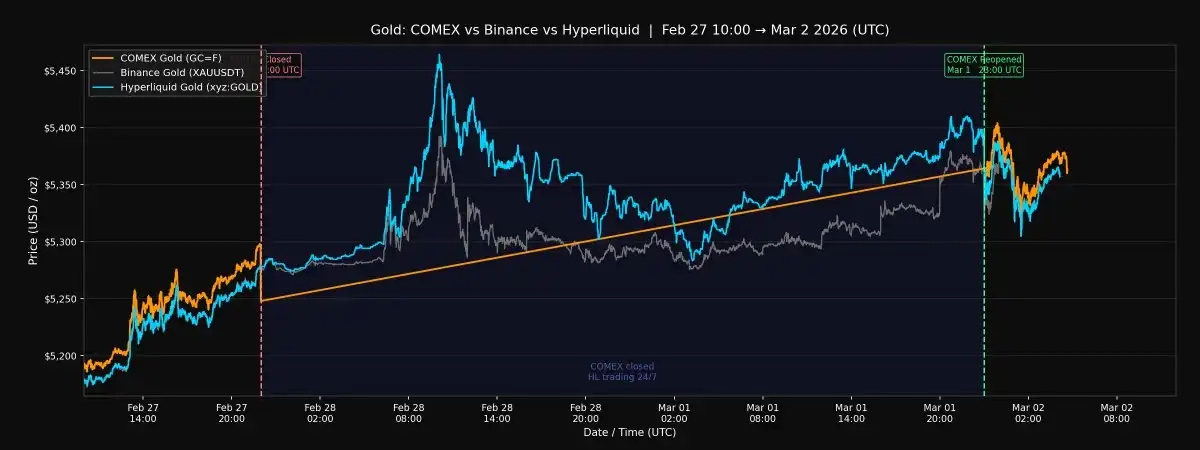
Gold Prices
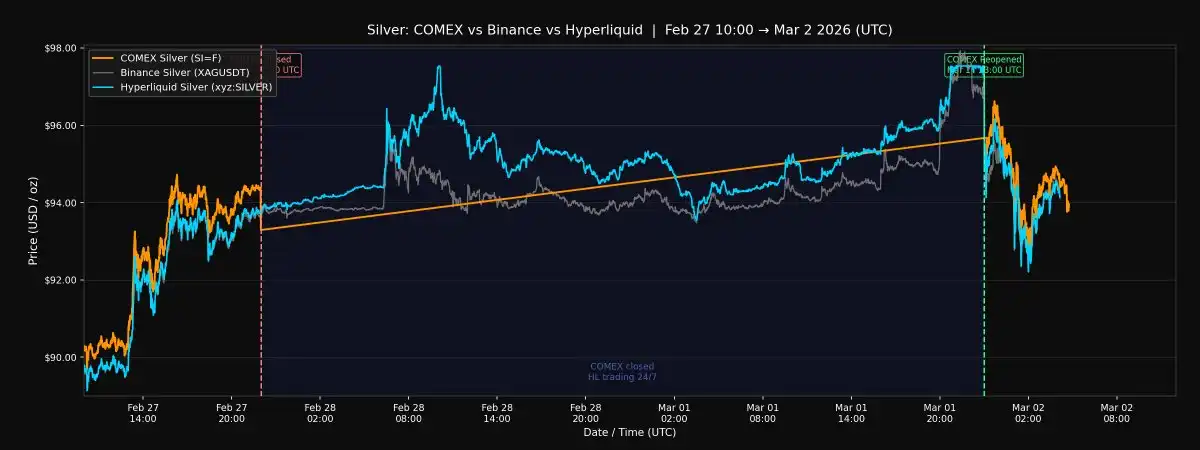
Silver Prices
Upon news of the airstrike in Iran, both exchanges reacted immediately. However, during the most volatile periods, Hyperliquid consistently priced gold and silver higher than Binance.
Throughout the weekend, the median premium of gold and silver on Hyperliquid relative to Binance was 75 and 78 basis points, respectively. On a normal workday, this cross-platform premium is usually close to zero. This deviation indicates that traders on Hyperliquid significantly priced geopolitical risk higher than Binance.
The real test comes at the reopening moment.
I benchmarked against the same one-minute candle as the COMEX opening price. When COMEX reopened, the futures price was higher on both platforms. Hyperliquid was within 22 basis points of the reopening price for gold and within 31 basis points for silver. In other words, Hyperliquid's weekend pricing proved to be a more accurate prediction of the traditional market reopening price.
However, the trading volume tells a completely different story.
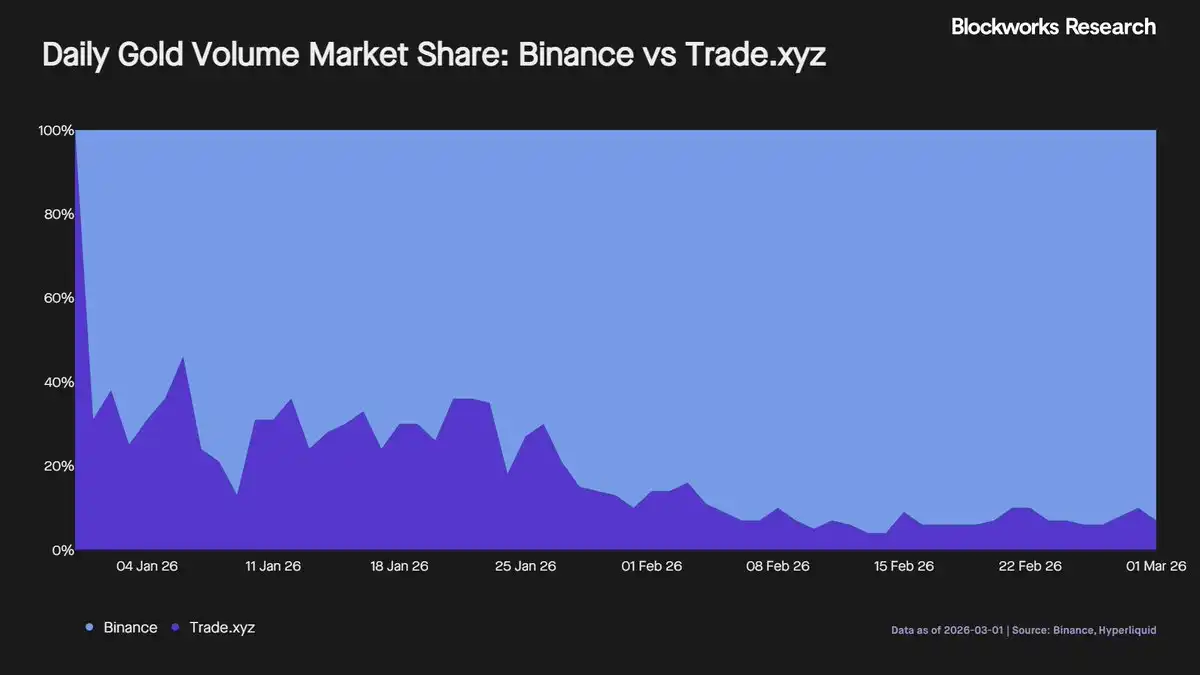
In absolute dollar terms, Binance is dominant. In the case of gold, Binance's share relative to Hyperliquid has risen from a low of 54% to today's 93%.
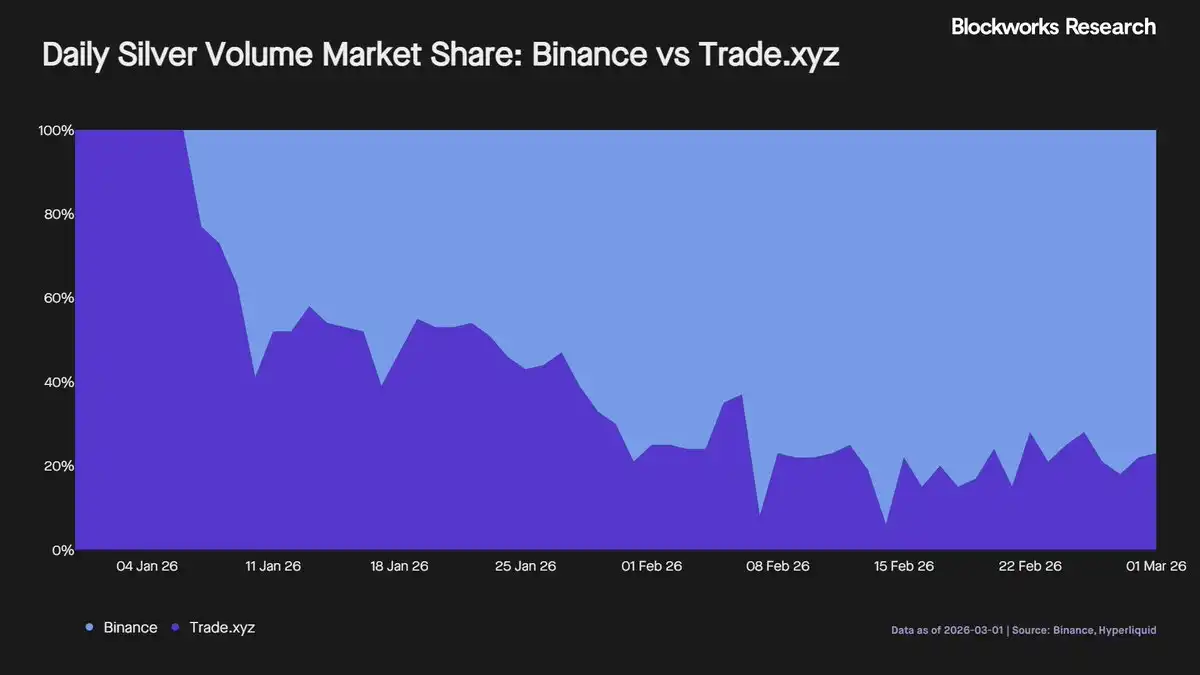
For silver, Binance's share has risen from 23% to 77%.
At first glance, Binance seems to be the clear winner.
But the open interest tells a different story. The scale of open contracts held by both platforms is similar. However, Binance generates significantly more trading on a per unit open interest basis. The turnover of positions of the same scale is much higher.
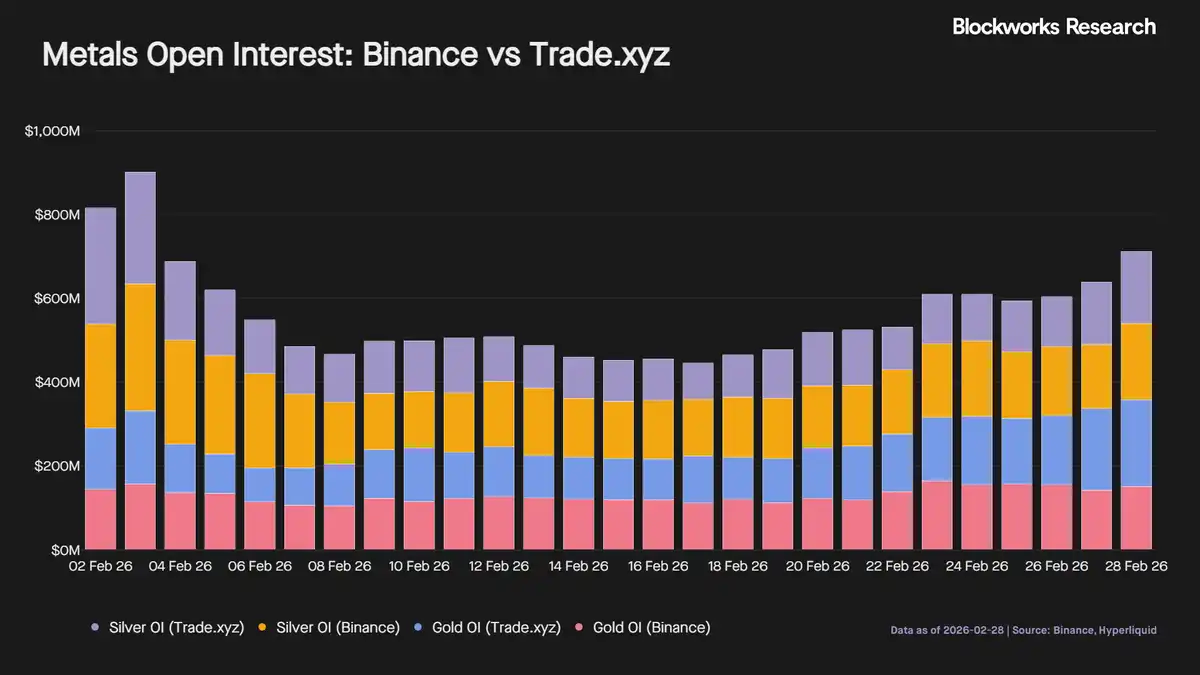
The daily trading volume for gold on Binance is 12.6 times the open interest, and for silver, it is 2.8 times on Hyperliquid. This is not a marginal difference but a whole order of magnitude higher in activity intensity.
If the open interest is similar but one platform has significantly higher trading volume, this activity deserves scrutiny. It indicates that a larger proportion of Binance's trading volume may be flipping the same position repeatedly rather than reflecting genuine directional conviction.
Liquidity provides another dimension, especially in gold.
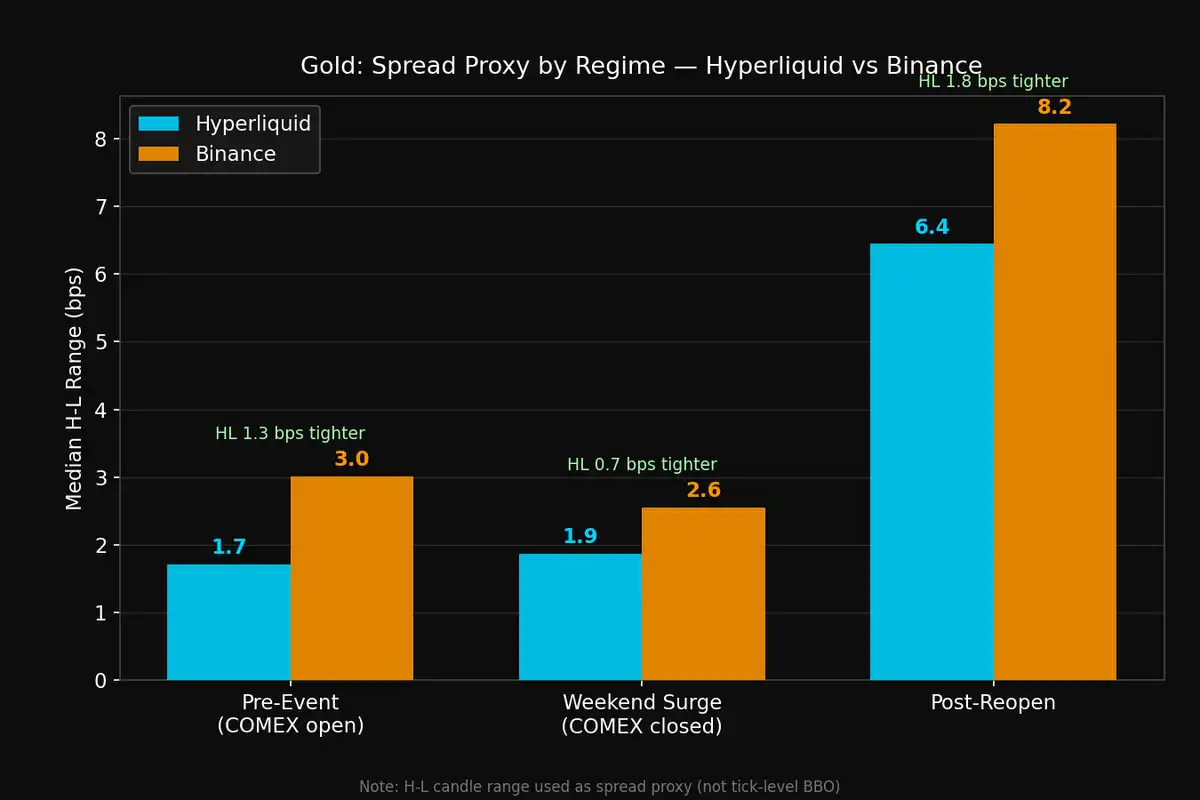
For gold, Hyperliquid has consistently had a narrower spread. Pre-event, Hyperliquid's average spread was 2.9 basis points, while Binance's was 3.7 basis points. During the weekend volatility, Hyperliquid averaged 1.9 basis points, and Binance had 2.6 basis points. After the reopening, the spreads on both platforms widened, but Hyperliquid remained narrower at 6.4 basis points compared to Binance's 8.2 basis points.
Silver situation is different.
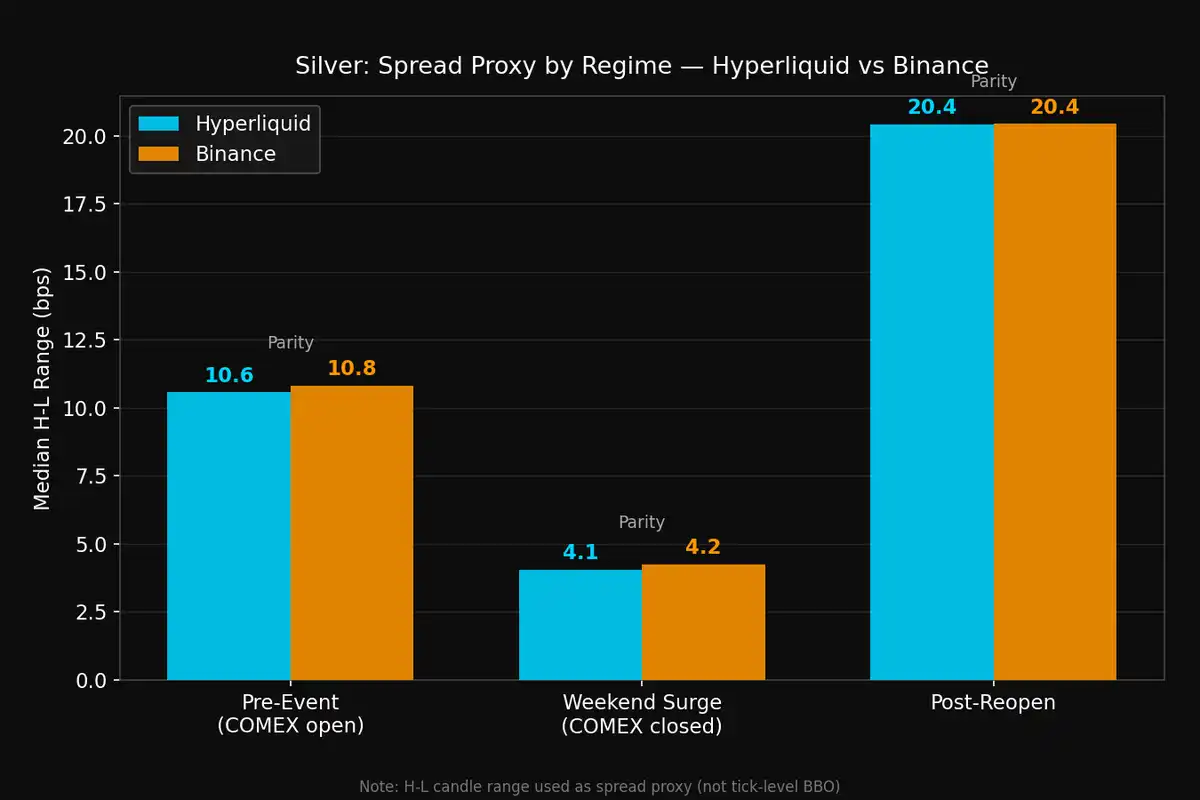
Prior to the event, the spread between the two platforms was already high and close to parity: Hyperliquid at 12.1 basis points, Binance at 11.8 basis points. Over the weekend, both narrowed to 4.1 and 4.2 basis points. Upon reopening, it sharply widened to 20.4 basis points on both platforms.
In this metric, silver did not show a structural liquidity advantage, and the spread performance of the two platforms was actually no different.
The funding rate provides yet another layer of information.
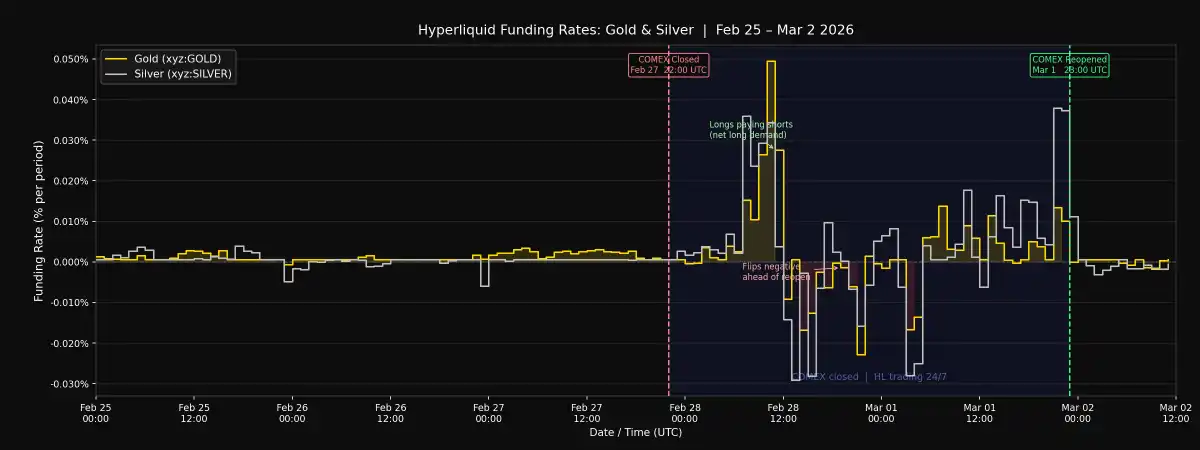
Hyperliquid's funding rate was positive in the early weekend hours, with longs paying fees to shorts. This indicates a net directional exposure demand to the upside as geopolitical risks evolve. Entering late Sunday, as traders positioned themselves ahead of the COMEX reopening, the funding rate slightly turned negative.
Summary
Binance dominates in raw trading volume, more trade count, and a larger activity share.
But not all trading volume is equal. When markets are closed, and real-time pricing is needed for geopolitical risk, Hyperliquid acts first and is closer to the eventual futures reopening price. Determining prices accurately under pressure is a core function of any exchange, and HYPE's performance this weekend indicates that the market is beginning to price in this shift.
You may also like

Perp DEX: The Next Generation Exchange "War"

The AI gamble of mining companies: Valuations enter a phase of differentiation, and it's hard to turn the tide

A letter from Alliance to entrepreneurs: Written on the occasion of Cursor selling for 60 billion dollars

Stablecoins Finally Find Real Returns: On-Chain Reinsurance Re Explained | Interview with Re Founder Karan Saroya

The impossible triangle is simply a pseudo problem

Will MicroStrategy fall into a death spiral? What will the macro trend be in the second half of the year?

Blockchain Capital Partner: The Core Secret of Arbitrage
STRC unanchored by 11%, can the perpetual motion machine of Strategy still operate?

Bitcoin Market Analysis 2026: Can BTC Reach $150K by Year-End?
Bitcoin ETF Outflows Hit a Record $4.4 Billion: What Are Traders Doing With Their Cash?
WEEX App Just Got Smarter – New Tabs for Faster Trades & Easy Asset Management

WEEX All-New Search Features: Find, Trade & Earn Faster Than Ever

Morning Report | Illinois signs the strictest digital asset tax law in the U.S.; RWA tokenization market size surpasses $43 billion, institutions accelerate the migration of on-chain assets
Full version of the debut Q&A! Federal Reserve Chairman Waller: Sticking to the 2% inflation target, establishing five special working groups, individual did not submit the dot plot

From Disruptor to Shadow Market: The Crypto Market is Becoming a Colony of Traditional Finance
Dalio's important long article: How to position in the current market environment?
OKX Star analyzes Binance's competitive advantages: when regulation levels the playing field, competition has just begun
New gameplay for participating in initial offerings on cryptocurrency exchanges
Perp DEX: The Next Generation Exchange "War"
The AI gamble of mining companies: Valuations enter a phase of differentiation, and it's hard to turn the tide
A letter from Alliance to entrepreneurs: Written on the occasion of Cursor selling for 60 billion dollars
Stablecoins Finally Find Real Returns: On-Chain Reinsurance Re Explained | Interview with Re Founder Karan Saroya
The impossible triangle is simply a pseudo problem
Will MicroStrategy fall into a death spiral? What will the macro trend be in the second half of the year?


