
Deconstructing the AI Agent: How to Pioneer a New Era of DeFai?




Original Article Title: Autonomous Agents On-chain: From Chat to Action
Original Article Author: @jainargh, brahma.fi Lead
Original Article Translation: zhouzhou, BlockBeats
Editor's Note: AI Agents are gradually attracting market attention, despite facing challenges such as lack of research tools and user onboarding. This article explores the potential applications of agents in DeFi, including automated fund management, yield optimization, and risk control, while also looking forward to the broad prospects of future agent collaboration and innovation.
The following is the original content (slightly reorganized for better readability):
In today's crypto space, AI agents are still in the "chat" stage. They analyze tweets, make predictions, and tell you what to do—but that's about it. When you ask it to "swap ETH for USDC," you are actually just having a conversation with a large language model (LLM) that culminates in an API call. It's more like a cumbersome Telegram bot, and you end up being farmed.
We believe AI agents can do more. They should take autonomous actions, protect assets, and execute strategies without the need for constant intervention.
To achieve this, we are introducing ConsoleKit, offering developers:
Full-stack tools: Instantly deploy an agent or build an on-chain custom workflow.
Security-first execution capability: Achieved through the SAFE wallet and modular strategies.
Powerful programmability: Supporting the development of adaptive multi-agent systems for any chain or protocol.
How to Achieve On-chain Autonomous Agents?
Different developers have different frameworks, but we believe that the beginning of agent in DeFi is what we call a specialized agent, which runs a "workflow" based on a strategy (guardrail).
Specialized agents are systems optimized for specific protocols. They can autonomously execute workflows, enhance dApp interaction experience, help users efficiently deploy funds, manage risks, and protect on-chain assets, providing a smarter and more secure DeFi experience.
Imagine that when you deposit in Morpho, you no longer just see a static APY. Instead, you have an agent that can:
Real-Time Market Monitoring
Rebalance across different lending markets for optimal yield
While keeping you in full control
Our first implementation, Morphoagent, does just that and more. It goes beyond the traditional vault interface, injecting intelligence into each interaction. No more need to watch the market or hastily adjust your positions—the agent takes care of it all. Want more granular control? You can directly communicate with the agent. Unlike today's agents, when you say "rebalance to highest-yield pool," it actually happens. Every conversation translates into action.
How Does a Specialized Agent Work?
A Specialized Agent combines deterministic execution with adaptive intelligence to achieve on-chain autonomous operations.
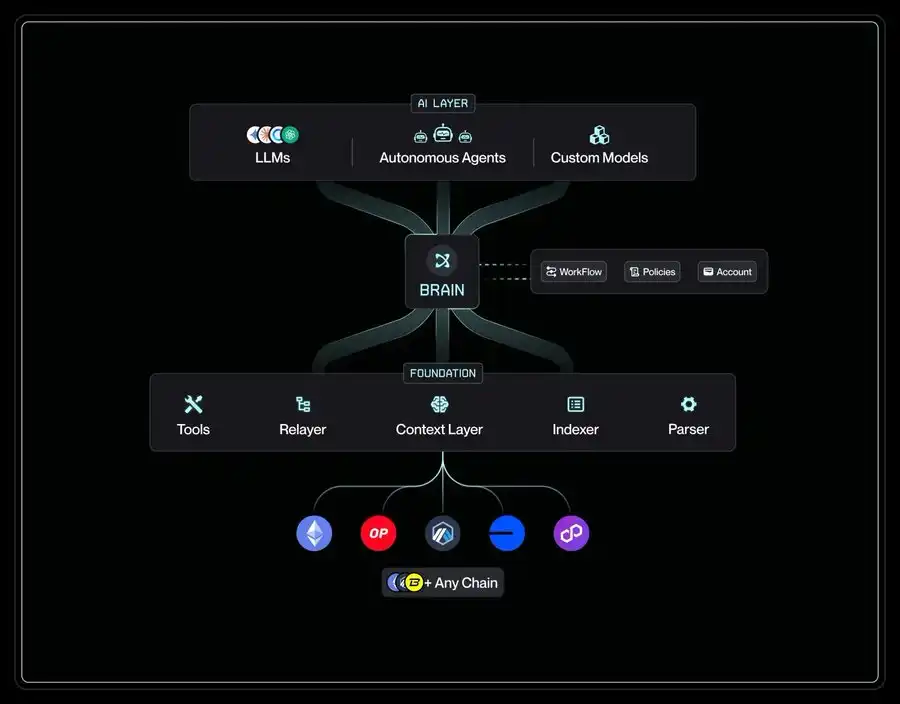
ConsoleKit Overview
AI Layer: Intelligence
LLM (Large Language Model): Formulates strategic decisions based on the following factors:
· User preferences and risk tolerance
· Market conditions and opportunities
· Historical performance patterns
RAG (Retrieval-Augmented Generation): Provides decision-making basis through the following:
· Protocol documents and mechanisms
· Past transaction records and outcomes
· Real-time market environment
Brain: Control
Workflow: Serializes operations into end-to-end strategies
· Deposit → Monitor → Rebalance process
· Multi-step position management
· Cross-chain operations
Account: safe-based
· Smart contract wallet
· Batch transactions
· Access control
Policy: Security Fence
· Transaction Limit
· Approved Protocols
· Risk Parameters
Foundation: Execution
· Tools: Core DeFi Operations
· Relayer: Transaction Relay
· Indexer: State Tracking
· Context: Market Data Flow
· Parser: Protocol Parsing
How It Works Together
Using Morpho Agent as an Example:
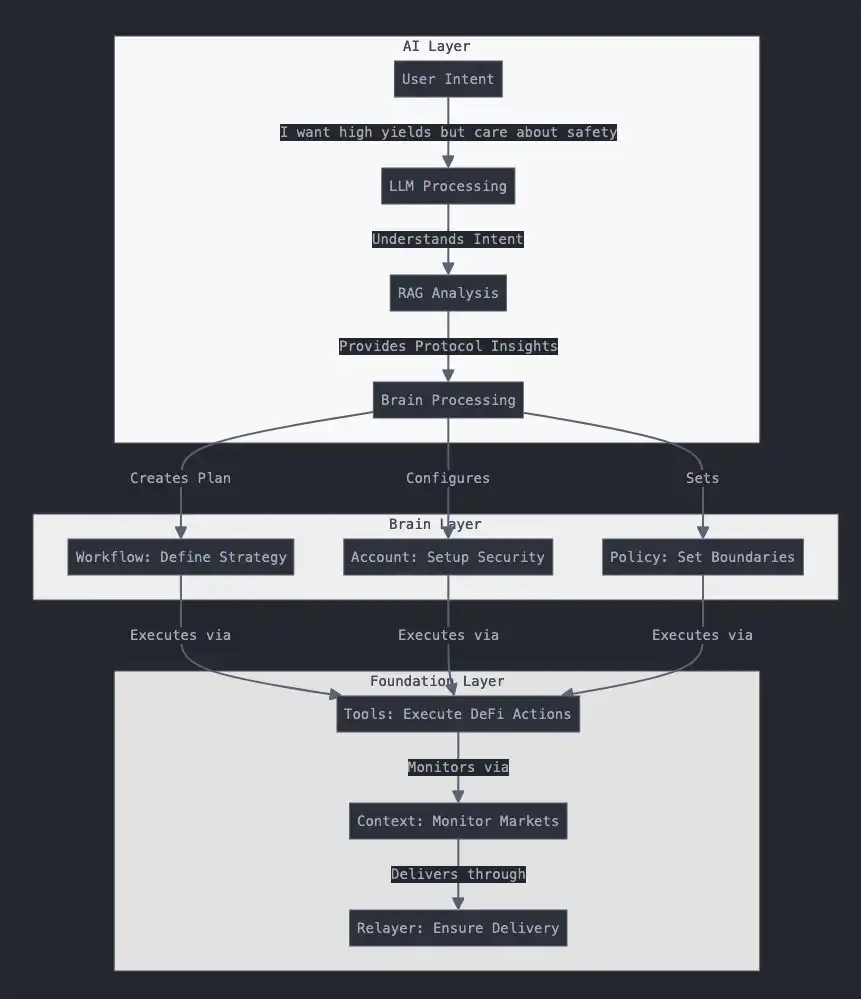
A Quick Process: Designed by Claude
A dedicated agent built on ConsoleKit's openness and modularity. Two SDKs have been released to developers:
1. Builder: Helps developers build complex workflows that agents can autonomously execute, providing strong execution guarantees.
2. Templates: Allow developers to easily add custom protocol tools.
ConsoleKit initially relies on battle-tested Relayers, Indexers, and Protocol Parsers, which have processed over $10 billion in transaction volume and manage over $3 billion in assets in Brahma Accounts.
What Does an Agent's Interface Look Like in DeFi?
(1) Embedded Agent
At first glance, the Morpho agent's interface looks no different from a regular DeFi vault—displaying APY, deposit amount, and rebalancing options. However, behind the scenes, each position is driven by a dedicated agent. It actively manages your funds using real-time market data, historical APY patterns, liquidity metrics, and Total Value Locked (TVL) trends.
1. Connect your regular EOA wallet.
2. ConsoleKit creates a secure smart account in the background (supported by SAFE).
3. Configure your risk preference and rebalancing parameters.
4. The agent actively manages your position within a strict policy fence.
5. Users retain custody of their assets.
Customize Your Strategy via Chat:
You: "I want to optimize yield, but I have a low risk preference."
Agent: "I will focus on stablecoin pools with TVL over 10 million USD. Currently, the best options are: Morpho-Aave USDC: 4.8% APY, TVL 50 million USD, Morpho-Compound USDT: 4.6% APY, TVL 45 million USD. Would you like to set any other preferences?"
You: "Yes, only use Gauntlet-selected vaults and rebalance weekly."
Agent: "Understood. I will optimize yield in Gauntlet-selected vaults, rebalance weekly on Mondays, while maintaining your risk parameters."
(2) Meeting Users Where They Are: The Fusion of Agent and DeFi
We envision a future where developers can leverage ConsoleKit to build millions of dedicated agents for public goods like Aave, Uniswap, and Morpho. Anyone can create an agent to help users interact more efficiently with these protocols—from optimizing yield on Aave to managing liquidity positions on Uniswap. These agents do not rely on a single user interface but exist wherever users need them, making DeFi more convenient and efficient.
Imagine a user who wants to provide assets on Aave and engage in borrowing. Instead of manually managing multiple steps, they can let a dedicated Aave agent seamlessly batch process transactions. Moreover, this agent can set triggers based on the user's health factor, actively manage risk, and prevent liquidation.
Developers can embed agents directly into wallet interfaces, whether through mobile apps or browser extensions, to offer users a smarter interactive experience. With ConsoleKit, agents can meet user needs anytime, anywhere, making DeFi smarter, more secure, and easier to use.
The Future of DeFi Agents
Users can seamlessly interact with a dedicated agent built on ConsoleKit, deploying funds or configuring workflows with just one click, all while retaining full asset ownership through safe practices. The on-chain complexities—such as cross-chain transactions, real-time decision-making, or protocol integrations—are abstracted away, allowing users to harness DeFi with simple yet powerful tools. As a trusted executor, the agent strictly follows instructions without taking over asset custody.
For developers, ConsoleKit simplifies the creation and deployment of agents with minimal code, enabling developers to focus on building interfaces and workflows. ConsoleKit ensures that agents support multi-chain functionality, connect to all major protocols, and can execute reliably. Protocol teams can embed dedicated agents into their dApps or build new interfaces, enhancing user experience and unlocking new possibilities.
In the future, millions of dedicated agents will be built on public goods such as Aave, Uniswap, Morpho, and Hyperliquid, with each agent autonomously performing specific tasks. These agents will collaborate—sharing insights, pooling resources, and optimizing outcomes. For example, a Morpho agent optimizing yield can collaborate with an Aave agent to manage collateral, while a Uniswap agent handles liquidity provision, collectively improving efficiency and risk management.
As agents continue to evolve, they will collaborate in a "swarm" form, creating new financial experiences and primitives. These swarms will accomplish workflows that individual agents cannot, such as managing decentralized treasuries, building yield strategies, and adjusting market conditions based on user demand. This future composed of interconnected agents is rapidly approaching, bringing a more intelligent and cooperative experience to DeFi.
You may also like

Mastercard Launches Agent Pay for AI, Plans to Record AI Agent Payment Authorizations on Polygon
Mastercard launched Agent Pay for AI, a new payment protocol designed to help AI agents make small payments such as pay-per-use access to data and APIs. The system plans to record human-granted AI agent permissions on Polygon, focusing on verifiable authorization, identity, and payment controls.

Curve Deploys Llamalend v2 on Optimism With 250,000 OP Incentives
Curve launched Llamalend v2 on Optimism with 250,000 OP incentives from the Optimism Foundation. The upgrade expands Llamalend beyond its earlier crvUSD-focused model, adding broader collateral support, LlamaRisk market reviews, and the ability to use Curve LP tokens as collateral.

Raydium Old Liquidity Pool Reportedly Exploited, With $1.34 Million Moved to Ethereum and Tornado Cash
An old Raydium liquidity pool was reportedly exploited for around $1.34 million in USDC, RAY, and wSOL, with the stolen funds bridged to Ethereum and deposited into Tornado Cash. The incident highlights the tail risks of legacy DeFi pools, old contracts, and cross-chain fund laundering paths.

Kalshi Executive Challenges “SBF Backed AI Unicorns” Narrative, Says Leopold Aschenbrenner Was Key Figure
Kalshi executive John Wang questioned the “SBF backed AI unicorns” narrative, saying Leopold Aschenbrenner was the key figure behind major AI investment decisions.

Pantera Capital Partner: How Tokenization is Restructuring the Private Equity and Early Investment Ecosystem?

New York Proposes Stricter Stablecoin Issuer Rules Aligned With Federal GENIUS Act
NYDFS proposed stricter stablecoin issuer rules aligned with the GENIUS Act, covering reserves, custody, redemption timelines, audits, and capital buffers.
Every exchange is a "Universal Exchange."

The counterattack of traditional finance: Alliance chains are quietly reviving

CryptoQuant Says Bitcoin Profitable Supply Is Near 45% Pressure Zone as On-Chain Data Points to Market Repricing
CryptoQuant said Bitcoin’s profitable supply is nearing the 45% pressure zone, signaling rising market stress, unrealized losses, and a possible on-chain repricing phase.

Bitcoin Falls Below 200-Week Moving Average as On-Chain Data Shows Over Half of Supply in Loss
Bitcoin dropped below its 200-week moving average as on-chain data showed over 50% of circulating supply is now in loss, signaling rising market stress.

CFTC Reportedly Plans New Prediction Market Rules Focused on Manipulation Risk and Public Interest Review
The CFTC is reportedly preparing new prediction market rules focused on manipulation risk, public interest review, and retail trader protections.

Meet the new WEEX trial fund—your gateway to greater profits

WEEX Labs Lands at Dutch Blockchain Week: A Disruptive Crypto × AI Conversation Sets Sail in Amsterdam
SK Hynix Reportedly Plans U.S. ADR Listing as Early as August, With SEC Approval Possible in Late June
SK Hynix may pursue a U.S. ADR listing as early as August, with SEC approval reportedly possible in late June amid strong AI chip supply chain demand.

SpaceX vs Tesla vs xAI: Which Elon Musk Trade Has the Biggest Upside in 2026?
OpenAI Reveals It Has Confidentially Submitted an S-1 to the SEC, Keeping the Door Open for a Future IPO
On June 9, according to an OpenAI announcement, the company recently confidentially submitted a draft S-1 registration statement to the U.S. Securities and Exchange Commission (SEC), beginning the preliminary compliance process for a potential initial public offering. OpenAI said it chose to disclose this proactively because it expected the news might leak; however, the company has not yet set a specific listing timeline, and related arrangements may still take some time.
Latest research from 13 top universities including Cornell University: The current state, challenges, and misconceptions of the fusion of Crypto and AI
Deconstructing Anthropic: The Best AI Company, Possibly Also a Type of Organizational Invention
Mastercard Launches Agent Pay for AI, Plans to Record AI Agent Payment Authorizations on Polygon
Mastercard launched Agent Pay for AI, a new payment protocol designed to help AI agents make small payments such as pay-per-use access to data and APIs. The system plans to record human-granted AI agent permissions on Polygon, focusing on verifiable authorization, identity, and payment controls.
Curve Deploys Llamalend v2 on Optimism With 250,000 OP Incentives
Curve launched Llamalend v2 on Optimism with 250,000 OP incentives from the Optimism Foundation. The upgrade expands Llamalend beyond its earlier crvUSD-focused model, adding broader collateral support, LlamaRisk market reviews, and the ability to use Curve LP tokens as collateral.
Raydium Old Liquidity Pool Reportedly Exploited, With $1.34 Million Moved to Ethereum and Tornado Cash
An old Raydium liquidity pool was reportedly exploited for around $1.34 million in USDC, RAY, and wSOL, with the stolen funds bridged to Ethereum and deposited into Tornado Cash. The incident highlights the tail risks of legacy DeFi pools, old contracts, and cross-chain fund laundering paths.
Kalshi Executive Challenges “SBF Backed AI Unicorns” Narrative, Says Leopold Aschenbrenner Was Key Figure
Kalshi executive John Wang questioned the “SBF backed AI unicorns” narrative, saying Leopold Aschenbrenner was the key figure behind major AI investment decisions.
Pantera Capital Partner: How Tokenization is Restructuring the Private Equity and Early Investment Ecosystem?
New York Proposes Stricter Stablecoin Issuer Rules Aligned With Federal GENIUS Act
NYDFS proposed stricter stablecoin issuer rules aligned with the GENIUS Act, covering reserves, custody, redemption timelines, audits, and capital buffers.


