
Coingecko: On-chain Gas Fees Surpass $6.9 Billion in 2024, Who Is the Biggest Winner?

Original Title: Blockchains Earned Over $6.9B Transaction Fees in 2024
Original Source: Lim Yu Qian, CoinGecko
Original Translation: Deng Tong, Golden Finance
Which Blockchains Earned the Most Fees?
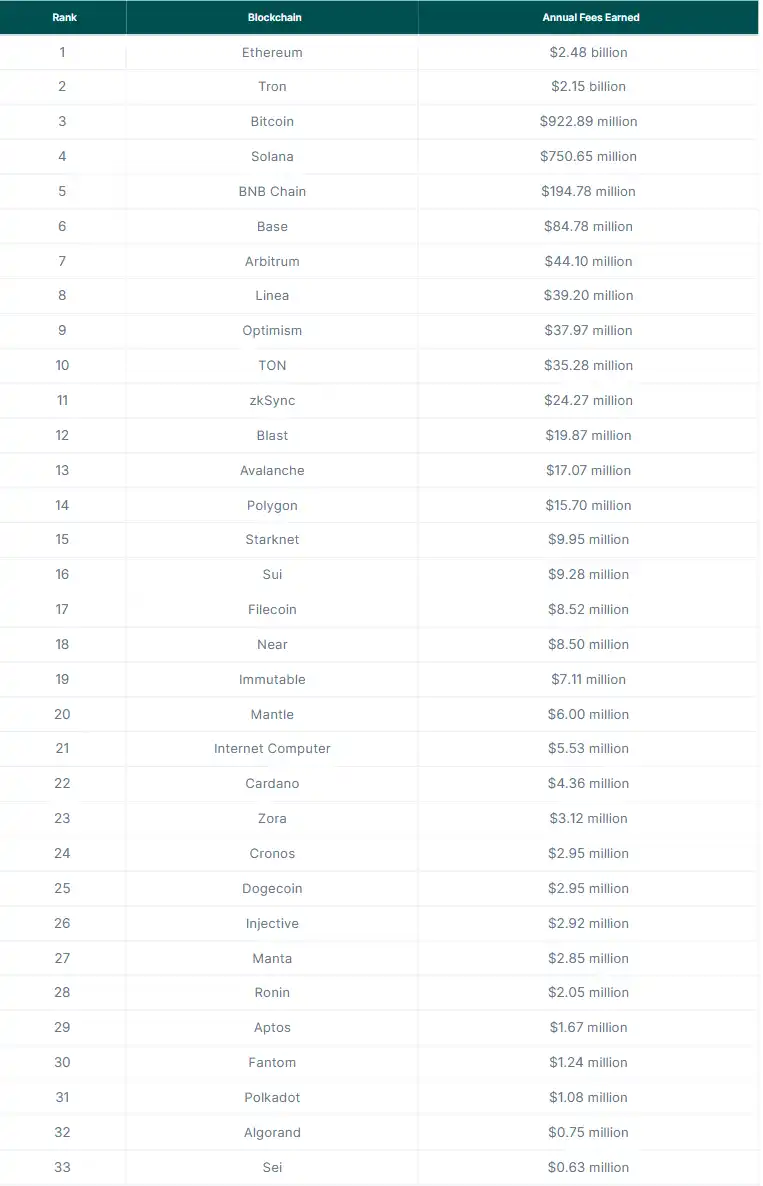
In 2024, Ethereum had the highest transaction fees of all blockchains, generating a total fee of $24.8 billion annually from gas fees. Tron became the second-highest-earning blockchain, with a total fee for the year of $21.5 billion. This means that on average, Ethereum earned $6.79 million in daily fee revenue last year, while Tron earned $5.89 million in daily fee revenue.
Bitcoin and Solana followed closely behind, with annual fees of $9.2289 billion and $7.5065 billion, respectively.
Overall, in 2024, Layer 1 (L1) and Layer 2 (L2) blockchains earned over $68.9 billion from transaction fees. Specifically, L1 accounted for $66 billion in fees across 21 blockchains, while L2 accounted for $2.9492 billion across 12 blockchains.
The top 10 highest-earning blockchains alone recorded a combined fee revenue of $67.4 billion. It is worth noting that among the top 10 highest-earning blockchains, 4 are Layer 2—namely Base, Arbitrum, Linea, and Optimism—which surpassed other Layer 1 chains, including TON, in annual fee revenue last year.
Ethereum Fee Revenue Over Time
Ethereum's $24.8 billion fee revenue in 2024 represented a 3.0% increase from the $24.1 billion in 2023. This indicates that despite the DenCun upgrade in March 2024 lowering L2 transaction costs and users migrating from L1 to its L2 scaling solutions, Ethereum maintained its leadership position in fee revenue. Ethereum's elastic fee revenue also contrasts sharply with ETH's price performance, which was lower than expected last year.
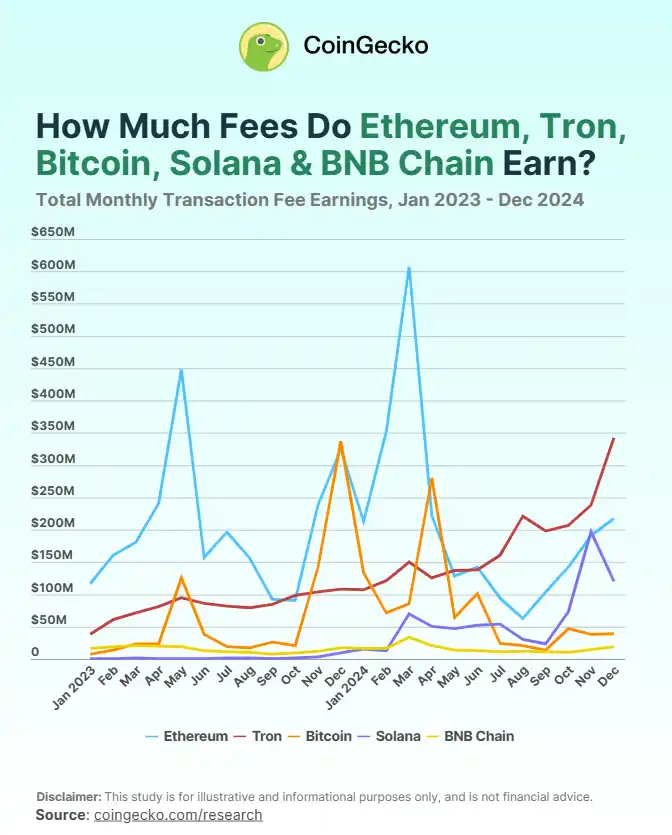
The amount of fees earned by Ethereum fluctuates monthly. In 2023, Ethereum's monthly revenue ranged from $91.22 million to $448.7 million, recording higher fee revenue during the meme frenzy in May and the market rebound at the year's end. In 2024, the range expanded, with Ethereum's monthly revenue ranging from $62.82 million to $606.77 million.
It is worth noting that in just the first quarter of 2024, Ethereum earned $1.17 billion, accounting for nearly half of its total annual fee revenue. This was also Ethereum's highest-earning quarter in the past two years, thanks to widespread airdrop initiatives and increased on-chain activities.
Tron, Solana Fee Revenue Shows Strong Growth
In the past year, Tron's fee revenue saw a significant increase of 116.7%, rising from $9.2208 billion in 2023 to $21.5 billion in 2024. As one of the largest blockchains for stablecoin transactions, the accelerated usage of stablecoins has steadily driven Tron's monthly fee revenue growth from $38.36 million in January 2023 to $342.54 million in December 2024.
Tron has outpaced Ethereum in fee revenue for the past six consecutive months. However, whether Tron can surpass Ethereum this year to become the blockchain with the highest fee revenue remains to be seen.
Solana saw an even larger increase in annual fee revenue, jumping from $25.55 million in 2023 to $750.65 million in 2024, a growth rate of 2,838.0%. As the most popular blockchain ecosystem last year, Solana's transaction volume surged to network congestion levels in April 2024. In contrast to Tron, Solana's monthly fee revenue remained stable throughout 2023 and experienced more volatile growth in 2024, increasing from $15.54 million in January to $197.5 million in November, then slowing to $120.95 million in December.
On the other hand, Bitcoin's annual fee revenue grew by 15.9%, BNB Chain grew by 8.7%, showing a much more modest increase but still surpassing Ethereum's 3.0% growth. In recent years, Bitcoin's fee-generating capacity has continued to strengthen, driven by the increased activity of Ordinal NFTs, BRC-20 tokens, and Rune tokens, as well as the rapid growth of interest in applications built on Bitcoin.
Meanwhile, TON ranks tenth as the highest-fee blockchain, with annual fee revenue of $35.28 million. Recently, the popular messaging app Telegram formally integrated TON, enabling more accessible on-chain interactions, such as blockchain games with earning incentives.
Which Layer 2 Solutions Earned the Most Fees?
Base was the top gas fee earner in L2, generating a total of $84.78 million in 2024. This represented a 548.2% increase from the $13.08 million earned in 2023, although it is worth noting that Base only launched its mainnet in August 2023.
Even accounting for the mainnet launch, Base's fee revenue doubled from an average of $6.38 million in the second half of 2023 to $21.20 million in 2024. Similar to Solana, Base has seen widespread adoption due to its retail-friendly nature, with its integration with Coinbase further amplifying this friendliness.
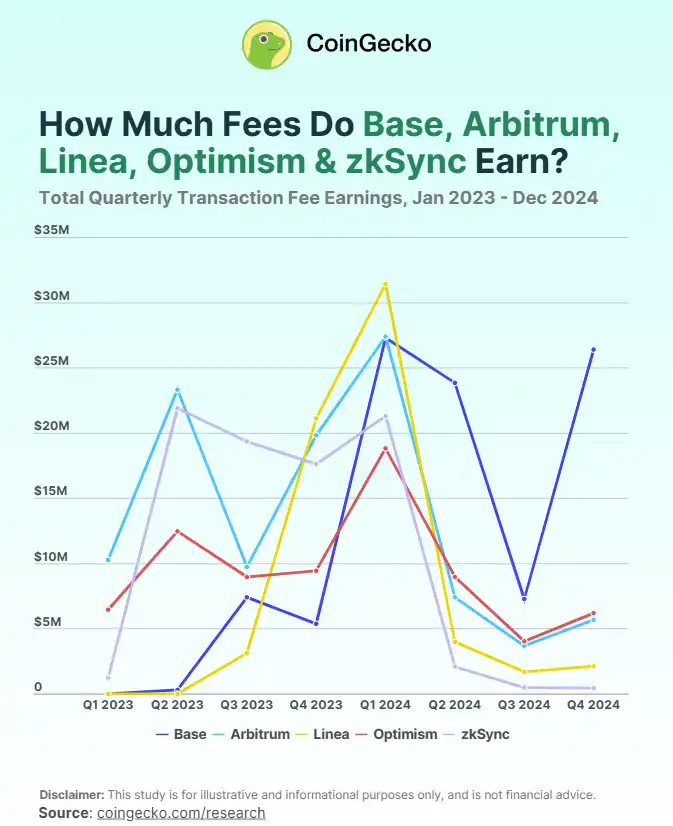
Likewise, Linea's mainnet was launched in August 2023, which partially explains the increase in annual fee revenue from $24.20 million in 2023 to $39.20 million last year, a growth of 62.0%. Most of Linea's 2024 annual fee was earned in the first quarter, when it set a quarterly record high of $31.40 million during the Linea Park airdrop event.
Meanwhile, Optimism saw a slight 1.9% increase in annual fee revenue, rising from $37.26 million in 2023 to $37.97 million in 2024.
Arbitrum, zkSync Fee Revenue Shrinks
Arbitrum was the second-highest fee earner in L2, bringing in $44.10 million in 2024. However, this represented a 30.1% decrease from the $63.12 million Arbitrum earned in 2023. Despite being a veteran player, both Arbitrum and Optimism are facing stiff competition in the increasingly crowded L2 space.
zkSync saw a larger decline, dropping from $60.04 million in annual fees in 2023 to $24.27 million in 2024, a 59.6% decrease. Specifically, during the L2 airdrop season, zkSync's quarterly fee revenue averaged $20.04 million from the second quarter of 2023 to the first quarter of 2024, but then plummeted to an average of $0.99 million per quarter from the second to fourth quarters of 2024.
Overall, the current fluctuations in L2 fee revenue seem to primarily reflect on-chain activity being primarily driven by token airdrops and incentive marketing programs. Therefore, it remains to be seen how much fees L2 chains can sustainably earn in the long run.
Blockchain Fee Revenue Ranking
The total fees earned by blockchains annually in 2024 are as follows:
You may also like

When the P2P illicit funds from ten years ago turned into 60,000 bitcoins

Morning News | CME Group launches Nasdaq Cryptocurrency Index futures; Asset management giant Janus Henderson strategically invests in Ethena

Why did Oracle deliver the strongest financial report in history, yet its stock price fell?

Bitcoin Layer 2 Network Botanix: Why Did We Choose to Dissolve?

Morning Report | OpenAI has submitted an S-1 registration statement draft to the U.S. SEC; Morpho completes $175 million financing

Galaxy Deep Research Report: How Hyperliquid's HIP-4 Upgrade Changes the Landscape of Prediction Markets?

Latest research from 13 top universities including Cornell University: The current state, challenges, and misconceptions of the fusion of Crypto and AI
Deconstructing Anthropic: The Best AI Company, Possibly Also a Type of Organizational Invention

Every exchange is a "Universal Exchange."

The counterattack of traditional finance: Alliance chains are quietly reviving
Pantera Capital Partner: How Tokenization is Restructuring the Private Equity and Early Investment Ecosystem?

Mastercard Launches Agent Pay for AI, Plans to Record AI Agent Payment Authorizations on Polygon
Mastercard launched Agent Pay for AI, a new payment protocol designed to help AI agents make small payments such as pay-per-use access to data and APIs. The system plans to record human-granted AI agent permissions on Polygon, focusing on verifiable authorization, identity, and payment controls.

Curve Deploys Llamalend v2 on Optimism With 250,000 OP Incentives
Curve launched Llamalend v2 on Optimism with 250,000 OP incentives from the Optimism Foundation. The upgrade expands Llamalend beyond its earlier crvUSD-focused model, adding broader collateral support, LlamaRisk market reviews, and the ability to use Curve LP tokens as collateral.

Raydium Old Liquidity Pool Reportedly Exploited, With $1.34 Million Moved to Ethereum and Tornado Cash
An old Raydium liquidity pool was reportedly exploited for around $1.34 million in USDC, RAY, and wSOL, with the stolen funds bridged to Ethereum and deposited into Tornado Cash. The incident highlights the tail risks of legacy DeFi pools, old contracts, and cross-chain fund laundering paths.
Kalshi Executive Challenges “SBF Backed AI Unicorns” Narrative, Says Leopold Aschenbrenner Was Key Figure
Kalshi executive John Wang questioned the “SBF backed AI unicorns” narrative, saying Leopold Aschenbrenner was the key figure behind major AI investment decisions.

New York Proposes Stricter Stablecoin Issuer Rules Aligned With Federal GENIUS Act
NYDFS proposed stricter stablecoin issuer rules aligned with the GENIUS Act, covering reserves, custody, redemption timelines, audits, and capital buffers.

CryptoQuant Says Bitcoin Profitable Supply Is Near 45% Pressure Zone as On-Chain Data Points to Market Repricing
CryptoQuant said Bitcoin’s profitable supply is nearing the 45% pressure zone, signaling rising market stress, unrealized losses, and a possible on-chain repricing phase.

Bitcoin Falls Below 200-Week Moving Average as On-Chain Data Shows Over Half of Supply in Loss
Bitcoin dropped below its 200-week moving average as on-chain data showed over 50% of circulating supply is now in loss, signaling rising market stress.
When the P2P illicit funds from ten years ago turned into 60,000 bitcoins
Morning News | CME Group launches Nasdaq Cryptocurrency Index futures; Asset management giant Janus Henderson strategically invests in Ethena
Why did Oracle deliver the strongest financial report in history, yet its stock price fell?
Bitcoin Layer 2 Network Botanix: Why Did We Choose to Dissolve?
Morning Report | OpenAI has submitted an S-1 registration statement draft to the U.S. SEC; Morpho completes $175 million financing
Galaxy Deep Research Report: How Hyperliquid's HIP-4 Upgrade Changes the Landscape of Prediction Markets?


