
CEX Exchange's New Coin Liquidation Exceeds $65 Million, Is the "Bear Market Bull" Coming to an End?


Summary: When retail investors' mindset is formed, the next step is harvesting
Today's best joke must be "Auntie transferred money to OKX, found that there was no such coin as PI, then saw IP at the top of the gainers list, angrily cursed the exchange for being too careless, got on board decisively."
As you can see, waking up this morning, the gainers list is full of new coins, as of the time of writing:
IP is up 47% in the last 24 hours, reaching a high of $8.9
KAITO is up 51% in the past 24 hours, reaching a high of $2.1
BERA is up 30% in the last 24 hours, reaching a high of $9.6
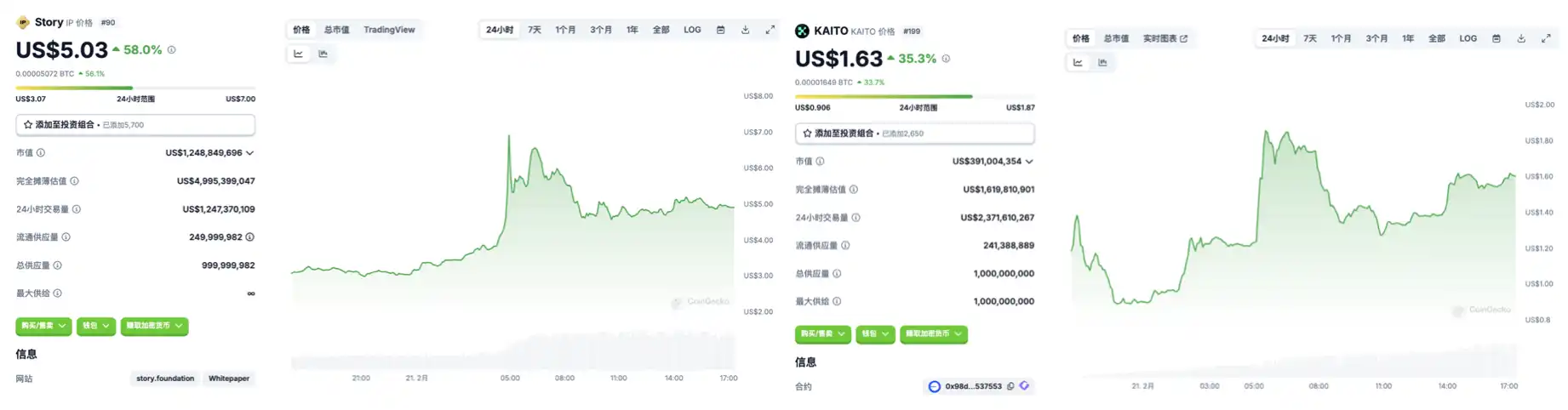
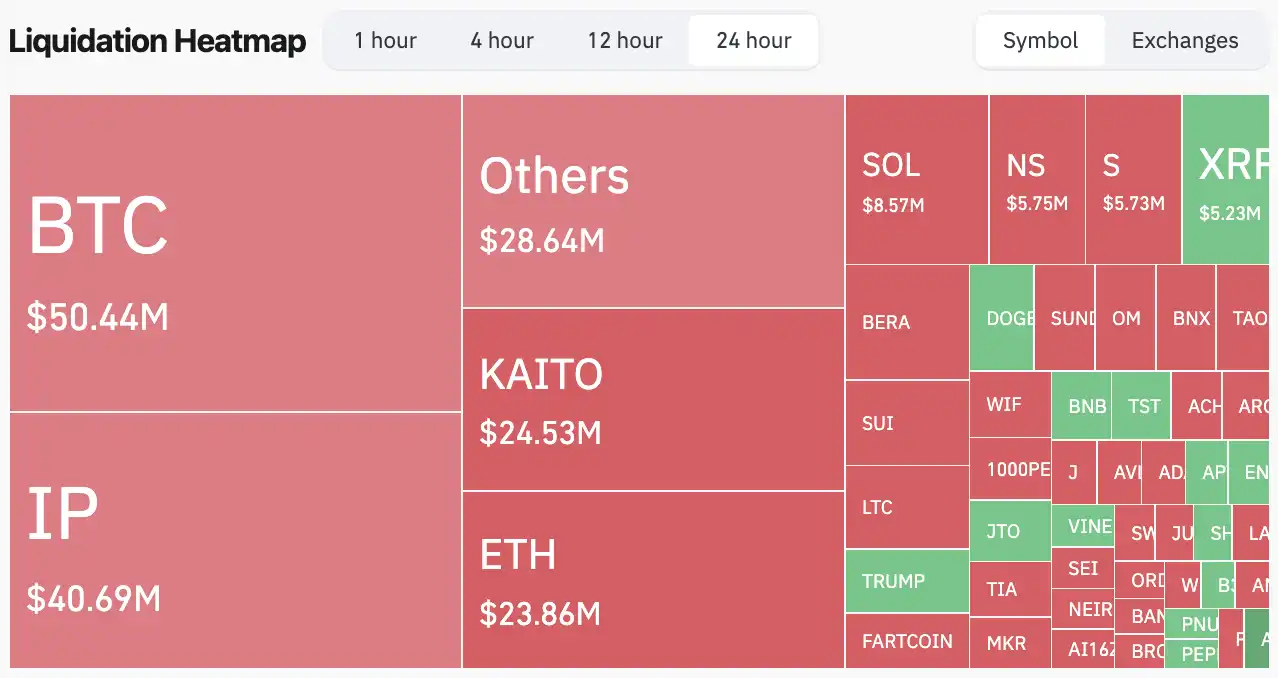
Market data shows that the IP contract price on the OKX platform reached $9 in the early hours of today, with a spot price of $8.96, up about 550% from the low on February 16. Coinglass data shows that the total liquidation in the IP contract trading on the network in the last 24 hours was $40.69 million, second only to BTC contract trading (liquidation of $50.44 million), with long liquidation of $10.38 million and short liquidation of $30.31 million.
Meanwhile, KAOTO's trading volume surpassed $2.5 billion, with a total network contract liquidation of $24.53 million, ranking third across the network in 24 hours, second only to BTC and IP, with long liquidation of $10.31 million and short liquidation of $14.22 million.
Why is there a liquidation frenzy?
Many investors exclaimed that this kind of market behavior is not common market behavior at all but more like the sophisticated manipulation of whales, market makers, or operators who believe that the cost of quickly driving up the price is far lower than consuming the positions of retail traders in liquidation.
In the past, when the price of a token rose, there would usually be a profound narrative, but the current situation is that fundamentals and price are barely related.
Some time ago, token burns by PENGU, or price buybacks by JUP did not cause a particularly significant reaction at the price level. Since "if you don't like it, you can short it" has become a consensus, the so-called "fundamentals" of new coins are hardly noticed by anyone. As long as the contract is launched, the whole network experiences a situation where negative rates are maxed out, and the bears rush in. "Profound narratives" are a thing of the past, and market trading behavior is now dominated by funds and contract leverage.
And when the mindset of retail investors is formed, the next step is harvesting. You can already see clues from the IP liquidation data: when everyone is on the "short" side, the whales only need to invest a relatively limited amount of money to drive up the coin price, allowing them to "consume" the liquidation positions of retail traders and profit from "contract liquidation."
Some in the community jokingly refer to it as "there are no retail investors who wake up at 4 a.m. and use $100 million to push the price to $9; this is the work of whales." For whales, rapidly pumping the price in the short term to benefit from the liquidation of short positions is often faster and more direct than slowly accumulating on the secondary market. Once those shorting retail investors are liquidated in a turn of events, whales can lock in profits at a high price. This back-and-forth movement of funds tilting towards whales makes the subsequent price manipulation easier.
The reason new coins can play this way is fundamentally because their liquidity and circulation are not as abundant as mainstream coins, allowing large funds to easily manipulate the market. If the hype is sufficient in the short term, whales are still willing to test the retail investors' loss tolerance.
Although many people love to summarize the market with "it won't rise if everyone is bullish," in the high-leverage, high-volatility ecosystem of new coin contracts, this rule is often amplified by the market's reflexivity. In short: as soon as the shorts become mainstream, whales often choose to liquidate them all. However, there is not a single way to liquidate the weak hands; market whales can both pump up the price and massively dump it when retail investors switch to "buying the dip" long positions. Therefore, simple "mindlessly chasing long" or "mindlessly longing" strategies may lead to being harvested.
With each round of the new coin myth, many people may harbor a sense of luck, thinking they are quick enough to avoid being harvested. However, most of the harvested weak hands initially thought they could take profits at the right time, but the outcome often leads to quicker liquidation triggers than imagined.
In this battle between retail investors and whales, in a market where everyone wants to short, whales, who nurture market groupthink, excel at harvesting during chaos, with reflexivity and capital leverage as their double-edged sword. To stay alert, the only thing one can rely on is perhaps a respect for risk and an understanding of market mechanisms. After all, the one who laughs last must have understood the logic and techniques behind the scenes, rather than blindly following the crowd. Whether the next price movement continues to skyrocket or plummet, rational and cautious behavior is always the best strategy.
You may also like

How TradeXYZ, xStocks, and Alpaca break down the SpaceX IPO into three different strategies

Why Is BlackRock Investing $5 Billion in the SpaceX IPO?

Cryptocurrency market makers collectively seek change as it becomes increasingly difficult to make money

a16z Crypto Partner: Cash flow is the moat

Citibank releases "2030 Asset Tokenization Market Outlook": 6 major trends may create a $8.2 trillion market

The trillion-dollar valuation test: Are the three major super IPOs a celebration for tech stocks or a nightmare for the crypto market?

Morning Report | Digital Asset completes $355 million financing led by a16z Crypto; Meta completes operational separation from Manus
Morning News | CME Group launches Nasdaq Cryptocurrency Index futures; Asset management giant Janus Henderson strategically invests in Ethena

Bitcoin Layer 2 Network Botanix: Why Did We Choose to Dissolve?

Why did Oracle deliver the strongest financial report in history, yet its stock price fell?
When the P2P illicit funds from ten years ago turned into 60,000 bitcoins

Dialogue with OmenX Founder: Why does the prediction market need an evolution from "spot" to "derivatives"?
Galaxy in-depth report: Is Solana still worth paying attention to?

Young people in South Korea make a "final effort" in the epic bull market
The pricing controversy of Trade.xyz exposes the fatal weakness of Pre-IPO perpetual contracts
How much longer can Ethereum's last big buyer hold on?

World Cup 2026 Coming – WEEX Celebrates with $1M Prize Pool & Michael Owen Live

Morning Report | OpenAI has submitted an S-1 registration statement draft to the U.S. SEC; Morpho completes $175 million financing
How TradeXYZ, xStocks, and Alpaca break down the SpaceX IPO into three different strategies
Why Is BlackRock Investing $5 Billion in the SpaceX IPO?
Cryptocurrency market makers collectively seek change as it becomes increasingly difficult to make money
a16z Crypto Partner: Cash flow is the moat
Citibank releases "2030 Asset Tokenization Market Outlook": 6 major trends may create a $8.2 trillion market
The trillion-dollar valuation test: Are the three major super IPOs a celebration for tech stocks or a nightmare for the crypto market?


