
 Buy Crypto
- Markets
 Futures
- Spot
- Copy Trade
- Earn
- More
Buffett's Latest Interview: Sold Apple Too Early, But It's Not Yet Time to Buy the Dip


Original Title: "95-Year-Old Buffett Said 7 Things: Now is Not the Time to Bottom Fish, Nuclear Weapons Will Sooner or Later Be Used"
Original Author: Kuri, Deep Tide TechFlow
Yesterday, Buffett was interviewed by American CNBC.
This is the first time he sat down for such a long chat since stepping down as Berkshire Hathaway's CEO on January 1st this year. At 95 years old, steering the ship for sixty years, handing over the reins to Greg Abel, theoretically, he could have stopped talking.
But he talked about Apple, the Fed, Bill Gates and Epstein, Iran's nuclear weapons, and also announced, in passing, that his charity lunch, after a four-year hiatus, is going to be held again.
There's a lot of information, let's go through it point by point.
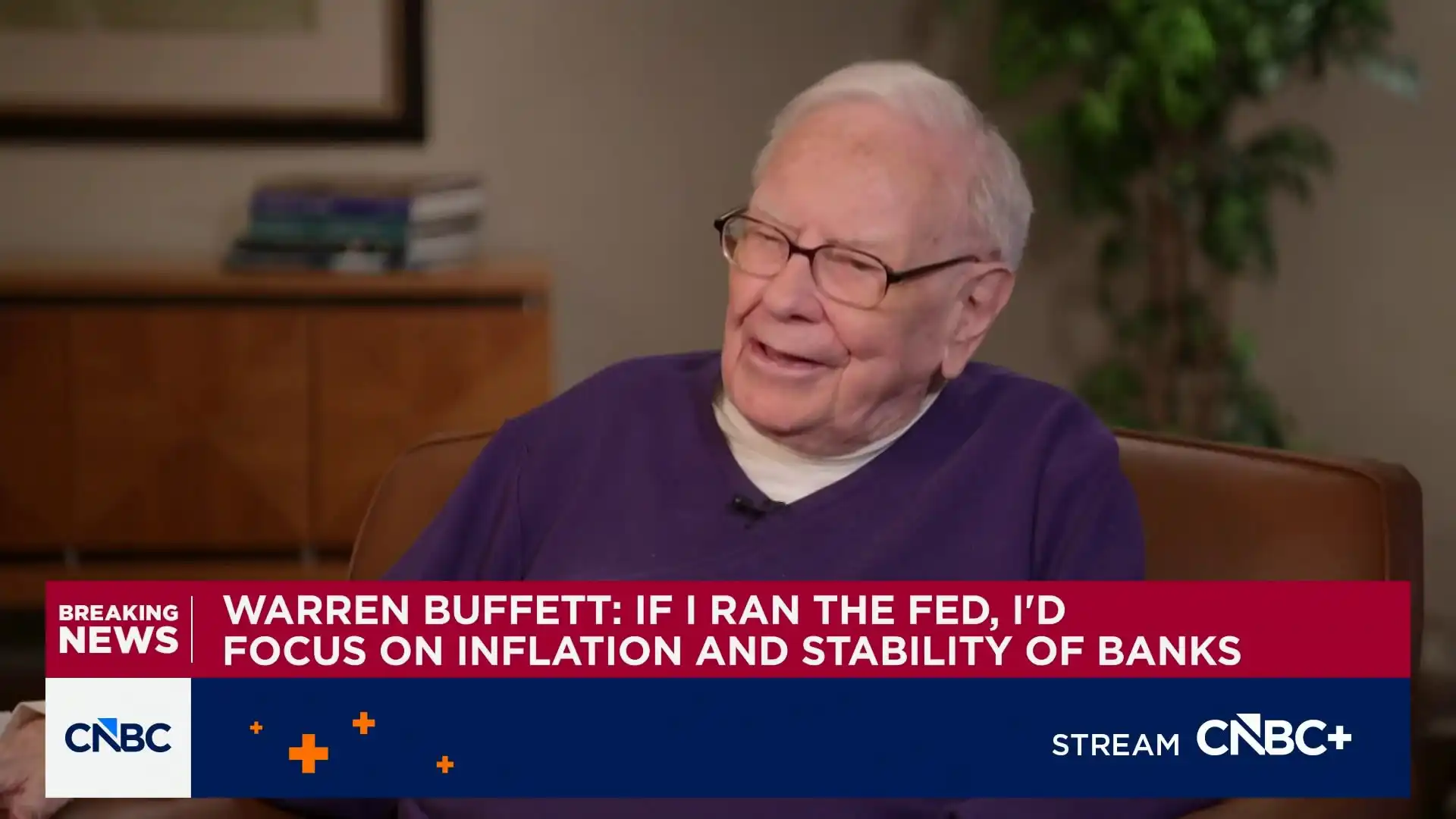
One, Went to Work on His First Day of Retirement
Buffett said he still goes to the office every day.
Every day before the market opens, he calls Berkshire's Chief Financial Officer Mark Millard to discuss market trends and trades. Millard's office is about six meters away from him. After the call, he goes to execute the trade. When asked if there have been any new transactions recently, Buffett said yes, he made a tiny transaction, but did not disclose what he bought.
He also drew a line: he will not make any investments that Abel does not agree with, and Abel receives a daily summary of investment activities.
This arrangement sounds like saying "the ultimate decision-making power lies with the new CEO," but viewed another way, it also means that the 95-year-old former CEO is present every day, participating every day, trading every day, while the successor works six meters away from him.
In the interview, Buffett praised Abel repeatedly, saying Abel does more in a day than he did in a week at his peak, and he would rather have him manage his money than give it to any top investment advisor in the United States.
He retired nominally. But this "retirement" is more like transitioning from CEO to someone sitting next to him.
Two, Sold Apple Early, But Not Buying Now Either
In this interview, Buffett admitted one thing: Berkshire sold Apple too early.
The original quote is: "I sold it too soon. But, I bought it even sooner, so."
The translation is that he sold early, but he bought even earlier, so he still made a profit. According to him, Berkshire's pre-tax profit from this Apple investment exceeded $100 billion.
The timeline is as follows: Berkshire started buying Apple around 2016, with the position peaking at over $170 billion, the largest single position in Berkshire's history.
Between 2023 and 2024, Berkshire reduced its Apple position by about two-thirds. As of the end of last year, according to SEC filings, Berkshire held about 22.79 million Apple shares, valued at about $62 billion, still accounting for 22.6% of the entire investment portfolio, remaining the largest position.
Buffett said, "Apple is better than any company Berkshire fully owns."
Berkshire's railroad company BNSF has a higher market value than the Apple position, but Apple still ranks first in holdings. He also praised Apple CEO Cook as a "fantastic manager," saying that Cook somehow manages to get along with everyone in the world.
When asked if he would increase the position again, Buffett gave a conditional answer: it's not impossible, if Apple's price drops to a certain level, Berkshire will buy a lot. But not now, "not in this market."
Apple has already dropped more than 14% from its high this year, but in Buffett's opinion, it hasn't reached a price point where he is willing to buy.
III. Dropped 50% three times, what's this little bit now
The U.S. stock market doesn't look good this year. As of the interview day, the Dow was down about 5% year-to-date, the S&P 500 was down about 6%, and the Nasdaq was down about 9%. Apple itself has retraced over 14% from its yearly high.
Buffett's reaction to this is: there's nothing to get excited about.
He said that since taking over Berkshire, the company's stock price has dropped by more than 50% at least three times. Compared to those, the current drop is nothing.
He also showed no inclination to make a major move. For him, the current market is far from those historical moments that "created great opportunities."
In just a few short sentences, the message is both to stay calm and not to expect me to buy the dip now.
IV. The Inflation Target Should Be Zero
When asked whether the Fed is currently more worried about inflation or employment, Buffett didn't take sides directly but made a bigger statement: he hopes the Fed's inflation target is zero.
His logic is that once you say you can tolerate 2% inflation, this number becomes very significant over the long term due to compounding. Moreover, for the average person, if you save money and earn 2% interest, but then have to pay taxes on that 2%, it means that in reality, your purchasing power is eroding.
Buffett also mentioned that rather than employment data, he is more concerned about the U.S. dollar's status as the global reserve currency and the stability of the banking system.
He praised Fed Chair Powell's decisive action during the outbreak of the pandemic in March 2020, saying that if they had acted two or three weeks later, it would have been a disaster; "once the dominoes start falling, they fall much faster than anyone expects." In Buffett's mind, Powell and Paul Volcker, who tamed inflation with aggressive rate hikes in the 1980s, are the two most respectable figures in Fed history.
However, he is not without criticism of the Fed. In his view, a 2% inflation target is a mistake because essentially, you're telling everyone that saving is inferior to spending.
V. The Charity Lunch Is Back
One person's passing led Buffett to change his mind.
Cecil Williams, the founder of the Glide Foundation, passed away in 2024. Glide is a charity organization in San Francisco that helps the homeless, where Buffett's ex-wife Susan volunteered for a long time. Starting in 2000, Buffett annually auctioned a lunch with himself, with all proceeds going to Glide. This tradition lasted for 22 years, and after the last one in 2022, Buffett said he wouldn't do it anymore.
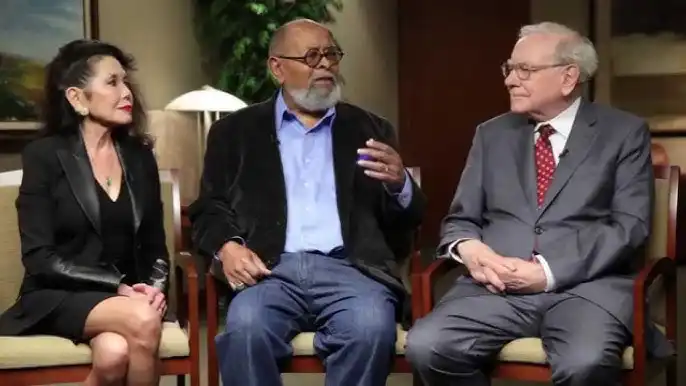
Image: Cecil Williams in the center
However, Cecil's passing changed his mind. Buffett stated that when Cecil passed away, he believed Glide should not perish.
This time, the new lunch has a different format.
Buffett is no longer going solo, his partner is NBA four-time champion Curry and his wife Ayesha Curry. The auction starts on May 7th on eBay with a starting price of $50,000, and the winning bidder can bring up to seven guests to have lunch with the three of them in Omaha on June 24th. Half of the auction proceeds will go to Glide and the other half to the Curry family's Eat. Learn. Play. Foundation, a charity organization that helps Oakland youth.
The last time there was a crypto-related auction was in 2019, when Tron founder Justin Sun spent $4.57 million. After that, Buffett donated the Bitcoin Sun had gifted him.
Six, No More Gates Connection
This is the first time Buffett has publicly mentioned Bill Gates since stepping down.
He said that since the Epstein-related documents were made public, he hasn't spoken to Gates again. The exact words were: "I don't want to be in a position where I know things ... to be called as a witness." He doesn't want to know too much, doesn't want to be subpoenaed as a witness.
Buffett and Gates' relationship has lasted for decades. The two jointly launched "The Giving Pledge" in 2010, calling on the world's wealthiest people to commit to donating most of their wealth to charity. Since 2006, Buffett has donated over $43 billion to the Gates Foundation.
Gates' association with Epstein began in 2011, three years after Epstein pleaded guilty to sex crimes in Florida in 2008. Since the end of last year, the U.S. Department of Justice and Congress have successively released a large amount of relevant documents, and emails and photos between Gates and Epstein have also been exposed.
According to The Wall Street Journal, Gates apologized to Gates Foundation employees in February this year, admitting to having interacted with Epstein and confessing to extramarital affairs. Gates has accepted an invitation from the U.S. House Oversight Committee to testify on this matter, but the date has not yet been determined.
When asked if he is still good friends with Gates, Buffett's tone was very restrained. He mentioned their past together in founding The Giving Pledge, but then said:
"I think there is no need to say much until things are clear."
7. Nuclear Weapons Will Be Used Sooner or Later
At the end of the interview, the conversation turned to Iran.
Buffett said that there are currently nine countries in the world with nuclear weapons. During the Cold War, there were only two, the United States and the Soviet Union, and everyone was already on edge. But at that time, the decision-makers on both sides could at least be considered rational. Now, the situation is completely different.
He specifically mentioned Iran and North Korea. He said the most dangerous situation is when the person with their finger on the nuclear button is either nearing death or facing immense disgrace. In such a scenario, no one can predict what decision someone might make.
When asked how he would advise on handling Iran's uranium enrichment issue if he were an advisor to the U.S. president, Buffett did not give specific advice but rather made a statement that sounded like determinism: Within the next hundred years, perhaps two hundred years, nuclear weapons will be used. He doesn't know exactly how it will happen, but he believes it's a probability issue—the more countries that possess nuclear weapons, the higher the probability.
Regarding whether Iran should have nuclear weapons, he only said: If Iran had a nuclear bomb, things would be even more complicated than they are without it.
A 95-year-old man who has witnessed the end of World War II, the entire Cold War, the Cuban Missile Crisis, the dissolution of the Soviet Union... left a thought-provoking judgment at the end of the interview.
The interview lasted about an hour, covering all possible topics.
However, the most intriguing detail throughout the whole process for the author was this: Warren Buffett, at 95 years old, having stepped down three months ago, did not say a single word in front of the camera about "looking back" or "summarizing his life."
All his words were about looking ahead.
Should Apple still be bought, how should the Fed set its goals, how will the situation in Iran develop, what should be done about the new charity lunch... The host Becky Quick, sitting across from him, gave him many opportunities to reminisce, but he did not take any of them.
You seldom see someone who has relinquished power, yet their interest in the future remains greater than their interest in the past.
Even when the Oracle of Omaha ages, he may still be the Oracle. It's just that before, he voted with money, and now he votes with judgment.
You may also like

Morning News | The Hong Kong Securities and Futures Commission announced the regulatory framework for secondary market trading of tokenized investment products; Strategy increased its holdings by 34,164 bitcoins last week; KAIO completed a strategic fi...

What Is an XRP Wallet? The Best Wallets to Store XRP (2026 Updated)
An XRP wallet lets you safely store, send, and receive XRP on the XRP Ledger. Learn what wallets support XRP and discover the best XRP wallets for beginners and long-term holders in 2026.

What are the Top AI Crypto Coins? Render vs. Akash: 5 Gems Solving the 2026 GPU Crisis
What are the best AI crypto coins for the 2026 cycle? Beyond the hype, we analyze top tokens like RNDR, AKT, and FET that provide real-world solutions to the global GPU shortage and the rise of autonomous agents.

What Is a Token in AI? What Is an AI Token + 3 Gems You Can't Miss in 2026
The era of AI hype has transitioned into an era of utility. As we move through Q2 2026, the market is no longer rewarding "narrative-only" projects. At WEEX Research, we are seeing a massive capital rotation into Decentralized Compute (DePIN) and Autonomous Agent coordination layers. This guide analyzes which AI tokens are capturing institutional liquidity and how to spot high-conviction setups in a maturing market.

Consumer-grade Crypto Global Survey: Users, Revenue, and Track Distribution

Prediction Markets Under Bias

Stolen: $290 million, Three Parties Refusing to Acknowledge, Who Should Foot the Bill for the KelpDAO Incident Resolution?

ASTEROID Pumped 10,000x in Three Days, Is Meme Season Back on Ethereum?

ChainCatcher Hong Kong Themed Forum Highlights: Decoding the Growth Engine Under the Integration of Crypto Assets and Smart Economy

Why can this institution still grow by 150% when the scale of leading crypto VCs has shrunk significantly?

Anthropic's $1 trillion, compared to DeepSeek's $100 billion

Geopolitical Risk Persists, Is Bitcoin Becoming a Key Barometer?

Annualized 11.5%, Wall Street Buzzing: Is MicroStrategy's STRC Bitcoin's Savior or Destroyer?
An Obscure Open Source AI Tool Alerted on Kelp DAO's $292 million Bug 12 Days Ago

Mixin has launched USTD-margined perpetual contracts, bringing derivative trading into the chat scene.
The privacy-focused crypto wallet Mixin announced today the launch of its U-based perpetual contract (a derivative priced in USDT). Unlike traditional exchanges, Mixin has taken a new approach by "liberating" derivative trading from isolated matching engines and embedding it into the instant messaging environment.
Users can directly open positions within the app with leverage of up to 200x, while sharing positions, discussing strategies, and copy trading within private communities. Trading, social interaction, and asset management are integrated into the same interface.
Based on its non-custodial architecture, Mixin has eliminated friction from the traditional onboarding process, allowing users to participate in perpetual contract trading without identity verification.
The trading process has been streamlined into five steps:
· Choose the trading asset
· Select long or short
· Input position size and leverage
· Confirm order details
· Confirm and open the position
The interface provides real-time visualization of price, position, and profit and loss (PnL), allowing users to complete trades without switching between multiple modules.
Mixin has directly integrated social features into the derivative trading environment. Users can create private trading communities and interact around real-time positions:
· End-to-end encrypted private groups supporting up to 1024 members
· End-to-end encrypted voice communication
· One-click position sharing
· One-click trade copying
On the execution side, Mixin aggregates liquidity from multiple sources and accesses decentralized protocol and external market liquidity through a unified trading interface.
By combining social interaction with trade execution, Mixin enables users to collaborate, share, and execute trading strategies instantly within the same environment.
Mixin has also introduced a referral incentive system based on trading behavior:
· Users can join with an invite code
· Up to 60% of trading fees as referral rewards
· Incentive mechanism designed for long-term, sustainable earnings
This model aims to drive user-driven network expansion and organic growth.
Mixin's derivative transactions are built on top of its existing self-custody wallet infrastructure, with core features including:
· Separation of transaction account and asset storage
· User full control over assets
· Platform does not custody user funds
· Built-in privacy mechanisms to reduce data exposure
The system aims to strike a balance between transaction efficiency, asset security, and privacy protection.
Against the background of perpetual contracts becoming a mainstream trading tool, Mixin is exploring a different development direction by lowering barriers, enhancing social and privacy attributes.
The platform does not only view transactions as execution actions but positions them as a networked activity: transactions have social attributes, strategies can be shared, and relationships between individuals also become part of the financial system.
Mixin's design is based on a user-initiated, user-controlled model. The platform neither custodies assets nor executes transactions on behalf of users.
This model aligns with a statement issued by the U.S. Securities and Exchange Commission (SEC) on April 13, 2026, titled "Staff Statement on Whether Partial User Interface Used in Preparing Cryptocurrency Securities Transactions May Require Broker-Dealer Registration."
The statement indicates that, under the premise where transactions are entirely initiated and controlled by users, non-custodial service providers that offer neutral interfaces may not need to register as broker-dealers or exchanges.
Mixin is a decentralized, self-custodial privacy wallet designed to provide secure and efficient digital asset management services.
Its core capabilities include:
· Aggregation: integrating multi-chain assets and routing between different transaction paths to simplify user operations
· High liquidity access: connecting to various liquidity sources, including decentralized protocols and external markets
· Decentralization: achieving full user control over assets without relying on custodial intermediaries
· Privacy protection: safeguarding assets and data through MPC, CryptoNote, and end-to-end encrypted communication
Mixin has been in operation for over 8 years, supporting over 40 blockchains and more than 10,000 assets, with a global user base exceeding 10 million and an on-chain self-custodied asset scale of over $1 billion.

$600 million stolen in 20 days, ushering in the era of AI hackers in the crypto world
Vitalik's 2026 Hong Kong Web3 Summit Speech: Ethereum's Ultimate Vision as the "World Computer" and Future Roadmap
On the same day Aave introduced rsETH, why did Spark decide to exit?
Morning News | The Hong Kong Securities and Futures Commission announced the regulatory framework for secondary market trading of tokenized investment products; Strategy increased its holdings by 34,164 bitcoins last week; KAIO completed a strategic fi...
What Is an XRP Wallet? The Best Wallets to Store XRP (2026 Updated)
An XRP wallet lets you safely store, send, and receive XRP on the XRP Ledger. Learn what wallets support XRP and discover the best XRP wallets for beginners and long-term holders in 2026.
What are the Top AI Crypto Coins? Render vs. Akash: 5 Gems Solving the 2026 GPU Crisis
What are the best AI crypto coins for the 2026 cycle? Beyond the hype, we analyze top tokens like RNDR, AKT, and FET that provide real-world solutions to the global GPU shortage and the rise of autonomous agents.
What Is a Token in AI? What Is an AI Token + 3 Gems You Can't Miss in 2026
The era of AI hype has transitioned into an era of utility. As we move through Q2 2026, the market is no longer rewarding "narrative-only" projects. At WEEX Research, we are seeing a massive capital rotation into Decentralized Compute (DePIN) and Autonomous Agent coordination layers. This guide analyzes which AI tokens are capturing institutional liquidity and how to spot high-conviction setups in a maturing market.



 App
App