
Bloomberg: $1.3 Billion Accounting Loss, Is Tom Lee's Ethereum Bet Facing Collapse?


Original Title: Tom Lee's Big Crypto Bet Buckles Under Mounting Market Strain
Original Author: Sidhartha Shukla, Bloomberg
Original Translation: Chopper, Foresight News
The Ethereum corporate treasury experiment is currently on the verge of collapse.
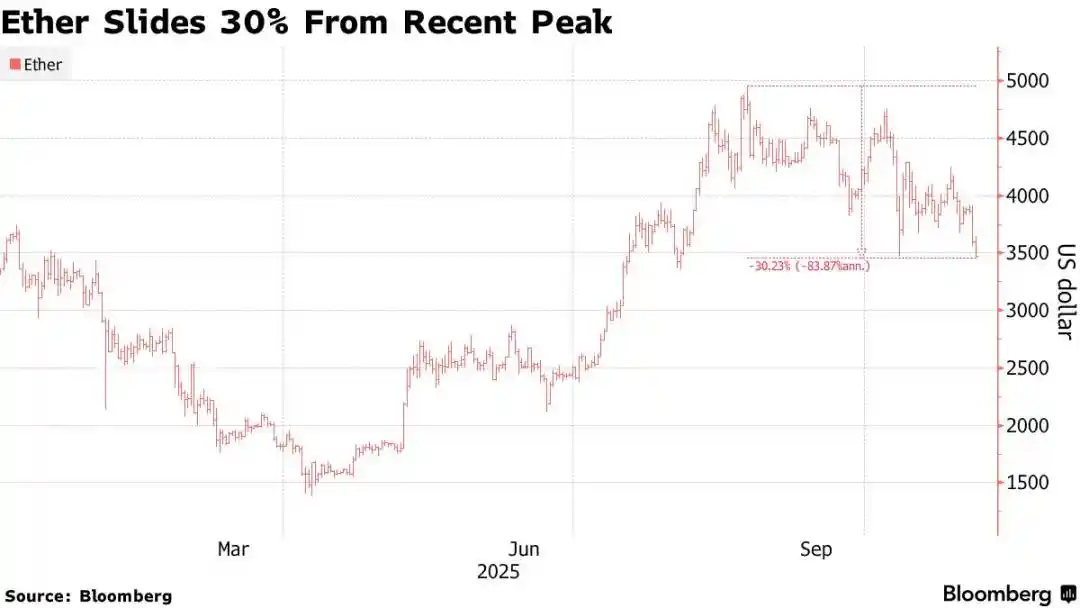
The world's second-largest cryptocurrency dropped below $3,300 on Tuesday, in sync with the market's benchmarks such as Bitcoin and tech stocks. This decline has pushed Ethereum's price down by 30% from its August peak, falling to levels before the large-scale corporate buy-in, further solidifying its bearish trend.
According to research firm 10x Research, this reversal has put Ethereum's most fervent corporate supporter, Bitmine Immersion Technologies Inc., at a staggering $1.3 billion paper loss. This publicly traded company, backed by billionaire Peter Thiel and led by Wall Street analyst Tom Lee, whose strategy mimicked Michael Saylor's Bitcoin treasury model, purchased 3.4 million Ethereum at an average price of $3,909. Today, Bitmine's treasury is fully deployed and facing increasing pressure.
10x stated in its report, "For months, Bitmine has been driving the market narrative and fund flows. Now with its treasury fully deployed, facing a paper loss of over $1.3 billion, and no available additional funds."
The report notes that retail investors who bought Bitmine stock at a premium to net asset value (NAV) have suffered even greater losses, and the market's willingness to catch falling knives is limited.
Lee did not immediately respond to a request for comment, and representatives from Bitmine did not respond immediately either.
Bitmine's bet is far from a simple asset-liability trade. Behind the company's accumulation is a grander vision: the transition of digital assets from speculative tools to corporate financial infrastructure, thereby cementing Ethereum's position in the mainstream financial realm. Supporters believe that by integrating Ethereum into a publicly traded company's asset treasury, enterprises will help build an entirely new decentralized economy. In this economic system, code replaces contracts, and tokens serve as assets.
This logic drove the summer bull run. Ethereum's price once approached $5000, and only in July and August, Ethereum ETFs attracted over $90 billion in inflows. However, after the crypto market crash on October 10, the situation reversed: according to Coinglass and Bloomberg compiled data, Ethereum ETFs saw outflows of $8.5 billion, and Ethereum futures' open interest decreased by $16 billion.
Lee had previously predicted that Ethereum would reach $16,000 by the end of this year.
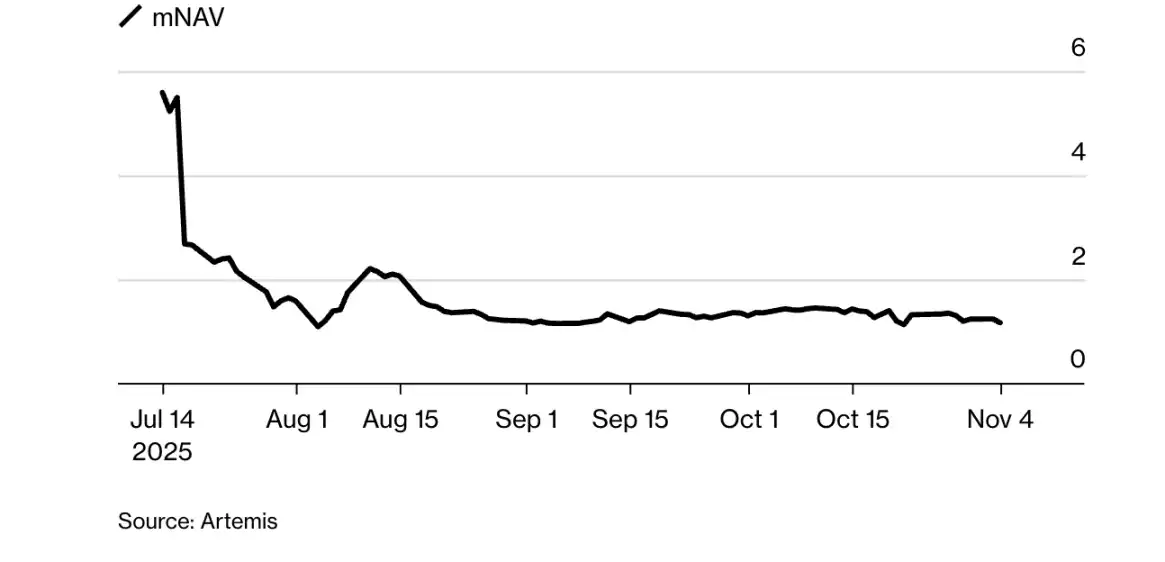
Bitmine's Net Asset Value (mNAV) Premium Decline
According to Artemis data, Bitmine's market cap to net asset value multiple has plummeted from 5.6 in July to 1.2, with its stock price falling 70% from its peak. Similar to other Bitcoin-related companies before it, Bitmine's stock price is now closer to its underlying asset value, as the market reevaluates the once high valuation of its crypto asset balance sheet.
Last week, another publicly traded Ethereum treasury company, ETHZilla, sold $40 million worth of Ethereum holdings to buy back shares, aiming to bring its modified Net Asset Value (mNAV) ratio back to a normal level. The company stated in a press release at that time: "ETHZilla plans to use the proceeds from the remaining Ethereum sales for further share buybacks and intends to continue selling Ethereum to repurchase shares until the discount to Net Asset Value normalizes."
Despite the price decline, Ethereum's long-term fundamentals appear to remain strong: its on-chain value processed still exceeds that of all competing smart contract networks, and the staking mechanism gives the token both yield attributes and deflationary properties. However, as competitors like Solana gain momentum, ETF flows reverse, and retail interest wanes, the narrative of "institutional stability in cryptocurrency prices" is gradually losing relevance.
You may also like

How much longer can Ethereum's last big buyer hold on?

The pricing controversy of Trade.xyz exposes the fatal weakness of Pre-IPO perpetual contracts

World Cup 2026 Coming – WEEX Celebrates with $1M Prize Pool & Michael Owen Live

Galaxy in-depth report: Is Solana still worth paying attention to?
Young people in South Korea make a "final effort" in the epic bull market

Dialogue with OmenX Founder: Why does the prediction market need an evolution from "spot" to "derivatives"?
When the P2P illicit funds from ten years ago turned into 60,000 bitcoins

Morning News | CME Group launches Nasdaq Cryptocurrency Index futures; Asset management giant Janus Henderson strategically invests in Ethena
Why did Oracle deliver the strongest financial report in history, yet its stock price fell?

Bitcoin Layer 2 Network Botanix: Why Did We Choose to Dissolve?

Morning Report | OpenAI has submitted an S-1 registration statement draft to the U.S. SEC; Morpho completes $175 million financing

Galaxy Deep Research Report: How Hyperliquid's HIP-4 Upgrade Changes the Landscape of Prediction Markets?

Latest research from 13 top universities including Cornell University: The current state, challenges, and misconceptions of the fusion of Crypto and AI
Deconstructing Anthropic: The Best AI Company, Possibly Also a Type of Organizational Invention

Every exchange is a "Universal Exchange."

The counterattack of traditional finance: Alliance chains are quietly reviving
Pantera Capital Partner: How Tokenization is Restructuring the Private Equity and Early Investment Ecosystem?

Mastercard Launches Agent Pay for AI, Plans to Record AI Agent Payment Authorizations on Polygon
Mastercard launched Agent Pay for AI, a new payment protocol designed to help AI agents make small payments such as pay-per-use access to data and APIs. The system plans to record human-granted AI agent permissions on Polygon, focusing on verifiable authorization, identity, and payment controls.
How much longer can Ethereum's last big buyer hold on?
The pricing controversy of Trade.xyz exposes the fatal weakness of Pre-IPO perpetual contracts
World Cup 2026 Coming – WEEX Celebrates with $1M Prize Pool & Michael Owen Live
Galaxy in-depth report: Is Solana still worth paying attention to?
Young people in South Korea make a "final effort" in the epic bull market
Dialogue with OmenX Founder: Why does the prediction market need an evolution from "spot" to "derivatives"?


