
 Buy Crypto
- Markets
 Futures
- Spot
- Copy Trade
- Earn
- More
Bitcoin Enters Bond Market, Moody's Provides First-Ever Rating for Global Cryptocurrency-Backed Bond

Original Title: "Bitcoin Enters the Municipal Bond Market, Moody's Issues First-Ever Credit Rating for Crypto-Backed Bond"
Original Author: Sanqing, Foresight News
On March 31, Moody's Investors Service provided a provisional credit rating of Ba2 for a Bitcoin-backed bond issued by the New Hampshire Business Finance Authority (New Hampshire BFA) in the United States. This marks the first time a traditional rating agency has conducted a credit assessment of a Bitcoin-backed municipal bond.
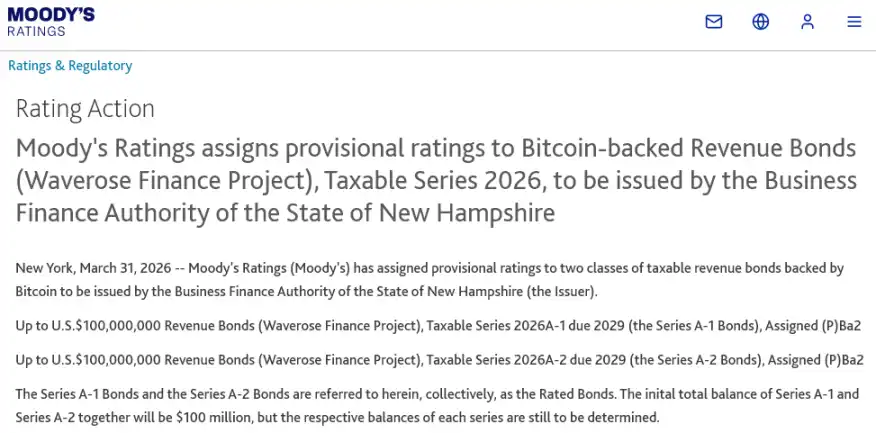
Image Source: MOODY'S Ratings & Regulatory
What Is This Bond?
This is a $100 million Bitcoin-backed taxable revenue bond linked to the Waverose Finance Project, divided into two series: 2026A-1 and 2026A-2, both maturing in 2029.
The bond was structured by Wave Digital Assets, Rosemawr Management serves as the investment manager, Orrick provides legal services, and the fees BFA receives from the transaction will be used to establish the "Bitcoin Economic Development Fund."
The core of the bond's structure does not rely on any entity's cash flow but instead directly repays using Bitcoin as collateral. The Bitcoin collateral is custody by BitGo Trust Company, Inc., held in regulated cold storage.
When the borrower needs to pay interest or repay principal, the collateral will be liquidated to cover the expenses. The bond also features a term favorable to holders. A-2 series holders have the right to receive additional BTC profit sharing if the Bitcoin price is higher than the pricing date at maturity after full principal and interest repayment.
Compared to Bitcoin lending tools on platforms like Coinbase, the significance of this bond lies in the fact that it has provided cryptocurrency with an opportunity to enter the public debt market for the first time. Borrowers no longer rely on private loans from centralized platforms but, by obtaining a traditional credit-rated public bond, can leverage institutional funds at scale and low cost within a compliant framework.
How Institutions Evaluate Bitcoin Risk
Moodys stated in a report that the provisional rating primarily reflects risks related to collateral, structure, and operations, with Bitcoin's high volatility being a key consideration.
To hedge against price volatility, the issuance structure introduced a 1.6x excess collateral requirement, with the BTC collateral value always required to be maintained above 160% of the debt exposure.
Once the collateral ratio falls to the 1.4x trigger line (i.e., LTV deteriorates to around 71%), a mandatory full redemption mechanism will be triggered, the bond will mature prematurely, and the Bitcoin will be liquidated for repayment.
In other words, to borrow $100, you must pledge at least $160 worth of Bitcoin. If the collateral value shrinks to below $140, the system will trigger a forced redemption, the bond will mature early, and the Bitcoin will be sold to repay the debt.
In the rating report, Moodys adopted a 72% advance rate and a shorter liquidation window to assess conservatism, simulating an extreme scenario where the Bitcoin price drops by around 28% from the pricing date. The test showed that the 1.6x initial excess collateral and 1.4x trigger mechanism still provide sufficient protection, supporting the Ba2 rating result.
This set of parameters is quite conservative, but for an asset with a historical drawdown of over 50%, this conservatism may also be a prerequisite for Moody's willingness to provide a rating.
Another detail worth noting separately is that, although this bond is named after the New Hampshire Business Finance Authority, it has no association with the state's public credit. Moodys clearly stated in the report that no public funds from the state can be used to repay the bond.
The issuer plays the role of a conduit issuer in the structure. It provides the issuance channel and nominal endorsement but does not take on any credit backstop responsibility.
This structure is not uncommon in the traditional municipal bond field and is typically used for special project financing in areas such as healthcare and education.
Why This Transaction is Important
To understand the historical significance of this bond, it needs to be viewed in a larger context.
Over the past few years, institutions' attitude towards Bitcoin has gone through three stages: from rejection to holding the asset (BTC reserves on the corporate balance sheet), and then to using it as collateral for financing (pledging BTC in exchange for fiat loans). This bond represents the beginning of the fourth stage: Bitcoin as the underlying collateral for a publicly rated debt instrument, entering the traditional public financial markets.
This track implies three things: opening a window for institutional investors to indirectly hold Bitcoin exposure through compliant channels; prompting Moody's to develop a rating methodology for crypto collateral, attracting more rating agencies to follow suit; demonstrating that Bitcoin can serve as an underlying logic for an "interest-bearing asset" under certain conditions, rather than just a zero-yield asset.
This bond issuance is not an isolated event. Concurrently, the US Department of Labor, under President Trump's executive order, issued a proposal to expand the range of digital assets available in retirement investment portfolios; multiple states are considering "Bitcoin Treasury Reserve" legislation; and New Hampshire became the first US state to pass a cryptocurrency reserve law.
At face value, a Ba2 rating is considered "junk bond" status, but this label itself can be misleading. In Moody's rating sequence, Ba2 is in the second tier of speculative grade, with a considerable distance from the bottom of the rating scale (C/D).
Tesla only achieved investment-grade ratings from S&P and Moody's in 2022 and 2023; Ford still maintains a speculative grade (Ba1) within the Moody's system, and barely holds the lowest investment-grade tier in the S&P system with a negative outlook. However, this does not prevent them from being key allocations for institutional investors.
Furthermore, the fact that this bond could attain a Ba2 instead of lower reflects that the 1.6x overcollateralization plus the forced liquidation mechanism passed relevant scenario simulations in Moody's stress tests. Therefore, Ba2 reflects the conservatism of the structural design, rather than a simple denial of the Bitcoin asset itself.
Looking back at historical precedents, the first MBS (mortgage-backed security) and the first green bond went through similar starting points when entering the rating system. As pricing experience accumulates and structural standards mature, ratings tend to improve. In this sense, Ba2 is merely a starting point.
You may also like

a16z: 5 Ways Blockchain Helps AI Agent Infrastructure

Morning News | The Hong Kong Securities and Futures Commission announced the regulatory framework for secondary market trading of tokenized investment products; Strategy increased its holdings by 34,164 bitcoins last week; KAIO completed a strategic fi...

What Is an XRP Wallet? The Best Wallets to Store XRP (2026 Updated)
An XRP wallet lets you safely store, send, and receive XRP on the XRP Ledger. Learn what wallets support XRP and discover the best XRP wallets for beginners and long-term holders in 2026.

What are the Top AI Crypto Coins? Render vs. Akash: 5 Gems Solving the 2026 GPU Crisis
What are the best AI crypto coins for the 2026 cycle? Beyond the hype, we analyze top tokens like RNDR, AKT, and FET that provide real-world solutions to the global GPU shortage and the rise of autonomous agents.

What Is a Token in AI? What Is an AI Token + 3 Gems You Can't Miss in 2026
The era of AI hype has transitioned into an era of utility. As we move through Q2 2026, the market is no longer rewarding "narrative-only" projects. At WEEX Research, we are seeing a massive capital rotation into Decentralized Compute (DePIN) and Autonomous Agent coordination layers. This guide analyzes which AI tokens are capturing institutional liquidity and how to spot high-conviction setups in a maturing market.

Consumer-grade Crypto Global Survey: Users, Revenue, and Track Distribution

Prediction Markets Under Bias

Stolen: $290 million, Three Parties Refusing to Acknowledge, Who Should Foot the Bill for the KelpDAO Incident Resolution?

ASTEROID Pumped 10,000x in Three Days, Is Meme Season Back on Ethereum?

ChainCatcher Hong Kong Themed Forum Highlights: Decoding the Growth Engine Under the Integration of Crypto Assets and Smart Economy

Why can this institution still grow by 150% when the scale of leading crypto VCs has shrunk significantly?

Anthropic's $1 trillion, compared to DeepSeek's $100 billion

Geopolitical Risk Persists, Is Bitcoin Becoming a Key Barometer?
Annualized 11.5%, Wall Street Buzzing: Is MicroStrategy's STRC Bitcoin's Savior or Destroyer?
An Obscure Open Source AI Tool Alerted on Kelp DAO's $292 million Bug 12 Days Ago

Mixin has launched USTD-margined perpetual contracts, bringing derivative trading into the chat scene.
The privacy-focused crypto wallet Mixin announced today the launch of its U-based perpetual contract (a derivative priced in USDT). Unlike traditional exchanges, Mixin has taken a new approach by "liberating" derivative trading from isolated matching engines and embedding it into the instant messaging environment.
Users can directly open positions within the app with leverage of up to 200x, while sharing positions, discussing strategies, and copy trading within private communities. Trading, social interaction, and asset management are integrated into the same interface.
Based on its non-custodial architecture, Mixin has eliminated friction from the traditional onboarding process, allowing users to participate in perpetual contract trading without identity verification.
The trading process has been streamlined into five steps:
· Choose the trading asset
· Select long or short
· Input position size and leverage
· Confirm order details
· Confirm and open the position
The interface provides real-time visualization of price, position, and profit and loss (PnL), allowing users to complete trades without switching between multiple modules.
Mixin has directly integrated social features into the derivative trading environment. Users can create private trading communities and interact around real-time positions:
· End-to-end encrypted private groups supporting up to 1024 members
· End-to-end encrypted voice communication
· One-click position sharing
· One-click trade copying
On the execution side, Mixin aggregates liquidity from multiple sources and accesses decentralized protocol and external market liquidity through a unified trading interface.
By combining social interaction with trade execution, Mixin enables users to collaborate, share, and execute trading strategies instantly within the same environment.
Mixin has also introduced a referral incentive system based on trading behavior:
· Users can join with an invite code
· Up to 60% of trading fees as referral rewards
· Incentive mechanism designed for long-term, sustainable earnings
This model aims to drive user-driven network expansion and organic growth.
Mixin's derivative transactions are built on top of its existing self-custody wallet infrastructure, with core features including:
· Separation of transaction account and asset storage
· User full control over assets
· Platform does not custody user funds
· Built-in privacy mechanisms to reduce data exposure
The system aims to strike a balance between transaction efficiency, asset security, and privacy protection.
Against the background of perpetual contracts becoming a mainstream trading tool, Mixin is exploring a different development direction by lowering barriers, enhancing social and privacy attributes.
The platform does not only view transactions as execution actions but positions them as a networked activity: transactions have social attributes, strategies can be shared, and relationships between individuals also become part of the financial system.
Mixin's design is based on a user-initiated, user-controlled model. The platform neither custodies assets nor executes transactions on behalf of users.
This model aligns with a statement issued by the U.S. Securities and Exchange Commission (SEC) on April 13, 2026, titled "Staff Statement on Whether Partial User Interface Used in Preparing Cryptocurrency Securities Transactions May Require Broker-Dealer Registration."
The statement indicates that, under the premise where transactions are entirely initiated and controlled by users, non-custodial service providers that offer neutral interfaces may not need to register as broker-dealers or exchanges.
Mixin is a decentralized, self-custodial privacy wallet designed to provide secure and efficient digital asset management services.
Its core capabilities include:
· Aggregation: integrating multi-chain assets and routing between different transaction paths to simplify user operations
· High liquidity access: connecting to various liquidity sources, including decentralized protocols and external markets
· Decentralization: achieving full user control over assets without relying on custodial intermediaries
· Privacy protection: safeguarding assets and data through MPC, CryptoNote, and end-to-end encrypted communication
Mixin has been in operation for over 8 years, supporting over 40 blockchains and more than 10,000 assets, with a global user base exceeding 10 million and an on-chain self-custodied asset scale of over $1 billion.

$600 million stolen in 20 days, ushering in the era of AI hackers in the crypto world
Vitalik's 2026 Hong Kong Web3 Summit Speech: Ethereum's Ultimate Vision as the "World Computer" and Future Roadmap
a16z: 5 Ways Blockchain Helps AI Agent Infrastructure
Morning News | The Hong Kong Securities and Futures Commission announced the regulatory framework for secondary market trading of tokenized investment products; Strategy increased its holdings by 34,164 bitcoins last week; KAIO completed a strategic fi...
What Is an XRP Wallet? The Best Wallets to Store XRP (2026 Updated)
An XRP wallet lets you safely store, send, and receive XRP on the XRP Ledger. Learn what wallets support XRP and discover the best XRP wallets for beginners and long-term holders in 2026.
What are the Top AI Crypto Coins? Render vs. Akash: 5 Gems Solving the 2026 GPU Crisis
What are the best AI crypto coins for the 2026 cycle? Beyond the hype, we analyze top tokens like RNDR, AKT, and FET that provide real-world solutions to the global GPU shortage and the rise of autonomous agents.
What Is a Token in AI? What Is an AI Token + 3 Gems You Can't Miss in 2026
The era of AI hype has transitioned into an era of utility. As we move through Q2 2026, the market is no longer rewarding "narrative-only" projects. At WEEX Research, we are seeing a massive capital rotation into Decentralized Compute (DePIN) and Autonomous Agent coordination layers. This guide analyzes which AI tokens are capturing institutional liquidity and how to spot high-conviction setups in a maturing market.



 App
App