
 Buy Crypto
- Markets
 Futures
- Spot
- Copy Trade
- Earn
- More
Amid the DeAI Craze, Is EMC the Value Oasis in This Bull Market?

Source: EMC Community Enthusiast
What kind of AI project can make waves in the crypto world? The answers can be diverse. But first, let's set aside more fantasies, fiction, and narratives, and look for answers from the world's top-tier and most valuable AI companies.
NVIDIA, one of the world's only three companies with a market cap exceeding three trillion dollars, is not only the cornerstone of global AI applications but also the undisputed overlord of GPU power. So, how does NVIDIA make money? The answer may not be complicated— the core of AI projects lies in computing power, especially in the battle for GPU power. The current logic of the AI industry is nothing more than a different form of the "selling shovels" business.
Recently, NVIDIA released its financial report for the third quarter of 2024, with data still impressive: $350.8 billion in revenue, a 94% year-on-year increase, surpassing analysts' expectations of $332.5 billion and exceeding the company's own performance guidance ($318.5 billion to $331.5 billion). Net profit reached $19.309 billion, compared to the second quarter's "300 billion in revenue, $165.9 billion in net profit," setting a new record high. These data not only exceeded market expectations but also once again affirmed NVIDIA's irreplaceability in the field of AI power.
Not only in the traditional financial sector, but back in the crypto world, the AI MEME craze is also sweeping through. From the initial AI MEME to the current AI Agents, an increasing number of large-scale AI-based applications are emerging, attracting a lot of capital and developer attention.
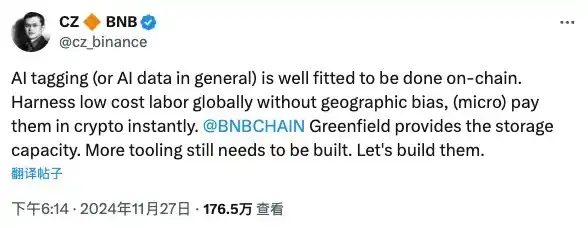
CZ, who was recently released from prison, is also very focused on AI. His recent tweets also mentioned the potential of combining AI and blockchain: "AI tagging (or AI data processing) is very suitable to be completed on-chain. It can leverage global low-cost labor, eliminate geographical bias, and enable instant payments through cryptocurrency." At the same time, Musk also announced that xAI will establish an AI game studio with the goal of "making games great again."
For a market like the crypto world full of "benefit mythology," replicating a 1:1 NVIDIA may be a bit too idealistic, after all, this is a behemoth with a high level of technological accumulation and market position. But if we replicate the "routine" of NVIDIA's profitability— that is, expanding the market through the core competitive advantage of powerful computing power and GPUs, perhaps it is not that difficult. Because, behind all AI Agents projects, there are massive AI models supporting them, and behind these models is the support of GPU power. Therefore, computing power remains the core driving force for the success of AI projects in the crypto world.
Crypto AI Computing Power Oasis
In this context, a project with GPU innovation that basically covers all the AI applications and possibilities you can think of in the current market: Layer 1, computing power leasing, decentralized AI+Web3 creation platform, and an AI agent project—Edge Matrix Chain, can be considered a very good ambush target, even a value oasis.
Lifting the "Heart" of AI
Traditional Layer 1 blockchains have demonstrated powerful capabilities in many areas in the past, but when you shift your focus to AI applications that require massive computational power, you will find that their computational limits cannot support these huge demands at all. AI, especially behemoths like Large Language Models (LLMs), require not just ordinary computing power but the unmatched computing power of GPUs. In the future of AI, without GPUs, nothing else matters.
EMC recognized this and thus developed a distributed GPU computing network aimed at providing sufficient computing power support for AI applications. Each EMC node not only provides ordinary computing power but offers powerful GPU support, allowing developers to run complex AI models seamlessly in a decentralized environment. What's even more astonishing is that all this computation can be done at a cost lower than traditional cluster computing. Yes, handling massive tasks is no longer the exclusive domain of cloud computing giants and no longer requires exorbitant fees.
Furthermore, EMC's network architecture further disrupts the limitations of traditional blockchains. It not only has the advantage of low latency and high throughput to ensure ultra-fast data storage and efficient retrieval, but more importantly, it provides an ideal stage for AI applications that require frequent data exchanges. In addition, EMC adopts a modular design, allowing developers to flexibly build protocol layers, network layers, application layers, and asset layers according to their needs. This design not only allows developers to focus on innovation without worrying about the limitations of the underlying architecture but also lays the foundation for the widespread application of decentralized AI.
When it comes to innovation, EMC goes beyond the technical level and brings a revolutionary product—the EMC Hub. This decentralized AI computing power scheduling platform provides unprecedented support for AI developers. Through EMC Hub, developers can build commercial AI services similar to Midjourney in just a few hours, at a cost that is only 30% of the traditional development approach.
Moreover, EMC has closely collaborated with JarvisBot to further advance decentralized AI capabilities in the market. JarvisBot, as an AI agent strongly supported by the EMC network, has successfully integrated into the TON ecosystem, offering users a diverse range of AI services: from article writing and image generation to content summarization and video creation. This AI agent was launched in June this year, putting it ahead of the market trend by almost half a year.
He Who Owns the GPU Owns the World, Possessing the Absolute Hard Currency
NVIDIA's GPU is almost the lifeblood of the entire industry, especially the NVIDIA H100 GPU, currently the latest GPU on the market.
Due to its critical importance, GPUs have also become an extremely scarce resource. Especially as AI has entered the "era of large models," the demand for GPUs has skyrocketed, making the market's supply-demand relationship increasingly tense. Obtaining high-performance GPU resources, especially top-tier chips like the NVIDIA H100, has become a form of "hard currency." For many AI companies, especially those in the early stages of startups, acquiring sufficient GPU resources is extremely challenging.
This also explains why large investment firms, such as a16z, are willing to stockpile large quantities of H100 GPUs at a high cost, renting out GPU resources to portfolio companies in exchange for equity or other benefits. It can be said that he who owns the GPU owns the world. However, as market demand is so urgent and supply is extremely limited, the "scarcity" of NVIDIA H100 GPUs has also provided investment opportunities for many industry pioneers.
Against this backdrop, EMC (Edge Matrix Chain) has utilized its innovative Layer 1 network to bridge GPU computing power with the DeFi platform, introducing a groundbreaking GPU tokenization solution. This solution not only addresses the liquidity issue of GPU computing power but also transforms these "high-performance hardware" into tradable assets, enabling more users to participate in this AI computing power ecosystem.
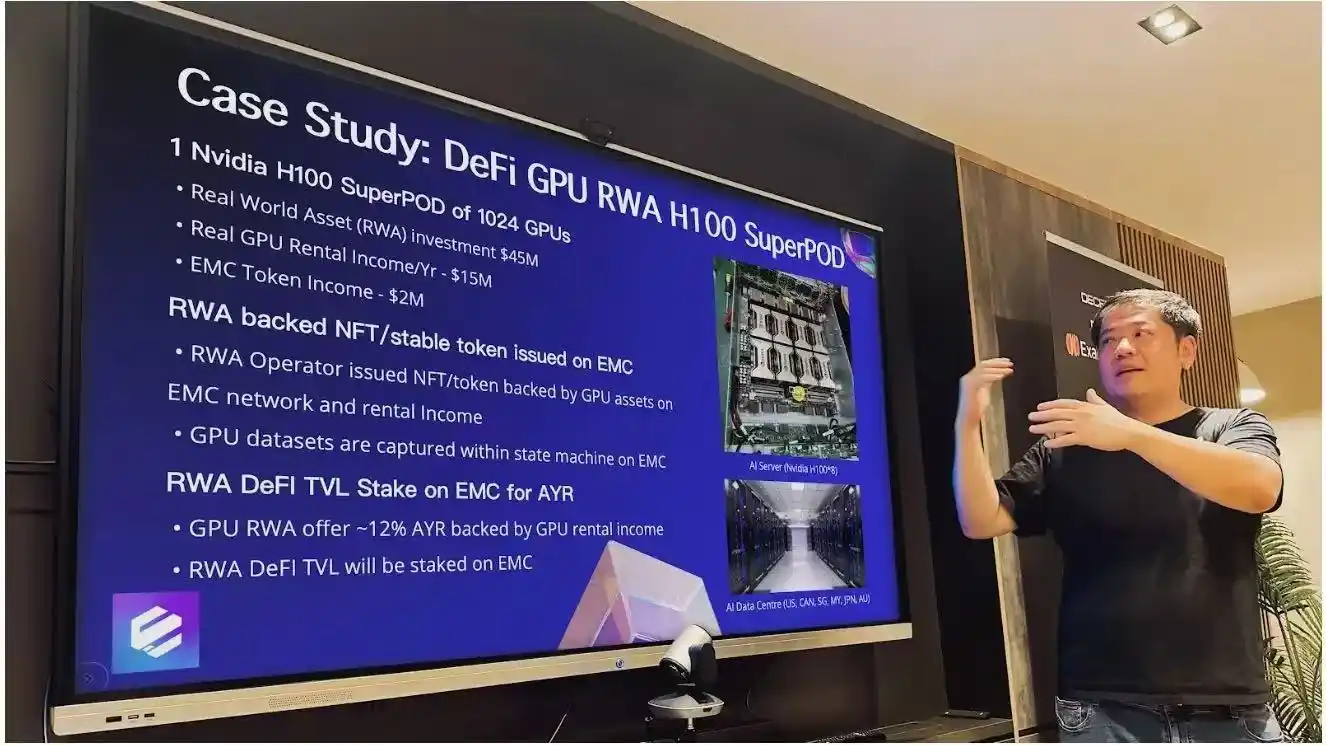
At the Token2049 conference on September 19, 2024, EMC showcased an incredibly innovative NVIDIA H100 SuperPOD Live Demo.
This modified machine, the NVIDIA H100 SuperPOD, consists of 1024 H100 GPUs, boasting powerful computing capabilities to provide substantial computing support for decentralized platforms. This computing power can not only sustain complex AI model training but also earn an annual income of up to $15 million through a GPU resource leasing model.
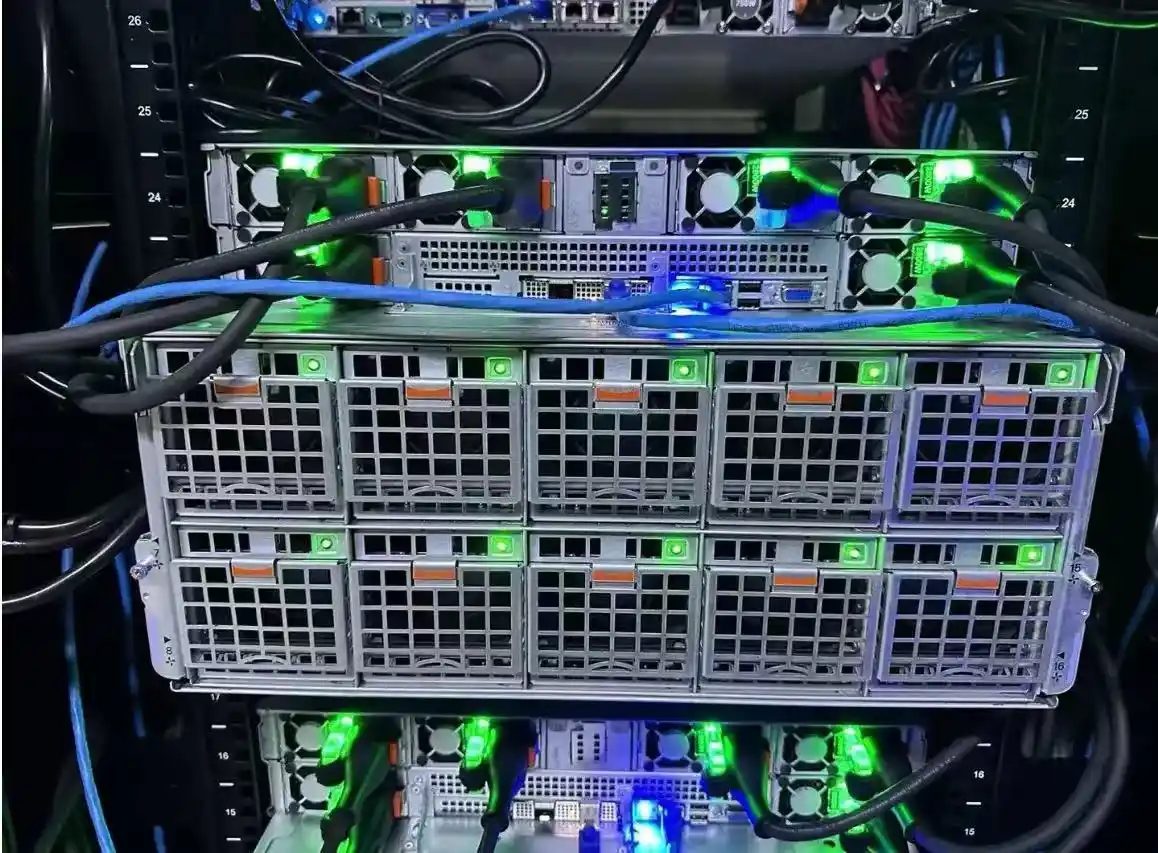
Through this demonstration, EMC not only showcased the decentralization of AI computing resources but also revealed how, through tokenizing GPU power, it is creating new economic opportunities and revenue streams for global users. What is this concept? This is not just the ultimate presentation of AI technology but also a deep exploration of the commercialization of AI computing power.
But that's not the most exciting part yet. By integrating these GPU computing resources into a decentralized platform, EMC has proposed the idea of tokenizing this high-performance hardware. In other words, global investors and developers can, through blockchain technology, break down these computing resources into small units, turning GPU power into a tradable asset. Consequently, anyone can purchase and stake this GPU power on the EMC platform, receiving approximately a 12% Annual Yield Rate (AYR) and directly participating in the AI computing wave.
Currently, the RWA assets offered by the EMC platform mainly come from top-tier high-performance GPUs such as NVIDIA A100, H100, and other models like 4090 and 3090. These GPU computing assets are provided by multiple ComputeDAO members, including significant participants like NWG and exaBITS.
This innovation not only further decentralizes AI infrastructure but also, through tokenization, breaks the traditional "high barrier to entry" of GPU resources that originally belonged to a few large enterprises, giving every ordinary user the opportunity to participate. Through EMC's technology, AI computing power has become a liquid asset rather than expensive hardware accumulated in the hands of certain institutions.
Why Is EMC Undervalued?
After introducing what EMC is doing and its unique selling points, let's return to the most crucial question: why do I think EMC is undervalued?
Let's start with the data. EMC currently spans multiple innovative fields: Layer 1 blockchain, computing power leasing, a decentralized AI+Web3 creation platform, and AI agent tools. Just looking at these concepts and business modules, its annual revenue has already reached $15 million. Considering all these highlights together, what do you think would be a reasonable market value for EMC?
If you're still having trouble giving an exact answer, let's look at the funding and valuation provided by VCs: On August 30th this year, the multi-chain infrastructure Edge Matrix Chain completed a $20 million financing round, led by P2 ventures and Amber Group.
This means that, from the perspective of these venture capital firms, EMC's valuation is approximately around 200 million US dollars. (Generally, in venture capital, when giving a valuation, a premium of about 10 times is added, and those familiar with investment know how deep the rabbit hole goes hh)
I believe this valuation is reasonable, especially considering that the current market cap of the GPU cloud mining project Ionet, which focuses solely on GPU hash power rental, is currently 300 million US dollars. And what about EMC? Not only does it have GPU hash power leasing, but it also has a whole Layer 1 blockchain network, in addition to a decentralized AI content creation platform and AI agent tools, which are four killer narrative enhancers.
Now, let's take a look at the strength behind EMC. Recently, EMC collaborated with DoraHacks to hold a high-profile hackathon, offering a direct grant of 10 million US dollars and a 1 million US dollar prize pool to support innovative projects.
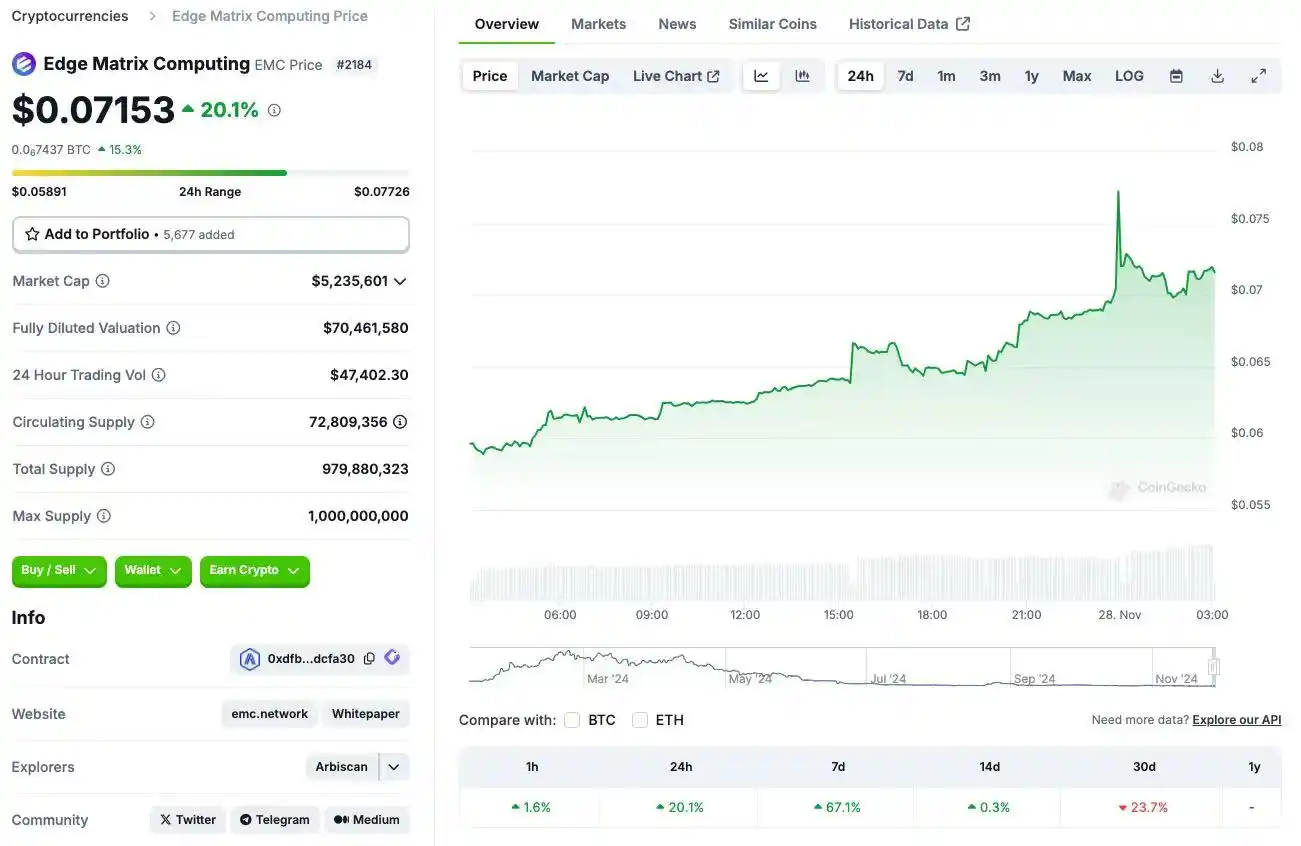
With such a project, setting aside 300 million US dollars for a moment, even if we talk about just 100 million US dollars, I don't think it's unreasonable at all, especially when nowadays there are countless meme coins launching with a quick 100 million US dollars from Pumpfun. In comparison, EMC's comprehensive advantages in technology, team, market outlook, and more can easily support a higher valuation. Currently, Edge Matrix Chain has a market cap of 5 million US dollars, surely harboring hidden alpha.
What's more interesting is that as I delved into researching the EMC project, I unexpectedly discovered that EMC had appeared in an article about GPUs in The Wall Street Journal. This article had sparked widespread attention at the time, and I had read it myself, though I didn't particularly focus on the mention of EMC back then. The title was "China's AI Engineers Are Secretly Accessing Banned Nvidia Chips".
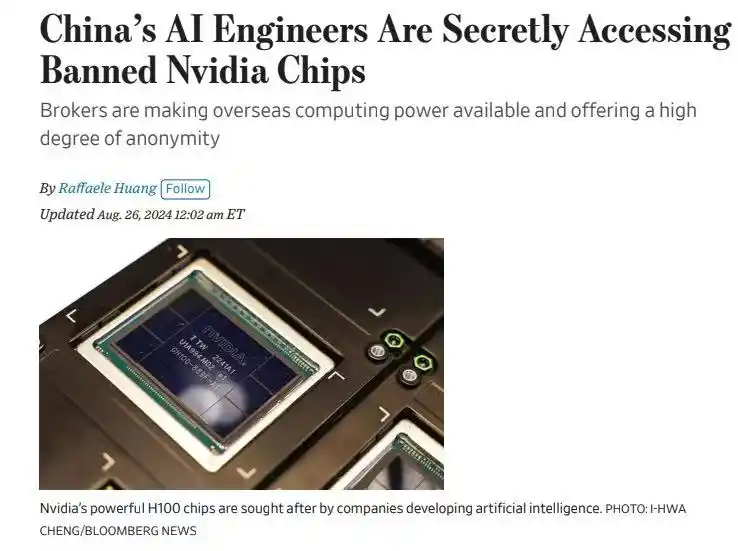
To address the shortage of hash power, Chinese AI engineers, through partnerships with international hash power suppliers, used decentralized GPU networks to access the necessary resources, and the lawyers stated that buyers, sellers, and brokers participating in accessing banned Nvidia AI chips in this manner did not violate any laws.
EMC was a key platform in this, allowing developers to access the world's top H100 GPU resources at a lower cost and with greater flexibility, widely used for training large language models (LLMs). This is undoubtedly a huge advantage for developers looking to participate in advanced AI projects.
Meanwhile, The Wall Street Journal also mentioned some technical details, such as how EMC uses smart contracts to protect transaction anonymity and ensure fair distribution of computing power. These details not only demonstrate the depth of EMC's technology but also reflect its forward-thinking approach to data privacy and security. Especially in a world where the demand for data security and privacy is increasingly growing, EMC's decentralized model appears to align more with future trends.
Moreover, The Wall Street Journal also highlighted some technical details, like how EMC safeguards transaction anonymity through smart contracts and ensures fair allocation of computing power. These details not only showcase the technical depth of EMC but also illustrate its forward-looking considerations regarding data privacy and security. Particularly in the context of a global rise in demand for data security and privacy protection, EMC's decentralized model seems even more in line with future development trends.
Nowadays, well-known AI projects have become too large in market capitalization. Once everyone realizes the potential of these projects, can they still be considered alpha?
What truly deserves exploration are often projects with lower market capitalization. Currently, EMC is undoubtedly such a hidden alpha and value oasis. If the project team collaborates on some marketing activities, waits for the right opportunity, EMC should be able to perform well.
This article is contributed content and does not represent the views of BlockBeats.
You may also like

How to Earn Free USDT in 2026: No High Volume Required (WEEX Poker Party Guide)
Is Joker Crypto legit in 2026 or just another memecoin? Can You Really Earn Passive Income with Joker Crypto in 2026? Learn how Joker staking rewards work, how to earn NFT bonuses, expected APY ranges, gas-fee rebates, and how to avoid crypto scams before joining.

How to Get Free USDT Welcome Bonus in 2026: Earn Up to 700 USDT on WEEX
Legit Free Welcome Bonus 2026: Learn how to earn up to 700 USDT on WEEX with Auto Earn Boost Fest. Increase your balance, activate Auto Earn, and qualify automatically.

AI Agent Payments Just Got Real: Utexo × x402 Brings 50ms USDT Transactions to Internet Scale
Utexo integrates USDT into the x402 protocol, enabling 50ms instant payments embedded natively in HTTP requests. Explore how this breakthrough is rewriting the rules for AI agent payments, API monetization, and the machine-to-machine economy.

DWF Deep Report: AI in DeFi Outperforms Humans in Yield Optimization, but Complex Trades Still Lag Behind by 5 Times

What Separates Smart Money from the Crowd in Crypto? Insights from Freedom of Money
Most crypto traders lose money not because of bad luck, but because they misunderstand how the market really works. From Freedom of Money to the rise and fall of Sam Bankman-Fried, they highlight a key divide in crypto: those who build the market and those who chase it. This reading guide explores essential books that reveal how narrative, regulation, capital, and psychology shape long-term success in the crypto industry.

The Risk Management Core Team has just been ousted, and Aave is now facing a $200 million default.

The $293 million bug wasn't in the code; so, what's the deal with the "DVN Configuration Bug," which led to the largest hack of 2026?

a16z on Recruitment: How to Choose Between Crypto-Native and Traditional Talent?

The biggest DeFi heist of 2026, hackers easily took advantage of Aave

Will Robots Replace Humans? He Says No!

Binance Coin's Price Skyrockets 15x to All-Time High, Saved by Three Bull Market Lifelines

The organization has accessed the prediction market, but is stuck at the third stage

Head of crypto VC collective shrinks: a16z crypto fund management scale plummets by 40%, Multicoin cut in half

Arthur Hayes New Post: It's "No Trade" Time Now
Claude Opus 4.7 Review: Is It Worthy of the Title of Strongest Model?

DWF In-Depth Report: AI Outperforms Humans in Yield Farming Optimization in DeFi, But Complex Transactions Still Lag Behind 5x
The financial tricks of the crypto giant Kraken

When proactive market makers start to take initiative
How to Earn Free USDT in 2026: No High Volume Required (WEEX Poker Party Guide)
Is Joker Crypto legit in 2026 or just another memecoin? Can You Really Earn Passive Income with Joker Crypto in 2026? Learn how Joker staking rewards work, how to earn NFT bonuses, expected APY ranges, gas-fee rebates, and how to avoid crypto scams before joining.
How to Get Free USDT Welcome Bonus in 2026: Earn Up to 700 USDT on WEEX
Legit Free Welcome Bonus 2026: Learn how to earn up to 700 USDT on WEEX with Auto Earn Boost Fest. Increase your balance, activate Auto Earn, and qualify automatically.
AI Agent Payments Just Got Real: Utexo × x402 Brings 50ms USDT Transactions to Internet Scale
Utexo integrates USDT into the x402 protocol, enabling 50ms instant payments embedded natively in HTTP requests. Explore how this breakthrough is rewriting the rules for AI agent payments, API monetization, and the machine-to-machine economy.
DWF Deep Report: AI in DeFi Outperforms Humans in Yield Optimization, but Complex Trades Still Lag Behind by 5 Times
What Separates Smart Money from the Crowd in Crypto? Insights from Freedom of Money
Most crypto traders lose money not because of bad luck, but because they misunderstand how the market really works. From Freedom of Money to the rise and fall of Sam Bankman-Fried, they highlight a key divide in crypto: those who build the market and those who chase it. This reading guide explores essential books that reveal how narrative, regulation, capital, and psychology shape long-term success in the crypto industry.



 App
App