
 Buy Crypto
- Markets
 Futures
- Spot
- Copy Trade
- Earn
- More
Americans are saying that the cost of living has become so high that it's unaffordable, and the reason is the $700 billion AI investment.




On April 1st, St. Louis Fed economists Miguel Faria-e-Castro and Serdar Ozkan published a blog post with a restrained title but a glaring conclusion: AI optimism itself is an inflationary force. Not because electricity prices have gone up, not because of chip shortages, but because everyone believes AI will make the future better—this belief is prompting them to spend more now.
On the same day, Fortune revealed an experiment by Deutsche Bank: they had three AI models assess the "Impact of AI on Inflation." The conclusion was that even AI itself believes it is driving up prices.

Posts on social media about skyrocketing U.S. prices are abundant
These two incidents together point to a somewhat uncomfortable cycle: the more investment in AI, the higher the inflation, the more distant the rate cuts, the higher the cost of financing—but investment continues to accelerate.
The Unstoppable Arms Race
Let's first look at the money. According to corporate financial reports, the combined capital expenditures of Amazon, Microsoft, Google, and Meta for 2023 are approximately $152 billion. By 2024, this figure jumps to $251 billion, a 65% increase. By the end of 2025, it totals $416 billion, another 66% increase.
The company guidance for 2026 is even more aggressive. As per Wolf Street's compilation, Amazon's guidance is $200 billion, Google's is $1.75 to $1.85 billion, Microsoft's is $1.45 to $1.5 billion, and Meta's is $1.35 billion. The combined total of these four companies is around $663 billion. If Oracle's $42 billion is included, the total approaches $700 billion.

In four years, the capital expenditures of these four companies have quadrupled. This growth rate is unprecedented in U.S. corporate history. According to Fortune, this scale already exceeds Sweden's GDP for a full year.
A Data Center Using as Much Electricity as an Entire State
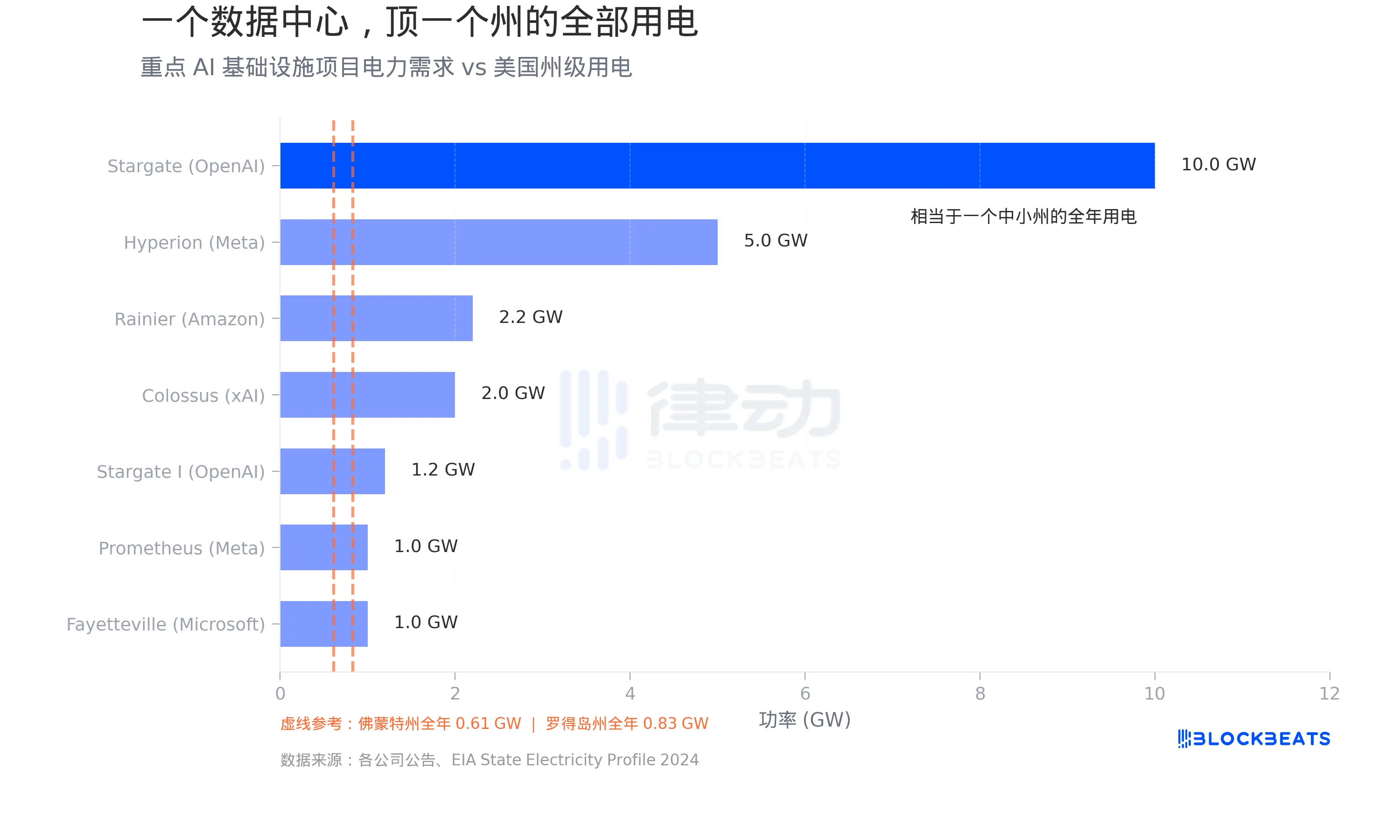
Most of this money is flowing into data centers. The biggest bottleneck for data centers is not land but electricity. According to EIA data, Vermont consumes approximately 5,364 gigawatt-hours of electricity per year, equivalent to an average load of 0.61 gigawatts. Rhode Island is slightly higher, at around 0.83 gigawatts.
Now take a look at what data centers are up to. According to company announcements, OpenAI's Stargate project, in partnership with Oracle and SoftBank, has a total planned power capacity of 10 gigawatts, equivalent to the entire electricity usage of 16 Vermonts. Meta plans 5 gigawatts at its Hyperion campus in Louisiana, with an investment of $27 billion. Musk's xAI in Tennessee's Colossus has expanded to 2 gigawatts, reportedly deploying 555,000 NVIDIA GPUs at a cost of around $18 billion, as reported by Introl. Amazon and Anthropic's Project Rainier in Indiana is planning for 2.2 gigawatts.
According to S&P Global data, U.S. data centers consumed a total of 183 terawatt-hours of electricity in 2024, accounting for over 4% of the national electricity usage. By 2030, this number is expected to triple.
These power demands are not a long-term story in the making; they are already squeezing the existing grids. According to a CBRE report, the North American data center vacancy rate dropped from 3.3% in the first half of 2023 to 1.6% in the first half of 2025, the lowest on record. According to Cushman & Wakefield data, the vacancy rate saw a slight increase to 3.5% in the second half of 2025, but only because a significant amount of new capacity came online — the absolute level remains historically low, and meaningful supply relief is unlikely to materialize before 2030.
Even AI Itself Says It's Fueling Inflation
These investments are driving demand, raising electricity prices, exacerbating chip shortages, and also revealing a more insidious inflation channel.
According to a Fortune report on April 1, a team led by Deutsche Bank's Chief U.S. Economist Matthew Luzzetti conducted an experiment: they had Deutsche Bank's in-house model dbLumina, Anthropic's Claude, and OpenAI's ChatGPT-5.2 separately assess the "probability of AI driving inflation in the next year."
Results: dbLumina gave 40%, Claude gave 25%, and ChatGPT-5.2 gave 20%. The three models were consistent in their assessment of the "probability of AI significantly lowering inflation": only 5%.
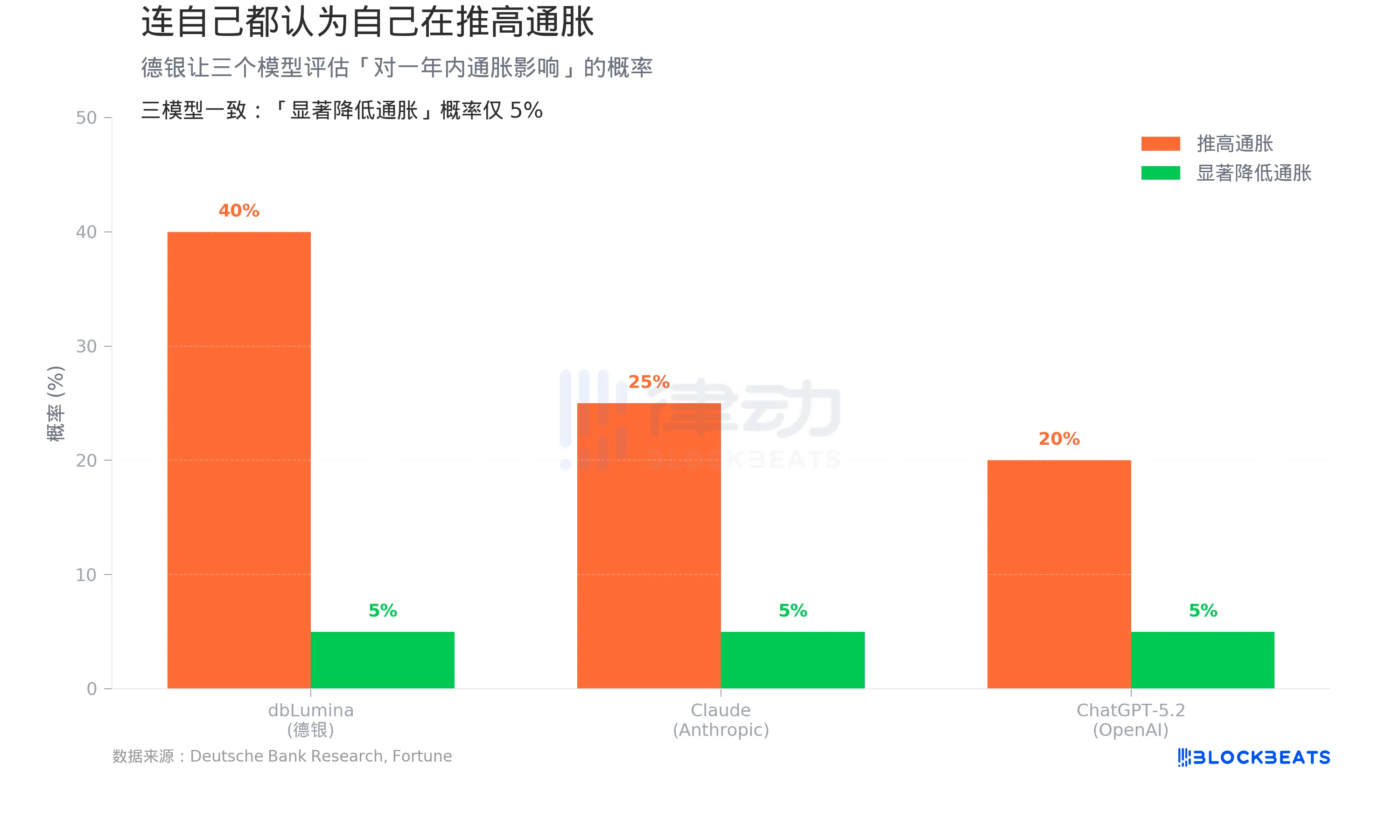
The highly consistent inflationary driver referenced by three models: data centers scaling up, semiconductor demand soaring, power consumption of AI workloads rapidly growing — all demand-driven price pressures.
This stands in stark contrast to the consensus among Wall Street investors. The Deutsche Bank team wrote in a research report: "Will AI become a major deflationary force? Not even AI thinks so."
Over a five-year horizon, the models have indeed shifted towards more deflation potential. However, the probability of "AI triggering large-scale deflation" is still squeezed in the tail risk range.
Optimism Itself Is Inflationary
A paper from the St. Louis Fed provides a theoretical framework to make sense of it all.
Faria-e-Castro and Ozkan use a standard macroeconomic model, defining the AI investment frenzy as a "news shock." According to the Fed post, the logic of the model is: when households see AI described as a revolutionary technology, they anticipate future income increases and increase consumption in advance. Businesses expect productivity gains and ramp up investment. The two effects combine, rapidly outstripping supply with demand. The paper states: "These forces jointly produce a surge of demand-driven inflation — a core feature of the early stages of a news shock."
The model presents two paths. If AI does deliver a productivity leap, short-term inflation will be absorbed by long-term output growth, setting the economy on a virtuous cycle. But if productivity fails to materialize — described in the paper as "sustained low growth and stubbornly high inflation," that is stagflation.
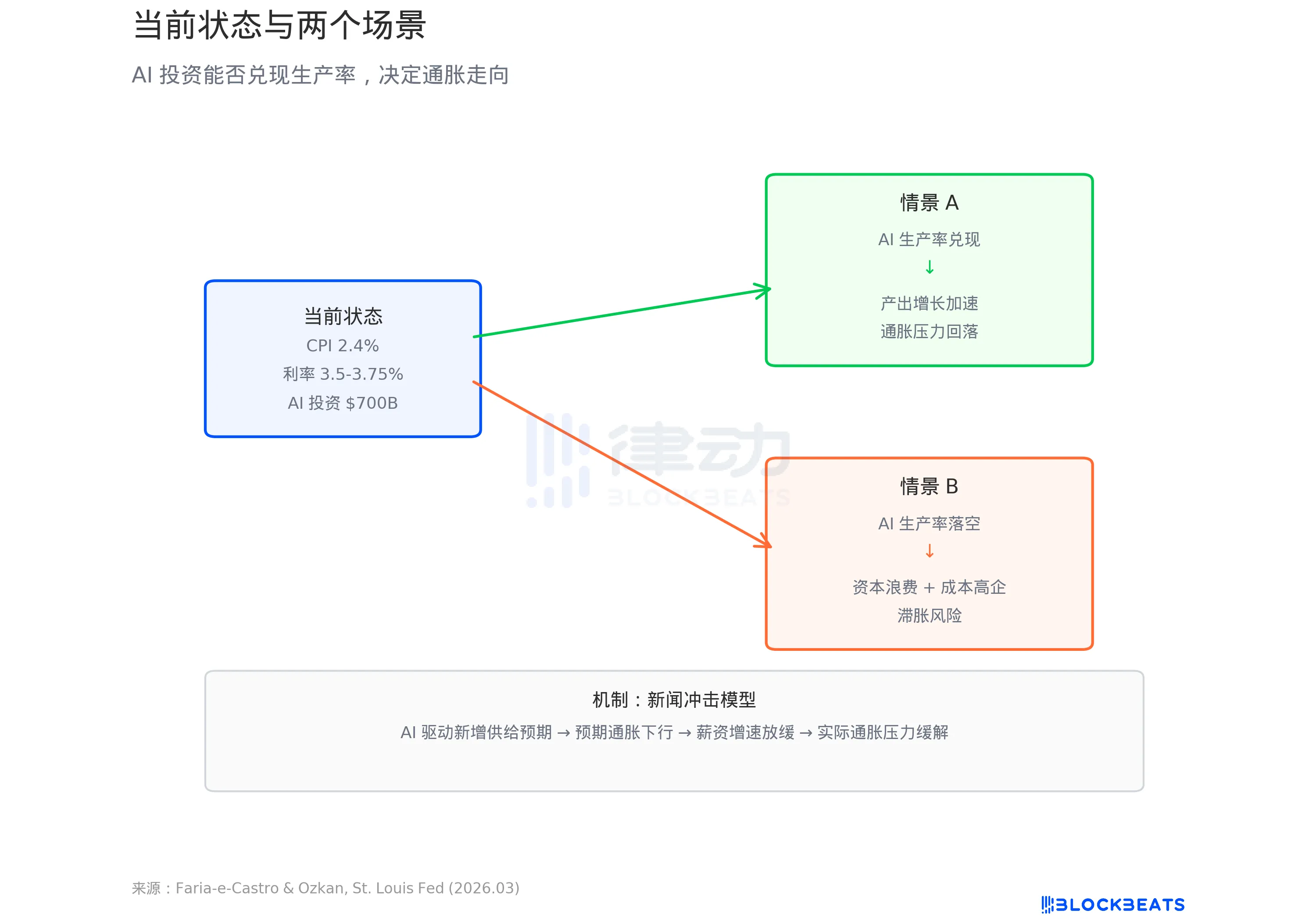
According to the Fed post-cited data, the annualized growth rate of total factor productivity (TFP) in the U.S. since the release of ChatGPT is 1.11%, below the historical average of 1.23%. So far, AI has not made its mark on productivity data.
Meanwhile, according to BLS data, the U.S. CPI in February 2026 was 2.4% year over year, core CPI at 2.5%, both still below the Fed's 2% target. The Fed's March dot plot shows a median year-end rate forecast of 3.4%, pointing to just one rate cut this year.
$700 billion is pouring into AI infrastructure. Whether this money is the cause of inflation or the prelude to a productivity revolution depends on a question that no one has been able to answer yet: Will the models running in these data centers actually make the economy more efficient?
You may also like

Consumer-grade Crypto Global Survey: Users, Revenue, and Track Distribution

Prediction Markets Under Bias

Stolen: $290 million, Three Parties Refusing to Acknowledge, Who Should Foot the Bill for the KelpDAO Incident Resolution?

ASTEROID Pumped 10,000x in Three Days, Is Meme Season Back on Ethereum?

ChainCatcher Hong Kong Themed Forum Highlights: Decoding the Growth Engine Under the Integration of Crypto Assets and Smart Economy

Why can this institution still grow by 150% when the scale of leading crypto VCs has shrunk significantly?

Anthropic's $1 trillion, compared to DeepSeek's $100 billion

Geopolitical Risk Persists, Is Bitcoin Becoming a Key Barometer?

Annualized 11.5%, Wall Street Buzzing: Is MicroStrategy's STRC Bitcoin's Savior or Destroyer?

An Obscure Open Source AI Tool Alerted on Kelp DAO's $292 million Bug 12 Days Ago

Mixin has launched USTD-margined perpetual contracts, bringing derivative trading into the chat scene.
The privacy-focused crypto wallet Mixin announced today the launch of its U-based perpetual contract (a derivative priced in USDT). Unlike traditional exchanges, Mixin has taken a new approach by "liberating" derivative trading from isolated matching engines and embedding it into the instant messaging environment.
Users can directly open positions within the app with leverage of up to 200x, while sharing positions, discussing strategies, and copy trading within private communities. Trading, social interaction, and asset management are integrated into the same interface.
Based on its non-custodial architecture, Mixin has eliminated friction from the traditional onboarding process, allowing users to participate in perpetual contract trading without identity verification.
The trading process has been streamlined into five steps:
· Choose the trading asset
· Select long or short
· Input position size and leverage
· Confirm order details
· Confirm and open the position
The interface provides real-time visualization of price, position, and profit and loss (PnL), allowing users to complete trades without switching between multiple modules.
Mixin has directly integrated social features into the derivative trading environment. Users can create private trading communities and interact around real-time positions:
· End-to-end encrypted private groups supporting up to 1024 members
· End-to-end encrypted voice communication
· One-click position sharing
· One-click trade copying
On the execution side, Mixin aggregates liquidity from multiple sources and accesses decentralized protocol and external market liquidity through a unified trading interface.
By combining social interaction with trade execution, Mixin enables users to collaborate, share, and execute trading strategies instantly within the same environment.
Mixin has also introduced a referral incentive system based on trading behavior:
· Users can join with an invite code
· Up to 60% of trading fees as referral rewards
· Incentive mechanism designed for long-term, sustainable earnings
This model aims to drive user-driven network expansion and organic growth.
Mixin's derivative transactions are built on top of its existing self-custody wallet infrastructure, with core features including:
· Separation of transaction account and asset storage
· User full control over assets
· Platform does not custody user funds
· Built-in privacy mechanisms to reduce data exposure
The system aims to strike a balance between transaction efficiency, asset security, and privacy protection.
Against the background of perpetual contracts becoming a mainstream trading tool, Mixin is exploring a different development direction by lowering barriers, enhancing social and privacy attributes.
The platform does not only view transactions as execution actions but positions them as a networked activity: transactions have social attributes, strategies can be shared, and relationships between individuals also become part of the financial system.
Mixin's design is based on a user-initiated, user-controlled model. The platform neither custodies assets nor executes transactions on behalf of users.
This model aligns with a statement issued by the U.S. Securities and Exchange Commission (SEC) on April 13, 2026, titled "Staff Statement on Whether Partial User Interface Used in Preparing Cryptocurrency Securities Transactions May Require Broker-Dealer Registration."
The statement indicates that, under the premise where transactions are entirely initiated and controlled by users, non-custodial service providers that offer neutral interfaces may not need to register as broker-dealers or exchanges.
Mixin is a decentralized, self-custodial privacy wallet designed to provide secure and efficient digital asset management services.
Its core capabilities include:
· Aggregation: integrating multi-chain assets and routing between different transaction paths to simplify user operations
· High liquidity access: connecting to various liquidity sources, including decentralized protocols and external markets
· Decentralization: achieving full user control over assets without relying on custodial intermediaries
· Privacy protection: safeguarding assets and data through MPC, CryptoNote, and end-to-end encrypted communication
Mixin has been in operation for over 8 years, supporting over 40 blockchains and more than 10,000 assets, with a global user base exceeding 10 million and an on-chain self-custodied asset scale of over $1 billion.

$600 million stolen in 20 days, ushering in the era of AI hackers in the crypto world
Vitalik's 2026 Hong Kong Web3 Summit Speech: Ethereum's Ultimate Vision as the "World Computer" and Future Roadmap
On the same day Aave introduced rsETH, why did Spark decide to exit?
Full Post-Mortem of the KelpDAO Incident: Why Did Aave, Which Was Not Compromised, End Up in Crisis Situation?

After a $290 million DeFi liquidation, is the security promise still there?
ZachXBT's post ignites RAVE nearing zero, what is the truth behind the insider control?




 App
App