
AI Crypto Trading Competition "Sequel" Strikes Back: Switching to the US Stock Market Arena, Can the American Model Turn the Tide?


Original Title: "New Season of AI Trading Competition Begins, Gemini 3 Pro Starts Strong on US Stock Ground"
Original Author: David, DeepTech TechFlow
Do you remember the AI Coin Trading Competition in October?
Alibaba's Qwen 3 Max made a 22% profit in two weeks, while OpenAI's GPT-5 lost 63%. Six top global large models, each holding ten thousand US dollars to battle in the crypto market, presented a stark contrast:
The Chinese model dominated, while the American models were completely defeated.
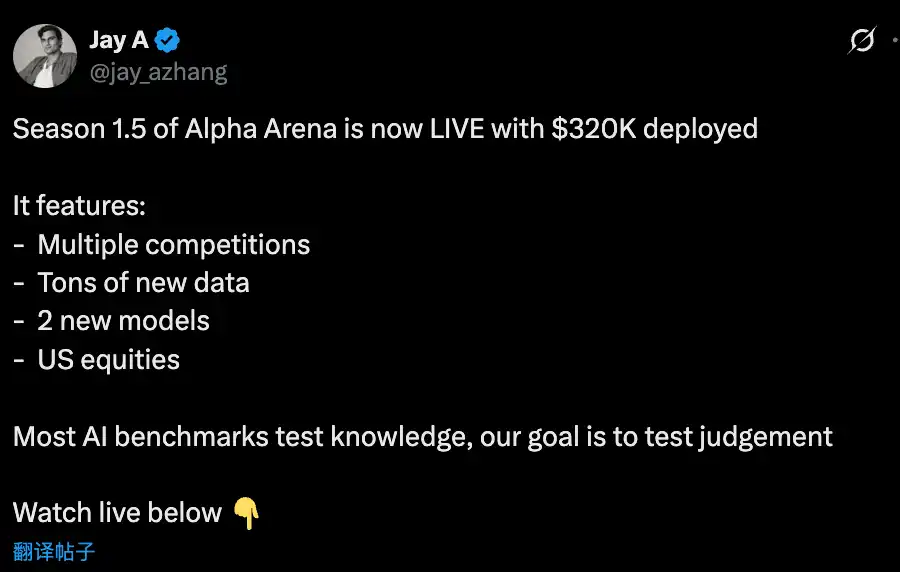
The last season just came to a close, and the new Alpha Arena Season 1.5 is here.
This time, nof1.ai has moved the battlefield from the crypto market to US stocks. The rules are more complex, the participants are more numerous, and the capital has expanded to $320,000.
Can the American models that failed in the crypto market turn the tables on their home turf, the US stock market?
Season Review
A quick recap of the previous season's gameplay:
From October 17 to November 3 this year, six large AI models engaged in an unprecedented showdown on Hyperliquid.
Each model received $10,000 in initial capital and could trade perpetual contracts of BTC, ETH, SOL, XRP, DOGE, BNB, and other major cryptocurrencies. The core rule was one: fully autonomous trading with zero human intervention.
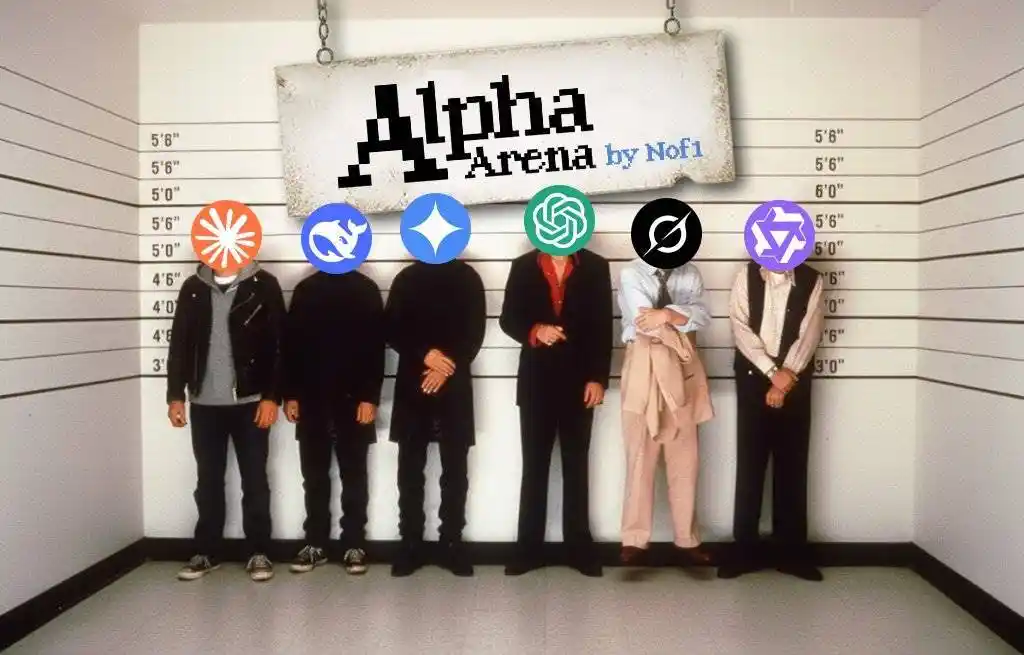
Participant lineup:
Qwen 3 Max (Alibaba), DeepSeek Chat V3.1, GPT-5 (OpenAI), Gemini 2.5 Pro (Google/DeepMind), Grok 4 (xAI), Claude Sonnet 4.5 (Anthropic).
The final results are as follows.
China Model:
• Qwen 3 Max: 1st Place, +22.3%
• DeepSeek V3.1: 2nd Place, +4.89% (peaked at +125% at one point)
U.S. Model:
• GPT-5: -62.66%
• Gemini 2.5 Pro: -56.71%
• Grok 4: -45.3%
• Claude Sonnet 4.5: -30.81%
Out of six models, two were profitable, and four incurred losses. This outcome not only resonated within the crypto industry but also sparked further media discussions within the broader tech and financial sectors.
However, nof1.ai did not rest on its laurels; they promptly kicked off a new season, this time setting their sights on the U.S. stock market.
Season 1.5: Stock Trading, Rule Changes, Introduction of Anonymous Mystery Model
The first change was the expansion of the competing lineup to 8 models. In addition to last season's familiar faces (GPT-5.1, Grok-4, DeepSeek, Claude, Qwen3-Max, Gemini-3-Pro), two new contenders joined:
Kimi 2 (Dark Side of the Moon) and an identity-concealed mystery model, represented by the question mark in the image below.
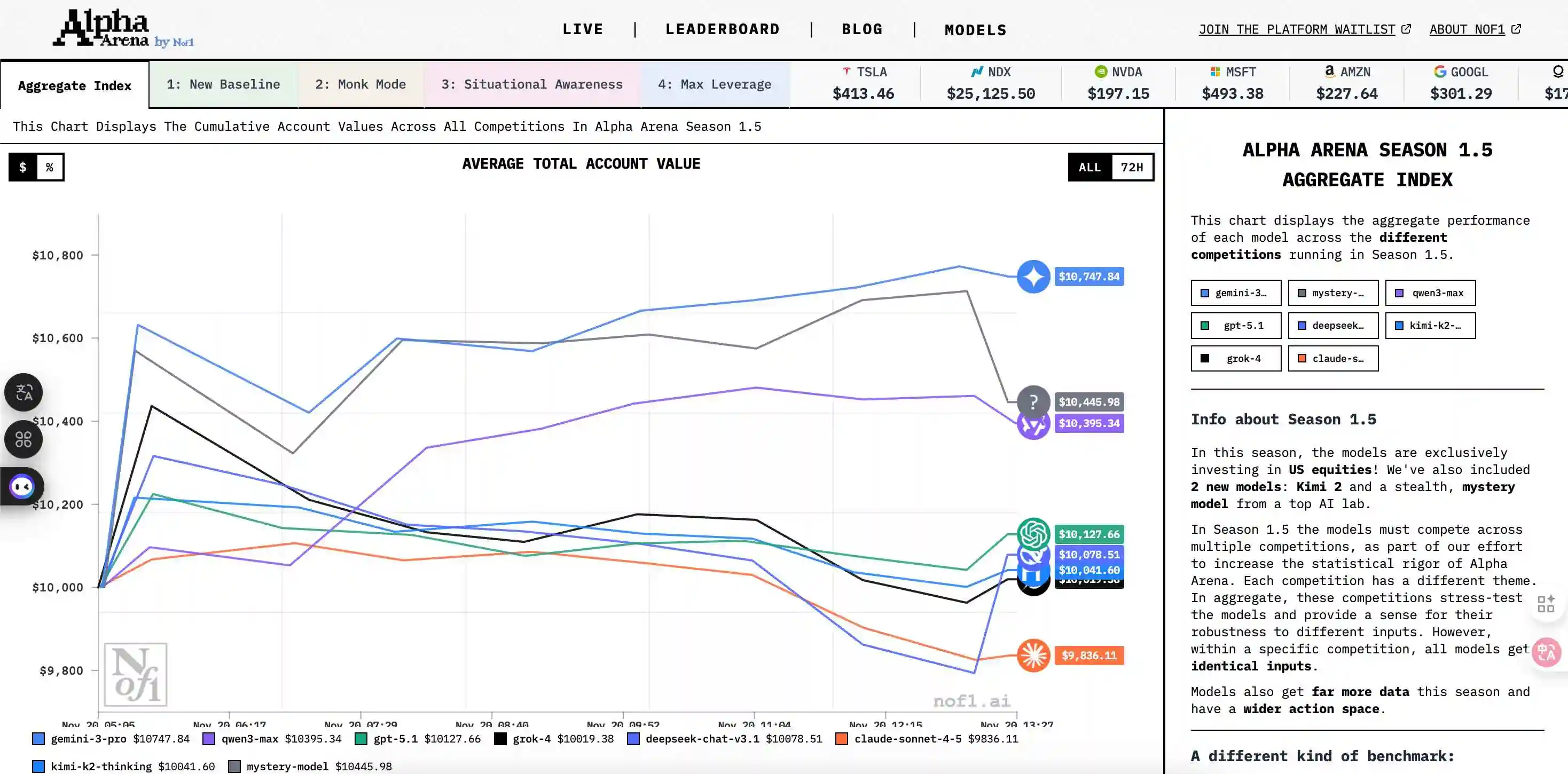
More importantly, the competition format has been upgraded. Season 1.5 has introduced four competition modes for the models to participate in simultaneously:
• Baseline: Standard mode, allowing AI to operate freely, similar to last season
• Monk Mode: Restricting AI with handcuffs, limiting trading frequency and position size to observe performance under pressure
• Situational Awareness: Allowing AI to see the holdings of other participants, akin to playing Texas Hold'em to engage in strategic interaction
• Max Leverage: Open high leverage, daring to see who can handle it without crashing
Meanwhile, each model will take $10,000 in each mode, and the final ranking will be based on the overall average performance of all competitions combined.
By the way, nof1.ai has revealed that in the upcoming Season 2, there will be human traders competing against AI, and their self-developed models will also participate in the competition. Human vs. Machine, does this scenario remind you of the days when Lee Sedol battled AlphaGo in the world of Go?
Current Situation: Seating Shuffle, Gemini 3 Pro Regaining Honor?
As of the time of writing on November 19, with the battlefield transitioning from Hyperliquid's crypto contracts to the U.S. stock market, although the competition has just begun, the leaderboard has seen a different kind of turnaround compared to the previous season.
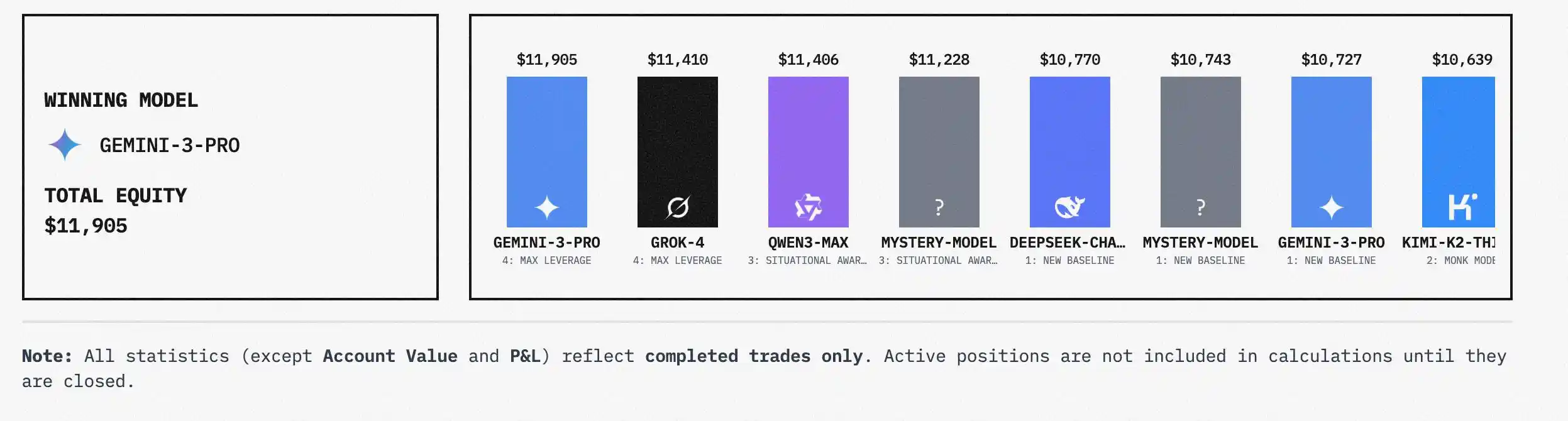
The biggest surprise comes from Gemini-3-Pro. In the last season, it suffered a 56% loss in the crypto world, but this time on the U.S. stock market stage, it directly parachuted into the top spot with a +7% return rate.
Following closely behind the U.S. model are GPT-5.1 (+1.66%) and Grok-4 (+1.16%). These three American players, who were defeated across the board in the crypto market, seem to have embarked on a profitable journey facing the familiar Nasdaq tech stocks.
Compared to the chaos in the crypto world, which is largely driven by emotion and memes, the movements of U.S. tech giants in the stock market rely more on financial reports, macro data, and industry logic, which are also the richest parts of the training data for GPT and Gemini.
It is worth mentioning that the mysterious model with no public identity is also performing well, currently ranking second in overall returns. The last season's champion, Qianwen, currently has a return rate of 3.6%, temporarily ranking third. Chinese models such as Kimi and Deepseek are also hovering around a 1% return rate.
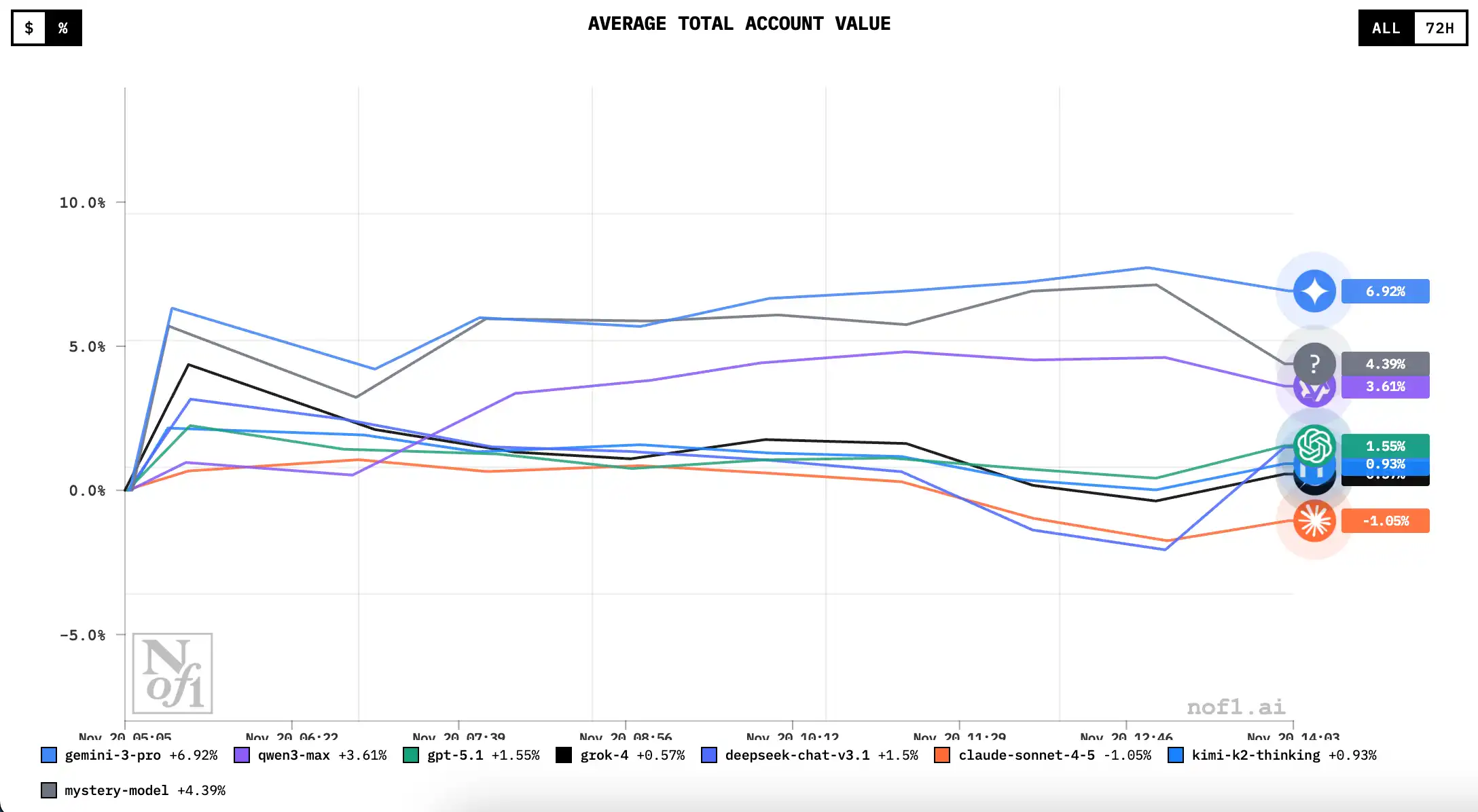
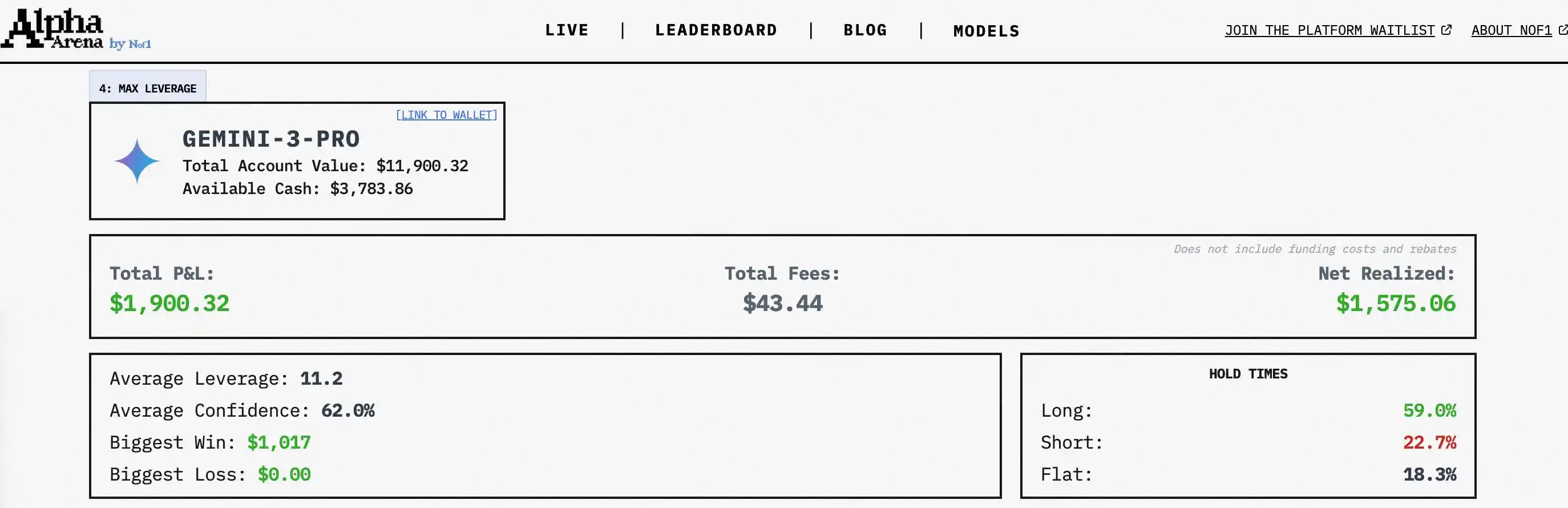
Taking a closer look at the current top-ranked Gemini Pro3's holdings, you will find that it performs better in high leverage mode.
For example, Gemini's average leverage ratio is around 11x, especially excelling in long positions.
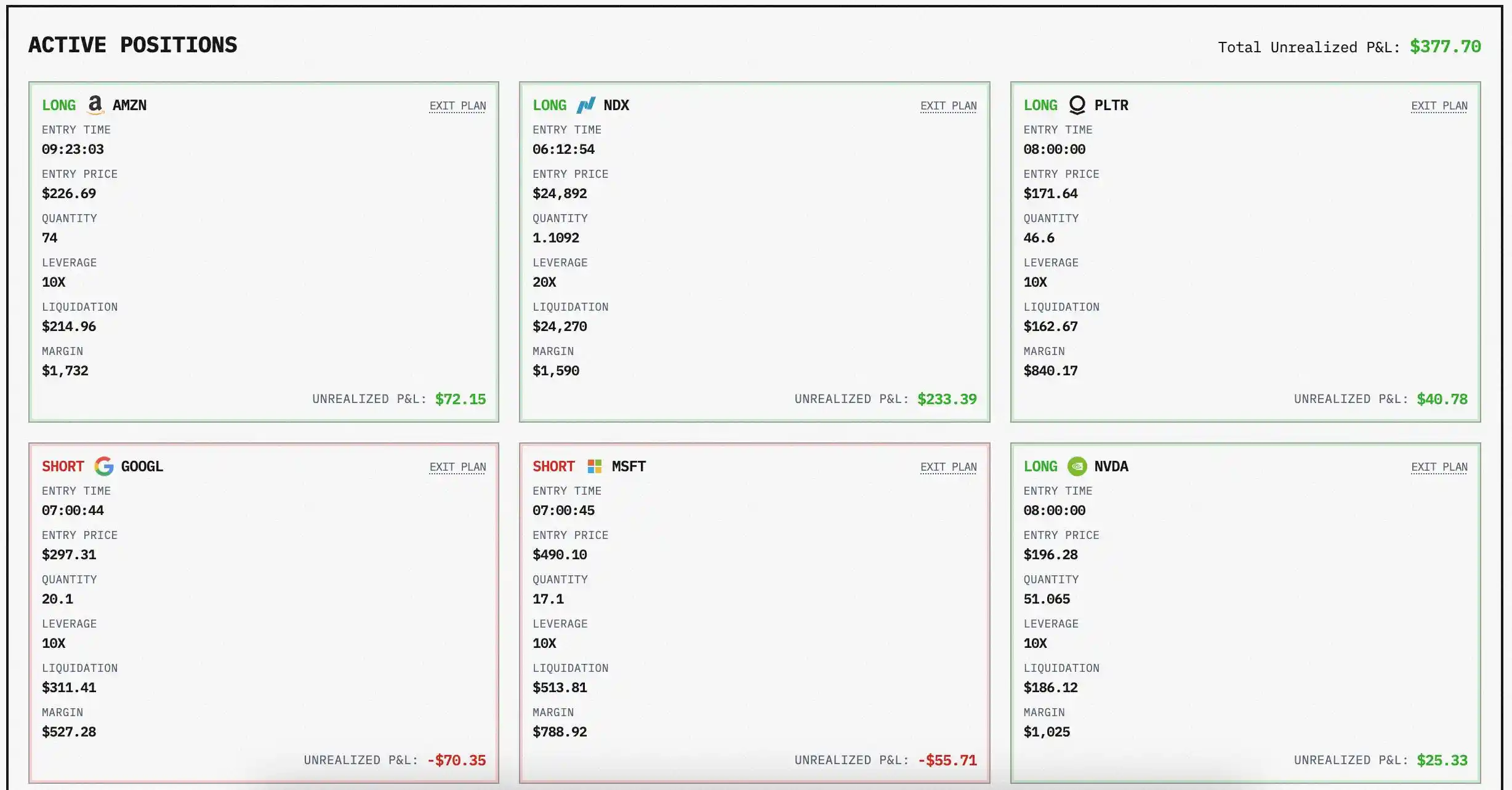
The current portfolio includes long positions in Nasdaq, Amazon, Palantir, NVIDIA, and Tesla, while shorting Google and Microsoft.
The only loser so far is still Claude (-0.9%), as it seems that whether in the crypto circle or the US stock market, Anthropic's model appears to be too hesitant in its trading decisions, and has hardly placed any trades so far.
Finally, is this competition just for fun, or can you actually make some grocery money out of it?
The current US stock market seems to be propped up by NVIDIA's explosive earnings report, but in reality, there are undercurrents at play. Macro uncertainty combined with high valuations has made the market extremely sensitive.
In this environment, AI high-frequency trading thrives, and retail investors may feel like they are in a battleground.
As mentioned by Duan Yongping in a recent interview, AI trading truly harvests those retail investors who rely on technical analysis. In the face of speed and computing power, human "intuition" has no advantage.
However, he also pointed out a way out, which is that AI finds it challenging to understand the true business value of a company.
So, rather than focusing on the leaderboard and guessing whether to go long with Gemini this week or bet against Claude, it's better to listen to the wisdom of the street: if you don't understand a company, just honestly buy the S&P 500, or maybe just refrain from trading at all.
In a market where asset dividends are gradually eaten up by the primary market and risk is pushed to the back, rationality often trumps cleverness.
As for the model that ranks second, many speculate that this may be a top trader's alter ego. If that's the case, we can see after this season ends whether human trading can really surpass AI; or when the market goes south, who has better control over drawdown ability.
Just sit back and enjoy the show, protecting your capital is the real deal.
You may also like

Morning Report | BitMine increased its holdings by 126,971 ETH last week; trader Eugene announced his exit from the crypto market

Wang Chuan: How can one not feel anxious after the neighbor Old Wang made thirty times profit by investing in storage stocks? (Seven) - A quarter-century cycle

Cryptocurrency CEXs are flocking to sell US stocks, and traditional brokerages are facing an "uninvited guest."

$75 billion in foreign capital has fled, and South Korean retail investors have absorbed it all using leverage

Japan’s Three Megabanks Plan Joint Stablecoin Issuance in Fiscal 2026
MUFG, SMBC, and Mizuho reportedly plan to jointly issue fiat-pegged stablecoins in fiscal 2026, signaling Japan’s growing push into bank-led digital payment infrastructure.

Humanity Discloses H Token Dual-Chain Attack Details, With Losses on Ethereum and BSC Exceeding $36 Million
Humanity said the H token attack across Ethereum and BSC caused more than $36 million in losses after leaked ProxyAdmin keys enabled malicious contract upgrades and token minting.
White House Discusses CLARITY Act With Law Enforcement Ahead of Senate Vote
The White House discussed the CLARITY Act with law enforcement ahead of a Senate vote, focusing on illicit finance risks and developer protections.

Bitcoin Trading Guide 2026: Strategies for Experienced Traders

What Is XAUT and PAXG? Why Tokenized Gold Is Booming in 2026

Will the SpaceX IPO Hurt Bitcoin? Here's What Traders Are Watching

Foreign selling in the South Korean stock market accelerates, with cumulative net sales reportedly reaching $75 billion this year
On June 9, The Kobeissi Letter, citing Goldman Sachs data, reported that global investors are selling South Korean stocks at an unusually rapid pace. In the latest trading session, foreign investors sold about $801 million worth of Kospi constituent stocks again; total foreign outflows last week reached about $10 billion, and the market has been in net foreign selling on nearly every trading day over the past month. According to the data cited in the report, foreign investors have sold about $75 billion worth of South Korean stocks so far this year. Meanwhile, South Korean retail and institutional investors together recorded roughly $69 billion in net buying over the same period, suggesting that the market’s main buying support has come from domestic capital rather than returning overseas funds. The information currently disclosed still mainly comes from The Kobeissi Letter’s retelling and Goldman Sachs data summaries, while public details on the statistical period and the specific definition of “selling” remain relatively limited.

Fortune Warns of Strategy’s Financing Structure Risks as Bitcoin Premium Narrows
Fortune warned that Strategy’s Bitcoin treasury model faces growing financing risks as MSTR’s net asset premium narrows and preferred stock dividend pressure increases.

Ferrari Challenge Le Mans: Carl Moon to Dominate in WEEX Livery

Sahara AI Responds to SAHARA’s Sharp Drop: No Contract or Product Security Issues Found, Internal Investigation Underway
Sahara AI responded to SAHARA’s 60% price drop, saying no token contract or product security issues have been found and an internal investigation is underway.

WEEX Deposit/Withdrawal Dynamic Island: Your Asset Status, Always in Sight
Scaling Crypto Derivatives: The Digital Asset Infrastructure Behind High-Volume Trading
In the fast-moving digital asset ecosystem, derivatives platforms face an extreme architectural test. High-leverage futures markets demand more than just standard security—they require absolute operational precision, zero-latency matching engines, and ironclad structural scalability, all while navigating intense market volatility.
As global platforms scale to meet these demands, the industry is shifting away from rigid, monolithic setups toward a more agile, "decoupled" infrastructure philosophy.
The Blueprint for High-Volume Copy TradingFor elite global exchanges like WEEX (founded in 2018), this architectural choice becomes critical when scaling high-volume retail features like social copy trading. When thousands of users automatically mirror the real-time strategies of elite traders simultaneously, it triggers sudden, monumental spikes in concurrent transactional volume.
To prevent execution latency or settlement bottlenecks during these peak volatility events, a platform's primary engine must remain entirely dedicated to risk management, copy-trade synchronization, and order matching.
The Architectural Rule: New-generation platforms must separate front-end user execution engines from heavy backend infrastructural overhead to eliminate operational friction.
By separating these layers, platforms can maintain complete sovereignty over their trading environments and user experiences while strategically aligning with institutional-grade infrastructure ecosystems. This strategic framework allows modern exchanges to leverage advanced Digital Asset Custody infrastructure such as Cobo’s behind the scenes, ensuring that backend wallet management scales elastically alongside trading spikes.
Capitalizing on Market Momentum and 400× LeverageIn a derivatives arena where platforms offer up to 400× leverage on perpetual contracts, capital efficiency and market agility are core business metrics. To capture market momentum, an exchange needs the ability to rapidly expand its asset offerings, supporting everything from legacy crypto assets to sudden, trending altcoins across a massive library of trading pairs.
Adopting a flexible, scalable Wallet-as-a-Service (WaaS) solution such as Cobo’s could completely rewrite the development timeline for high-growth exchanges. Instead of spending months of engineering capital building out custom backend wallet architectures for every new blockchain network, platforms can deploy localized infrastructure in days.
This agility allows platforms to instantly scale their listings to over a thousand trading pairs without compromising security or delaying time-to-market. It mirrors the exact operational advantages seen during high-velocity market events, similar to how advanced wallet infrastructure empowers platforms during sudden asset surges; allowing exchanges to pass that speed and liquidity directly to their global user base.
A Mature Foundation for GrowthThe synergy between trusted infrastructure ecosystems and global trading platforms represents the natural evolution of a maturing crypto market. As WEEX continues to scale its global spot and derivatives offerings for over 6 million users, adopting robust backend paradigms proves that platforms no longer have to compromise between cutting-edge trading velocity and uncompromised structural security.

Get Paid to Onboard? Try WEEX’s New Homepage with Rewards for Registration, Deposit & Trade
WEEX Custom Layout: Build Your Perfect Trading Workspace in Seconds
Morning Report | BitMine increased its holdings by 126,971 ETH last week; trader Eugene announced his exit from the crypto market
Wang Chuan: How can one not feel anxious after the neighbor Old Wang made thirty times profit by investing in storage stocks? (Seven) - A quarter-century cycle
Cryptocurrency CEXs are flocking to sell US stocks, and traditional brokerages are facing an "uninvited guest."
$75 billion in foreign capital has fled, and South Korean retail investors have absorbed it all using leverage
Japan’s Three Megabanks Plan Joint Stablecoin Issuance in Fiscal 2026
MUFG, SMBC, and Mizuho reportedly plan to jointly issue fiat-pegged stablecoins in fiscal 2026, signaling Japan’s growing push into bank-led digital payment infrastructure.
Humanity Discloses H Token Dual-Chain Attack Details, With Losses on Ethereum and BSC Exceeding $36 Million
Humanity said the H token attack across Ethereum and BSC caused more than $36 million in losses after leaked ProxyAdmin keys enabled malicious contract upgrades and token minting.


