
 Buy Crypto
- Markets
 Futures
- Spot
- Copy Trade
- Earn
- More
AI Agent Empowering the Metaverse, GameFi is Breaking Through with Cheats

Original Article Title: Tokenization of Agentic Metaverse
Original Article Author: Defi0xJeff, Head of Steak Studio
Original Article Translation: zhouzhou, BlockBeats
Editor's Note: This content discusses the rapid development of the agentic metaverse, particularly how an immersive gaming world is being created through AI agents, tokenization, and Web3 technology. Platforms like powpowfun, virtuals io, and moddio allow creators to easily build and manage their games using open-source AI and custom tokens. The article also mentions that a major challenge faced by Web3 games is the fleeting nature of player interest and token volatility, but platforms like Indiedotfun address this issue by quickly releasing lightweight games. Lastly, the article emphasizes the importance of learning visual language models for the future of gaming.
The following is the original content (slightly reorganized for readability):
The agentic metaverse is no longer a distant concept; it is gradually becoming a reality, redefining how we interact with AI, games, and digital ownership. From open-source tools to AI-driven environments in operation, we are witnessing a rapid evolution of the virtual world in terms of construction, experience, and monetization models.
Here are some exciting recent developments in this field:
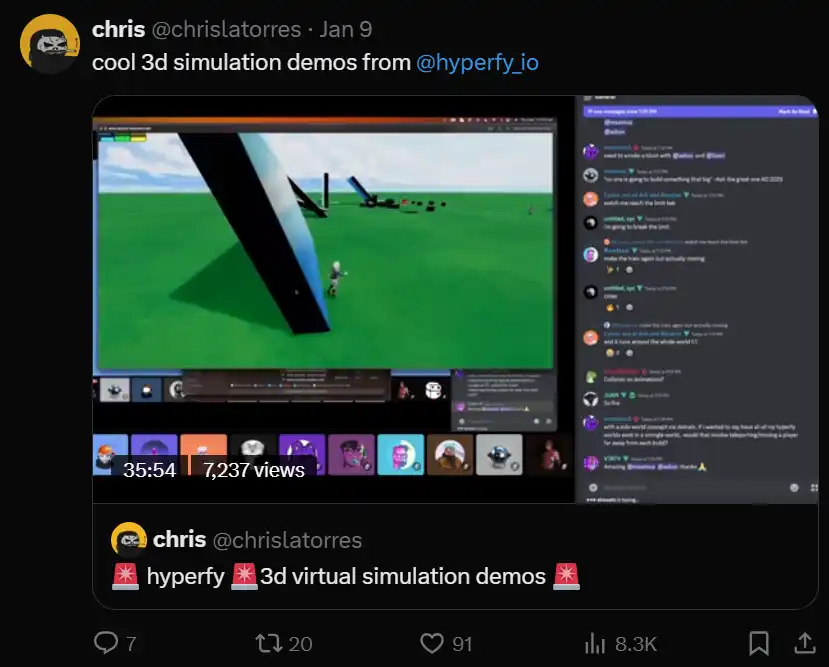
hyperfy io has just open-sourced its engine, supporting self-hosted multiplayer worlds with features such as real-time building, drag-and-drop tools, and interoperable assets.
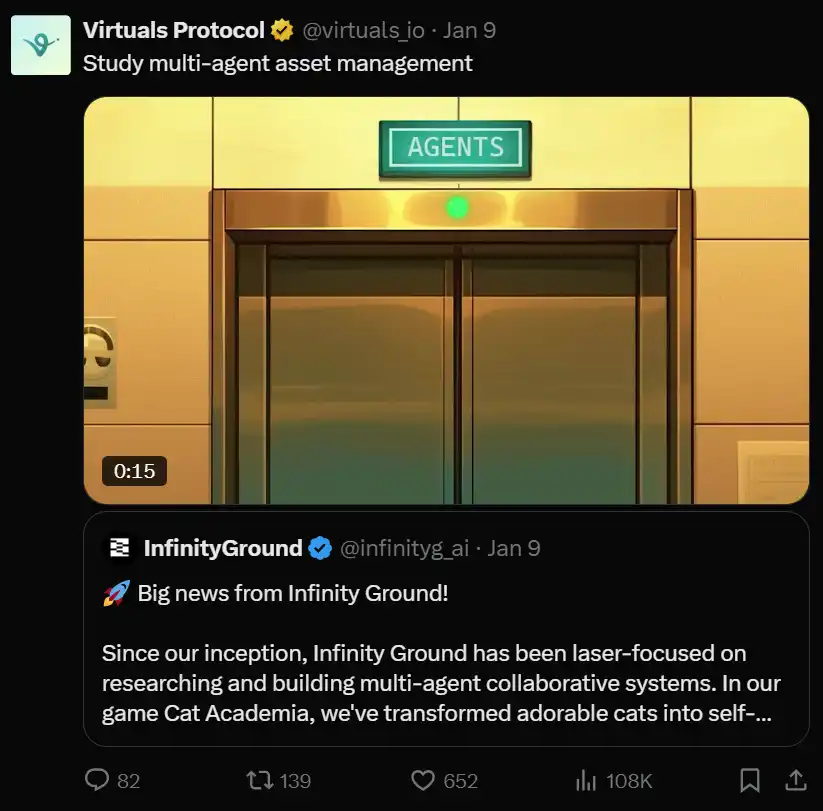
virtuals io has announced a partnership with infinityg ai to launch a multi-agent asset management model and establish the first AI-operated asset management company, Zenith XBT, laying the foundation for agentic sociality (interaction between agents).
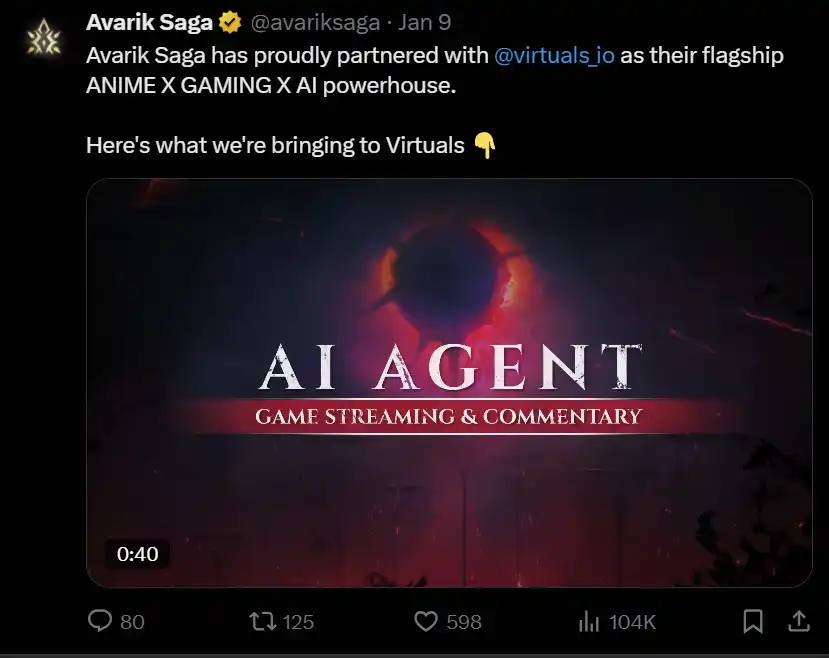
virtuals io has announced a partnership with avariksaga, allowing agents to live stream games in real-time, provide commentary, and engage in live narration.
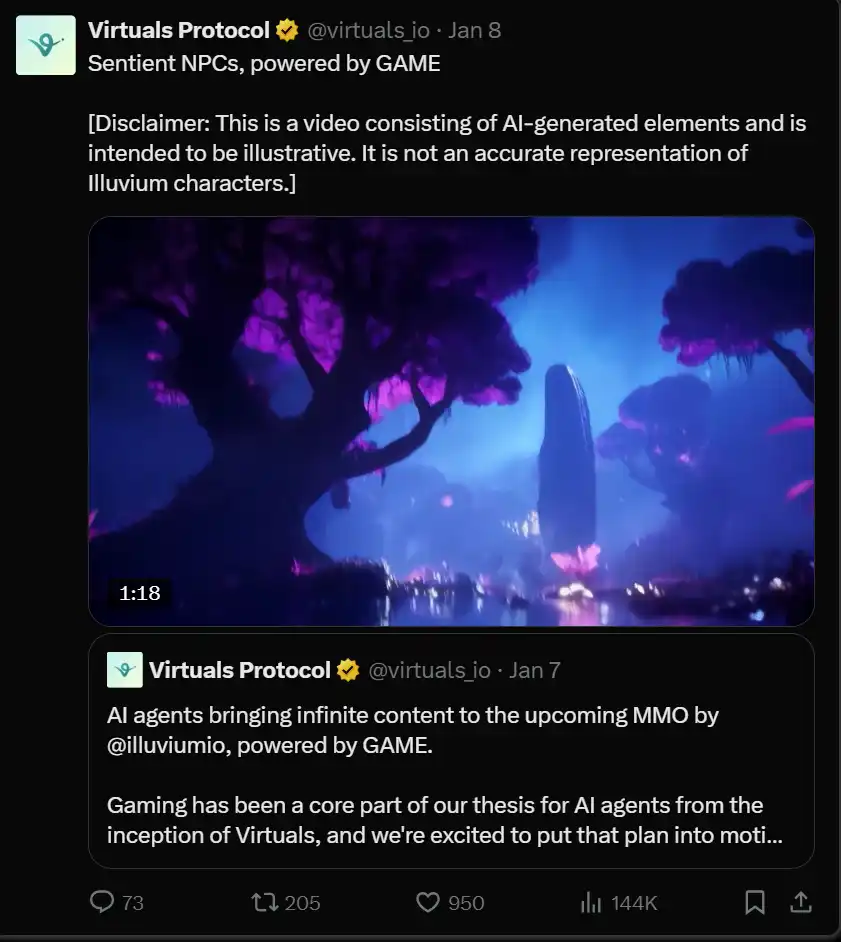
Prior to this, they also collaborated with illuviumio to introduce sentient NPC/AI-NPCs into the Illuvium game.
In addition to the Virtuals ecosystem, we have also witnessed the rise of the World State Machine, which goes beyond the traditional conversational agent by creating a continuously running 24/7 simulation environment, allowing Kira to exist as a humanoid digital being.
Unlike typical AI, Kira does not just react to inputs; she lives within this environment, engaging in activities that mimic human life such as learning, working, and socializing. All of this is based on a complex system that tracks time, weather, location, and interactions with other AI characters or NPCs (such as Mei, Keiko, and Izumi).

Game Reality Inspired by Westworld
While everyone is talking about creating games similar to "Westworld" (an immersive world driven by dynamic NPCs), powpowfun has already been conducting the alpha test of its virtual Western world game. The AI agent in this game is powered by Fullmetal AI's open-source model. It is worth noting that Fullmetal recently integrated ElizOS, a system that enables long-term memory through RAG.
The team plans to launch indiedotfun in approximately a week. Indiedotfun is similar to pumpdotfun but tailored for gaming, allowing anyone to quickly build their own world through templates and moddio's game/physics engine. These worlds can then be tokenized, allowing users and communities to own the games they love.
Introducing Indie: Tokenizing the Agent Metaverse
Indie is a platform that enables developers to build and release Web3-enabled worlds without needing cryptocurrency knowledge. It is powered by the moddio game engine, which already has a large Web2 community building thousands of games every month.
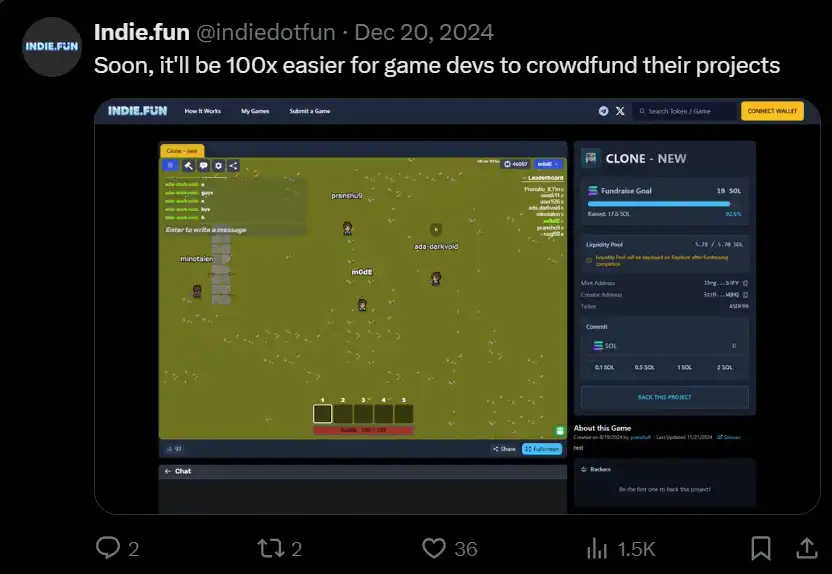
Creators can choose to launch a token that allows supporters to fund the game and receive token rewards. These tokens act as in-game currency. Imagine Roblox, but instead of using Robux, creators can use their own token as currency.
The FullmetalAI open-source LLM is built-in, allowing creators to directly incorporate an AI agent into the game, making the game more dynamic and engaging.
Addressing the Challenges of Web3 Games
One challenge that Web3 games face is a lack of interest in AAA-grade games. Web3 itself is a game—people find speculating on AI agent coins more exciting than playing Web3 games.
This has led to a fleeting focus, with interest typically shifting to the next hot topic after 2-3 days.
From a game studio perspective, there is a significant risk: even if the game is fun, if the token does not appreciate, interest will diminish. Conversely, if the token appreciates but the game is not enjoyable, people may participate briefly, but sustaining interest remains challenging. Studios face a dual challenge: delivering engaging gameplay while ensuring token price appreciation.
Why Indie Is Perfect for Web3's Fleeting Attention
Indiedotfun is the perfect engine to deal with this fleeting attention. Through moddio, lightweight indie games can be launched in a matter of days (rather than months), allowing creators to quickly deliver immersive worlds with dynamic AI-NPCs. When players get bored, they can jump from one indie game to another, while creators enhance their metaverse experience to retain players and maintain the value of the in-game token.
Imagine not just a conversational agent on Twitter but an agent metaverse world to play in, speculate on its token, and have ownership in these worlds.
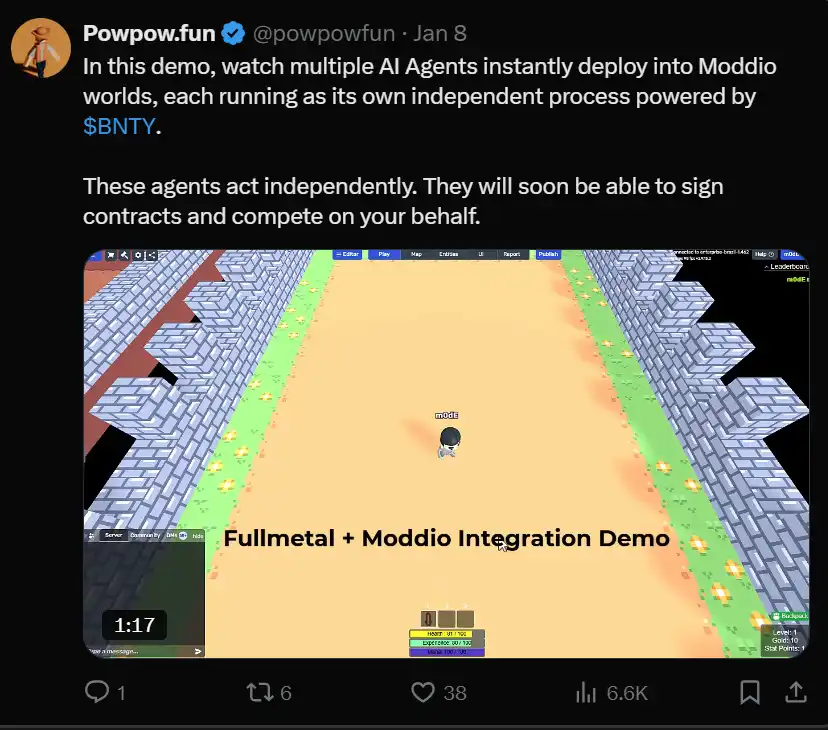
BNTY serves as the primary currency for all things in this ecosystem. Alpha Tip: indiedotfun handles the supply side, while ARCAgents manages the demand side.
In Conclusion
The metaverse narrative of agent is rapidly evolving, and I anticipate more game studios and teams will leverage G.A.M.E and Eliza to drive their games. Despite existing gaps that need to be addressed within these frameworks, in the coming months, unique game-centric solutions may emerge.
Furthermore, I expect reinforcement learning and vision language models to become increasingly crucial. The B2B market's demand for dynamic AI in games is continuously rising, positioning ARCAgents at the industry's forefront with its agent gamification engine.
You may also like

Consumer-grade Crypto Global Survey: Users, Revenue, and Track Distribution

Prediction Markets Under Bias

Stolen: $290 million, Three Parties Refusing to Acknowledge, Who Should Foot the Bill for the KelpDAO Incident Resolution?

ASTEROID Pumped 10,000x in Three Days, Is Meme Season Back on Ethereum?

ChainCatcher Hong Kong Themed Forum Highlights: Decoding the Growth Engine Under the Integration of Crypto Assets and Smart Economy

Why can this institution still grow by 150% when the scale of leading crypto VCs has shrunk significantly?

Anthropic's $1 trillion, compared to DeepSeek's $100 billion

Geopolitical Risk Persists, Is Bitcoin Becoming a Key Barometer?

Annualized 11.5%, Wall Street Buzzing: Is MicroStrategy's STRC Bitcoin's Savior or Destroyer?

An Obscure Open Source AI Tool Alerted on Kelp DAO's $292 million Bug 12 Days Ago

Mixin has launched USTD-margined perpetual contracts, bringing derivative trading into the chat scene.
The privacy-focused crypto wallet Mixin announced today the launch of its U-based perpetual contract (a derivative priced in USDT). Unlike traditional exchanges, Mixin has taken a new approach by "liberating" derivative trading from isolated matching engines and embedding it into the instant messaging environment.
Users can directly open positions within the app with leverage of up to 200x, while sharing positions, discussing strategies, and copy trading within private communities. Trading, social interaction, and asset management are integrated into the same interface.
Based on its non-custodial architecture, Mixin has eliminated friction from the traditional onboarding process, allowing users to participate in perpetual contract trading without identity verification.
The trading process has been streamlined into five steps:
· Choose the trading asset
· Select long or short
· Input position size and leverage
· Confirm order details
· Confirm and open the position
The interface provides real-time visualization of price, position, and profit and loss (PnL), allowing users to complete trades without switching between multiple modules.
Mixin has directly integrated social features into the derivative trading environment. Users can create private trading communities and interact around real-time positions:
· End-to-end encrypted private groups supporting up to 1024 members
· End-to-end encrypted voice communication
· One-click position sharing
· One-click trade copying
On the execution side, Mixin aggregates liquidity from multiple sources and accesses decentralized protocol and external market liquidity through a unified trading interface.
By combining social interaction with trade execution, Mixin enables users to collaborate, share, and execute trading strategies instantly within the same environment.
Mixin has also introduced a referral incentive system based on trading behavior:
· Users can join with an invite code
· Up to 60% of trading fees as referral rewards
· Incentive mechanism designed for long-term, sustainable earnings
This model aims to drive user-driven network expansion and organic growth.
Mixin's derivative transactions are built on top of its existing self-custody wallet infrastructure, with core features including:
· Separation of transaction account and asset storage
· User full control over assets
· Platform does not custody user funds
· Built-in privacy mechanisms to reduce data exposure
The system aims to strike a balance between transaction efficiency, asset security, and privacy protection.
Against the background of perpetual contracts becoming a mainstream trading tool, Mixin is exploring a different development direction by lowering barriers, enhancing social and privacy attributes.
The platform does not only view transactions as execution actions but positions them as a networked activity: transactions have social attributes, strategies can be shared, and relationships between individuals also become part of the financial system.
Mixin's design is based on a user-initiated, user-controlled model. The platform neither custodies assets nor executes transactions on behalf of users.
This model aligns with a statement issued by the U.S. Securities and Exchange Commission (SEC) on April 13, 2026, titled "Staff Statement on Whether Partial User Interface Used in Preparing Cryptocurrency Securities Transactions May Require Broker-Dealer Registration."
The statement indicates that, under the premise where transactions are entirely initiated and controlled by users, non-custodial service providers that offer neutral interfaces may not need to register as broker-dealers or exchanges.
Mixin is a decentralized, self-custodial privacy wallet designed to provide secure and efficient digital asset management services.
Its core capabilities include:
· Aggregation: integrating multi-chain assets and routing between different transaction paths to simplify user operations
· High liquidity access: connecting to various liquidity sources, including decentralized protocols and external markets
· Decentralization: achieving full user control over assets without relying on custodial intermediaries
· Privacy protection: safeguarding assets and data through MPC, CryptoNote, and end-to-end encrypted communication
Mixin has been in operation for over 8 years, supporting over 40 blockchains and more than 10,000 assets, with a global user base exceeding 10 million and an on-chain self-custodied asset scale of over $1 billion.

$600 million stolen in 20 days, ushering in the era of AI hackers in the crypto world
Vitalik's 2026 Hong Kong Web3 Summit Speech: Ethereum's Ultimate Vision as the "World Computer" and Future Roadmap
On the same day Aave introduced rsETH, why did Spark decide to exit?
Full Post-Mortem of the KelpDAO Incident: Why Did Aave, Which Was Not Compromised, End Up in Crisis Situation?

After a $290 million DeFi liquidation, is the security promise still there?
ZachXBT's post ignites RAVE nearing zero, what is the truth behind the insider control?




 App
App