
 Buy Crypto
- Markets
 Futures
- Spot
- Copy Trade
- Earn
- More
After a 40% Reduction in Staff, Twitter's Founder to Give Away $1 Million in Bitcoin


On the early morning of April 6, Block posted a tweet on X: "The bitcoin faucet is back." The link pointed to btc.day. Jack Dorsey subsequently retweeted.
"Faucet" is a very old term in the crypto industry and also a very old way of doing things: receiving free tokens to your wallet. This culture can be traced back to as early as 2010 when Bitcoin was less than two years old, worth just a few cents, with almost no one aware of its existence or what it would eventually become.
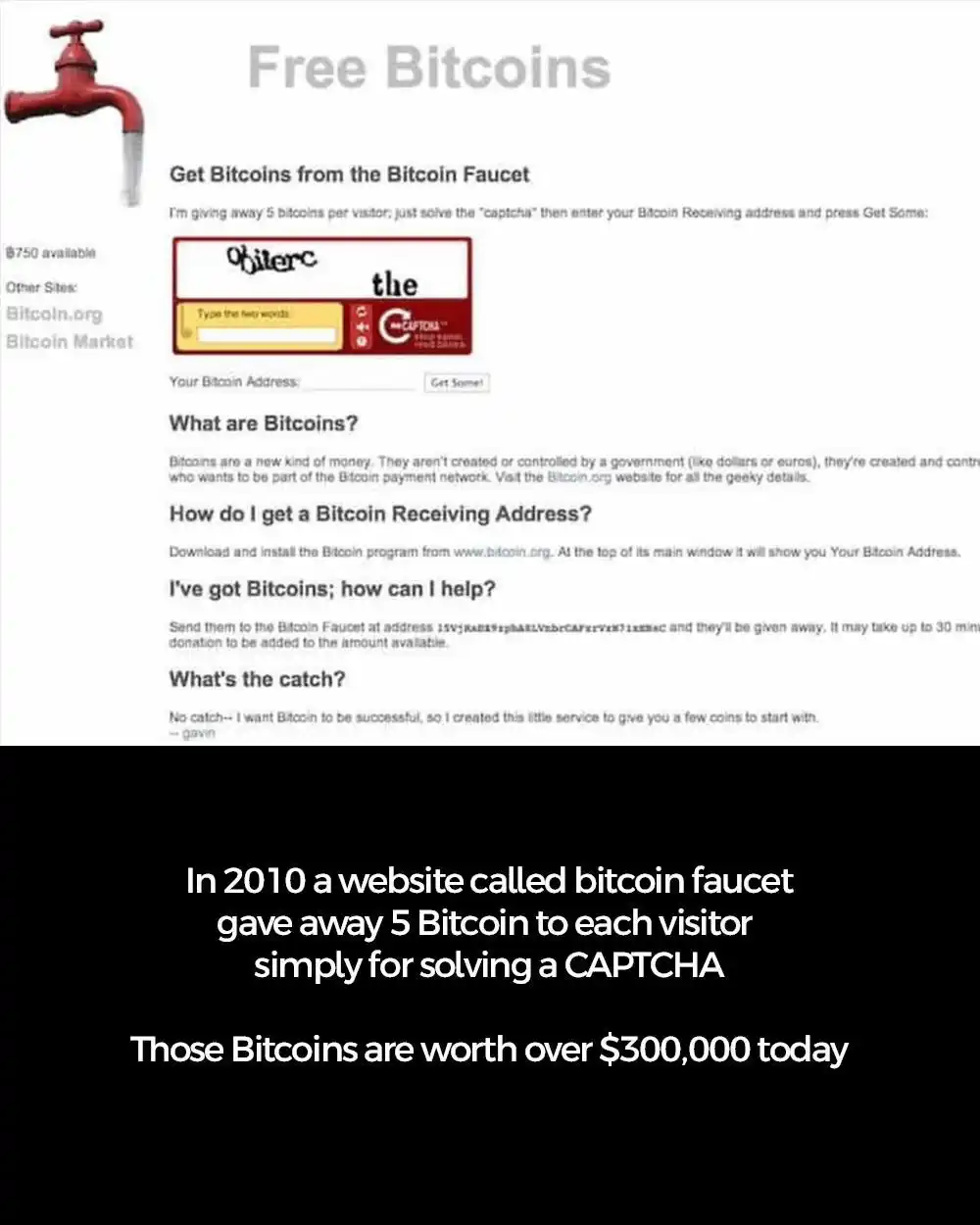
Early developer Gavin Andresen sat in front of his computer, using his own BTC, to set up a rudimentary webpage. He was one of the core developers in Satoshi Nakamoto's early circle, with high-ranking code contributions. However, he created this page not for project promotion or storytelling for fundraising. He simply felt that for this network to survive, more people needed to actually hold Bitcoin, experience this peer-to-peer payment network firsthand, and not just discuss it on mailing lists.
The logic of the page was simple: you come, solve a captcha, and 5 BTC goes into your wallet, done. There was no minimum purchase requirement, no account linking, no additional conditions. Anyone could visit, claim, and leave.
The page ran for several months, with Andresen using his own BTC for supply until it was almost depleted, then he shut it down. In total, he gave out approximately 19,700 BTC.
At today's price of about $67,000, that's about $1.3 billion.
This "faucet" culture has not disappeared from the crypto industry.
"Faucet Is Back"
Returning to Jack Dorsey, we all know him as the co-founder of Twitter (now X), but in recent years, he has completely shifted his focus to Block, formerly known as Square, a fintech company with Bitcoin at its core strategic focus.
Key products under Block include:
- Cash App: a mobile payment and Bitcoin purchase platform for regular users;
- Square: a payment terminal and point-of-sale system for merchants;
- Bitkey: Block's self-developed Bitcoin hardware wallet, focusing on Self-Custody;
- Proto Rig: Block's modular Bitcoin miner launched in August 2025;
Jack Dorsey himself is a staunch Bitcoin believer, having publicly stated: "Bitcoin will become the native currency of the Internet, and fiat currency will disappear in the future." All his business strategies are built around this belief.
Returning to Block's activities, we can see that the rewards on the page are divided into three tiers: buy BTC worth over $10 on Cash App, get $5 in BTC back; pay Square merchants with Bitcoin, get $25 in BTC back; withdraw BTC to the Bitkey hardware wallet, get $50 in BTC back.
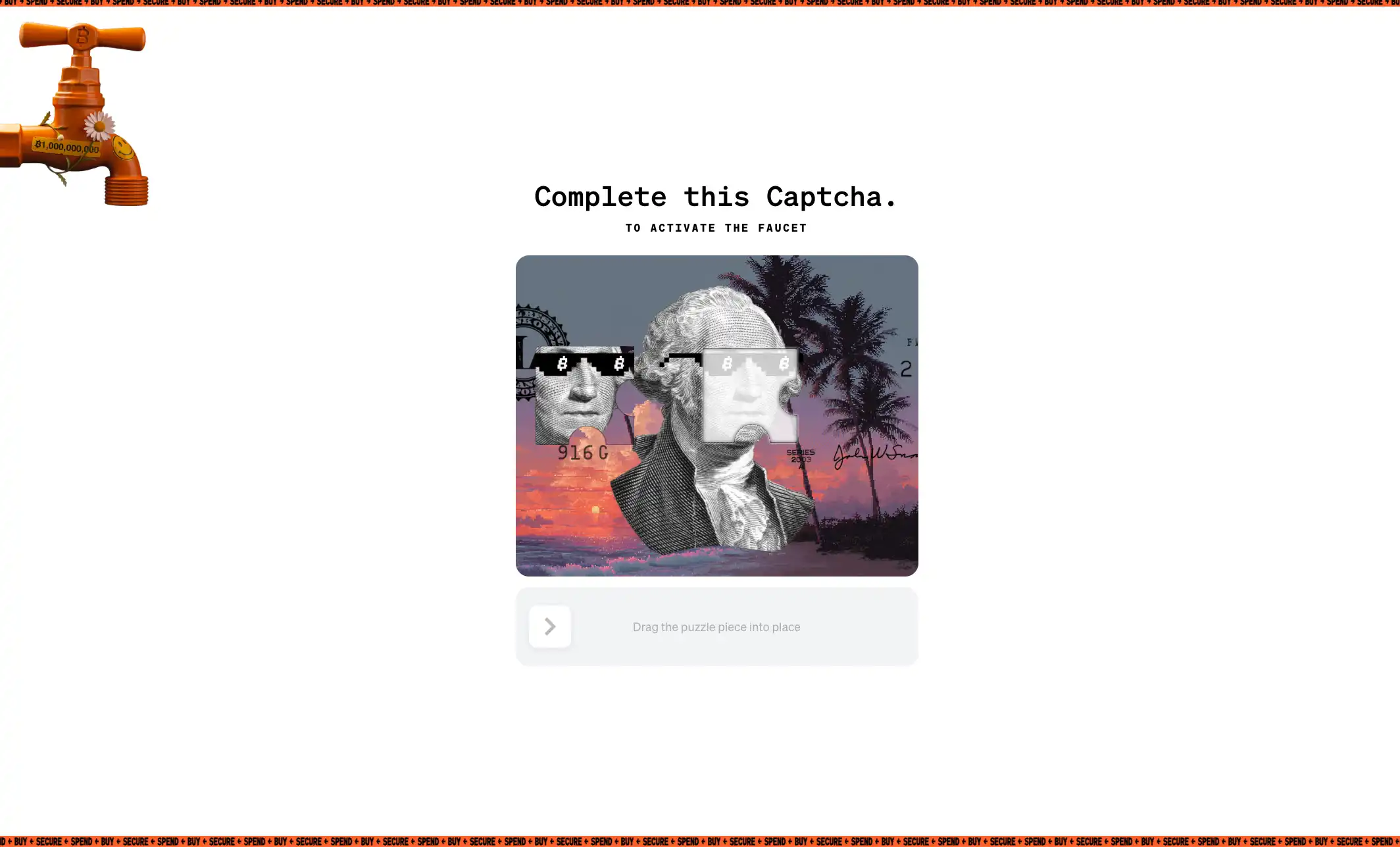
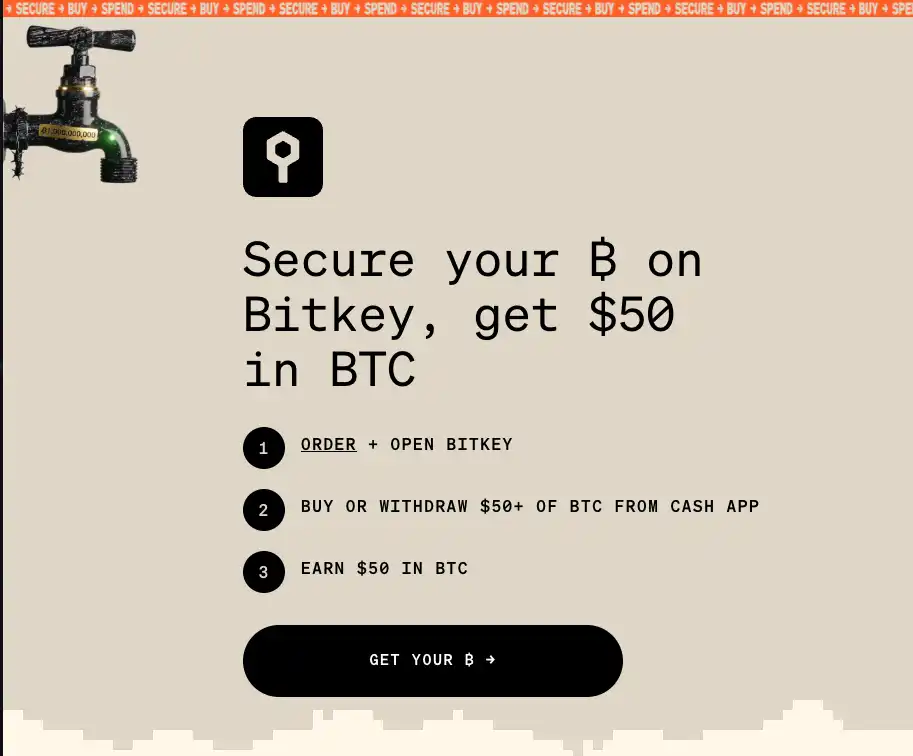
btc.day Activity Page
By completing all three tasks, you can receive up to $80 in BTC.
A total reward pool of $1 million, the event ends on April 10, first come, first served, available only to U.S. residents aged 18 and above. There's a detail in the terms: New York residents can buy BTC on Cash App, but they cannot receive the rewards for Square payments and Bitkey withdrawals. New York's cryptocurrency licensing rules have excluded these two actions.
Looking at the three reward tiers side by side, the structure is also very clear, with each reward tier linked to a specific product line in the Block ecosystem:
For the $5 tier, it incentivizes users to make their first BTC purchase within the Cash App, establishing a buying habit;
For the $25 tier, it encourages users to try using Bitcoin to make purchases at physical stores, specifically within the Square merchant network;
As for the $50 reward, the highest one, it incentivizes users to transfer Bitcoin to their self-controlled Bitkey hardware wallet, promoting the idea of self-custody. This happens to be the step Block most wants to promote.
The Block, acquired for $1 million, is a deep experience of its three product lines by a large number of real users, which is more cost-effective than any advertisement.
The event was launched when the Bitcoin price was around $67,000, experiencing a nearly 50% pullback from the peak of $126,000 at the end of 2025. Proactively taking action amidst a low market sentiment, the company introduced the "Free BTC Giveaway" event. This move not only attracts cautious users but also conveys The Block's strong confidence in Bitcoin's long-term value.
On the other hand, this also aligns with Jack Dorsey's vision of financial inclusion. Jack Dorsey has long advocated that Bitcoin is not just an investment tool but also a financial instrument for ordinary people in emerging markets to bypass the traditional banking system. Bitcoin Day is the practical realization of this concept, lowering the entry barrier and enabling more people to truly "hold" Bitcoin for the first time.
The Radical Transformation of The Block
The Block, making this judgment, is already a thoroughly transformed company.
On February 26, 2026, The Block announced the layoff of about 4,000 people, accounting for 40% of the total workforce, reducing from 10,000 to less than 6,000 employees. After the layoff news, the stock price surged from over $50 to nearly $90.
In an internal memo, Jack Dorsey wrote that he wanted the company to "feel uncomfortably lean." Meanwhile, the company's in-house AI tool, Goose (built on the Model Context Protocol), was already responsible for around 90% of code commits.
Prior to this downsizing, The Block also shut down its long-running decentralized web project TBD, reallocating resources entirely to Bitcoin mining machines and the Bitkey ecosystem. In August 2025, The Block launched the Proto Rig, a modular Bitcoin mining machine aimed at breaking Bitmain's roughly 80% market share, along with the open-source mining farm management software, Proto Fleet.
The Block currently holds 8,883 BTC, with an average acquisition cost of around $33,000 per BTC and a current unrealized gain of about 103%. With BTC now around $67,000, down nearly half from the peak of $126,000 at the end of 2025, Jack Dorsey has not reduced his position at the peak nor stopped betting.
Community and Market Response
Following the announcement, the cryptocurrency community's response was generally positive, seeing this move as a "return to Bitcoin's roots." Analysts pointed out that the launch of Bitcoin Day may significantly increase BTC purchases within Cash App around April 6, with short-term trading volume potentially experiencing fluctuations.
However, there were also criticisms focused on: the reward cap being only $80, limiting its appeal to true "newbies"; the requirement to have an existing Cash App account to participate, closing off access to non-U.S. users entirely; fundamentally being a customer acquisition marketing effort for Block's own product, differing from Andresen's purely altruistic nature back in the day.
Nevertheless, most observers believe that obtaining hundreds of thousands of users for $1 million in a real product experience is a highly cost-effective marketing strategy for Block.
Looking back 16 years ago, when Andresen shut down the page, he had no idea those 19,700 coins would be worth so much. What he did, would be called "user acquisition" in today's terms, but his intention back then was not a business model, but a belief. He believed the Bitcoin network needed genuine participants. All he could offer was his own Bitcoin, and he gave it away.
The result was that thousands of strangers owned Bitcoin for the first time in a few months, not bought, but given by others. This is precisely the core spirit behind Dorsey's current event.
Jack Dorsey's Bitcoin Day event is an expression of belief that spans history and reality. It takes the seed of "changing the world with free Bitcoin" from 16 years ago and replants it in Block's business soil.
You may also like

ChainCatcher Hong Kong Themed Forum Highlights: Decoding the Growth Engine Under the Integration of Crypto Assets and Smart Economy

Why can this institution still grow by 150% when the scale of leading crypto VCs has shrunk significantly?

Anthropic's $1 trillion, compared to DeepSeek's $100 billion

Geopolitical Risk Persists, Is Bitcoin Becoming a Key Barometer?

Annualized 11.5%, Wall Street Buzzing: Is MicroStrategy's STRC Bitcoin's Savior or Destroyer?

An Obscure Open Source AI Tool Alerted on Kelp DAO's $292 million Bug 12 Days Ago

Mixin has launched USTD-margined perpetual contracts, bringing derivative trading into the chat scene.
The privacy-focused crypto wallet Mixin announced today the launch of its U-based perpetual contract (a derivative priced in USDT). Unlike traditional exchanges, Mixin has taken a new approach by "liberating" derivative trading from isolated matching engines and embedding it into the instant messaging environment.
Users can directly open positions within the app with leverage of up to 200x, while sharing positions, discussing strategies, and copy trading within private communities. Trading, social interaction, and asset management are integrated into the same interface.
Based on its non-custodial architecture, Mixin has eliminated friction from the traditional onboarding process, allowing users to participate in perpetual contract trading without identity verification.
The trading process has been streamlined into five steps:
· Choose the trading asset
· Select long or short
· Input position size and leverage
· Confirm order details
· Confirm and open the position
The interface provides real-time visualization of price, position, and profit and loss (PnL), allowing users to complete trades without switching between multiple modules.
Mixin has directly integrated social features into the derivative trading environment. Users can create private trading communities and interact around real-time positions:
· End-to-end encrypted private groups supporting up to 1024 members
· End-to-end encrypted voice communication
· One-click position sharing
· One-click trade copying
On the execution side, Mixin aggregates liquidity from multiple sources and accesses decentralized protocol and external market liquidity through a unified trading interface.
By combining social interaction with trade execution, Mixin enables users to collaborate, share, and execute trading strategies instantly within the same environment.
Mixin has also introduced a referral incentive system based on trading behavior:
· Users can join with an invite code
· Up to 60% of trading fees as referral rewards
· Incentive mechanism designed for long-term, sustainable earnings
This model aims to drive user-driven network expansion and organic growth.
Mixin's derivative transactions are built on top of its existing self-custody wallet infrastructure, with core features including:
· Separation of transaction account and asset storage
· User full control over assets
· Platform does not custody user funds
· Built-in privacy mechanisms to reduce data exposure
The system aims to strike a balance between transaction efficiency, asset security, and privacy protection.
Against the background of perpetual contracts becoming a mainstream trading tool, Mixin is exploring a different development direction by lowering barriers, enhancing social and privacy attributes.
The platform does not only view transactions as execution actions but positions them as a networked activity: transactions have social attributes, strategies can be shared, and relationships between individuals also become part of the financial system.
Mixin's design is based on a user-initiated, user-controlled model. The platform neither custodies assets nor executes transactions on behalf of users.
This model aligns with a statement issued by the U.S. Securities and Exchange Commission (SEC) on April 13, 2026, titled "Staff Statement on Whether Partial User Interface Used in Preparing Cryptocurrency Securities Transactions May Require Broker-Dealer Registration."
The statement indicates that, under the premise where transactions are entirely initiated and controlled by users, non-custodial service providers that offer neutral interfaces may not need to register as broker-dealers or exchanges.
Mixin is a decentralized, self-custodial privacy wallet designed to provide secure and efficient digital asset management services.
Its core capabilities include:
· Aggregation: integrating multi-chain assets and routing between different transaction paths to simplify user operations
· High liquidity access: connecting to various liquidity sources, including decentralized protocols and external markets
· Decentralization: achieving full user control over assets without relying on custodial intermediaries
· Privacy protection: safeguarding assets and data through MPC, CryptoNote, and end-to-end encrypted communication
Mixin has been in operation for over 8 years, supporting over 40 blockchains and more than 10,000 assets, with a global user base exceeding 10 million and an on-chain self-custodied asset scale of over $1 billion.

$600 million stolen in 20 days, ushering in the era of AI hackers in the crypto world
Vitalik's 2026 Hong Kong Web3 Summit Speech: Ethereum's Ultimate Vision as the "World Computer" and Future Roadmap
On the same day Aave introduced rsETH, why did Spark decide to exit?
Full Post-Mortem of the KelpDAO Incident: Why Did Aave, Which Was Not Compromised, End Up in Crisis Situation?

After a $290 million DeFi liquidation, is the security promise still there?
ZachXBT's post ignites RAVE nearing zero, what is the truth behind the insider control?

Vitalik 2026 Hong Kong Web3 Carnival Speech Transcript: We do not compete on speed; security and decentralization are the core
In-depth Analysis of RAVE Events: Short Squeeze, Crash, and Quantitative Financial Models of Liquidity Manipulation

Eve of Ceasefire, US Military Fires on Iranian Vessel | Rewire News Morning Brief

Figma's stock price drops over 7%, will Claude Design be the terminator?




 App
App