
 Buy Crypto
- Markets
 Futures
- Spot
- Copy Trade
- Earn
- More
A Decade-Old Crypto Veteran, Zcash Is Facing a Midlife Crisis Too

Source: TechFlow (Shenchao)
On January 7, Zcash’s entire core development team resigned.
Not one or two people in a dispute—but the whole Electric Coin Company (ECC), around 25 people in total, including the CEO, walked out together.
ECC is the primary developer behind Zcash. Put simply, the people who write the code quit.
The market reacted immediately. ZEC fell more than 20% on the news.
A quick reminder: Zcash is almost ten years old.
It launched on October 28, 2016—earlier than many people even entered crypto. Its original selling point was “privacy transactions”: sender, receiver, and amount fully encrypted, invisible on-chain.
In reality, after nine years, less than 1% of ZEC transactions actually use the privacy feature
The remaining 99% are effectively transparent.
For nine years, usage stagnated while the team kept going. The price collapsed from over USD 3,000 at launch to around USD 15 in July 2024.
Then, at the end of 2025, ZEC suddenly took off.
From hovering around USD 40 earlier in the year, it surged to USD 744 on November 7, pushing market cap above USD 10 billion and back into the top 20.
The long-dormant “privacy coin” narrative suddenly became fashionable again.
And then—the development team left.
It reads like a midlife script: buy a Porsche, then get divorced. Get the year-end bonus, then break up.
When money is scarce, everyone is a comrade. When money arrives, the fight becomes about who decides.
So what was the fight about?
A wallet called Zashi.
Zashi is a mobile wallet launched by ECC in early 2024, designed with privacy enabled by default. It is the most important user gateway in the Zcash ecosystem.
ECC wanted to privatize Zashi, bring in external capital, and turn it into a venture-backed company that could raise funds and iterate quickly.
But ECC is not an independent for-profit company.
In 2020, ECC was placed under a nonprofit entity called Bootstrap, structured as a U.S. 501(c)(3).
In simple terms: this structure is designed for charities and public-interest organizations. The upside is tax exemption. The downside is that profits cannot be distributed internally, and asset decisions are subject to board approval.
At the time, this was done for compliance—to reduce regulatory pressure from the SEC. In the bear market, nobody cared. There was no money to fight over.
Now, the Bootstrap board said no.
Their reasoning was straightforward: as a nonprofit, they have a legal obligation to protect donor interests. Privatizing Zashi could be illegal, invite lawsuits, or trigger political backlash. They pointed to OpenAI as a cautionary example—how many lawsuits followed its attempt to move from nonprofit to for-profit.
Former ECC CEO Josh Swihart strongly disagreed.
On X, he called the board’s actions “malicious governance behavior”, saying it made it “impossible for the team to perform its duties effectively and with dignity.”
He used a legal term: “constructive discharge”—meaning you’re not formally fired, but working conditions are made untenable, effectively forcing you to leave.
In this case, 25 people were forced out together.
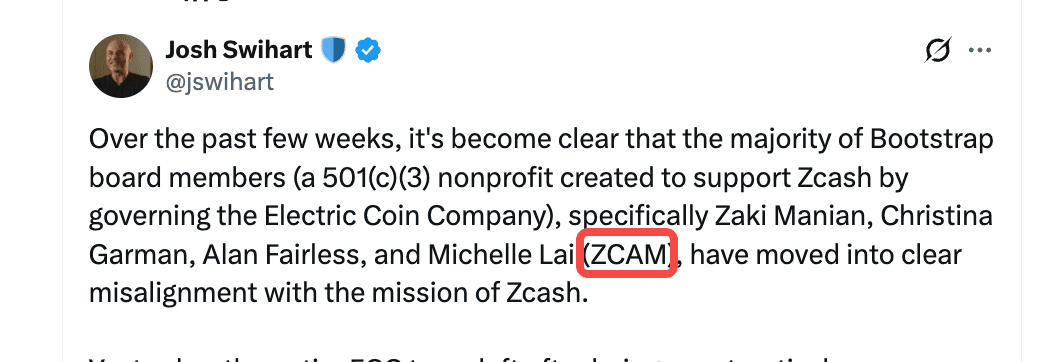
Swihart also publicly named four board members: Zaki, Christina, Alan, and Michelle—and combined their initials into “ZCAM.”
ZCAM.
It sounds a lot like “SCAM.”
Whether intentional or not is unclear.
Among them, Zaki Manian has the most controversial history.
A long-time figure in the Cosmos ecosystem, he was a core member of Tendermint before resigning in 2020 after a public conflict with founder Jae Kwon.
In 2023, the FBI informed him that two developers in a project he oversaw were North Korean agents. He allegedly knew and did not disclose this for 16 months. In October 2024, Jae Kwon publicly accused him of gross negligenceand betraying community trust.
Today, he sits on the Zcash board.
One day after the mass resignation, the former ECC team announced a new company, code-named CashZ.
They said they would use the existing Zashi codebase to launch a new wallet within weeks. Existing Zashi users would be able to migrate seamlessly.
“We are still the same team, with the same mission: to build unstoppable private money.”
No new token. No fork. Just changing the shell and continuing the work.
The most ironic part of this story is the timing.
When ZEC was USD 15, nobody cared who controlled the wallet.
When it hit USD 500, the value of Zashi suddenly became existential.
Money clarifies relationships.
The same nonprofit-versus-startup tension played out very differently elsewhere. At OpenAI, the board lost. At Zcash, the team left.
Who “won” is unclear—but the conflict itself is common across crypto.
On the CashZ website, Swihart wrote why they left:
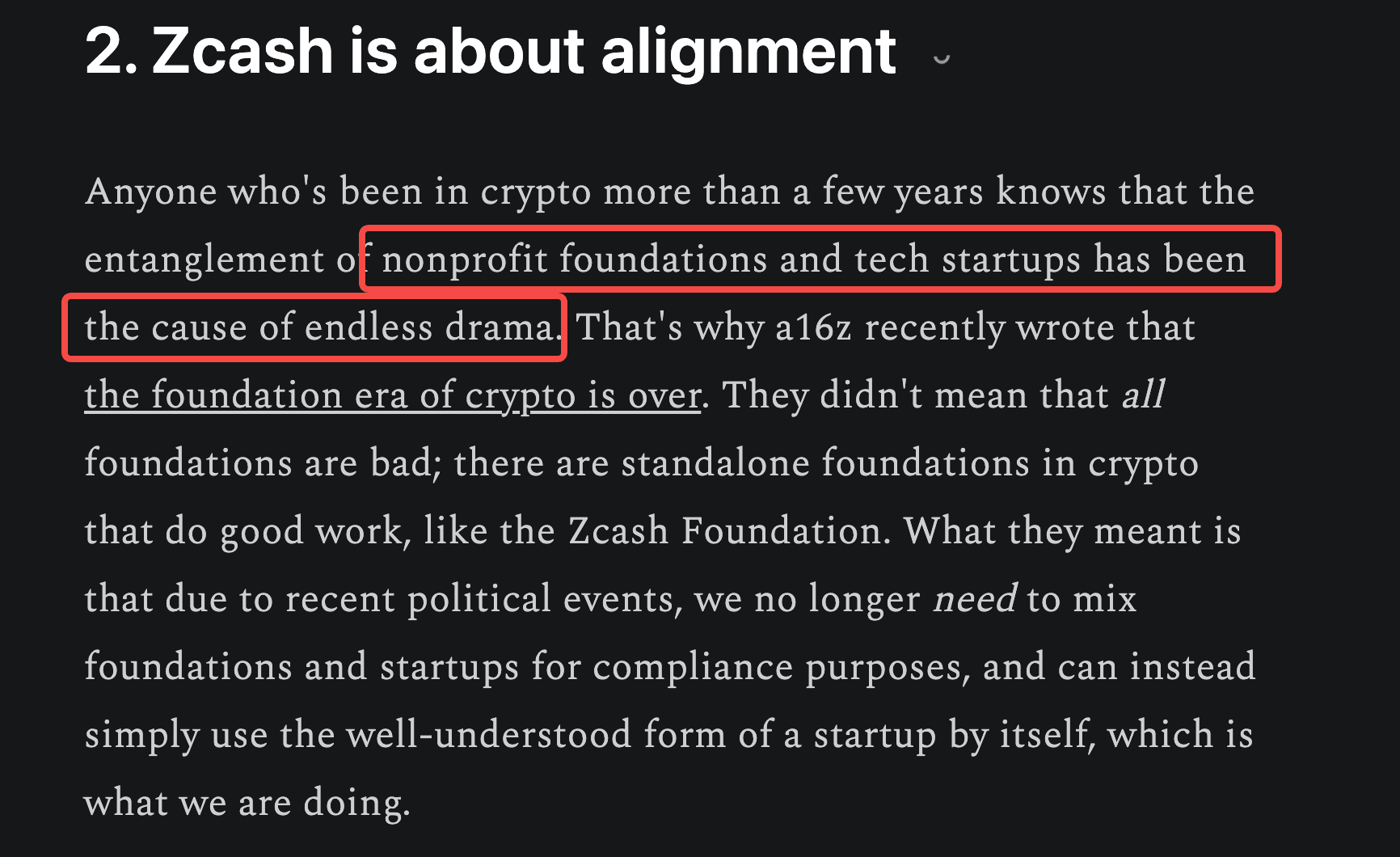
“The nonprofit foundation model is a relic of crypto’s compliance era. Back then, projects needed a ‘regulatory buffer’ to protect themselves. But those buffers bring bureaucracy and strategic deadlock. Startups can scale quickly. Nonprofits cannot.”
He added:
“Anyone who has spent time in crypto knows this: the entanglement between nonprofit foundations and tech startups is an endless source of drama.”
Endless drama indeed.
In 2023, when Zooko stepped down as CEO, rumors already circulated of disagreements with Swihart. In January 2025, Peter Van Valkenburgh, a board member of the Zcash Foundation, also resigned.
After ten years, most of the original figures are gone.
Someone asked on X: Will Zcash die?
The chain is still running.
The code still exists.
Only the people writing it have changed.
But Swihart is likely right: the tension between nonprofits and startups is a structural flaw in crypto governance. Cosmos fought over it. Ethereum fought over it. Solana fought over it too.
The difference is only in intensity and outcome.
Zcash chose the cleanest option of all.
Break up.
You may also like

Morning Report | Drift receives support from Tether and others to establish a $147.5 million recovery fund; Charles Schwab launches spot cryptocurrency trading services; Morgan Stanley lists asset tokenization as a growth priority

Beta, meet cash flow

How do tokenized stocks work? A conversation with the head of digital assets at BlackRock
Is the rebound an illusion? The bond market has already provided the answer

The End of Crypto Premium? Observing the Market Logic Shift from the Dilemma After Gemini's Listing

The third round of repurchase and destruction by JST has been completed as scheduled, with a repurchase and destruction scale exceeding 21 million USD

Will Bitcoin ETF Increase Bitcoin Price in 2026?
Will Bitcoin ETF increase BTC price in 2026? See what ETF inflows signal about institutional demand, market momentum, and Bitcoin’s long-term outlook.

How to Track Bitcoin ETF Flows in 2026: Best Free Trackers Used by Analysts
Since 2024, Bitcoin ETFs have become one of the main channels through which institutional capital enters the crypto market. Unlike traditional crypto exchange volume data, ETF flow data reflects portfolio allocation decisions from large investors, which often influence long-term price direction rather than short-term speculation.
How to Invest in Bitcoin ETF in 2026: Beginner's Step-by-Step Guide
For users who want the simplest way to follow Bitcoin price movements, ETFs can be a convenient starting point.

What Is a Bitcoin ETF? Is Bitcoin ETF a Good Investment Entry for Crypto Beginners in 2026?
What is a Bitcoin ETF and why does it matter in 2026? Learn how Bitcoin ETFs work, why institutions use them, and how they changed crypto market access worldwide.

Bitcoin ETF vs Ethereum ETF: What's the Difference in 2026?
Bitcoin ETF vs Ethereum ETF: What’s the difference and which should you choose in 2026? Compare risk, adoption trends, and portfolio roles before investing.
The Bounce is a Illusion? The Bond Market Has Answered

The Flip Side of the Stock Market Rally: Energy Reconfiguration, Bitcoin Short Squeeze, and Market Dislocation

Claude's Request for Identity Verification Prompts Reflection from a Relay Operator
PinPet × VELA: Solana's First Atomic Swap Engine and Yield Hedging Protocol, Reframing the DeFi Financial Paradigm

From Coinbase to OpenAI: When lobbying experts start to flee crypto

Understanding the Key Issues of Tokenization in One Article




 App
App