
 Buy Crypto
- Markets
 Futures
- Spot
- Copy Trade
- Earn
- More
6 Major Global Institutions 2025 Outlook: AI Boom Continues, Key Year for Exploring Alpha


Original Author: Stoic
Original Translation: DeepTech TechFlow
Distill the core views of top global institutions for you, saving you time reading hundreds of pages of reports.
Data Source: J.P. Morgan, Blackrock, Deutsche Wealth, World Bank, Goldman Sachs, and Morgan Stanley.
1. J.P. Morgan's Core Views
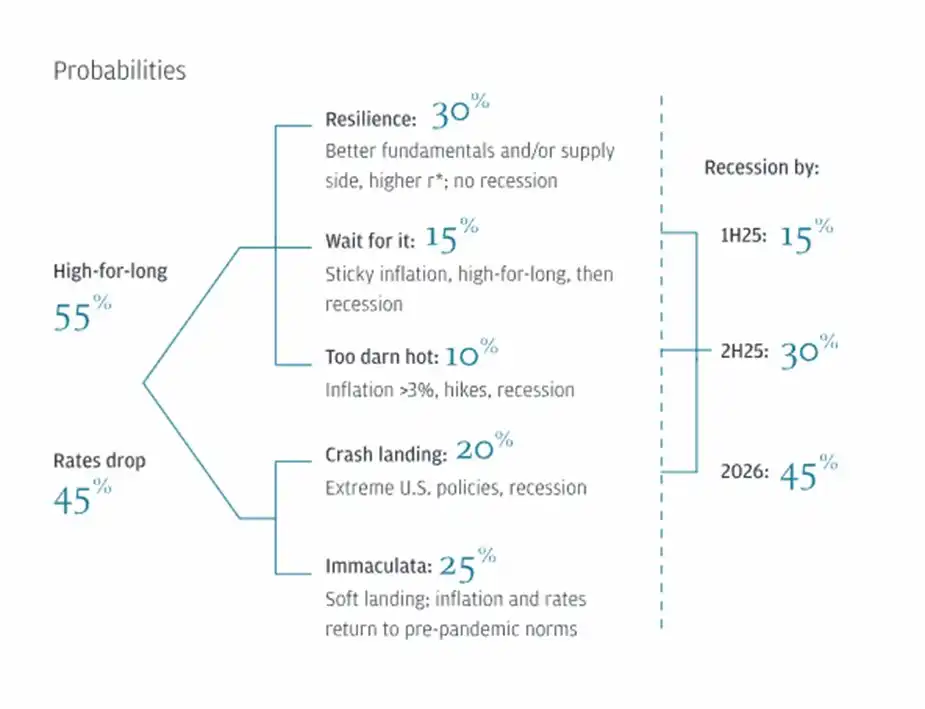
· Global Economic Growth: It is expected that global economy will continue to grow by 2025, but China's economy may experience significant slowing.
· Stock Market Forecast: The S&P 500 index is expected to reach 6500 points, but global stock markets may show divergence.
Global Market Outlook
In the coming months, market trends will be influenced by the interaction of macroeconomic trends and monetary policy, while policy changes by the new U.S. administration will also bring uncertainty.
Technological innovation, especially the 'Continuation of the AI Boom,' will be a key driver of the market.
Interest Rate Outlook
The baseline forecast suggests that global economic growth is resilient, but the persistence of inflation will limit further monetary policy easing in 2025.
However, the new Trump administration may bring risks, such as overly aggressive trade and immigration policies that could impact the supply side and dent global market confidence.
Baseline Scenario Forecast
· Strong global economic growth.
· Positive outlook for U.S. stocks and gold, but the prospects for oil and base metals are not optimistic.
2. Blackrock's Core Views
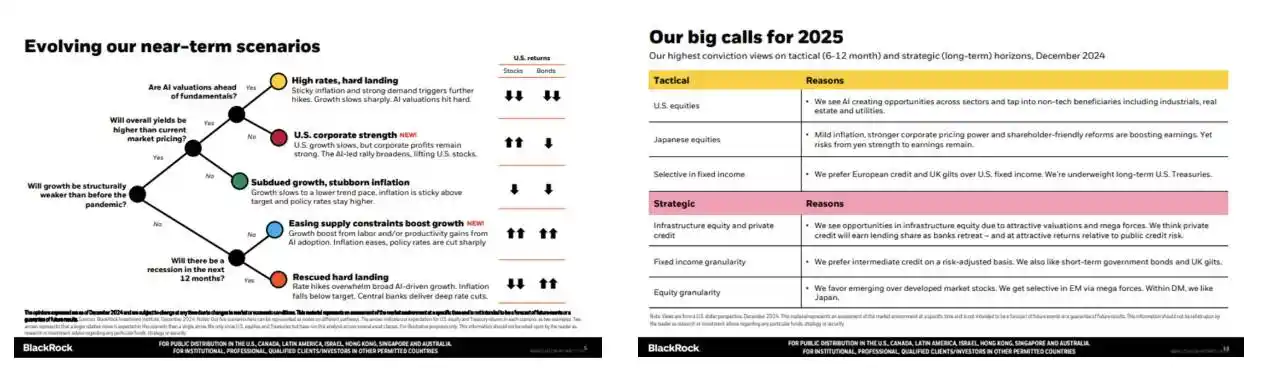
· Unique Market Environment: The current market is in a unique phase, where long-term assets exhibit unusually strong reactions to short-term events.
· Investment Strategy: Bullish on risk assets, further overweighting U.S. stocks as the 'AI theme is rapidly expanding'.
· Inflation and Interest Rates: It is expected that inflation and interest rates will remain at levels higher than pre-pandemic.
2025 Market Outlook
· Inflation Pressure: Due to intensified geopolitical divisions and accelerated spending on "AI infrastructure development and low-carbon transformation," inflation pressure is expected to persist.
· Fed Policy: The Fed is unlikely to significantly cut interest rates, and rates are not expected to drop below 4%.
· Long-Term Bond Yields: Given budget deficits, sticky inflation, and increased market volatility, investors may require a higher risk premium, leading to a rise in long-term government bond yields.
Key Investment Themes
· AI-Driven Investment Craze: The AI race will continue to drive market investments.
· U.S. Stocks to Continue Outperforming: U.S. stocks are expected to continue their strong performance, but investors need to be flexible in response to market changes.
· Monitoring Risk Signals: Signals such as a surge in long-term bond yields or escalated trade protectionism could be key triggers for adjusting investment strategies.
3. Deutsche Wealth's Core Views
In a backdrop of an "economically challenging environment," inflation may remain high due to "increased fiscal spending and potential tariff hikes."
"This will limit central banks' room to stimulate the economy through rate cuts, forcing them to seek a balance between growth and inflation control. This uncertainty could alter market expectations and trigger more volatility than in 2024. Additionally, geopolitical conflicts triggered by changes in trade policies could further exacerbate market instability."
Asset Allocation Themes
· The U.S. economy may achieve a soft landing, with steady economic growth and robust investment.
· Focus on growth stocks, but be cautious of high volatility risks.
· Corporate profit growth and large-scale stock buybacks will benefit the U.S. stock market.
Investment Advice:
- Focus on the long-term positive trend of economic growth.
- Consider adopting a diversified investment portfolio and actively manage risks.
Key Points Overview
· Despite geopolitical tensions and high interest rates, global economic growth is expected to edge up from 2.6% in 2024 to 2.7% in 2025-26.
· While short-term growth prospects have improved, the growth of most economies globally remains below the average level of the 2010s.
· Global inflation is expected to slowly decline, averaging 3.5% in 2025. Central banks may remain cautious in their accommodative policies.
· Risks such as geopolitical conflicts and climate disasters continue to exist, with a greater impact on vulnerable economies.
· Policy recommendations include supporting green and digital transformation, promoting debt relief, and enhancing food security.
4. World Bank Group 2025 Outlook Highlights
· Despite facing challenges from geopolitical tensions and high interest rates, global economic growth is expected to remain at 2.6% in 2024. By 2025-2026, with a gradual recovery in trade and investment, this growth rate may slightly increase to 2.7%.
· While short-term growth prospects have improved, overall performance remains weak. During 2024-2025, nearly 60% of the world's economies are projected to grow at rates lower than the average level of the 2010s, accounting for over 80% of global output and population.
· The global inflation easing is expected to be slower than previously anticipated, with an average inflation rate of 3.5% this year. Due to lingering inflationary pressures, central banks may exercise more caution in easing monetary policies.
· Recent multiple shocks have caused many emerging markets and developing economies to stagnate in catching up with advanced economies. Data shows that nearly half of EMDEs underperformed compared to advanced economies during 2020-2024. The future prospects are even bleaker for those fragile economies heavily impacted by conflicts.
· Despite a somewhat balanced risk picture, downside risks still dominate overall. Key risks include:
- Continued geopolitical tensions.
- Further global trade fragmentation.
- Sustained high interest rates coupled with persistent inflationary pressures.
-Frequent occurrence of natural disasters related to climate change.
· To address the above challenge, global policies need to focus on the following aspects:
-Maintaining the stability of the international trade system.
-Promoting green and digital transformation to support economic sustainability.
-Providing debt relief support to help alleviate the pressure on highly indebted countries.
-Improving food security issues, especially in fragile economies.
· For emerging markets and developing economies, high debt and its servicing costs pose a severe challenge. These countries need to find a balance between meeting significant investment needs and maintaining fiscal sustainability.
· To achieve long-term economic and social development goals, countries need to take the following policy measures:
-Increase productivity growth to drive economic efficiency.
-Improve the efficiency of public investments to ensure proper fund utilization.
-Enhance human capital development, such as education and skills training.
-Narrow the gender gap in the labor market and increase female labor force participation.
5. Goldman Sachs Key Insights
「2025: The Key Year for Exploring Excess Returns」
· The simultaneous occurrence of interest rate declines and economic growth may favor the stock market.
· Current stock valuations are nearing highs, and future earnings growth will be a key driver of the market.
· Since October 2023, global stock markets have risen by 40%, making the market more susceptible to negative news.
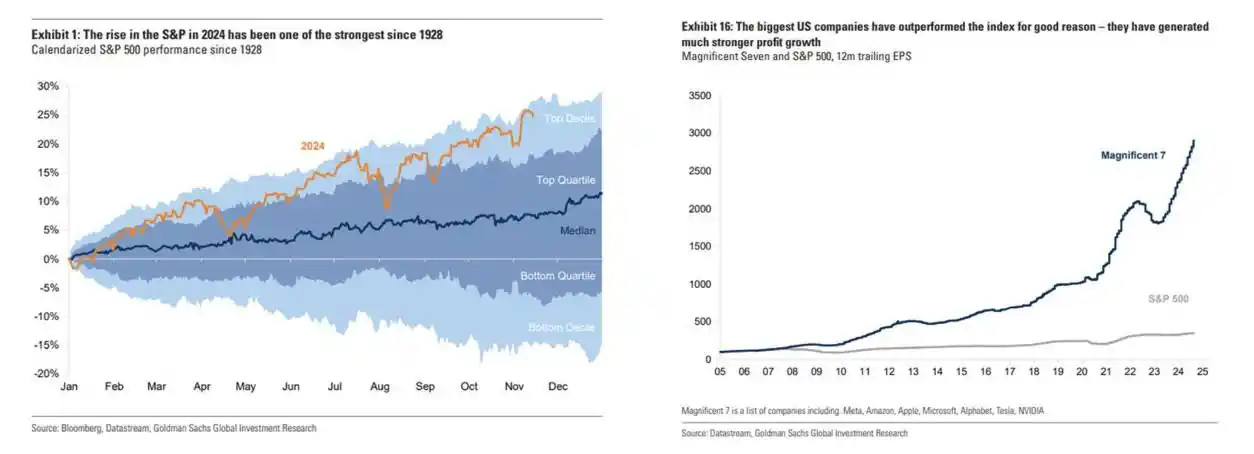
· The S&P 500 index has had one of the strongest rallies since 1928, with the Nasdaq index rising over 50%, and NVIDIA seeing a surge of up to 264%. This trend is mainly driven by expectations of "peak inflation" and a "shift in Fed policy."
· The increase in price-to-earnings ratios has brought stock and credit valuations to historic highs, especially with the performance in European and Chinese markets nearing long-term average levels, no longer in undervalued territory.
· Although stock valuations are high, this does not completely suppress the possibility of further upside. However, high valuations may exert some pressure on future returns.
· Large US tech companies have performed well, primarily benefiting from strong profit growth. Their valuation levels reflect their solid fundamentals rather than market hype.
Risk Analysis
The report mentions two key risks:
1. The recent optimism in the market has already priced in some of the future returns, making the market more vulnerable to correction.
2. There are still many unknown factors regarding tariff risks, which may introduce uncertainty.
Goldman Sachs emphasizes the strategy of "diversifying investments and achieving alpha" to address these risks.
The specific strategies include:
· Broadening the investment scope to include more asset classes;
· Seeking potential value investment opportunities;
· Achieving geographical investment diversification to mitigate risks.
6. Market Outlook from Morgan Stanley
Key Themes
1. High Market Valuations Morgan Stanley believes that current market valuations are generally high, and most investors no longer see asset prices as cheap. Therefore, it is recommended to prioritize generating alpha through optimizing asset allocation and investment selection, rather than relying solely on overall market returns (beta).
2. Bull Market Entering Optimistic Phase The market is entering the "optimistic phase" of the bull market, which is usually the late stage of a bull market, followed by a possible "euphoria phase," just before a bear market. Morgan Stanley states that "the market performance in 2025 is still expected to be promising."
3. Impact of Generative AI on the Private Market The potential impact of Generative AI on the private market is considered one of the key themes for 2025. The rapid development of this technology may bring new opportunities and challenges to private equity investments.
Summary and Recommendations
From the perspectives of major institutions, some common trends and themes can be identified, such as high market valuations, the impact of AI technology, and the importance of diversified investments. These insights can serve as references for investors when formulating strategies.
It is important to note that these perspectives are not absolute truths but rather provide different viewpoints for investors to compare and analyze.
If this content receives enough attention, I plan to write an article specifically discussing the cryptocurrency market outlook. If there are any other noteworthy reports or materials from research institutions, please feel free to recommend them to me as I am very keen to further research.
You may also like

Why can this institution still grow by 150% when the scale of leading crypto VCs has shrunk significantly?

Anthropic's $1 trillion, compared to DeepSeek's $100 billion

Geopolitical Risk Persists, Is Bitcoin Becoming a Key Barometer?

Annualized 11.5%, Wall Street Buzzing: Is MicroStrategy's STRC Bitcoin's Savior or Destroyer?

An Obscure Open Source AI Tool Alerted on Kelp DAO's $292 million Bug 12 Days Ago

Mixin has launched USTD-margined perpetual contracts, bringing derivative trading into the chat scene.
The privacy-focused crypto wallet Mixin announced today the launch of its U-based perpetual contract (a derivative priced in USDT). Unlike traditional exchanges, Mixin has taken a new approach by "liberating" derivative trading from isolated matching engines and embedding it into the instant messaging environment.
Users can directly open positions within the app with leverage of up to 200x, while sharing positions, discussing strategies, and copy trading within private communities. Trading, social interaction, and asset management are integrated into the same interface.
Based on its non-custodial architecture, Mixin has eliminated friction from the traditional onboarding process, allowing users to participate in perpetual contract trading without identity verification.
The trading process has been streamlined into five steps:
· Choose the trading asset
· Select long or short
· Input position size and leverage
· Confirm order details
· Confirm and open the position
The interface provides real-time visualization of price, position, and profit and loss (PnL), allowing users to complete trades without switching between multiple modules.
Mixin has directly integrated social features into the derivative trading environment. Users can create private trading communities and interact around real-time positions:
· End-to-end encrypted private groups supporting up to 1024 members
· End-to-end encrypted voice communication
· One-click position sharing
· One-click trade copying
On the execution side, Mixin aggregates liquidity from multiple sources and accesses decentralized protocol and external market liquidity through a unified trading interface.
By combining social interaction with trade execution, Mixin enables users to collaborate, share, and execute trading strategies instantly within the same environment.
Mixin has also introduced a referral incentive system based on trading behavior:
· Users can join with an invite code
· Up to 60% of trading fees as referral rewards
· Incentive mechanism designed for long-term, sustainable earnings
This model aims to drive user-driven network expansion and organic growth.
Mixin's derivative transactions are built on top of its existing self-custody wallet infrastructure, with core features including:
· Separation of transaction account and asset storage
· User full control over assets
· Platform does not custody user funds
· Built-in privacy mechanisms to reduce data exposure
The system aims to strike a balance between transaction efficiency, asset security, and privacy protection.
Against the background of perpetual contracts becoming a mainstream trading tool, Mixin is exploring a different development direction by lowering barriers, enhancing social and privacy attributes.
The platform does not only view transactions as execution actions but positions them as a networked activity: transactions have social attributes, strategies can be shared, and relationships between individuals also become part of the financial system.
Mixin's design is based on a user-initiated, user-controlled model. The platform neither custodies assets nor executes transactions on behalf of users.
This model aligns with a statement issued by the U.S. Securities and Exchange Commission (SEC) on April 13, 2026, titled "Staff Statement on Whether Partial User Interface Used in Preparing Cryptocurrency Securities Transactions May Require Broker-Dealer Registration."
The statement indicates that, under the premise where transactions are entirely initiated and controlled by users, non-custodial service providers that offer neutral interfaces may not need to register as broker-dealers or exchanges.
Mixin is a decentralized, self-custodial privacy wallet designed to provide secure and efficient digital asset management services.
Its core capabilities include:
· Aggregation: integrating multi-chain assets and routing between different transaction paths to simplify user operations
· High liquidity access: connecting to various liquidity sources, including decentralized protocols and external markets
· Decentralization: achieving full user control over assets without relying on custodial intermediaries
· Privacy protection: safeguarding assets and data through MPC, CryptoNote, and end-to-end encrypted communication
Mixin has been in operation for over 8 years, supporting over 40 blockchains and more than 10,000 assets, with a global user base exceeding 10 million and an on-chain self-custodied asset scale of over $1 billion.

$600 million stolen in 20 days, ushering in the era of AI hackers in the crypto world
Vitalik's 2026 Hong Kong Web3 Summit Speech: Ethereum's Ultimate Vision as the "World Computer" and Future Roadmap
On the same day Aave introduced rsETH, why did Spark decide to exit?
Full Post-Mortem of the KelpDAO Incident: Why Did Aave, Which Was Not Compromised, End Up in Crisis Situation?

After a $290 million DeFi liquidation, is the security promise still there?
ZachXBT's post ignites RAVE nearing zero, what is the truth behind the insider control?

Vitalik 2026 Hong Kong Web3 Carnival Speech Transcript: We do not compete on speed; security and decentralization are the core
In-depth Analysis of RAVE Events: Short Squeeze, Crash, and Quantitative Financial Models of Liquidity Manipulation

Eve of Ceasefire, US Military Fires on Iranian Vessel | Rewire News Morning Brief

Figma's stock price drops over 7%, will Claude Design be the terminator?

Plunge by 10% Followed by Rebound, Weekend Oil Market Watch

SpaceX Mascot ASTEROID Fast Track $170 million, Stemming from an Unfinished Space Dream
Why can this institution still grow by 150% when the scale of leading crypto VCs has shrunk significantly?
Anthropic's $1 trillion, compared to DeepSeek's $100 billion
Geopolitical Risk Persists, Is Bitcoin Becoming a Key Barometer?
Annualized 11.5%, Wall Street Buzzing: Is MicroStrategy's STRC Bitcoin's Savior or Destroyer?
An Obscure Open Source AI Tool Alerted on Kelp DAO's $292 million Bug 12 Days Ago
Mixin has launched USTD-margined perpetual contracts, bringing derivative trading into the chat scene.
The privacy-focused crypto wallet Mixin announced today the launch of its U-based perpetual contract (a derivative priced in USDT). Unlike traditional exchanges, Mixin has taken a new approach by "liberating" derivative trading from isolated matching engines and embedding it into the instant messaging environment.
Users can directly open positions within the app with leverage of up to 200x, while sharing positions, discussing strategies, and copy trading within private communities. Trading, social interaction, and asset management are integrated into the same interface.
Based on its non-custodial architecture, Mixin has eliminated friction from the traditional onboarding process, allowing users to participate in perpetual contract trading without identity verification.
The trading process has been streamlined into five steps:
· Choose the trading asset
· Select long or short
· Input position size and leverage
· Confirm order details
· Confirm and open the position
The interface provides real-time visualization of price, position, and profit and loss (PnL), allowing users to complete trades without switching between multiple modules.
Mixin has directly integrated social features into the derivative trading environment. Users can create private trading communities and interact around real-time positions:
· End-to-end encrypted private groups supporting up to 1024 members
· End-to-end encrypted voice communication
· One-click position sharing
· One-click trade copying
On the execution side, Mixin aggregates liquidity from multiple sources and accesses decentralized protocol and external market liquidity through a unified trading interface.
By combining social interaction with trade execution, Mixin enables users to collaborate, share, and execute trading strategies instantly within the same environment.
Mixin has also introduced a referral incentive system based on trading behavior:
· Users can join with an invite code
· Up to 60% of trading fees as referral rewards
· Incentive mechanism designed for long-term, sustainable earnings
This model aims to drive user-driven network expansion and organic growth.
Mixin's derivative transactions are built on top of its existing self-custody wallet infrastructure, with core features including:
· Separation of transaction account and asset storage
· User full control over assets
· Platform does not custody user funds
· Built-in privacy mechanisms to reduce data exposure
The system aims to strike a balance between transaction efficiency, asset security, and privacy protection.
Against the background of perpetual contracts becoming a mainstream trading tool, Mixin is exploring a different development direction by lowering barriers, enhancing social and privacy attributes.
The platform does not only view transactions as execution actions but positions them as a networked activity: transactions have social attributes, strategies can be shared, and relationships between individuals also become part of the financial system.
Mixin's design is based on a user-initiated, user-controlled model. The platform neither custodies assets nor executes transactions on behalf of users.
This model aligns with a statement issued by the U.S. Securities and Exchange Commission (SEC) on April 13, 2026, titled "Staff Statement on Whether Partial User Interface Used in Preparing Cryptocurrency Securities Transactions May Require Broker-Dealer Registration."
The statement indicates that, under the premise where transactions are entirely initiated and controlled by users, non-custodial service providers that offer neutral interfaces may not need to register as broker-dealers or exchanges.
Mixin is a decentralized, self-custodial privacy wallet designed to provide secure and efficient digital asset management services.
Its core capabilities include:
· Aggregation: integrating multi-chain assets and routing between different transaction paths to simplify user operations
· High liquidity access: connecting to various liquidity sources, including decentralized protocols and external markets
· Decentralization: achieving full user control over assets without relying on custodial intermediaries
· Privacy protection: safeguarding assets and data through MPC, CryptoNote, and end-to-end encrypted communication
Mixin has been in operation for over 8 years, supporting over 40 blockchains and more than 10,000 assets, with a global user base exceeding 10 million and an on-chain self-custodied asset scale of over $1 billion.






 App
App