
6% Annual Percentage Yield as Musk Declares War on Traditional Banks




Original Title: "6% Annualized, Musk Declares War on Traditional Banks"
Original Author: Cathy, Plain English Blockchain
In early March 2026, American actor William Shatner—also known as Captain Kirk from "Star Trek"—posted a screenshot on X.
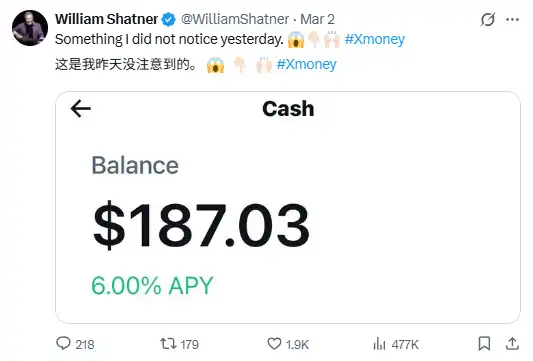
Nothing major, just him testing a new product called X Money.
The screenshot included a line of numbers, Annualized Return Rate: 6%.
This post didn't cause a huge stir, but quietly exploded in the finance world.
Not because of William Shatner, but because of that 6%.
If you open a regular savings account at JPMorgan Chase, the interest rate is 0.01%. You go to Bank of America, it's about the same. Deposit $100, and after a year, the big bank gives you one cent. Whereas X Money gives you $6.
The difference, 600 times.
This is how Musk declares war on traditional finance—not through a technical whitepaper, not through regulatory PR, but through a screenshot.
A Black Metal Card
X Money's appearance is easy to understand: a digital wallet that can send, receive, and store money, paired with a physical debit card.
But every detail reveals ambition.
That debit card is black metal, laser-engraved with your X username (Handle). Not your name, not an account number, but your social identity on the X platform.
This design is not accidental. It links social accounts and spending power together. Every time you swipe the card to pay, what's displayed is not just a payment tool, but your digital identity. The stickiness of the X ecosystem builds up layer by layer like this.
On the settlement front, X Money integrates with Visa Direct. Traditional bank ACH transfers take 1 to 3 business days to clear, while Visa Direct offers instant settlement. For the gig economy and content creators, this speed difference is a tangible improvement in experience.
Deposits are held by Cross River Bank (a member of the FDIC), with each user enjoying up to $250,000 in FDIC deposit insurance.
In one sentence, summarize this product: 6% APY, Laser-Etched Black Metal Card, Instant Settlement, Zero Overseas Fees, $250k Insurance Limit.
Looking at the parameter table alone, it's hard to find fault.
Why 6% Is Possible
This is the most critical question.
Where does the money for 6% APY come from? X Money is not burning money to subsidize users—at least not under the current business logic. The answer lies in a subtle difference in cost structure.
Traditional big banks maintain a full physical network: branches, tellers, ATM clusters, decades-old IT systems. These are huge fixed costs, and regardless of the deposit scale, this expense is there.
Whereas X Money is a cloud-native, API-first platform with no physical branches, no historical baggage. The front-end user experience is handled by X, while bank compliance and fund custody are handled by Cross River Bank. This “frontend to tech company, backend to licensed bank” embedded finance model significantly reduces operating costs, and the saved space can be shared with users.
This logic is not new in itself. Robinhood, Ally Bank, SoFi are taking the same path.
But X Money has something that traditional fintech companies generally lack: over 500 million monthly active users, with almost zero Customer Acquisition Cost (CAC).
There is no need to spend money on user acquisition; just need to keep the users who are already on X to also keep their money in X.
Who Is Being Threatened
X Money has far more opponents to squeeze than it initially appears.
First are the traditional deposit markets.
Big banks' business model relies on a premise: depositors have no better choice or are too lazy to switch.
A 6% APY breaks this premise. When over 500 million X users have access to this rate, the pressure of fund migration will turn into real pressure. In order to retain deposit customers, banks will have to increase their deposit rates, squeezing the interest margin. About 60% of the U.S. banking industry's revenue comes from net interest, which is not a trivial matter but a systemic shake-up of the profit structure.
Next is the payment intermediary layer.
Social payment players like Venmo, PayPal, and Cash App are already accustomed to their position in this field. However, none of them have a social platform with over 500 million users as a traffic entry point.
The core logic of X Money is to build a "funds loop": money comes in, circulates within the X ecosystem, and is used for content rewards, subscriptions, and purchases, without the need to flow out. Once the loop is formed, the role of intermediaries like PayPal will be marginalized.
Finally, cross-border remittances
According to World Bank data for the first quarter of 2025, the average cost of global cross-border remittances is around 6.49%, and the funds often take several days to arrive. Leveraging Visa Direct's global network, X Money aims to significantly reduce this cost and achieve near real-time settlement. Western Union and MoneyGram's business in X user-dense markets such as India, Indonesia, and Brazil are the primary targets of X Money.
Regulatory Battlefield
However, whether the threat can be realized, the biggest variable is regulation.
X Payments LLC has currently obtained money transmission licenses (MTL) in over 40 states and the District of Columbia. But one state has consistently withheld approval: New York.
New York legislators publicly wrote to the state's Department of Financial Services (DFS) urging them to deny X a license. Reasons include: Musk's historic antagonistic attitude towards regulators, vulnerabilities in X's platform identity verification mechanism, and a more sensitive allegation—during Musk's tenure leading the Department of Government Efficiency (DOGE), it was reported that his staff had contact with the Consumer Financial Protection Bureau's (CFPB) consumer payment data, which theoretically includes competitors' trade secrets.
Regulators engaging in competition as well, once this allegation is confirmed, will trigger a series of antitrust lawsuits.
Another variable is the "GENIUS Act." This stablecoin legislation, officially signed into effect in July 2025, expressly prohibits payment stablecoin issuers from paying any form of return or interest to holders.
Currently, X Money's 6% APY on fiat deposits follows a traditional banking deposit agreement and does not pose a direct issue within the current framework. However, if X wishes to convert the account balance into a stablecoin form in the future or to deeply integrate cryptocurrencies such as Dogecoin, XRP, the earnings ban of the "GENIUS Act" will effectively block this path.
Musk needs to prove to regulators: that the 6% is a compliant bank deposit interest, not an indirect unregistered security gain, nor a prohibited stablecoin dividend.
Grok Entry
If the 6% APY is X Money's ticket to entry, Grok is the moat it intends to build.
X's AI Grok is deeply integrating with financial functions. Musk's vision is: Grok is not just a chatbot but an "intelligent agent" that can perform financial duties—providing real-time sentiment-based trading suggestions on the platform, automatically reallocating funds among products of different risk levels, and even, during a user's content browsing, directly navigating to the trading interface through the "Smart Cashtags" feature.
This represents a new product form: consuming content and managing assets within the same interface.
Traditional wealth management firms rely on information asymmetry and human service fees. When AI can process massive social data and market signals at a millisecond speed, this information advantage diminishes.
For creators, the change is more direct: tips, subscription splits, ad revenue, all flowing directly into an X wallet with a 6% APY, bypassing an intermediary bank account. X is transforming itself into the settlement center for creators—essentially their "bank."
Summary
WeChat Pay and Alipay's success in China once made numerous U.S. tech companies envious but they were never able to replicate it. The reasons are manifold: the U.S. financial regulation is more fragmented, consumer habits favor credit card cashback culture, and there exist barriers between different platforms.
X Money represents the closest attempt to date at this goal.
It has a user base, AI capabilities, Visa's global network, a founder who disregards existing rules—and a bunch of regulators and politicians waiting to cause trouble for it.
The outcome of this power play between the two will gradually become clear over the next 18 months. If X Money can secure the New York charter, stay within the compliance boundaries of the GENIUS Act, and successfully implement Grok's AI financial planning feature, it may indeed complete the experiment of a U.S. super app.
If not, all it leaves behind is a sleek black metal card and a 6% APR.
For traditional banks and payment giants, the gap between these two outcomes is at a company-defining level.
You may also like

The AI gamble of mining companies: Valuations enter a phase of differentiation, and it's hard to turn the tide

A letter from Alliance to entrepreneurs: Written on the occasion of Cursor selling for 60 billion dollars

Stablecoins Finally Find Real Returns: On-Chain Reinsurance Re Explained | Interview with Re Founder Karan Saroya

The impossible triangle is simply a pseudo problem

Will MicroStrategy fall into a death spiral? What will the macro trend be in the second half of the year?

Blockchain Capital Partner: The Core Secret of Arbitrage
STRC unanchored by 11%, can the perpetual motion machine of Strategy still operate?

Bitcoin Market Analysis 2026: Can BTC Reach $150K by Year-End?
Bitcoin ETF Outflows Hit a Record $4.4 Billion: What Are Traders Doing With Their Cash?
WEEX App Just Got Smarter – New Tabs for Faster Trades & Easy Asset Management

WEEX All-New Search Features: Find, Trade & Earn Faster Than Ever

Morning Report | Illinois signs the strictest digital asset tax law in the U.S.; RWA tokenization market size surpasses $43 billion, institutions accelerate the migration of on-chain assets
Full version of the debut Q&A! Federal Reserve Chairman Waller: Sticking to the 2% inflation target, establishing five special working groups, individual did not submit the dot plot

From Disruptor to Shadow Market: The Crypto Market is Becoming a Colony of Traditional Finance
Dalio's important long article: How to position in the current market environment?
OKX Star analyzes Binance's competitive advantages: when regulation levels the playing field, competition has just begun

New gameplay for participating in initial offerings on cryptocurrency exchanges
Why Is Bitcoin Down Today? What the Hawkish FOMC Means for SpaceX, Gold and Nasdaq
The AI gamble of mining companies: Valuations enter a phase of differentiation, and it's hard to turn the tide
A letter from Alliance to entrepreneurs: Written on the occasion of Cursor selling for 60 billion dollars
Stablecoins Finally Find Real Returns: On-Chain Reinsurance Re Explained | Interview with Re Founder Karan Saroya
The impossible triangle is simply a pseudo problem
Will MicroStrategy fall into a death spiral? What will the macro trend be in the second half of the year?
Blockchain Capital Partner: The Core Secret of Arbitrage


